

Can I File a Personal Injury Lawsuit in California for Opioid Addiction?

- People killed by opioids yearly: Almost 8,000.
- Opioid pounds seized (By state’s National Guard): Almost 29,000.
- People and organizations the state is suing for turning innocent people into drug addicts: doctors, pharmacists, pharmaceutical companies, medicine manufacturers and distributors.
Most people who think about drug distribution think of shady dealers. The federal and state governments, on the other hand, seem to be thinking about Big Pharma. It’s not surprising. Most addicts report they got their first dose as a legal prescription. From their doctor. Does this mean that you can sue your doctor if you got addicted to opioids because he or she prescribed them to you?
It does.
A Detailed Overview On California Opioid Litigation:
California has laws and regulations in place to prevent over-prescription of opioids that often leave people addicted.
If medical professionals or companies don’t follow these laws, and you get hurt, you can sue.
The type of suit you would file is a medical malpractice suit. It’s a type of personal injury claim that asserts your doctor:
- Didn’t prescribe the right drug.
- Didn’t prescribe the right dosage.
- Wasn’t watching out for signs of addiction.
But it’s not always the doctor’s fault.
If your pharmacist didn’t fill the prescription right, you can sue the pharmacy.
If your medicine didn’t come with the right instructions and warnings, you can sue the manufacturer.
Why Opioid Lawsuits Have Increased in Recent Years:
Opioid addiction has become a crisis.
And it’s become clear that the addicts aren’t completely to blame.
As plaintiffs have won billions of dollars from huge companies, it’s become clear that opioid lawsuits are valid and can be successful.
Common Legal Options for Victims:
There are many parties that could be responsible for your addiction. And you can sue more than one:
- Your doctor.
- The hospital that employs your doctor.
- Your pharmacy.
- The manufacturer.
Medical Malpractice Claims Against Doctors and Providers:
You can sue your doctor if he/she:
- Prescribed too many opioids, or the wrong type.
- Didn’t look for signs of addiction on follow-up visits.
Pharmaceutical Product Liability Claims:
Pharmaceutical companies can also be to blame if:
- They advertised opioids without warning of their dangers.
- Didn’t monitor suspicious prescriptions.
- Didn’t protect opioids from loss or theft.
When Is Opioid Addiction Considered Medical Malpractice?
Opioids are legal for a reason. Some people need them if:
- They have chronic pain.
- They have just had surgery.
- They’re getting cancer treatment.
If your doctor prescribed you opioids, he or she likely had a good reason to do so. Your addiction alone isn’t a good enough reason to sue.
You need to be able to show the doctor did something wrong if you want to claim compensation.
When a Doctor’s Conduct Becomes Legally Negligent?
Sometimes doctors do everything right and a patient still gets addicted to opioids.
But sometimes the addiction is at least partly because of medical mistakes or negligence.
Common Opioid Prescription Mistakes That May Lead to a Claim:
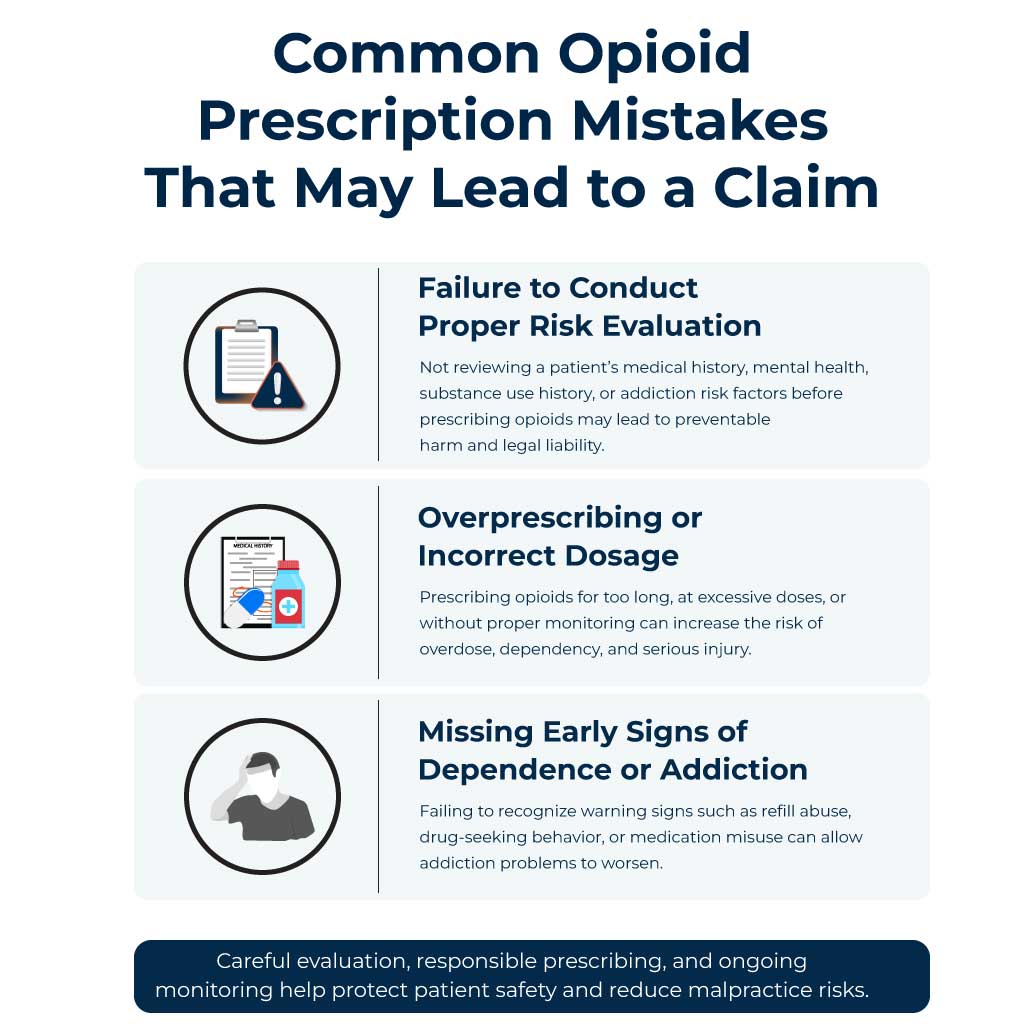
Doctors can screw up by:
- Not properly evaluating new patients.
- Making prescription mistakes.
- Missing signs that a patient is getting addicted.
Failure to Conduct Proper Risk Evaluation:
Your doctor is supposed to read your medical history before prescribing you drugs.
And they’re supposed to know that some people are more at risk of getting addicted than others:
- Young white men.
- People with mental health problems.
- Anyone who’s been on opioids for more than three months.
Overprescribing or Incorrect Dosage:
Doctors who prescribe opioids must:
- Make sure they’re giving you the right drug.
- Prescribe the right dosage.
- Limit the prescription to ensure you’re not getting drugs you don’t need.
Missing Early Signs of Dependence or Addiction:
If your medical condition calls for an opioid prescription, the odds are you’re seeing your doctor regularly.
Your doctor is legally required to be on the lookout for signs of dependence/addiction:
- Pinpoint pupils.
- Drowsiness.
- Coordination problems.
- Itchy skin.
- Problems speaking clearly.
- Weight loss.
If your doctor notices you’re having problems but doesn’t do anything about it, that’s medical malpractice.
Can I File a Personal Injury Lawsuit in California for an Opioid Addiction?
Absolutely.
But you’ll need proof if you want your case to go anywhere:
- Medical records.
- Witness testimony.
- Expert witness testimony.
- Proof of loss.
How Do I Know If I Can File A Medical Malpractice Case Against My Doctor?
- Find a lawyer.
- Show your evidence.
- Your lawyer will tell you if you’ve got a case or not.
- If you do, your lawyer will also investigate. Find evidence.
- The evidence will show if you can file a medical malpractice lawsuit.
- It will also show who should get sued.
What Do You Need to Prove in an Opioid Malpractice Lawsuit?
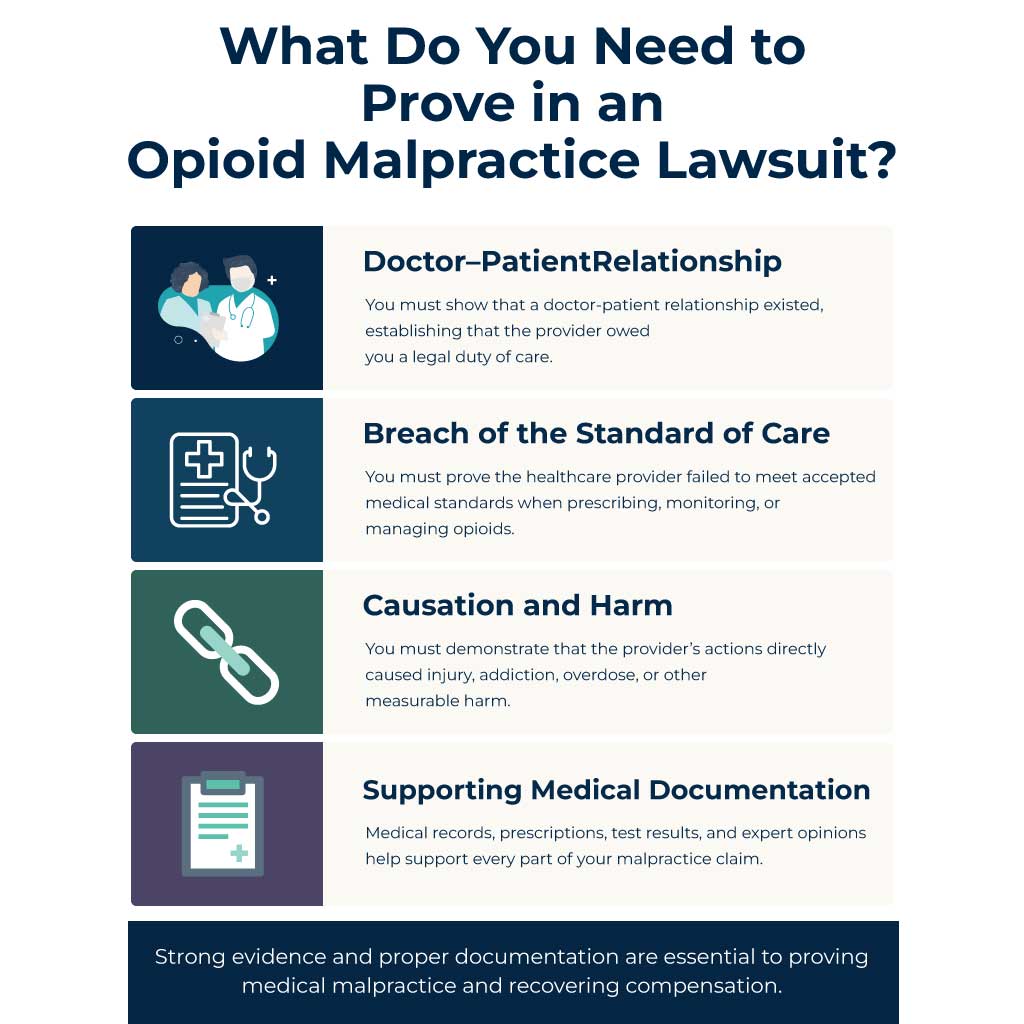
- You have an opioid addiction.
- You got addicted after taking a prescription opioid.
- Someone (or more than one someone) screwed up your prescription.
- Your addition caused you loss, be it:
- Economics.
- Mental.
- Emotional.
Doctor-Patient Relationship.
You need to show:
- You saw a doctor.
- Your doctor prescribed medication.
- How often your doctor followed up on your care.
Breach of the Standard of Care:
You need evidence to show your doctor screwed up with your care:
- Your medical records.
- Expert witnesses to testify your doctor didn’t follow standard procedures.
Causation and Harm:
You need to show the doctor’s actions (or lack of action) hurt you. And show how it hurt you.
Supporting Medical Documentation:
Supporting medical documentation can include:
- Records of others’ complaints about your doctor.
- Your medical history.
1. Can I file a personal injury lawsuit if prescribed opioids caused my addiction?
You can if:
- The doctor messed up.
- Your pharmacist messed up.
- The drug manufacturer messed up.
2. Do I qualify to file a lawsuit?
You can if:
- You suffered from an opioid addiction.
- That addiction is at least partly someone else’s fault.
- You file your case before the statute of limitations runs out.
3. What are the eligibility requirements to file an opioid lawsuit in California?
- You have to show proof of harm.
- You have to show proof that the person you’re suing is responsible for your addiction.
- You need to file your case before the statute of limitations runs out.
4. If I was given opioids by a doctor, can I sue?
You can sue if:
- The doctor prescribed the wrong opioid.
- The doctor prescribed the wrong dosage.
- The doctor didn’t have a good reason to prescribe you opioids in the first place.
- Your doctor didn’t follow up on your care or notice signs of addiction during follow up visits.
5. Can I file a claim if I am partly at fault for my addiction or misuse?
It’ll affect how much compensation you’ll get.
But you can still get something.
Especially if you have a good lawyer.
6. Who can be held responsible for opioid-related damages?
- Your doctor.
- The hospital.
- The pharmacy.
- The manufacturer.
7. Can I sue a doctor for prescribing opioids that caused my addiction?
Only if your doctor did something wrong.
A prescription on its own isn’t malpractice.
8. Can I file a lawsuit against pharmaceutical companies for opioid addiction or injury in California?
You can if you have evidence and a good lawyer.
9. What injuries qualify for an opioid lawsuit?
You can sue for:
- Medical bills.
- Lost wages.
- Mental health problems.
- Pain/Suffering.
10. What kinds of opioid lawsuits exist in California?
- Medical malpractice.
- Personal injury.
- Wrongful death.

Emery Brett Ledger brings more than 27 years of experience to personal injury law. He founded & led The Ledger Law Firm in securing over $100 million in compensation for clients with life-altering injuries & complex claims. Licensed in California, Texas, & Washington, Emery earned his law degree from Pepperdine University School of Law. His practice areas include car & truck accidents, wrongful death, catastrophic injuries, maritime claims, & mass tort litigation. He has been recognized by The National Trial Lawyers’ Top 100, Mass Tort Trial Lawyers Top 25, and America’s Top 100 Personal Injury Attorneys. Emery also received the 2025 Elite Lawyer Award & holds a perfect 10.0 Avvo rating with Platinum Client Champion status. His legal work has been featured on CNN, Forbes, NBC, & ABC.
Free Case Evaluation
Recent Posts
- What Type of Accident Kills the Most Construction Workers? The Fatal Four Explained
- Average Payout for Pedestrian Hit by Car: Settlements, Compensation & Factors
- Lower Back Pain Car Accident Settlement: Compensation, Injury Types & Claim Factors
- Who Pays for High School Sports Injuries? School Liability, Medical Bills & Legal Options
- Social Media and Personal Injury Claims: How Social Media Can Destroy Your Personal Injury Claim
Emery Brett Ledger brings more than 27 years of experience to personal injury law. He founded & led The Ledger Law Firm in securing over $100 million in compensation for clients with life-altering injuries & complex claims. Licensed in California, Texas, & Washington, Emery earned his law degree from Pepperdine University School of Law. His practice areas include car & truck accidents, wrongful death, catastrophic injuries, maritime claims, & mass tort litigation. He has been recognized by The National Trial Lawyers’ Top 100, Mass Tort Trial Lawyers Top 25, and America’s Top 100 Personal Injury Attorneys. Emery also received the 2025 Elite Lawyer Award & holds a perfect 10.0 Avvo rating with Platinum Client Champion status. His legal work has been featured on CNN, Forbes, NBC, & ABC.
