

Can I Sue My Employer for Emotional Distress? Workplace Lawsuits and Compensation Explained

“Proving injury” used to mean proving that someone physically hurt you. You showed bruises. Broken bones. Bite marks.
Medical science advanced. People saw physical injury isn’t the only kind of injury.
Courts started recognizing emotional distress as real. As something that deserves compensation.
You can make this claim if you’ve been harassed. Discriminated against. Subjected to unsafe work conditions.
However, making a claim is a lot easier than winning one.
There are many ways someone can cause emotional distress. But claims have to fall under two categories: intentional infliction of emotional distress and negligent infliction of emotional distress.
The first type covers things people do to you.
The second type of claim covers cases where your company doesn’t do what it should to prevent emotional pain/suffering and protect you.
What Is Emotional Distress in the Workplace?
Is your job stressful? Join the club. Plenty of jobs are. Working at a daycare, for instance. Doing construction work. Even running a business.
But there’s a difference between “normal” job stress and emotional distress.
Is your job causing you to feel:
- Anxiety?
- Depression?
- Chronic stress?
Just as importantly, why is your job causing mental and emotional health issues?
Is it because:
- Your workmates are doing something illegal?
- Your boss is doing something illegal?
- Your company is ignoring employees’ illegal actions?
When Can You Sue Your Employer for Emotional Distress?
You can sue for:
- Harassment
- Discrimination
- Hostile work environment
- Retaliation
- Emotional distress that was caused by an on-the-job accident or injury. But only if that claim isn’t covered by your workers’ compensation insurance policy
Experienced Harassment or Retaliation?
Can I Sue My Employer for Stress and Anxiety?
Often you can. But you have to prove:
- You’re not just stressed because of your regular work schedule, expected job conduct, or your chosen line of work
- The employer either caused it or knew about the cause and didn’t stop it
Being a store manager for a mom-and-pop business can be a very stressful job. You have to train employees. Talk to angry customers. Take inventory. Make orders. Coordinate deliveries. Maybe even work overtime sometimes to make sure everything gets done.
However, if your boss is always asking you to work unpaid overtime and yells at you whenever an employee makes a mistake, you may have grounds to sue.
The same point applies if a low-level employee is constantly trying to bully you, harass you, or threaten you. Because your company is responsible for employee conduct, you can sue your company for emotional distress.
Understanding Workers’ Compensation and Emotional Distress
Companies in almost all states are legally required to buy workers’ compensation insurance for full-time employees.
If you get hurt on the job, the insurance covers medical bills and lost wages. It also covers emotional distress related to your physical injuries. And there are limits to the amount of compensation you can claim
- If your company has between 15 and 100 employees, the cap is $50,000
- There’s a $300,000 cap for companies with more than 500 employees
You can’t sue your employer if you file a workers’ compensation claim. Legally, it’s called the “exclusive remedy rule”. Insurance pays no matter who was at fault or negligent.
When Can You Sue for Emotional Distress After a Work Injury?
You might be able to sue if:
- Workers’ compensation insurance doesn’t cover you. Maybe you’re a freelancer or part-time/seasonal employee.
- You can prove your employer broke federal laws
- You’re suing a person or company that isn’t your colleague/employer.
Types of Emotional Distress Claims Against Employers
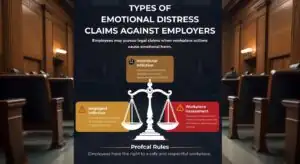
- Intentional infliction
- Negligent infliction
- Workplace harassment
Damages Available When Suing Your Employer for Emotional Distress
You can claim:
- Emotional suffering. This includes mental health issues you’ve suffered because of your employer’s actions or lack of action
- Therapy costs
- Lost wages
- Pain and suffering
- Punitive damages. Punitive damages aren’t easy to claim. You have to show gross negligence and/or a consistent pattern of wrongdoing.
How Much Can You Sue for Emotional Distress at Work?
Even the best lawyers won’t make promises when they take your case.
How much money you’ll get depends on:
- Your situation
- How long the harassment went on
- How severe the harassment was
- How much you suffered from it
- How much money you spent on therapy
- The amount of lost wages
- The other party’s behavior, track record, and how good their lawyer is
How To Prove Emotional Distress in a Workplace Lawsuit
Proving emotional distress is hard. Really hard.
You’re going to need:
- Medical records
- Therapist reports
- Witness testimony
- Expert witness testimony
- Work records
- Photo/video evidence is a plus
What Can You Do About Emotional Distress at Work?
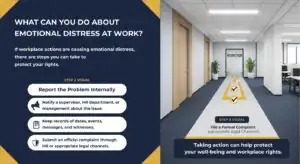
- Report the problem internally
- Document the incidents.
- File a formal complaint
How an Attorney Can Help With Emotional Distress Claims
Your lawyer will:
- Evaluate how strong your claim is
- Collect evidence
- Find expert witnesses to testify for you
- File the case
- Negotiate a settlement or, if that fails, represent you in court
Conclusion – Suing Your Employer for Emotional Distress
Your employer can’t legally create or ignore a toxic workplace.
If you’re experiencing distress at work you’ll want to:
- Document it
- Report it
If that doesn’t work, call a lawyer.
A good lawyer will:
- Be familiar with state and federal laws that affect your case
- Know if you have a strong claim
- Know if your claim is valid (if it’s past the statute of limitations or covered by worker’s compensation insurance, you might be out of luck)
- Collect as much evidence as he or she can
- Keep your evidence safe and organized
- Get in touch with expert witnesses to have them look at your case and give advice.
- Arrange to have expert witnesses testify for you
- Represent you in dealing with your boss, in settlement negotiations, and in court
Ledger Law lawyers know how to handle workplace lawsuit claims from employees in any industry.
We offer free initial consultations. We work on a “no win, no fee” basis.
You have nothing to lose.
Call us.
We will:
- Answer your questions
- Connect you with the lawyer who’s the best fit for your case
- Schedule a free consultation so you can talk about your case and review your options
FAQs About Can I Sue My Employer for Emotional Distress
Can I sue my employer for emotional distress caused by workplace harassment?
You might be able to. But not always. It depends on:
- When it happened
- The nature of your claim
- Local and state laws
What do you need to prove when suing your employer for emotional distress?
You have to prove two things:
- Your employer is intentionally causing the emotional distress or is responsible for it due to his/her negligence
2. The distress hurts your mental health. And affects your finances.
Can I sue my employer for stress/anxiety at work?
No.
Just about everyone gets stressed at work.
You have to show your stress/anxiety levels aren’t normal for your job.
And show that this is the company’s fault. Because they did something they shouldn’t. Or didn’t do what they were supposed to.
What types of emotional distress claims can employees file against employers?
- Intentional infliction of pain/suffering
- Negligent infliction of pain/suffering
Can you sue your employer for emotional distress without physical injury?
Yes, you can. But it’s often a lot harder to do so.
Does workers’ compensation cover emotional distress claims?
Workers’ compensation does cover emotional distress claims. But only if these claims are connected to a physical on-the-job injury.
What evidence is needed to prove emotional distress at work?
- Photo/video/paperwork evidence
- Evidence you tried to resolve the matter in-house
- Medical records
- Therapy records
- Records of lost wages
- Expert witnesses
How long do I have to sue my employer for emotional distress?
The statute of limitations for these types of cases depends on where you live. Ask your lawyer.
Do you need a lawyer when suing your employer for emotional distress?
These types of cases are very complex.
And the party you’re suing will likely be lawyered up.
You almost certainly need a good lawyer if you want a good chance of winning your case.

Emery Brett Ledger brings more than 27 years of experience to personal injury law. He founded & led The Ledger Law Firm in securing over $100 million in compensation for clients with life-altering injuries & complex claims. Licensed in California, Texas, & Washington, Emery earned his law degree from Pepperdine University School of Law. His practice areas include car & truck accidents, wrongful death, catastrophic injuries, maritime claims, & mass tort litigation. He has been recognized by The National Trial Lawyers’ Top 100, Mass Tort Trial Lawyers Top 25, and America’s Top 100 Personal Injury Attorneys. Emery also received the 2025 Elite Lawyer Award & holds a perfect 10.0 Avvo rating with Platinum Client Champion status. His legal work has been featured on CNN, Forbes, NBC, & ABC.
Free Case Evaluation
Recent Posts
- What Type of Accident Kills the Most Construction Workers? The Fatal Four Explained
- Average Payout for Pedestrian Hit by Car: Settlements, Compensation & Factors
- Lower Back Pain Car Accident Settlement: Compensation, Injury Types & Claim Factors
- Who Pays for High School Sports Injuries? School Liability, Medical Bills & Legal Options
- Social Media and Personal Injury Claims: How Social Media Can Destroy Your Personal Injury Claim
Emery Brett Ledger brings more than 27 years of experience to personal injury law. He founded & led The Ledger Law Firm in securing over $100 million in compensation for clients with life-altering injuries & complex claims. Licensed in California, Texas, & Washington, Emery earned his law degree from Pepperdine University School of Law. His practice areas include car & truck accidents, wrongful death, catastrophic injuries, maritime claims, & mass tort litigation. He has been recognized by The National Trial Lawyers’ Top 100, Mass Tort Trial Lawyers Top 25, and America’s Top 100 Personal Injury Attorneys. Emery also received the 2025 Elite Lawyer Award & holds a perfect 10.0 Avvo rating with Platinum Client Champion status. His legal work has been featured on CNN, Forbes, NBC, & ABC.
