

San Antonio Car Accident Lawsuit | Legal Framework | Guide to Seek Compensation | Evidence | Types of Compensation

- You have the right to file a lawsuit against those who cause you harm.
- Victims can seek compensation for all damages, including pain and suffering. But you have to prove who’s at fault and what those losses are.
- Most cases don’t go to a lawsuit. Most settle out of court, especially if you’re working with a proven attorney.
- It’s up to you to understand your rights under the law. Working with a San Antonio car accident lawyer minimizes your risks.
- Don’t give up until you work with an attorney. You won’t know what all of your losses are until you speak to a lawyer.
Car accidents devastate thousands of lives every year. San Antonio car accidents are fully avoidable. That’s why it’s so important to know your rights when someone causes you to suffer injuries. One of those rights is fighting for compensation.
Most cases settle out of court. Your lawyer proves your case and worth. The insurance company won’t go to trial if they can avoid it. But you’ll need to make a valid case for your claim. That’s where an attorney becomes a critical asset.
What a Car Accident Lawsuit Is?
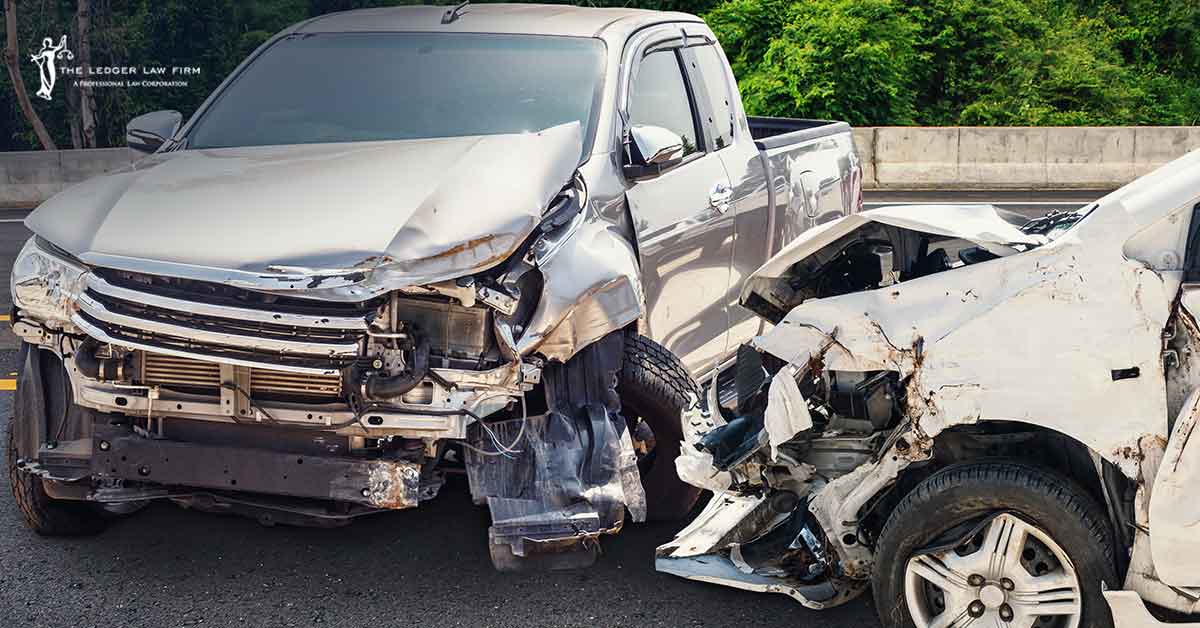
A car accident lawsuit is a legal claim made against a person, business, or other party you believe caused your losses. Lawsuits are based on negligence. That means you must prove the other party caused your injuries and losses.
Most car accidents resolve without a lawsuit being filed. Your attorney typically seeks a claim against the at-fault party out of court. If they don’t agree, then the victim files a lawsuit.
Understand the Legal Framework for San Antonio Car Accident Lawsuits:
You’re hurt and deserve fair compensation. But all the burden of proof is on your shoulders. Here’s what you need to know to seek fair compensation.
Texas Car Accident Laws:
Victims of a personal injury matter have the legal right to pursue compensation for all losses they have. Car accident claims are meant to make you whole again. That means compensating you for all of the losses you’ve suffered. The law places the burden of proof on the victim. That means you must prove the other person is responsible for your losses. You then must prove the value of those losses. To do this, you must demonstrate negligence:
- The other party owed you a duty of care. They are responsible for following traffic laws and taking every step they can to be safe.
- They breached that duty of care. They broke the law. They otherwise put others at risk knowingly.
- The breach caused your accident. There must be a direct correlation between what they did and what caused your car accident.
- You suffered losses. This includes losses such as medical costs, lost wages, and pain and suffering.
Proving all four of these elements allows you to seek legal action against the at-fault party.
Texas At-Fault & Comparative Fault Rules:
Texas is an at-fault state. That means victims seek damages against the party that caused the accident. That’s unlike no-fault states. In a no-fault state, you file a claim for your losses against your own insurance company. This doesn’t happen in Texas. Rather, you seek compensation for your losses against those who are at fault.
Comparative negligence applies in Texas car accidents. That means you can still seek a claim if you are partially at fault. But the value of your claim drops by the percentage of fault attributed to you. It’s important to show you’re not at fault in every way possible. That’s something our attorney will help you navigate.
Texas Filing Deadline and Why Timing Matters:
The statute of limitations for taking legal action in Texas is two years from the date of the injuries. Don’t wait beyond this. If you do, you lose the right to seek compensation. Act within the timeframe.
But remember that your attorney needs time to first prove fault and then build a claim. Most claims are presented with the expectation of a settlement. If that doesn’t happen, then a lawsuit happens. That has to be done within the two-year timeframe.
Your Guide to Seek Compensation After a Car Accident in San Antonio:
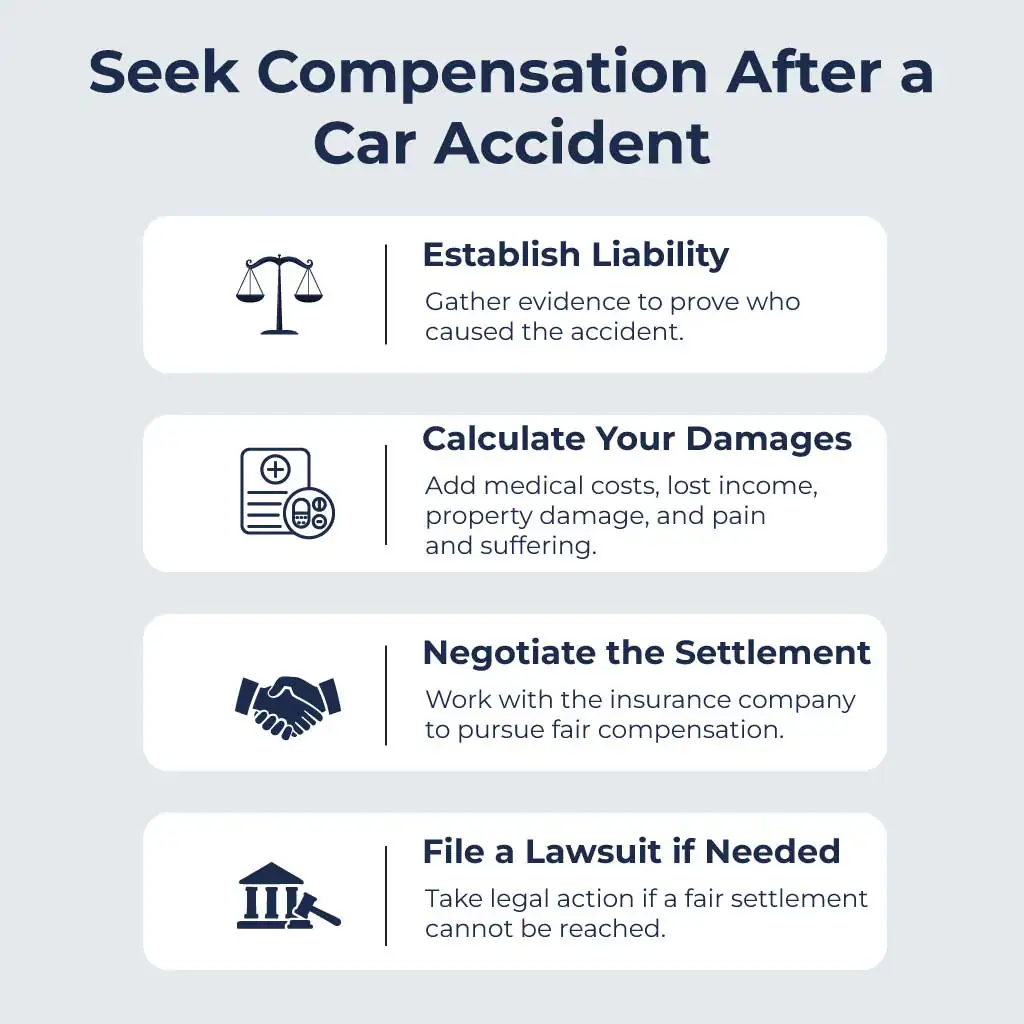
There are several factors you need to think about when you’re in an accident. Your attorney will help you with this process.
Prove fault:
You must demonstrate that the other party is at fault. That means proving negligence.
Calculate all of your losses:
You’ll need to add up all of the losses you have. This includes current and future costs. It also includes both economic and non-economic losses. Then, file a claim with the insurance company of the responsible driver.
Negotiate to seek compensation:
There’s often a period of back-and-forth communication between the victim and at-fault party. The goal is to prove your rights. This may require getting additional information. It may also mean agreeing to a lower value.
File a lawsuit:
Filing a lawsuit happens when the insurance company refuses to be fair. If that occurs, and a settlement cannot be reached, file a lawsuit in the court of law within your jurisdiction.
Evidence Needed for a San Antonio Car Injury Claim:
Evidence is critical to proving the other person owes you compensation. The more evidence you have, the better. Examples of valuable evidence include:
Police reports:
These are unbiased documentation of what happened based on evidence at the scene. Mistakes can happen, but police reports tend to be accurate.
Photo and video evidence:
Take photos after the car accident. Demonstrate with video who is at fault and why. This footage is hard to disprove.
Witness testimony:
Get the name and contact information for any person who stops after the accident. They can also provide you with insight into what they saw before your accident.
Expert testimony:
Dispute resolution often benefits from expert testimony. This may include statements from accident reconstruction organizations. Medical experts may also be called on.
Medical records:
Medical records demonstrate your injuries and healing. They also show the condition of the driver prior to the accident if intoxication is a factor.
Types of Compensation Available in Car Accident Cases in San Antonio:
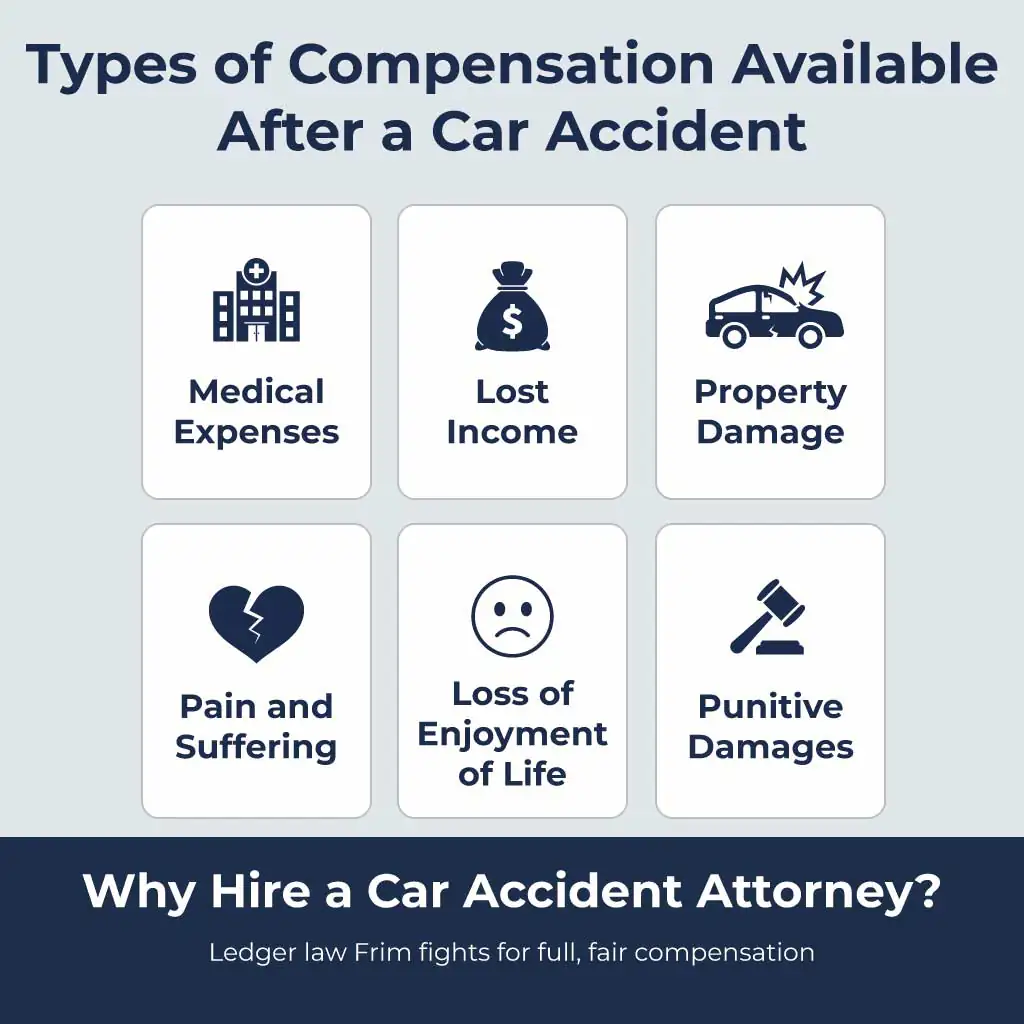
Prove all of your losses with evidence. Your losses include both economic and non-economic damages. The following are some examples of the most common car accident damages.
Current and future medical expenses:
All medical costs should be a part of your claim. This includes emergency care at the time of the accident. It may also include hospitalization, treatment, and medications. It covers ongoing care you need.
Lost wages:
File a claim that includes all benefits, bonuses, and wages you missed because you couldn’t work. Document any loss of time off as well.
Property damage or vehicle damage:
You can incorporate any type of asset damage and loss into your claim. That may include the cost to repair or fix your vehicle.
Pain and suffering:
This type of compensation is harder to prove in value. But it should be a figure that represents the severity of your injuries and ongoing pain.
Loss of enjoyment of life:
Demonstrate how much your life has changed because of the accident. Show how the accident is impacting your life.
Punitive damages:
Some cases allow for punitive damages. These are a form of punishment leveled against the at-fault driver. They’re only available in cases of malice, fraud, and intentional actions.
Why To Hire a Car Accident Attorney in San Antonio?
Ledger Law Firm provides victims with answers. We know how to value your claim. We also know how to find the evidence to prove every party at fault. Expect our legal team to pursue full and fair compensation for you.
Conclusion:
You deserve fair compensation. Let your car accident lawyer in San Antonio get to work on your case and claim. Contact us now to learn how we can help you.
1. What should I do right after a car accident in San Antonio?
Call 911 after a car accident to get medical care and police on the scene. Document what happened, take photos, and then seek medical care to preserve your case.
2. How does fault or negligence work in a car accident case?
Victims must demonstrate the other party is at fault. That means showing how they are negligent and caused your injuries and other losses.
3. What are the key elements required to prove your case?
You’ll need to prove negligence using evidence. You also must demonstrate the value of your losses.
4. Do I need a lawyer, and how much does it cost to hire one?
Most people benefit from hiring a lawyer.
5. Should I file a lawsuit or just an insurance claim?
Most incidents begin with an insurance claim. They only lead to a lawsuit when the insurance company or other at-fault party refuses to agree to a fair settlement.
6. Can I sue if the other driver was uninsured, underinsured, or drunk?
You can sue the other driver if they are at fault for your accident and injuries. Even if they don’t have insurance or drunk.
7. How long do I have to file a car accident lawsuit in Texas?
Under the Texas statute of limitations, victims have two years from the date of the accident to file a lawsuit against those at fault. Otherwise, they miss their opportunity to do so.
8. How much is my car accident settlement worth?
The value of your car accident claim is dependent on the severity of your injuries, the type of injuries, and your ability to prove what your losses are.
9. What expenses does my settlement cover?
Your settlement should cover all of your expenses. That includes property damage expenses, medical costs, and lost wages.

Emery Brett Ledger brings 28+ years of experience to personal injury law. He founded & led The Ledger Law Firm in securing over $100 million in compensation for clients with life-altering injuries & complex claims. Prior results do not guarantee a similar outcome. Licensed in California, Texas, & Washington, Emery earned his law degree from Pepperdine University School of Law. His practice areas include car & truck accidents, wrongful death, catastrophic injuries, maritime claims, & mass tort litigation. He has been recognized by The National Trial Lawyers’ Top 100, Mass Tort Trial Lawyers Top 25, and America’s Top 100 Personal Injury Attorneys. Emery also received the 2025 Elite Lawyer Award & holds a perfect 10.0 Avvo rating with Platinum Client Champion status. His legal work has been featured on CNN, Forbes, NBC, & ABC.
Free Case Evaluation
Recent Posts
- Punitive Damages in a Car Accident: When Can You Recover Them?
- Tailgating Injury: What Causes Tailgating, Road Rage & How to Stay Safe
- Waiting to Call a Lawyer Can Hurt Your Case: Evidence, Deadlines & Legal Risks
- What Is Property Damage in a Car Accident? Claims, Costs & Who Pays
- Bodily Injury & Property Damage: Coverage, Claims, Liability & Compensation
Emery Brett Ledger brings 28+ years of experience to personal injury law. He founded & led The Ledger Law Firm in securing over $100 million in compensation for clients with life-altering injuries & complex claims. Prior results do not guarantee a similar outcome. Licensed in California, Texas, & Washington, Emery earned his law degree from Pepperdine University School of Law. His practice areas include car & truck accidents, wrongful death, catastrophic injuries, maritime claims, & mass tort litigation. He has been recognized by The National Trial Lawyers’ Top 100, Mass Tort Trial Lawyers Top 25, and America’s Top 100 Personal Injury Attorneys. Emery also received the 2025 Elite Lawyer Award & holds a perfect 10.0 Avvo rating with Platinum Client Champion status. His legal work has been featured on CNN, Forbes, NBC, & ABC.