What evidence should a Texas truck accident attorney preserve?

A Texas truck accident attorney should preserve the truck’s electronic data, camera footage, driver logs, maintenance records, dispatch communications, physical crash evidence, and records connecting your injuries to the collision. For a 2026 crash, the immediate priority is identifying who controls evidence that can be overwritten, repaired, moved, or discarded—not waiting for the insurance investigation to finish.
- Texas truck accident attorney evidence priorities include electronic data, video, driver records, vehicle condition, and injury documentation.
- A preservation letter requests protection of evidence; it does not automatically provide access or stop every deletion.
- Federal retention periods are not safe waiting periods for investigating a truck crash.
- Ledger Law represents injured people seeking personal injury legal help after Texas truck accidents.
Why this matters
You can photograph your injuries and keep your medical paperwork. You usually cannot access a trucking company’s onboard systems, internal messages, or inspection files yourself. Those records can help explain what happened and identify whose conduct needs investigation.
Ledger Law represents people injured in truck accidents in Texas, as well as other personal injury matters. Your treatment and the evidence investigation should proceed alongside each other. You do not need to finish recovering before discussing preservation with an attorney.
This page addresses evidence for a Texas injury claim in 2026. Federal trucking recordkeeping rules discussed below apply to covered motor carriers; they do not replace Texas law or establish fault by themselves.
What evidence should a Texas truck accident attorney preserve?
An attorney should identify the truck, trailer, driver, businesses involved, and likely evidence holders, then seek preservation of records tied to the collision. The request should describe the event precisely enough to identify relevant vehicles, accounts, devices, and time periods.
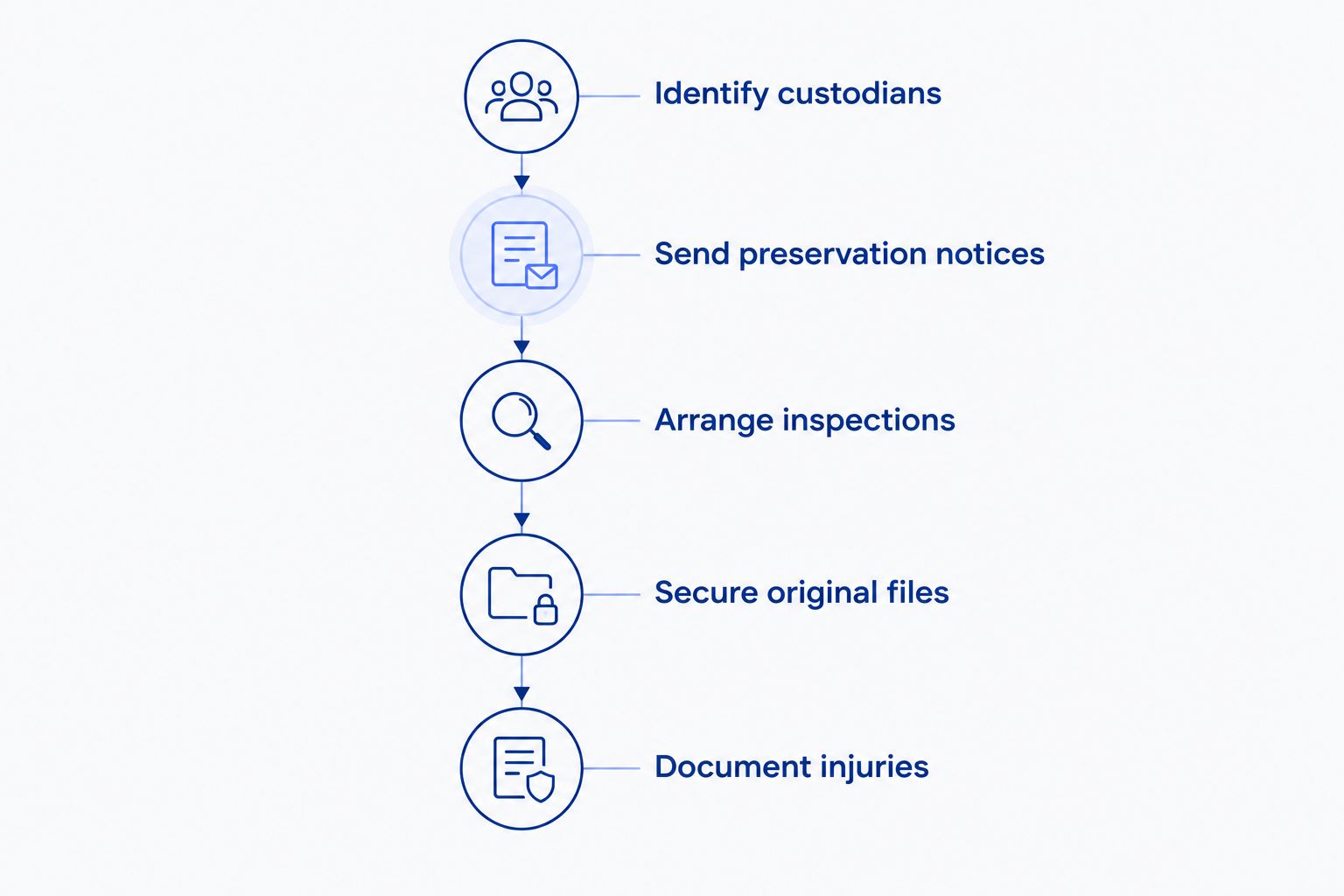
A practical preservation sequence is:
- Identify custodians. Determine who controls the truck, trailer, electronic systems, video, dispatch records, and nearby surveillance footage.
- Send preservation notices. Describe the evidence to retain, including original files, metadata, physical components, and relevant communications.
- Arrange inspections. Seek appropriate access before repairs, salvage, or destructive testing changes the evidence.
- Secure original files. Preserve available exports and document their source rather than relying only on screenshots.
- Document injuries. Collect treatment records, work restrictions, expenses, and accounts of how the injuries affect daily life.
A preservation notice and an evidence request serve different purposes. The notice asks that material not be destroyed; obtaining it can require cooperation, an inspection agreement, or formal legal procedures. Sending a letter is a starting point, not proof that everything is protected.
What each evidence category can establish
| Evidence category | Best for investigating | Important limitation |
|---|---|---|
| Truck electronic data | Recorded vehicle operation around the crash | Available information depends on the vehicle and installed systems |
| Dashcam and surveillance footage | Vehicle movements, signals, and surrounding traffic | Camera angles and recording gaps can leave events unseen |
| Driver and dispatch records | Driving history, schedules, assignments, and communications | Records require context and comparison with other evidence |
| Maintenance and inspection records | Reported defects, repairs, and inspection history | Paperwork alone does not establish the truck’s crash-time condition |
| Physical evidence | Damage patterns, component condition, and roadway marks | Repairs, weather, and vehicle movement can change it |
| Medical and employment records | Injury treatment, restrictions, and lost work | The connection between the collision and each claimed loss still matters |
No single category answers every question. Video can clarify movement without explaining a brake defect; maintenance records can identify a reported problem without showing whether it caused the crash.
Electronic truck data: preserve the source and its context
An attorney should investigate whether the truck has an engine control module, electronic logging device, GPS or telematics system, collision-warning system, or onboard camera. These systems serve different functions. An electronic logging device is not the same thing as a crash recorder.
Depending on the equipment, relevant information can include location, recorded speed, braking events, engine activity, duty status, and system alerts. Not every truck records every item, and a system’s presence does not guarantee that useful crash-related data exists.
Preservation should address:
- Original data and available exports, not just selected screenshots.
- Information identifying the vehicle, device, account, and relevant time zone.
- Available records showing edits or annotations.
- The method used to retrieve or copy the information.
- Provider-held records outside the trucking company’s immediate possession.
An attorney should also consider whether an appropriate specialist needs to download or interpret the data. A number without its units, timestamp, or system explanation can be misleading.
Video and physical evidence: protect what changes
Dashcam footage can show events before impact, not just the collision itself. Nearby businesses, residences, traffic systems, or other motorists might also have recordings. The investigation should identify cameras promptly without assuming that every camera records or retains footage.
The truck, trailer, and your vehicle also matter. Relevant items can include damage, tires, brakes, lights, reflective markings, cargo securement, and detached components. Photographs help, but they do not always replace an inspection.
Tell your attorney where your vehicle is stored before authorizing disposal or major repairs. Do not enter a tow yard, handle damaged components, or approach traffic to collect evidence without permission and safe conditions.
When the truck leaves the scene or its identity is disputed, witnesses and surrounding video become particularly important. The investigation principles discussed in how a Dallas lawyer can investigate a hit-and-run injury also explain why identifying vehicles and independent witnesses deserves early attention.
Driver, dispatch, and maintenance records: connect the decisions
A truck crash investigation should examine more than the driver’s actions at impact. Dispatch instructions, trip timing, reported mechanical problems, and loading information can help explain the circumstances leading to the collision.
Relevant requests can cover driver qualification materials, duty-status records, trip documents, dispatch messages, inspection reports, repair records, and communications about defects. Cargo records can also matter when load placement, weight, or securement is part of the investigation.
These requests should stay connected to the crash. Collecting a large file is not the same as establishing what caused an injury.
Federal retention periods are not preservation deadlines
For covered motor carriers, federal rules establish several recordkeeping requirements relevant to a 2026 investigation:
- 6 months: Driver records of duty status and supporting documents must be retained under federal regulations.
- 6 months: Federal regulations separately address retention of required supporting documents.
- 1 year: Required vehicle inspection, repair, and maintenance records generally must remain where the vehicle is housed or maintained under federal regulations.
- 6 months: Federal regulations also require retention after the vehicle leaves the carrier’s control.
These periods concern specified records and covered operations. They are not universal retention rules for camera footage, every electronic system, or every vehicle.
A retention requirement also does not tell you when a company actually deletes a particular file. Do not treat a federal minimum as permission to wait. An attorney should identify the applicable records and request preservation based on the collision’s circumstances.
Why the preservation plan varies
A useful evidence plan follows the facts, not a standard checklist sent without changes. The main factors are:
- Vehicle equipment: Installed systems determine what electronic information could exist.
- Evidence ownership: The carrier, vehicle owner, repair shop, technology provider, or another business might control different records.
- Crash mechanism: A disputed lane change calls for different detail than an alleged tire failure or shifting load.
- Elapsed time: Repairs, ordinary recording cycles, and changes at the scene affect what remains available.
- Injury circumstances: Treatment, recovery, and work restrictions determine which medical and employment records matter.
Ownership and control also deserve separate attention. The company name on a trailer does not, by itself, resolve who owned the tractor, employed the driver, maintained the equipment, or directed the trip.
What can you preserve while your attorney handles company records?
Your own evidence can fill gaps that business records cannot. Keep original photographs, videos, messages, insurance correspondence, witness details, and the incident number supplied by the investigating agency. Avoid editing the only copy of a file.
For your phone, retain the original material and make a backup you can access. Keep a brief note identifying who took a photograph, where it was taken, and what it shows. Do not guess when you cannot remember.
Basic steps after a car accident—getting medical attention, recording witness details, and preserving photographs—also support evidence preservation after a truck collision. The linked article addresses New York City; Texas legal procedures and claim requirements need separate advice.
Do not contact the truck driver to demand a statement or ask a witness to adopt your version of events. Give your attorney the person’s contact information and your own factual account instead.
Which medical records help prove your injuries?
For a 2026 Texas truck injury claim, preserve records showing what symptoms developed, when you sought care, what providers found, and what treatment they recommended. Emergency records, imaging reports, specialist notes, prescriptions, therapy records, and written work restrictions can each address a different part of that history.
Describe your symptoms accurately, including changes over time. Do not minimize a problem because you hope it will resolve, and do not exaggerate it to strengthen a claim. Tell your treating providers about relevant prior symptoms or injuries so they can assess your condition with context.
Keep practical loss records too:
- Employer communications about missed shifts or modified duties.
- Wage records supporting time away from work.
- Receipts for injury-related expenses.
- Notes describing tasks you cannot perform or need help completing.
A symptom journal records your experience; it does not replace medical assessment. If symptoms are severe or worsening, seek appropriate medical care rather than waiting for a legal consultation.
Does a preservation letter guarantee access to truck data?
A preservation letter does not guarantee access to truck data. It identifies evidence that should be retained, but access can involve separate requests, agreements, or court procedures.
The attorney should track responses and investigate where the information actually resides. Asking the carrier alone is not enough when a separate provider controls relevant files.
What if the truck has already been repaired?
Repairs do not automatically end an injury claim. An attorney should investigate pre-repair photographs, estimates, inspection findings, replaced components, repair invoices, and any electronic information that remains.
Tell the attorney what you know about the repair date and location. Whether missing evidence creates a legal remedy requires a fact-specific assessment under the applicable law; destruction does not automatically prove fault.
What should you ask during a case evaluation?
Ask who will identify evidence holders, send preservation requests, arrange inspections, and track responses. Also ask what you should do about your vehicle, phone files, insurer communications, and medical documentation while the investigation develops.
Ledger Law is best suited here to injured people and families seeking personal injury representation after a Texas truck accident. A case evaluation can identify evidence priorities, but it cannot guarantee recovery or establish liability before the facts are examined.
Before hiring an attorney, request a clear explanation of attorney fees and case expenses. Ask who advances inspection or expert expenses, how those expenses are handled, and what obligations apply if there is no recovery. Do not assume attorney fees and case costs mean the same thing.
Discuss your truck accident injuries
Explain the collision, your injuries, and any evidence at risk of being lost.
FAQ
What evidence matters most after a Texas truck accident?
The priority is evidence that can disappear or change, including video, truck data, vehicle condition, and witness information. Medical and work records are also necessary to document the injury claim.
Can I get the truck’s black box data myself?
Truck electronic data generally requires permission or an appropriate legal process to obtain. Your attorney should identify the system, its custodian, and the appropriate retrieval method rather than assuming every truck has the same recorder.
How long do trucking companies keep driver logs?
Covered motor carriers must retain driver records of duty status for 6 months under federal regulations. That rule is not a safe waiting period for requesting preservation of crash evidence.
Should I keep my damaged vehicle after a truck crash?
Discuss inspection and preservation with your attorney before authorizing disposal or major repairs. Also address storage charges and insurer requirements promptly rather than leaving the vehicle indefinitely without a plan.
Is the police report enough to prove my truck accident claim?
A police report is not a substitute for the full evidence investigation. Video, physical evidence, electronic records, and medical documentation can address issues the report does not resolve.
Can deleted footage automatically prove the trucking company was at fault?
Deleted footage does not automatically prove fault. The circumstances of its loss and the applicable legal standards require separate assessment.
What should I bring to a Texas truck accident consultation in 2026?
Bring the crash date and location, available photographs, witness details, insurance correspondence, and treatment information. Tell the attorney immediately if a vehicle is scheduled for repair or disposal.
One last thing
A screenshot preserves what you can see, not necessarily the underlying file. Keep original recordings, photographs, and messages whenever possible, along with a backup. Tell your attorney where each item came from before forwarding compressed copies or deleting anything from the original device.
Related guides
- What to bring to a Dallas car accident lawyer consultation
- Which medical records help a Newport Beach car accident claim—California context

Emery Brett Ledger brings 28+ years of experience to personal injury law. He founded & led The Ledger Law Firm in securing over $100 million in compensation for clients with life-altering injuries & complex claims. Prior results do not guarantee a similar outcome. Licensed in California, Texas, & Washington, Emery earned his law degree from Pepperdine University School of Law. His practice areas include car & truck accidents, wrongful death, catastrophic injuries, maritime claims, & mass tort litigation. He has been recognized by The National Trial Lawyers’ Top 100, Mass Tort Trial Lawyers Top 25, and America’s Top 100 Personal Injury Attorneys. Emery also received the 2025 Elite Lawyer Award & holds a perfect 10.0 Avvo rating with Platinum Client Champion status. His legal work has been featured on CNN, Forbes, NBC, & ABC.
Free Case Evaluation
Recent Posts
- Attorneys for Work Injuries: How to Decide Whether to Contact One and Prepare for an Evaluation
- Injury Attorneys Dallas: How to Decide Whether to Contact a Car Accident Lawyer
- Personal Injury Lawyer Greenville South Carolina: How to Decide Whether to Seek Help After a Slip and Fall
- Lawyers for Wrongful Death: How to Choose One and Prepare for a Case Evaluation
- Injury Attorney in LA: How to Decide Whether to Seek a Case Evaluation After a Crash
Emery Brett Ledger brings 28+ years of experience to personal injury law. He founded & led The Ledger Law Firm in securing over $100 million in compensation for clients with life-altering injuries & complex claims. Prior results do not guarantee a similar outcome. Licensed in California, Texas, & Washington, Emery earned his law degree from Pepperdine University School of Law. His practice areas include car & truck accidents, wrongful death, catastrophic injuries, maritime claims, & mass tort litigation. He has been recognized by The National Trial Lawyers’ Top 100, Mass Tort Trial Lawyers Top 25, and America’s Top 100 Personal Injury Attorneys. Emery also received the 2025 Elite Lawyer Award & holds a perfect 10.0 Avvo rating with Platinum Client Champion status. His legal work has been featured on CNN, Forbes, NBC, & ABC.