

What Percentage of Personal Injury Cases Go to Trial? Court Statistics, Settlement Trends, and Key Insightsocument

Most personal injury cases don’t go to trial. That’s the good news. The other good news is that the law gives you this right. And there are times when you’ll need it.
But insurance companies lose money when they have to pay you. That means you have to fight for it by going to trial. What percentage of personal injury cases go to trial?
Here’s the good news. Most cases settle out of court. That means you don’t have to go to trial. Settlements are less expensive for insurance companies and for you. But it’s not that easy.
What Percentage of Personal Injury Cases Go to Trial?
95% of cases settle out of court. Only between 3% and 5% of cases go to trial. That’s according to The Law Library.
Insurance companies are for-profit organizations. And that means their goal is to save money. Paying you is costly. They may deny your claim or offer far less than you know you’re owed.
Your attorney may recommend filing a lawsuit. Filing a lawsuit forces the insurance company to take action. They have to determine if going to trial is beneficial. Most of the time, it’s not. That leads to pre-trial settlements.
Do Personal Injury Cases Go to Trial?
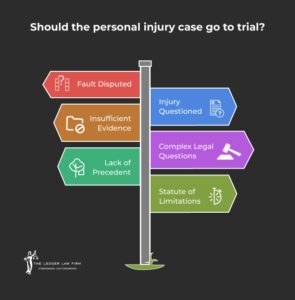
Personal injury cases can go to trial. When do personal injury cases go to trial? The bottom line is the insurance company doesn’t want to pay you more than it thinks it can get away with paying. They justify this in various ways, like these:
- They don’t believe they are at fault. They don’t believe they should cover the policyholder.
- They question your injuries. Sometimes they even say your accident didn’t cause them.
- You can’t justify what you’re asking for. You don’t have enough evidence.
- There are complex legal questions about responsibility. The court needs to weigh in.
- There’s a lack of precedent. No other case is like yours, and that makes decisions harder.
- The statute of limitations is approaching, and they want you to miss it.
Most questions can be answered pre-trial. But there are situations where the victim and the at-fault party can’t agree. The court has to decide.
Why Do Most Personal Injury Cases Settle Before Trial?
Settlements really are a faster solution for most people, and that means less stress for you.
Insurance companies don’t want to pay for legal representation to challenge your claim. It’s far more expensive to them to hire a lawyer, go to court, and they have to pay you anyway.
Insurance companies prefer to avoid trial risks, too. Going to trial could lead to reputational harm for the company. That’s even more loss if they are found at fault. Settling out of court avoids these situations. A company doesn’t want the public to learn about the accident because that could affect future customers. Going to court means everything’s on the public record.
For victims, settling is the better route, too. Settling means you get your money sooner. Cases that go to court may take months or even years longer to settle, and that’s a long time to wait for money you need.
What Factors Influence Whether a Case Goes to Court?
So, how many personal injury claims go to court? Very few actually make it there. So many factors play a role in it, like:
- The damage claim value
- Injury severity
- Clear or lacking evidence of their liability
- Whether they get a bad rep in the public’s view
Insurance companies make the decision to go to trial when they believe it will cost them less. Paying a settlement is often less expensive.
The Personal Injury Process From Filing to Settlement
Here’s what you can expect from the personal injury process, typically:
-
- You file a claim. It’s your demand for payment for the damages the insurer owes you.
- The insurance company reviews your claim.
- They decide if they will pay the claim and how much.
- You’ll find skilled attorneys very good at compelling insurance companies to pay more. Negotiations can happen at any point in this process.
- You’ll need to file a lawsuit if you can’t agree. A period of discovery happens where insurance companies ask questions and gather more information.
- Mediation could help close some gaps in negotiations.
- No decision? Trial prep is the next step.
- The judge or jury decides.
Turn Injuries Into Justice
It’s a long process from start to finish. At any time during this process, settlement negotiations occur. It’s always possible that an agreement occurs before going to trial at any phase.
Pros and Cons of Going to Trial
You’re not better off going to trial in all cases. Sometimes it’s the only option to receive anything. Discuss the pros and cons with your attorney extensively.
Pros for Going to Trial
- There’s the potential for higher compensation
- The at-fault party is acknowledged for their wrongdoing
- There is stronger legal precedent
- A judge and jury use fairness and the law to determine the outcome of your claim
- You are no longer at the mercy of the insurance company
- You have a voice in explaining why you deserve more
Cons of Going to Trial
- It takes far longer to get your money
- There’s no guarantee the judge will rule in your favor
- You will need to testify in court in some situations
- The process costs more in attorney and court fees
- It is emotionally stressful for plaintiffs
How Long Do Personal Injury Cases Take?
Every case is different. A simple claim the insurance company doesn’t dispute may take a few months to process. Most claims are not that simple.
- Settlements often take 6 to 9 months. Some may take as long as 12 to 18 months.
- Personal injury trials take longer. It takes several months to get to court. There’s the process of discovery that happens first. Going to trial typically means 12 months to 18 months, and sometimes longer.
Statistics: Settlement vs. Trial Outcomes
There’s no statistic that shows going to trial is the better option for all cases. That’s because every case has its unique details. Remember, about 3% to 5% of cases go to trial. The vast majority don’t. Settlements make sense when insurance companies are being fair.
The burden of proof throughout this legal process is on your shoulders as the victim. That means you must prove fault. You must prove the value of your losses. The insurance company does not have to prove they are innocent. Most people pursue settlements because it’s faster and there’s less risk of facing no award.
Should You Accept a Settlement or Go to Trial?
This is another trick question. There’s no way to make that decision until you know your rights. Small details matter here. The decision ultimately depends on:
- Your proof of what happened
- Your evidence
- The amount you are demanding
- What the insurance company offers
Talk to a personal injury attorney to discuss the details of your case. Learn about the potential outcome as well as the complications you’ll likely face.
Taking Action Means Getting Insight
Only a small number of personal injury cases go to trial. That’s a good thing. It means your case is likely to be settled out of court. Most get a settlement and can move on. But that is not always possible.
We’re transparent with you about your options at Ledger Law. Let us answer your questions. We don’t charge for a consultation either.
Frequently Asked Questions About What Percentage of Personal Injury Cases Go to Trial
Why do most personal injury cases settle instead of going to trial?
Going to trial costs more. It takes much longer. There’s also the fact that with settling, you know what you’ll receive.
How many personal injury claims actually reach trial?
Only about 5% of cases go to trial.
What factors determine if a personal injury case goes to trial?
You may have to go to trial in a denial. Insurance companies deny claims for all sorts of reasons. That could include a lack of evidence or proof that they’re responsible.
Is it better to settle a personal injury case or go to trial?
Settling is better because it lowers your costs. It’s also far faster.
How long does it take for a personal injury case to go to trial?
You should expect it to take six months to up to 18 months to go to trial. That’s always dependent on the situation.

Emery Brett Ledger brings more than 27 years of experience to personal injury law. He founded & led The Ledger Law Firm in securing over $100 million in compensation for clients with life-altering injuries & complex claims. Licensed in California, Texas, & Washington, Emery earned his law degree from Pepperdine University School of Law. His practice areas include car & truck accidents, wrongful death, catastrophic injuries, maritime claims, & mass tort litigation. He has been recognized by The National Trial Lawyers’ Top 100, Mass Tort Trial Lawyers Top 25, and America’s Top 100 Personal Injury Attorneys. Emery also received the 2025 Elite Lawyer Award & holds a perfect 10.0 Avvo rating with Platinum Client Champion status. His legal work has been featured on CNN, Forbes, NBC, & ABC.
Free Case Evaluation
Recent Posts
- Who Is at Fault in a Self-Driving Car Accident? Liability, Insurance, and Self-Driving Car Crash Injury Claims
- Car Accident Out of State: Insurance, Jurisdiction, and What Happens If You Get in an Accident in Another State
- Car Accident Caused by Flooding: Who Is Liable, Insurance Coverage, and Your Legal Rights After a Flooding Car Accident
- Single Car Accident Due to Weather: Fault, Insurance Claims, and Your Legal Rights After a Bad Weather Car Accident
- Suing for Emotional Distress After a Car Accident: How to Prove Your Claim and Maximize Emotional Distress Compensation
Emery Brett Ledger brings more than 27 years of experience to personal injury law. He founded & led The Ledger Law Firm in securing over $100 million in compensation for clients with life-altering injuries & complex claims. Licensed in California, Texas, & Washington, Emery earned his law degree from Pepperdine University School of Law. His practice areas include car & truck accidents, wrongful death, catastrophic injuries, maritime claims, & mass tort litigation. He has been recognized by The National Trial Lawyers’ Top 100, Mass Tort Trial Lawyers Top 25, and America’s Top 100 Personal Injury Attorneys. Emery also received the 2025 Elite Lawyer Award & holds a perfect 10.0 Avvo rating with Platinum Client Champion status. His legal work has been featured on CNN, Forbes, NBC, & ABC.
