

Who Is at Fault in a Self-Driving Car Accident? Liability, Insurance, and Self-Driving Car Crash Injury Claims
Determining fault in an autonomous vehicle crash is complex. More so than a simple car accident. Liability may involve numerous parties. And getting answers isn’t always easy. That’s why working with a car accident lawyer tends to be important.
How Are Self-Driving Car Accidents Different From Traditional Car Accidents?
Autonomous vehicles are more complex than traditional crashes. It’s necessary to prove fault in every car accident by looking at all parties involved. In a simple crash, that’s usually you and the other driver. In autonomous vehicle crashes, it also includes technology failures. Shared liability is possible. This means both human negligence and technology failures can occur.
Who Is Responsible for Self-Driving Car Accidents?
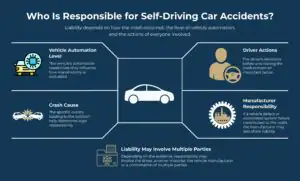
Who’s at fault comes down to the cause. What led to the accident. It could be:
- The vehicle’s level of automation
- Driver actions before and during the incident
- The cause of the crash
That means you and the other driver are still likely at fault. But sometimes the manufacturer of the autonomous vehicle could also be at fault.
The Human Driver
Usually, it is the person behind the wheel who is at fault. Misuse of driver-assistance features. Failure to intervene when required tends to make drivers at least partially at fault.
The Vehicle Manufacturer
Sometimes the manufacture’s mistakes cause the accident. That may include defective design or manufacturing defects. Other times, they don’t provide safety warnings. That means the manufacturer can be held accountable if we can prove product liability.
The Software or Technology Developer
Product liability may also apply to the technology developer that creates an unsafe situation. This may be the case when the following causes an accident:
-
- AI decision-making issues
- Sensor failures
- Programming errors
- Software defects
- System malfunctions
Vehicle Owners, Fleet Operators, or Commercial Operators
Some situations involve third parties. For example robotaxis and ride-sharing fleets. It can also include delivery vehicles and autonomous commercial vehicles. The party responsible for maintenance and operational responsibilities could be at fault. This could happen if those things fail. Each situation is different.
Get Legal Guidance After a Self-Driving Car Accident
Factors That Determine Fault in a Self-Driving Car Accident
So how do we know? Investigators examine human behavior and vehicle tech to determine what went wrong. There are several factors that typically play a role in this.
Vehicle Automation Level
How much automation is being used matters. Most vehicles operate at different levels, spanning from Level 2 to Level 5, with higher levels meaning the vehicle is doing more of the work. In most parts of the U.S. driver supervision requirements exist. That means that, depending on the automation level, the driver could be responsible.
Electronic Data and Vehicle Logs
Often, the problems are evident in the data available. Investigators look at electronic evidence to learn what occurred. That includes data recorders, sensor logs, software records, and system alerts. That gives them insight into what happened just before the accident.
Driver Conduct and Traffic Law Compliance
Drivers speeding or distracted. Or if impaired behind the wheel are at fault. Liability could be affected if the driver fails to monitor their vehicle.
What Should You Do After a Self-Driving Car Accident?
You need to know what to do if you have been hurt. Gather as much evidence as possible. The more the better. Follow these steps. This helps to protect your health and legal rights.
Seek Immediate Medical Attention
Prompt medical evaluation is critical. This helps to document what happened. It protects your health. Get to the ER right away.
Preserve Electronic Evidence
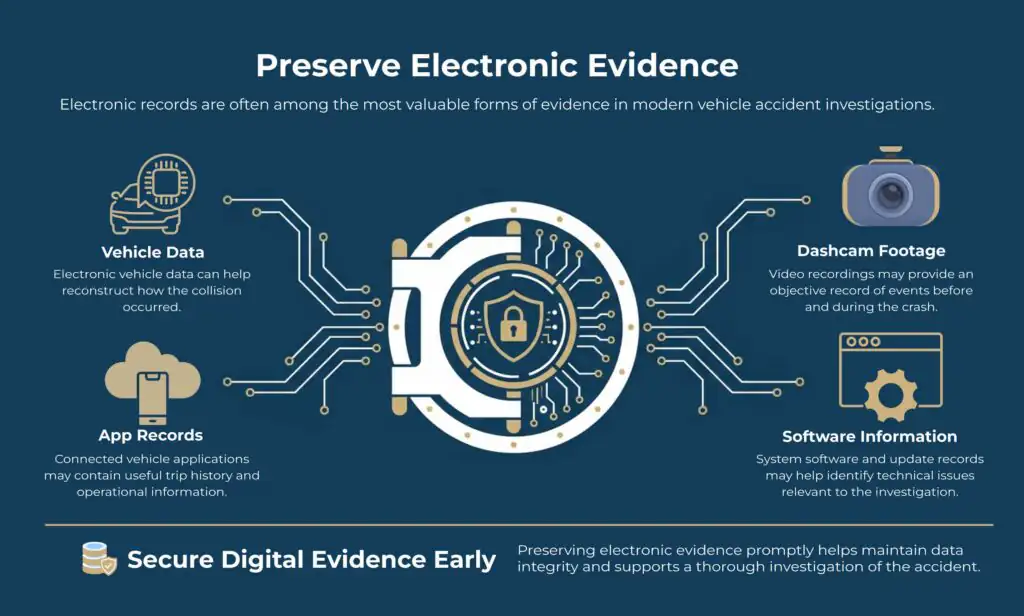
Electronic data needs preservation as it’s nearly always the most important evidence in your case. That includes:
- Vehicle data
- Dashcam footage
- App records
- Software information
Document the Accident Scene
Take photos of the accident scene. Document the road conditions. You also want to take photos of all damage to the vehicle, traffic lights, and the layout of the area.
Collect Witness Information
Get the name and contact information for everyone at the scene. That includes any witnesses that stopped to help.
Notify Your Insurance Company
Let your insurance company know you were in an accident. Don’t make statements about what caused it. Just alert them.
Contact a Personal Injury Lawyer
Contact our legal team immediately. Let us get to work protecting your rights. We will:
- Preserve all evidence
- Identify all parties involved at fault
- Work with experts to gather further evidence
Can You File a Self-Driving Car Crash Injury Claim?
If you’re hurt, you can seek compensation depending on liability in your case. That’s going to be dependent on state law and the situation. Your attorney will help you to determine your rights.
What Compensation Is Available After a Self-Driving Car Accident?
You can receive compensation for any losses you can prove. Economic and non-economic damages are the most common.
Economic Damages
These are losses you have that can be easily documented. Examples include:
-
- Medical expenses
- Lost wages
- Future treatment
- Rehabilitation
- Property damage
Non-Economic Damages
Non-economic damages are more speculative in terms of value. However, they often include:
-
- Pain and suffering
- Emotional distress
- Permanent disability
- Reduced quality of life
Wrongful Death Damages
If your loved one lost their life, a fatal autonomous vehicle accident claim may include compensation for loss of companionship. It may also include financial impact and numerous other losses. These could be those that both the individual and the family suffer.
How Does Insurance Work After a Self-Driving Car Accident?
Insurance coverage depends on your state. You also need to look at your policy. Personal auto insurance covers self-driving cars, as long as you’ve selected a policy to include it. Commercial coverage applies when the incident is the result of a company’s mistakes. And, product liability insurance may be applicable when technology fails.
Can You Still Recover Compensation If You Are Partly at Fault?
That depends on state laws. In a comparative negligence state, you may be able to seek compensation if you can show the other party was at fault. Your compensation is reduced by the level of fault you have. In a contributory negligence state you cannot seek compensation. Even if you are only 1% at fault.
How Long Do You Have to File a Self-Driving Car Accident Lawsuit?
The statute of limitations differs in each state. However, it’s always best to turn to an attorney immediately.
Do Self-Driving Cars Reduce Accidents
It’s not yet clear if self-driving cars will reduce accidents. Advanced driver-assistance technologies may reduce some types of crashes. But they also bring in new legal and technical challenges.
When Should You Hire a Lawyer After a Self-Driving Car Accident?
It’s always wise to hire an attorney if you’ve been in an accident. It’s very important if you have serious injuries or there ar disputes over who is at fault. Commercial operators and complex insurance issues also warrant working with an attorney.
How a Personal Injury Lawyer Can Help
Your attorney can help you in numerous ways:
- Investigate the accident
- Bring experts into the picture to clarify concerns
- Preserve evidence
- Negotiate a fair claim
- Go to court when necessary
Conclusion – Understanding Fault in Self-Driving Car Accidents
Who is at fault in a self-driving car accident depends on what happened at the time of the accident. Liability may involve drivers, manufacturers, software developers, and fleet operators depending on the situation. After an accident, work to preserve evidence, seek medical care, and understand your legal rights before pursuing a self-driving car crash injury claim.
Ledger Law can help you. We help injured parties get fair compensation. Let us talk to you about your rights and support you through the legal process. Our decades of experience can help you.
FAQs About Who Is at Fault in a Self-Driving Car Accident
Who is at fault in a self-driving car accident?
It depends on the situation. It could be numerous parties depending on what occurred.
Who is responsible for self-driving car accidents involving autonomous vehicles?
It could be either driver, the manufacturer of the vehicle, the technology manufacturer, or others. It all depends on what caused the accident.
Can I file a self-driving car crash injury claim after an accident?
You can file a claim if you can demonstrate someone else was responsible for your injuries and losses.
Can I sue the manufacturer after a self-driving car accident?
You may be able to see a lawsuit against the manufacturer if you can show they were responsible for your injuries and losses.
Does insurance cover injuries from a self-driving car accident?
It may cover injuries if they were caused by negligence on the party of any other party.
What evidence is needed to prove fault in a self-driving car accident?
You’ll need as much evidence as possible. Data from the vehicles, witness statements, and dashcam footage are some examples.
How long do I have to file a self-driving car accident lawsuit?
The statute of limitations to file a claim depends on where you live. Most states provide you with 1 to 3 years to take action for personal liability claims.
What damages can I recover after a self-driving car accident?
You can recover any losses you can demonstrate. That includes economic and non-economic damages.
Should I hire a personal injury lawyer after a self-driving car accident?
It’s wise to hire a personal injury lawyer to protect your rights.

Emery Brett Ledger brings 28+ years of experience to personal injury law. He founded & led The Ledger Law Firm in securing over $100 million in compensation for clients with life-altering injuries & complex claims. Prior results do not guarantee a similar outcome. Licensed in California, Texas, & Washington, Emery earned his law degree from Pepperdine University School of Law. His practice areas include car & truck accidents, wrongful death, catastrophic injuries, maritime claims, & mass tort litigation. He has been recognized by The National Trial Lawyers’ Top 100, Mass Tort Trial Lawyers Top 25, and America’s Top 100 Personal Injury Attorneys. Emery also received the 2025 Elite Lawyer Award & holds a perfect 10.0 Avvo rating with Platinum Client Champion status. His legal work has been featured on CNN, Forbes, NBC, & ABC.
Free Case Evaluation
Recent Posts
- Punitive Damages in a Car Accident: When Can You Recover Them?
- Tailgating Injury: What Causes Tailgating, Road Rage & How to Stay Safe
- Waiting to Call a Lawyer Can Hurt Your Case: Evidence, Deadlines & Legal Risks
- What Is Property Damage in a Car Accident? Claims, Costs & Who Pays
- Bodily Injury & Property Damage: Coverage, Claims, Liability & Compensation
Emery Brett Ledger brings 28+ years of experience to personal injury law. He founded & led The Ledger Law Firm in securing over $100 million in compensation for clients with life-altering injuries & complex claims. Prior results do not guarantee a similar outcome. Licensed in California, Texas, & Washington, Emery earned his law degree from Pepperdine University School of Law. His practice areas include car & truck accidents, wrongful death, catastrophic injuries, maritime claims, & mass tort litigation. He has been recognized by The National Trial Lawyers’ Top 100, Mass Tort Trial Lawyers Top 25, and America’s Top 100 Personal Injury Attorneys. Emery also received the 2025 Elite Lawyer Award & holds a perfect 10.0 Avvo rating with Platinum Client Champion status. His legal work has been featured on CNN, Forbes, NBC, & ABC.