

What Is Pure Comparative Negligence In California Personal Injury Law | Comparative Fault Determination Process | California’s Fault-Based Insurance

- California follows what’s known as the pure comparative negligence rule.
- Damages can still be recovered even if you’re partly at fault.
- If all parties involved are found at fault, the jury will assign a percentage to everyone involved.
- Your total compensation will be reduced to your percentage of fault.
- Even if you’re 99% at fault, you’ll still be awarded 1% of your damages.
Accidents happen. Because humans. People make mistakes. Distractions. The weather. Whatever. It’s just a fact of life. If it’s your fault, you’re at a complete loss in some states. But not so in California. The good news is in this situation, you can still recover money if you get injured in an accident in California. This is called comparative negligence.
With this rule, you’ll get less money if you’re at fault, but as long as 100% of the blame isn’t yours, you can still collect. How much is decided by a jury. For example, if your damages are $100,000 in an accident and a jury determines you’re 30% at fault, you’d still collect $70,000.
Explained: What Is Pure Comparative Negligence California Law?
So what is pure comparative negligence in California personal injury law? It’s a legal framework that allows you to recover money for damages, no matter how much of the fault belongs to you. About a dozen states allow for this, and California is one of them. Lots of other states don’t protect you at all if you’re even a small percentage at fault.
California changed this in 1975 when the state’s Supreme Court took on a case called Li v. Yellow Cab Co. (13 Cal.3d 804). Prior to that, California followed contributory negligence. So if someone shared any of the blame at all, they couldn’t get paid a dime.
The difference between California’s law and states that don’t have comparative negligence.
- There’s not a cutoff point. Just because you share some of the blame doesn’t mean you lose all your rights.
- The amount of money you receive is your percentage of the fault. Proportional reduction is what it’s called.
- Car crashes, slip and falls, product injuries, medical malpractice, and workplace incidents. All personal injury claims.
What ends up happening in California is that the courts divide responsibility in a way that’s fair.
How Does California Pure Comparative Negligence Law Work?
A specific sequence is involved. We see the exact same steps play out almost every time. This is the case whether a case settles with an insurance company, or ends up in a courtroom.
- Total damages are added up: Medical bills, lost wages, pain and suffering, property damage. Plus any future costs you’ll have because of your injuries.
- A jury assigns percentages to everyone involved: The total has to add up to 100%.
- Basic math: Your share is the percentage the jury says you’re not at fault.
Let’s use a car wreck as an example. You’re driving along minding your own business and someone runs a red light and rams into you. Of course it’s mostly their fault. But you were going 10 miles over the speed limit. Your damages total up to $200K. A jury decides you’re 20% at fault, but the other driver is mostly to blame, so they’re given 80% of the fault. You’d get $160,000.
And if you’re driving the car that ran a red light? If it’s 80% your fault, using the same numbers, you’d still walk away with $40,000 in California. That’s not the case in lots of other states.
All of these matter when it comes to how a jury determines your percentage of fault:
- Police reports.
- Traffic citations.
- Witness statements and testimony.
- Physical evidence.
- Surveillance footage.
- Dash cam footage.
- Expert accident reconstruction analysis.
Insurance adjusters always want to try to make it more your fault so they can save money. And this isn’t us speculating. It’s how it almost always plays out. We’ve seen it over and over again. That’s why you need an attorney if you’re in this situation. It can drastically change the numbers. And even a small percentage increase in a $200K case can mean big bucks for you.
The reason is that a good lawyer will look over initial fault assessments from insurance companies and find evidence that they’re conveniently chosen to ignore. When we’re done editing their assessment, it will favor you as much as possible. Not them. The percentage they try to assign to you isn’t set in stone until a judge or jury says so.
A Guide to California’s Fault-Based Insurance System Under Civil Code 1714:
California has a fault-based insurance system. This means the person who injured you (or their insurance company) is responsible for paying you. This is based on California Civil Code Section 1714. That’s the law that says everyone’s responsible for injuries if they’re caused by a lack of ordinary care.
This usually works through liability insurance. Someone causes an accident, they pay the injured party’s claim through their at-fault insurance policy. The insurance company pays up to the holder’s policy limit.
Comparative negligence works like this.
- The at-fault driver’s insurance company investigates the accident.
- They assign their own fault percentages to the person at fault and you.
- Your payout gets reduced by the percentage they say you’re at fault.
- If you disagree, you negotiate. Or, ideally, your lawyer does it for you or file a complaint with the California Department of Insurance. Or the matter can go to court.
The law in California requires all drivers to have minimum liability coverage. This is $15,000 per person and $30,000 per accident for bodily injury. But minimum coverage very often falls far short of the damages you actually have.
Comparative Fault: How Is Percentage Determined?
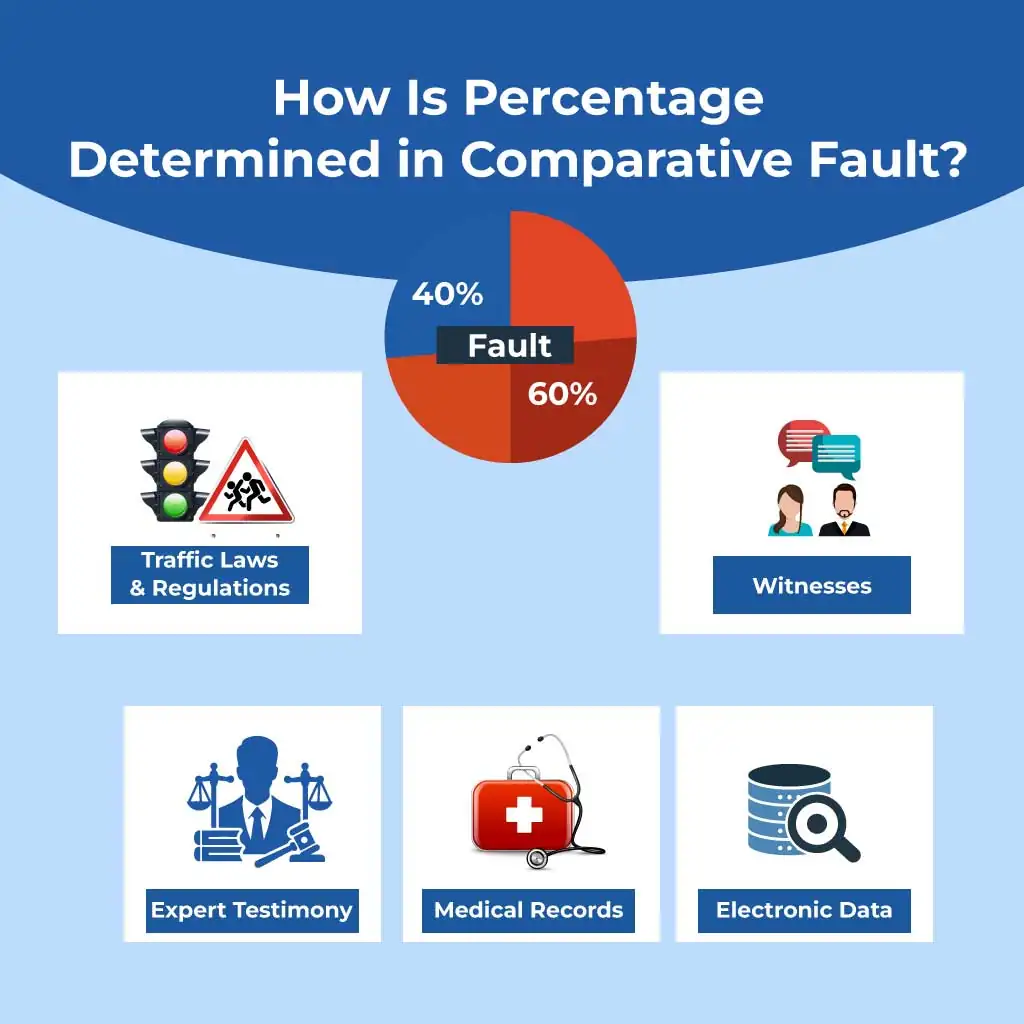
Percentages come from evidence. But different parties can reach different conclusions depending on what evidence they choose to emphasize.
When there’s a lawsuit, the jury will assign fault percentages once they’ve heard all the evidence. Insurance adjusters decide what they think it should be, and you can contest that.
How does the jury decide on the percentages?
- Traffic laws and regulations: Was a law broken? A red light violation or illegal turn is an automatic presumption of negligence under California’s “negligence per se.”.
- Physical evidence: Skid marks, vehicle damage, road conditions when the accident happened. Things like that.
- Witnesses: If there were witnesses, juries place a lot of value in what they have to say.
- Expert testimony: Accident reconstructionists can calculate speeds and angles. Even things like your reaction time.
- Medical records: The type of injuries can give clues to what exactly happened.
- Electronic data: This is stuff like cell phone records, vehicle black box data, GPS logs.
California follows CACI Jury Instruction No. 405. Meaning, jurors assign a percentage of responsibility to each person who had a “substantial factor” in someone’s injuries or damages. So it’s clear that percentages have to be based on actual fault. Not on sympathy or bias.
Pure Comparative Negligence Examples:
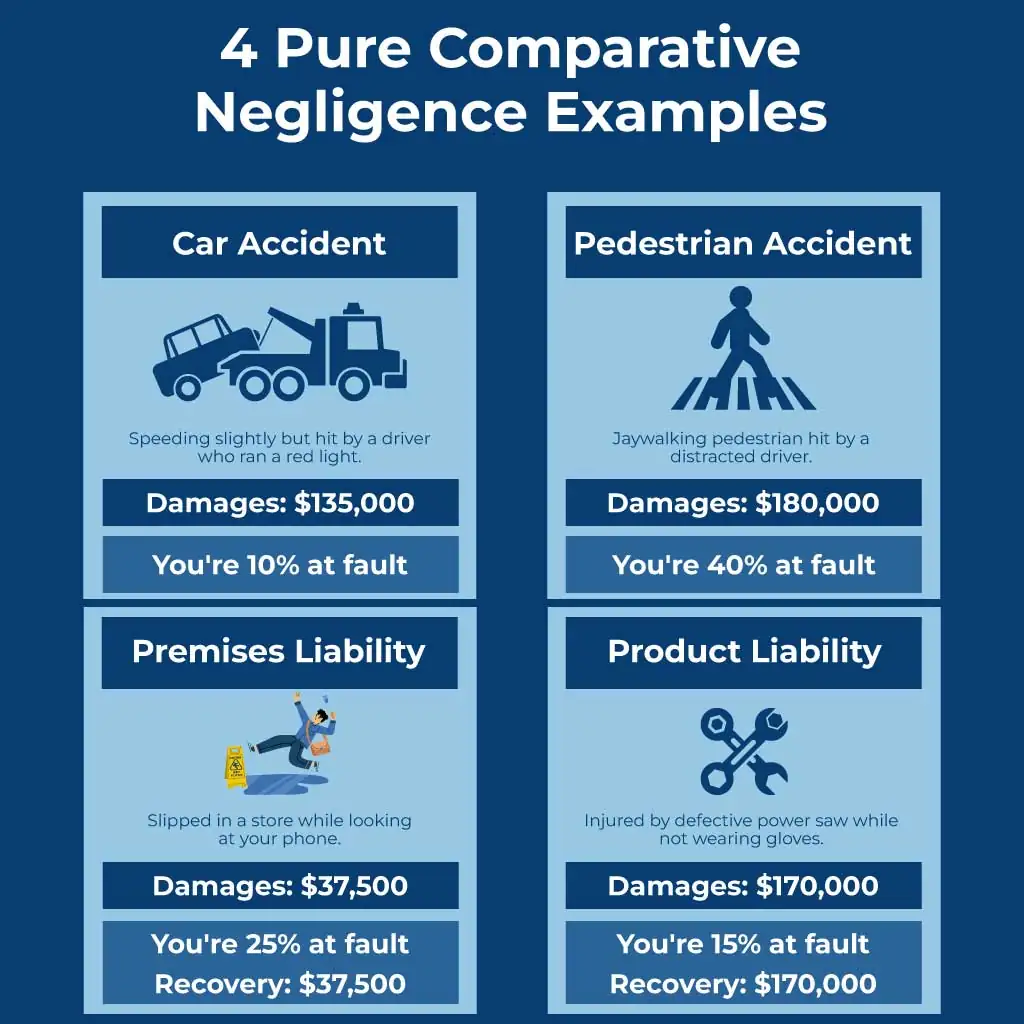
It’s easier to understand if you look at different scenarios with examples of what happens.
Car Accidents:
You’re driving five miles over the speed limit and another driver runs a red light and hits you. Your medical bills and other damages come up to $150,000. Jury members determine you’re 10% at fault for speeding, the other driver’s 90% at fault. Your recovery would be $135,000.
Just because the other driver messed up doesn’t mean you’re completely off the hook. But it doesn’t completely cancel out your claim either.
Pedestrian Accident:
You’re jaywalking (not crossing the street on a crosswalk) when a distracted driver hits you. Your damages come up to a whopping $300,000. A jury is going to find the driver mostly at fault at 60%, but you were in the wrong, too, so you’re assigned 40%. You’d collect $180K.
Yes, you broke the law, but the other driver being distracted was the main problem.
Premises Liability Claim:
You’re at a grocery store and slip because the employees just finished mopping and didn’t put a wet floor sign up. But also, you weren’t paying attention because you were checking your text messages or playing Words With Friends on your phone. And your injuries add up to $50,000. Maybe the jury says you’re 25% at fault, but the store is at 75%. Your share would be $37,500.
It was mostly the store’s fault, but looking down at your phone while you were walking around the store didn’t do you any favors.
Product Liability Claim:
You’re using that hot new power saw you got for Christmas and end up cutting a huge gash in your hand when it malfunctions. The design was defective, and the company will end up paying hugely for that. But also, you weren’t wearing safety gloves. And the manufacturer’s instructions clearly stated that you should.
So your damages are $200,000. And that’s if you don’t cut your hand off. A jury may find you 15% at fault, but the manufacturer at 85%. You end up with $170,000.
The defective saw was the main problem, but not wearing the safety gloves didn’t help.
Contact The Ledger Law Firm to Help With California Pure Comparative Negligence Rule:

If you’ve been injured and the insurance company’s blaming you, don’t accept their fault assessment without putting up a fight. Every percentage point adds up so you can get more money. If you’re talking about $100K, 5% is $5,000. That will cover a lot of medical bills.
We help clients across California who are facing unfair determinations by insurance companies. They’re never going to make sure you get every penny you deserve. But that’s what the Ledger law firm is here for you. You don’t have to pay for a consultation with us.
1. What is the difference between contributory negligence and comparative negligence?
With contributory negligence, you get zero if it’s your fault. But comparative negligence means you can still collect some damages if you played a role in the accident.
2. What is the modified California pure comparative negligence law?
California doesn’t use a modified system. This type of rule sets a fault threshold (maybe 50% or 51%), beyond which you can’t recover. California’s pure system doesn’t have this cutoff.
3. What is the 49 comparative negligence rule?
The “49% rule” is a modified comparative negligence standard used in some states. It bars recovery if you’re 50% or more at fault.
4. When did California switch from contributory to comparative negligence?
In 1975 when the California Supreme Court decided Li v. Yellow Cab Co. That ruling did away with the harsh contributory negligence that’s standard in some other states.
5. Who determines the percentage of fault in California injury cases?
If your case goes to trial, the jury. During insurance negotiations, the adjusters come up with percentages. You can accept them, negotiate, or get a lawyer to take them to court.
6. How does comparative negligence work with multiple responsible parties?
Both of the parties are assigned their own fault percentage. All percentages must total 100%. Your recovery’s reduced only by your own share of fault, not by what the other parties owe each other.
7. What happens if several parties share responsibility?
Everyone pays their proportional share of your damages for non-economic losses. So if there are three parties plus you, and they all share 30% of the blame and you 10%, they’ll all owe you their 30%.
8. When does "joint and several liability" come into play?
California’s Proposition 51 rules that joint and several liability only apply to financial damages. Like medical bills and lost wages. The defendants can be held responsible for the full amount of economic damages no matter their fault percentage.
9. What if you are primarily at fault for the accident?
You can still be awarded damages. California’s pure comparative negligence system makes sure there’s not a threshold to block your claim.
10. What to do if I disagree with the insurance company's fault percentage?
Get your evidence and documentation together. Anything that supports your claim. Then hire a lawyer. They’ll take it from there.
11. What should I do if the at-fault driver has no insurance?
You probably have your own uninsured motorist coverage on your policy. File a claim there. Or you can sue the driver directly. It’s not always easy to actually collect damages from someone who doesn’t even have the money to pay for car insurance.
12. What to do if a defendant countersues you?
This happens a lot in comparative negligence cases. The other party might argue you were more at fault and caused their injuries too. The claims are handled together, the jury assigns fault accordingly.

Emery Brett Ledger brings 28+ years of experience to personal injury law. He founded & led The Ledger Law Firm in securing over $100 million in compensation for clients with life-altering injuries & complex claims. Prior results do not guarantee a similar outcome. Licensed in California, Texas, & Washington, Emery earned his law degree from Pepperdine University School of Law. His practice areas include car & truck accidents, wrongful death, catastrophic injuries, maritime claims, & mass tort litigation. He has been recognized by The National Trial Lawyers’ Top 100, Mass Tort Trial Lawyers Top 25, and America’s Top 100 Personal Injury Attorneys. Emery also received the 2025 Elite Lawyer Award & holds a perfect 10.0 Avvo rating with Platinum Client Champion status. His legal work has been featured on CNN, Forbes, NBC, & ABC.
Free Case Evaluation
Recent Posts
- Punitive Damages in a Car Accident: When Can You Recover Them?
- Tailgating Injury: What Causes Tailgating, Road Rage & How to Stay Safe
- Waiting to Call a Lawyer Can Hurt Your Case: Evidence, Deadlines & Legal Risks
- What Is Property Damage in a Car Accident? Claims, Costs & Who Pays
- Bodily Injury & Property Damage: Coverage, Claims, Liability & Compensation
Emery Brett Ledger brings 28+ years of experience to personal injury law. He founded & led The Ledger Law Firm in securing over $100 million in compensation for clients with life-altering injuries & complex claims. Prior results do not guarantee a similar outcome. Licensed in California, Texas, & Washington, Emery earned his law degree from Pepperdine University School of Law. His practice areas include car & truck accidents, wrongful death, catastrophic injuries, maritime claims, & mass tort litigation. He has been recognized by The National Trial Lawyers’ Top 100, Mass Tort Trial Lawyers Top 25, and America’s Top 100 Personal Injury Attorneys. Emery also received the 2025 Elite Lawyer Award & holds a perfect 10.0 Avvo rating with Platinum Client Champion status. His legal work has been featured on CNN, Forbes, NBC, & ABC.