How to Choose an Attorney at Law Near You After a Slip and Fall

Start with the decision your records can support
Choose among nearby attorneys with a consistent premises-liability comparison checklist. For each option, note:
- Whether the professional is licensed and authorized to handle the matter in the relevant jurisdiction.
- Whether the lawyer has handled slip-and-fall or other premises-liability matters like yours.
- What the initial evaluation covers and how the lawyer expects to assess the available evidence.
- How communication works and what the written fee terms say.
- Which questions remain unanswered after the conversation.
Use the same questions with each option: What experience do you have with matters like mine? What credentials or certification are relevant? Do you carry malpractice insurance? How will you assess damages and the evidence needed to support a claim? What does the written fee agreement say about fees and recovery?
A lawyer and a prospective client can both assess whether a working relationship is a good fit. This comparison does not determine whether a property owner is liable; it helps you choose whom to contact for a qualified review of the facts.
The incident record can begin with a short account written in your own words. Include the date and location if you know them, what you noticed before the fall, what surface or object caused it, what happened immediately afterward, who was present, and how you reported the incident. Add photographs, medical records, witness details, and written communications about reporting the fall as you collect them. A refusal to prepare an incident report does not automatically prevent you from pursuing a claim, although the available circumstances and evidence may affect how the incident is established.
Use the checklist to choose whom to contact first, not to decide whether the property owner is liable. The attorney’s response can help you identify what remains to be clarified about fit, evidence, fees, or communication.
Verify licensing and premises-liability relevance
The meaning of “lawyer” and “attorney” can depend on the jurisdiction and the source using the term. In Texas, the terms are interchangeable for someone who graduated from law school, passed the bar exam, and is licensed by the State Bar of Texas. Some legal usage distinguishes an attorney who can practice in court after meeting state requirements from a lawyer who may not have that qualification or experience. Because terminology is not a reliable substitute for jurisdiction-specific licensing information, ask whether the professional is licensed and authorized to handle your matter where the fall occurred.
Ask whether the attorney has handled legal matters like yours. Ask directly:
- How often do you handle slip-and-fall or premises-liability matters?
- Have you handled claims involving stores, landlords, property managers, or other settings like mine?
- Which facts about the hazard, notice, inspection, warning, and injury would you examine first?
- Do you have relevant practice-area credentials or certification?
- Who would conduct the initial evaluation and communicate with me afterward?
A professional can ask questions about your matter while you decide whether the relationship appears suitable. Choosing legal help is a two-way decision: you and the attorney can assess whether the proposed relationship is a good fit.
A nearby listing can tell you where to begin, but it cannot by itself establish premises-liability experience, courtroom authority, availability, or fit. Treat the listing as an invitation to ask focused questions. If the answers stay general, do not treat the search ranking or location as proof that the practice is prepared for your situation.
Make the licensing question concrete before you compare presentation or convenience:
- In which state or states is the attorney licensed?
- Is the attorney authorized to handle a matter arising where the fall occurred?
- If court action became necessary, would the attorney be able to practice in the relevant court?
- Does the attorney regularly handle premises-liability disputes in that jurisdiction?
- Will another attorney or firm handle part of the matter?
The answers help you distinguish a professional who can address the applicable jurisdiction from a listing that merely appears nearby. Ask for a clear answer rather than inferring authority from the words “lawyer” or “attorney” alone.
Translate the property condition into evaluation questions
The property condition is the part of a slip-and-fall account that needs the clearest questions. An attorney may examine how long the hazard existed, whether the property had a procedure for examining the premises, whether there was a reason for the condition, and whether safer placement, a warning sign, or a barrier was possible.
Turn your memory and photographs into questions such as:
- What was the hazard: liquid, uneven flooring, stairs, poor lighting, an object, or something else?
- Where exactly was it, and what could you see before you encountered it?
- Could the condition have existed long enough for property personnel to discover it?
- Was the area being cleaned, repaired, stocked, or used for another stated purpose?
- Was a warning sign or barrier present, and where was it in relation to the hazard?
- Could the object have been moved or the area arranged more safely?
- Did anyone tell you that the condition had been reported before your fall?
You do not need to answer every question before requesting an evaluation. Mark the answers you know, the answers you are unsure about, and the facts that need investigation.
Your uncertainty is part of the evaluation record. Write “unknown” rather than filling a gap with a guess, and identify who might know more: a witness, store employee, landlord, property manager, or medical provider. Preserve the original photographs and messages along with any later notes so the attorney can distinguish what you observed from what you learned afterward.
The person or organization responsible for the area may be a separate question from the person who spoke with you after the fall. Note the store, landlord, property manager, maintenance contractor, or other names you know, but do not guess about legal responsibility. Ask the attorney how control of the area, inspection practices, the duration of the condition, and available warnings affect the evaluation.
Take the first steps that preserve the fall record
The first post-fall sequence should protect your health and preserve information without asking you to investigate beyond your physical ability. After a slip and fall, seek medical care so injuries can be evaluated and treated and the visit can be documented. If you are physically able, collect evidence at the scene before leaving because conditions such as spills or broken steps may be changed or repaired.
Use this order as a practical checklist:
- Seek medical care and describe the symptoms and circumstances accurately.
- If you can do so safely, photograph or record the condition that caused the fall before it changes.
- Capture the surrounding area, not only a close-up of the hazard.
- Note warning signs, barriers, or the absence of warnings.
- Ask witnesses for their names and contact information.
- Report the fall to the appropriate property representative and keep your communication about that report.
- Write down what you remember while the sequence is still clear.
The order may change if your physical condition prevents you from documenting the scene. Your health comes first; a missing photograph does not tell you that no evaluation is possible.
Scene documentation should show the hazard and its setting. Clear photographs or videos may include a wet floor, uneven stairs, poor lighting, or another condition that caused the fall, along with the surrounding aisle, walkway, entrance, stairs, or other relevant area. Include warning signs or their absence and the general environment, such as a crowded store aisle. If witnesses were present, ask for their names and contact information because their statements can corroborate your account of the incident.
Prompt medical care also gives you a dated record of evaluation and treatment. Insurance companies often argue that delayed treatment means injuries are unrelated or exaggerated, so do not delay care because you are waiting to speak with a lawyer. Keep the medical records you receive, and tell the attorney what care has already occurred and what care has been recommended.
Control the first insurance conversation
Insurance outreach can arrive before you understand the full extent of the fall. An insurer may contact you about the incident or offer a quick settlement, and adjusters often aim to minimize payouts. That does not establish that the insurer has acted improperly, but it does give you a reason to slow down and understand what you are being asked to provide.
Before giving a recorded statement or signing documents for an insurer, consult an attorney because those actions could weaken your claim. You can keep the communication factual and limited while you decide how to obtain legal help. Do not guess about the hazard, your diagnosis, or your future treatment just to answer quickly.
Your insurance communication log should preserve the caller’s name, company, phone number, date, time, stated purpose, and any follow-up message or document. Keep copies of emails, letters, forms, and your responses. Add a note when you reported the fall to the property owner or manager and record whether the property representative prepared, declined to prepare, or did not respond to an incident report.
Insurance and premises-liability rules can vary by jurisdiction. Florida law, for example, includes rules about insurer conduct and knowledge of a hazard that apply to Florida matters. Do not transfer those Florida rules to another state without asking an attorney about the law that applies to your fall.
Assemble a usable evaluation packet
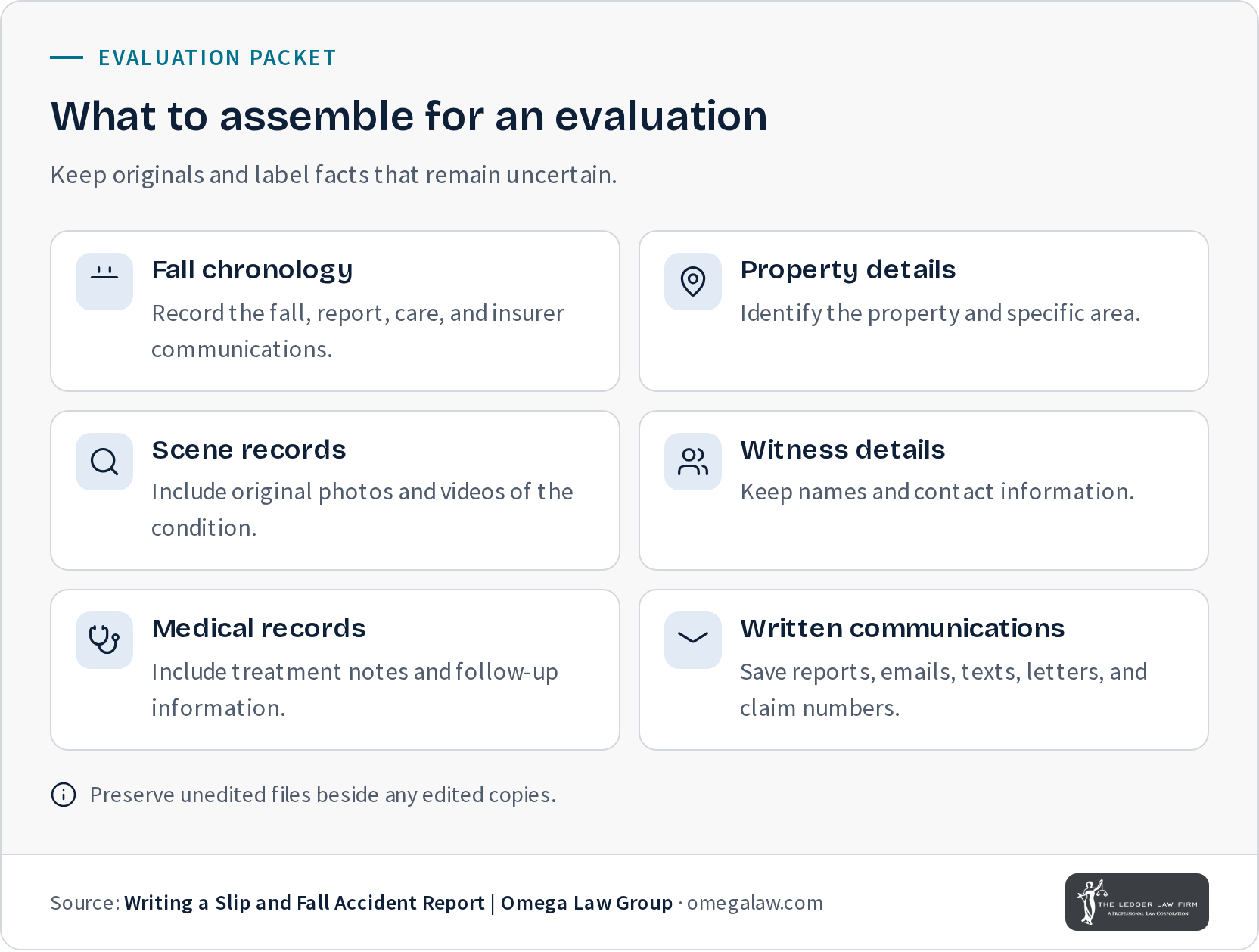
An evaluation packet should let an attorney understand the event without making you build a complete case before asking for help. Put the materials in a simple folder, use clear file names, and keep a separate page for facts you still need to confirm. The packet can contain:
- A short chronology of the fall, report, medical care, and insurer communications.
- The address or description of the property and the specific area where you fell.
- Original photographs and videos of the hazard, surrounding area, warnings, and lighting or crowd conditions.
- Names and contact information for witnesses or people who helped you afterward.
- Medical records, discharge paperwork, treatment notes, and information about recommended follow-up care.
- Written reports, emails, texts, letters, claim numbers, and messages about reporting the fall.
- Your questions about who controlled the area, how the condition may have developed, and what the attorney needs next.
Keep original files when possible. If you edit a copy to highlight a detail, preserve the unedited version beside it.
Your chronology should separate observation from assumption. For example, write that you saw liquid near the entrance rather than stating who placed it there if you do not know. Note when you first felt pain, when you sought care, and what you told the medical provider. Keep photographs, medical records, witness details, and communications about reporting the fall together; those materials give the attorney a starting record for the evaluation.
A property representative’s refusal to prepare a report does not automatically prevent you from pursuing a claim. Save your written request, the response or lack of response, the name of the person you contacted, and the time and place of the conversation. The circumstances and available evidence may affect how the incident is established, so bring the reporting history to the evaluation instead of discarding it.
The packet should also show the timing of medical care. Prompt treatment helps protect your health and claim, while a delay may lead an insurance company to argue that an injury is unrelated or exaggerated. Include a brief explanation for any gap in care without changing the underlying dates.
Add a one-page cover note so the first review has a clear starting point. Put the fall date and location at the top, then list the suspected hazard, the property contact, the injury information you know, the medical care received, the insurer’s involvement, and your three most important questions. Label each item as known, uncertain, or still missing. A short, accurate cover note is more useful than a long narrative that blends observation, assumption, and later conclusions.
Compare attorneys by fit and working relationship
The attorney-client relationship is a two-way decision. You can assess whether the attorney’s experience, communication, and approach fit your matter, while the attorney can ask questions to decide whether the relationship is suitable. An evaluation is therefore more useful when you bring questions instead of treating the first conversation as a test you must pass.
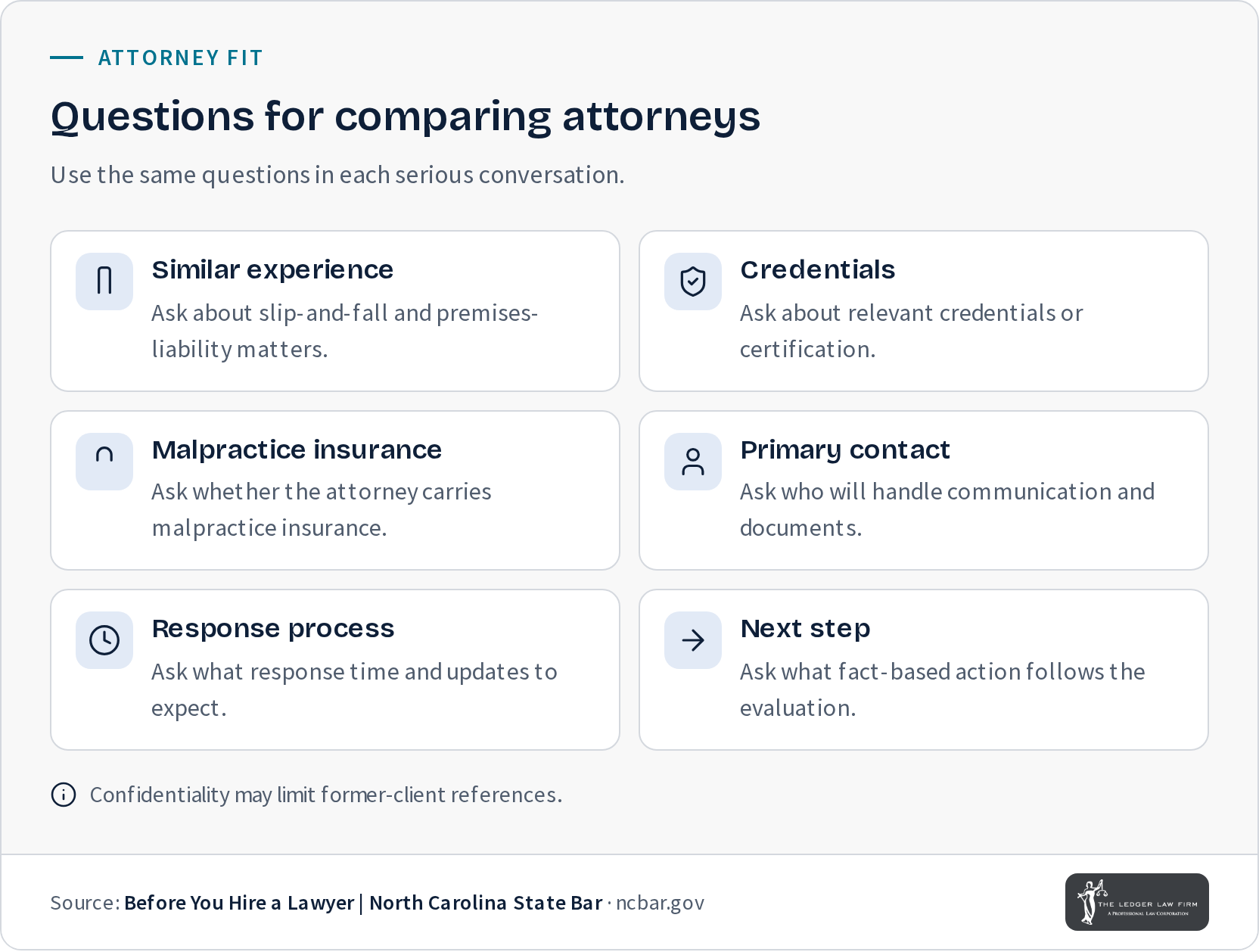
Use the same questions with each attorney you are seriously considering:
- How much of your work involves slip-and-fall or premises-liability matters?
- Have you handled a property-condition dispute involving facts like mine?
- What information would you need before deciding whether to work with me?
- Do you have relevant credentials or certification?
- Do you carry malpractice insurance?
- Who will be my primary contact, and how should I send new documents or questions?
- What response time and update process should I expect?
- Can you explain what you know now, what remains uncertain, and what would change the evaluation?
The goal is not to collect impressive-sounding labels. The goal is to learn whether the attorney can connect your documented facts to the questions that arise in a premises-liability matter.
You may ask whether an appropriate former-client reference is available, but confidentiality limits what an attorney can provide. An attorney cannot give you a former client’s name without that former client’s consent. Treat the response as part of the communication comparison rather than demanding private client information.
After each conversation, write down what the attorney understood about the fall, which records the attorney requested, what questions remained open, how communication would work, and what the proposed next step was. Record the answer in the attorney’s own terms. That makes it easier to compare substance later instead of relying on how reassuring the conversation felt in the moment.
Use a consistent comparison sheet for each conversation. Give each attorney the same short incident summary, then record whether the response addressed premises-liability experience, the hazard and notice questions, evidence gaps, expected communication, fee terms, and the conditions that could change the timeline. You do not need to rank people by personality. Compare whether each conversation gave you a clear, fact-based next step.
Make the evaluation include fees and evidence expectations
The evaluation should address both the evidence and the harm you are asking the claim to account for. Ask how damages would be calculated and what evidence would support the calculation. Ask which medical records, treatment information, bills, wage information, or other documents are relevant to the attorney’s assessment, without assuming that every possible category applies to your matter.
Be cautious of any lawyer who promises a specific amount upfront. A responsible discussion can address factors, uncertainties, and a possible range based on the facts available, but a promise before the attorney understands your injuries, property evidence, and applicable law does not answer the decision you need to make.
Read the written agreement so you understand the terms that apply to your matter rather than assuming every personal-injury arrangement is identical.
Put these fee questions on your list:
- What event makes the fee payable?
- What percentage applies, and does the percentage change at different stages?
- What does “recovery” mean in the written agreement?
- Which terms address a matter that does not result in a recovery?
- What documents explain the fee arrangement in plain language?
A fee discussion belongs in the initial comparison because cost, evidence, timing, and communication all shape whether the proposed working relationship fits your situation.
Treat the fee agreement as a decision document, not a formality after you have already chosen. Compare the percentage, the event that triggers payment, and the language addressing no recovery. Ask about any term you cannot explain in your own words. The purpose is to understand the proposed arrangement before you agree to it, not to assume that a familiar fee label answers every question.
Compare direct contact, referral, and self-directed handling
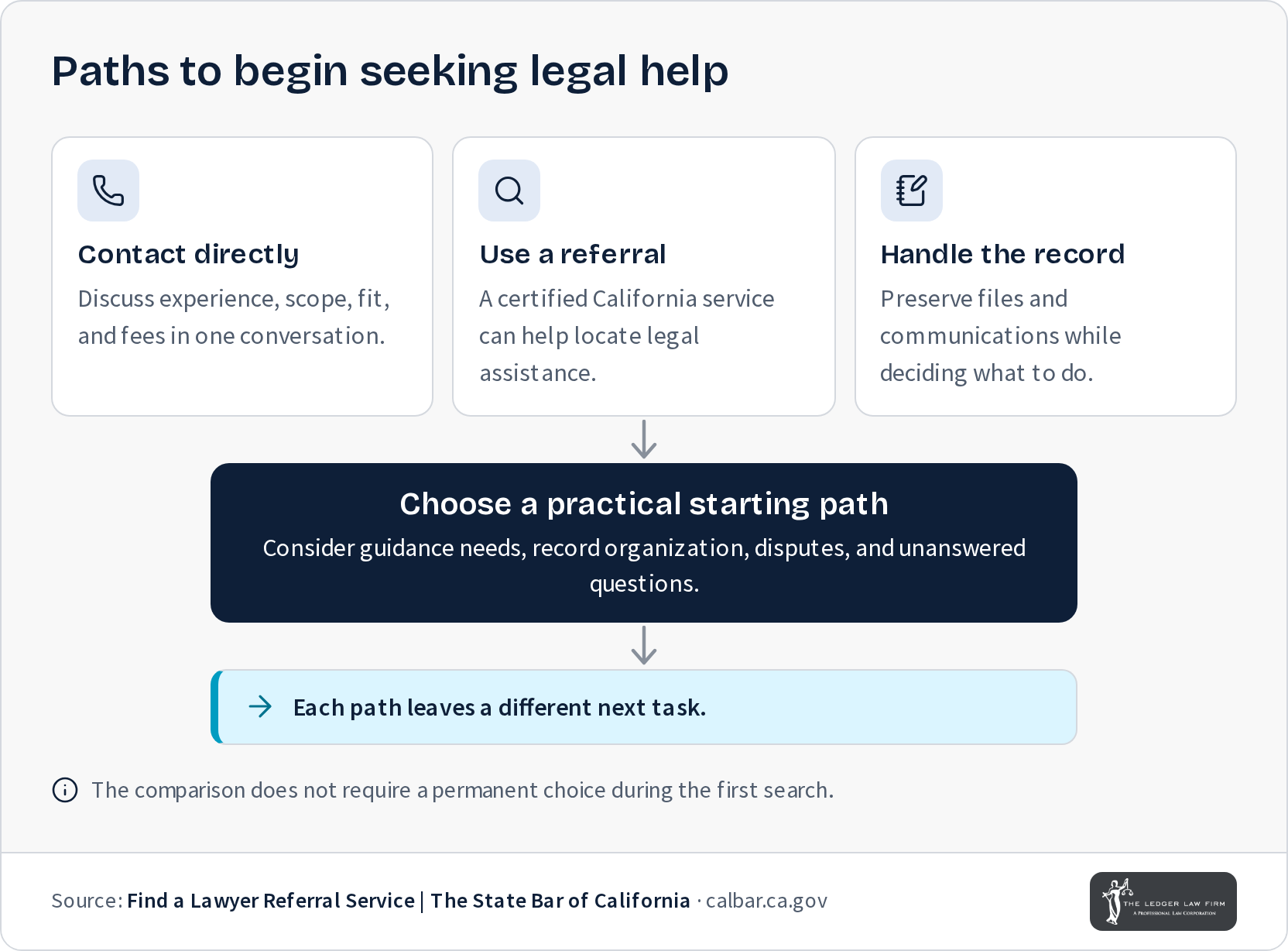
You have more than one way to begin looking for legal help after a slip and fall. You can contact an attorney directly, use a lawyer-referral service where an appropriate certified service is available, or continue handling the record and communications yourself while deciding what to do. The right comparison is practical: how much guidance you need, how organized your records are, whether responsibility is disputed, and what questions remain unanswered.
| Path | Fit and evaluation | Evidence readiness | Fees and communication | Direct next step |
|---|---|---|---|---|
| Contact an attorney directly | You can ask about slip-and-fall experience, licensing, evaluation scope, and working fit in the same conversation. | Bring the chronology, scene records, medical information, witness details, and insurer communications you have. | Ask about the proposed fee arrangement, contact person, updates, and documents needed. | Choose an attorney to contact and send a focused summary with your questions. |
| Use a certified California Lawyer Referral Service | In California, certified Lawyer Referral Services can help you find legal assistance and must meet standards approved by the California Supreme Court. | Explain the property, fall, injury, location, and records available so the referral can be relevant to your request. | Ask whether the connection is for an initial evaluation, a referral, or another form of legal assistance, and ask what communication follows. | Use the service if you want help locating legal assistance in California rather than selecting a practice from search results alone. |
| Continue self-directed handling | You retain control of the record while you decide whether direct legal help would answer unresolved questions. | Keep the original files, medical records, witness information, reporting communications, and a dated chronology organized. | You remain responsible for tracking communications and learning what the applicable agreement would require if you later seek representation. | Set a clear point for reassessing the path, especially if the hazard, injury, or insurer position becomes disputed. |
The comparison does not require you to choose a permanent path during the first search. If you contact an attorney directly, ask what the evaluation covers. If you use a referral service, ask what happens after the connection. If you continue on your own, keep the record current and identify the unanswered questions that make professional review useful. A choice based on those answers is more grounded than a choice based only on distance.
Each path leaves you with a different task. Direct contact puts the fit and evidence questions in one conversation. A referral service can help you locate legal assistance in California, but you still need to ask the connected professional about experience, scope, fees, and communication. Self-directed handling leaves you responsible for preserving the record and recognizing when a disputed hazard, developing injury issue, or insurer request calls for professional review.
Set expectations for a conditional timeline
A slip-and-fall matter may move through an insurance claim and settlement negotiations rather than a lawsuit.
A slip-and-fall case may take months and up to years to conclude if it goes to trial. Settlement negotiations may continue after a lawsuit is filed and before the parties reach civil court, so filing does not necessarily mean that a trial will occur. Ask what event would move the matter from investigation to negotiation, from negotiation to filing, or from filing toward trial.
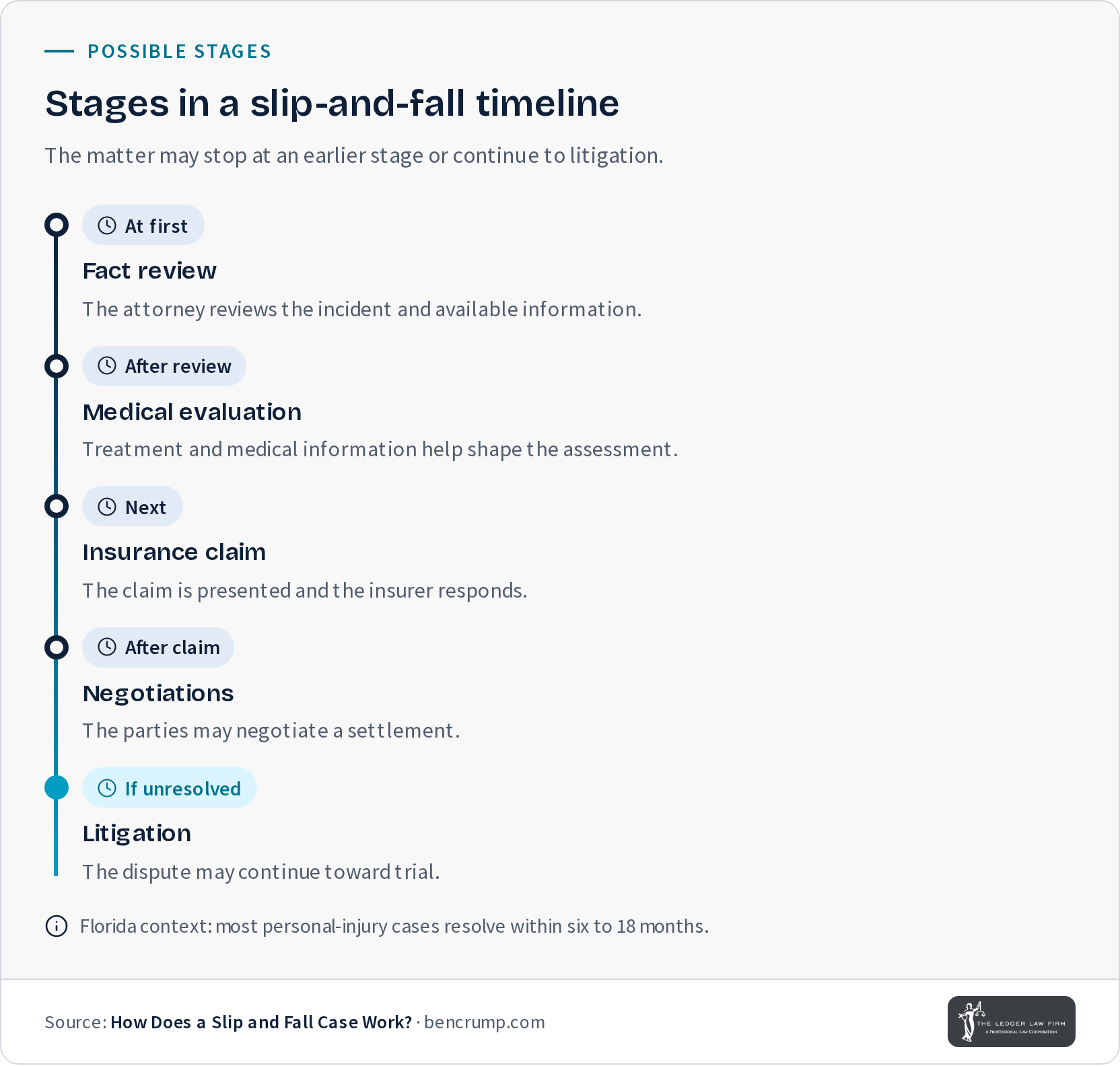
In Florida, most personal-injury cases resolve within six to 18 months, while exact timing varies dramatically with case type, injury severity, and court backlog. Premises-liability cases often settle more slowly than auto-accident claims. Treat that range as Florida-specific context, not a prediction for your case or another state.
Ask each attorney to explain the conditions behind any timeline discussion:
- What information is needed before the claim can be evaluated?
- Does the expected path depend on medical treatment reaching a stable point?
- What response from the property owner or insurer could lengthen the process?
- What facts would make litigation more likely?
- Which updates would you receive, and when would you be asked to make a decision?
A useful answer identifies the events that could change the duration. It does not promise that your matter will follow a particular schedule.
Think of the timeline as a series of possible stages rather than a fixed countdown: initial fact review, medical evaluation, an insurance claim, negotiations, and, if the dispute remains unresolved, litigation. A case can stop at an earlier stage or continue into a later one. Ask which stage the attorney is describing, what must happen before the next stage, and what decision you would need to make at that point.
Recognize when a qualified evaluation matters most
A qualified evaluation becomes especially useful when the facts require more than a simple description of where you fell. Consider requesting one when:
- The property owner, manager, or insurer disputes what caused the fall.
- You cannot tell how long the hazard existed or who controlled the area.
- The available photographs, witnesses, or reporting records leave important gaps.
- Your treatment is continuing or the relationship between the fall and your injuries is being questioned.
- An insurer requests a recorded statement, signature, or quick settlement.
- You need help deciding which documents or property questions deserve follow-up.
A request for an evaluation can focus on the hazard, records, treatment, or insurer communications without assuming that the property owner is liable. If you are in doubt about what to do next, contact a qualified professional or the responsible authority promptly.
Reporting the fall and considering an attorney early can help establish a timeline and document the property owner’s knowledge of the hazard. Early contact is most useful when you bring the facts you already have and clearly label what remains uncertain. You do not need to wait until every medical record, photograph, or witness detail is available before asking what should happen next.
Use a final decision check before choosing how to proceed:
- Can you describe the fall and property condition without guessing?
- Have you preserved the records that may change or disappear?
- Do you know which attorney questions remain unanswered?
- Have you compared experience, evaluation scope, communication, and fee terms?
- Do you understand what would cause the expected timeline to change?
If several answers are no, organize those gaps rather than treating them as proof that no help is available. The gaps themselves are useful topics for an initial evaluation.
Request the evaluation with your comparison questions ready
Your next step is a focused request supported by the records you already have. Keep your incident summary, scene photographs or videos, witness information, medical records, reporting communications, insurer messages, and fee and communication questions together. Explain what you know, identify what you do not know, and ask the attorney to address premises-liability relevance, evidence needs, fees, communication, timing, and the next decision.
A qualified attorney must decide whether the facts support a claim, which jurisdiction’s rules apply, and whether the proposed relationship fits your needs. No evaluation can promise liability, compensation, or a particular result. Your task is to make the record clear enough for a professional to assess the available path and tell you what information matters next.
You can begin even when the record is imperfect. Preserve the original materials, avoid guessing in your chronology, keep insurer communications, and bring unresolved questions into the first conversation. Those steps give you a clearer basis for deciding whether direct legal help is appropriate and which comparison points still need an answer.
Questions to ask before requesting a slip-and-fall case evaluation
What does an attorney at law near me typically charge for a slip-and-fall case?
The fee arrangement and percentage depend on the written agreement for the matter. Read the written agreement and ask what percentage applies, what counts as a recovery, when the fee is payable, and which terms apply if there is no recovery.
How long does a slip-and-fall case usually take?
There is no reliable fixed timeline for every jurisdiction or case. A matter may proceed through medical evaluation, an insurance claim, negotiations, and possibly litigation; negotiations may resolve it, while a case that reaches trial may take months to years. Timing can change with the injury, evidence, insurer or property-owner response, and court conditions, so ask what milestones and uncertainties apply to your facts.
What alternatives are available if I do not choose an attorney directly?
You can use a certified Lawyer Referral Service where one is available, or continue organizing the record and handling communications yourself while deciding whether professional review is needed. In California, certified Lawyer Referral Services can help people find legal assistance and must meet standards approved by the California Supreme Court. A referral does not replace questions about the professional’s experience, scope, fees, licensing, and communication.
Are “attorney” and “lawyer” the same when I am searching for legal help?
The meaning can depend on the jurisdiction and the source using the term. In Texas, “attorney” and “lawyer” are interchangeable for someone who completed law school, passed the bar exam, and is licensed by the State Bar of Texas. Because terminology alone does not confirm authority where the fall occurred, ask whether the professional is licensed and authorized to handle your matter in the relevant jurisdiction.

Emery Brett Ledger brings 28+ years of experience to personal injury law. He founded & led The Ledger Law Firm in securing over $100 million in compensation for clients with life-altering injuries & complex claims. Prior results do not guarantee a similar outcome. Licensed in California, Texas, & Washington, Emery earned his law degree from Pepperdine University School of Law. His practice areas include car & truck accidents, wrongful death, catastrophic injuries, maritime claims, & mass tort litigation. He has been recognized by The National Trial Lawyers’ Top 100, Mass Tort Trial Lawyers Top 25, and America’s Top 100 Personal Injury Attorneys. Emery also received the 2025 Elite Lawyer Award & holds a perfect 10.0 Avvo rating with Platinum Client Champion status. His legal work has been featured on CNN, Forbes, NBC, & ABC.
Free Case Evaluation
Recent Posts
- How to Choose an Attorney at Law Near You After a Slip and Fall
- 6 steps to take after a motorcycle accident in Dallas
- 8 mistakes to avoid after a California motorcycle accident
- 7 steps to take after a motorcycle accident in California
- How to Choose Attorneys After a Commercial-Truck Crash: A Practical Case-Evaluation Guide
Emery Brett Ledger brings 28+ years of experience to personal injury law. He founded & led The Ledger Law Firm in securing over $100 million in compensation for clients with life-altering injuries & complex claims. Prior results do not guarantee a similar outcome. Licensed in California, Texas, & Washington, Emery earned his law degree from Pepperdine University School of Law. His practice areas include car & truck accidents, wrongful death, catastrophic injuries, maritime claims, & mass tort litigation. He has been recognized by The National Trial Lawyers’ Top 100, Mass Tort Trial Lawyers Top 25, and America’s Top 100 Personal Injury Attorneys. Emery also received the 2025 Elite Lawyer Award & holds a perfect 10.0 Avvo rating with Platinum Client Champion status. His legal work has been featured on CNN, Forbes, NBC, & ABC.