8 mistakes to avoid after a California motorcycle accident

The biggest mistakes to avoid after a California motorcycle accident are delaying medical care, losing evidence, and signing away an injury claim before you understand it. This 2026 guide explains eight mistakes, the safer response to each, and what to bring to a case evaluation.
- Mistakes to avoid after a California motorcycle accident include delayed treatment, lost evidence, and premature settlement releases.
- Preserve the motorcycle, helmet, photographs, witness information, and original recordings without putting yourself at risk.
- Ledger Law represents injured California motorcyclists; a case evaluation can address evidence, insurance questions, and next steps.
- Separate necessary insurance cooperation from assumptions about fault or requests you do not understand.
Why this matters
After a motorcycle crash, your immediate concern is getting help. You should not have to solve an insurance dispute from a hospital bed. But decisions about treatment, damaged equipment, and paperwork can affect what evidence remains available later.
Ledger Law is a personal injury firm for California motorcyclists seeking representation after an injury crash. If you need help organizing the next steps, you can request a case evaluation with the records you already have. Do not delay medical care while gathering documents.
This guide addresses California injury crashes, including Newport Beach. It does not apply Texas or Washington rules to a California claim.
What makes a useful post-crash decision in 2026?
Judge each decision by what it protects, not how quickly it closes the file:
- Health: Does the decision help you obtain appropriate care and explain symptoms accurately?
- Evidence: Does it preserve original information rather than replace it with memory?
- Accuracy: Does it separate what you observed from what you assume?
- Claim protection: Do you understand a document before signing it?
- Practical support: Can a trusted person help without taking over medical or legal decisions?
California motorcycle accident mistakes at a glance
These are priorities, not a rigid schedule. Emergency care comes first; a family member can help preserve records while you recover.
| Mistake | Safer response | Best for | Main limitation |
|---|---|---|---|
| Delaying medical care | Get appropriate assessment and explain symptoms | Riders with pain or new symptoms | Medical records do not establish fault by themselves |
| Losing scene evidence | Save photographs, witnesses, and original files | Riders facing a disputed crash account | Safety limits what you can collect |
| Repairing or discarding equipment too soon | Preserve the motorcycle and riding gear | Riders whose equipment could need inspection | Storage arrangements still need attention |
| Guessing about fault | Give accurate facts without speculation | Riders asked to explain an uncertain collision | Other evidence still needs review |
| Mishandling insurance requests | Identify the insurer and understand each request | Riders receiving calls or forms | Your own policy can impose duties |
| Treating paperwork as one task | Separate reports, insurance notices, and claim deadlines | Riders managing several organizations | Each requirement needs individual checking |
| Accepting an early release | Understand treatment needs and release terms | Riders considering a settlement offer | Reviewing an offer does not guarantee a better result |
| Keeping scattered or misleading records | Maintain a consistent, truthful injury file | Riders documenting recovery and missed work | Records cannot replace necessary treatment |
1. Delaying medical care: prioritize your health
Best for: Riders with pain, symptoms, or an uncertain injury.
Do not use the condition of your motorcycle to judge your physical condition. Seek appropriate medical care, and tell the clinician that you were in a motorcycle collision. Describe what hurts, when symptoms began, and whether they are changing.
Follow the treatment instructions you receive. If transportation, scheduling, or another practical problem prevents follow-up, tell the provider rather than silently disappearing from care. Ask the medical team how to handle new or worsening symptoms.
- Benefit: Timely assessment addresses your health and creates a record of the symptoms you reported.
- Limit: A medical visit documents care; it does not automatically prove who caused the collision.
Keep discharge instructions and referral information together. You do not need to diagnose yourself or use medical terminology.
Verdict: Skip the wait-and-see approach when you need medical assessment.
2. Losing scene evidence: preserve what you safely can
Best for: Riders facing conflicting accounts of the collision.
Do not enter traffic, remain in danger, or delay emergency treatment to take pictures. If you cannot document the scene, ask a trusted person to help where it is safe and lawful.
Useful evidence includes vehicle positions, damage, road markings, debris, traffic controls, and witness contact information. Save original photographs and recordings rather than keeping only cropped images or screenshots. Write down nearby businesses or vehicles that appeared to have cameras; do not assume someone else will obtain footage.
- Benefit: Original evidence preserves details that are difficult to reconstruct later.
- Limit: A photograph shows one view, not necessarily the full collision sequence.
Record what you remember while keeping observations separate from guesses. For a lane-splitting collision, the location of traffic and vehicles deserves particular attention.
Verdict: Skip risky evidence collection, but preserve the information already within reach.
3. Repairing or discarding equipment: keep inspection options open
Best for: Riders whose motorcycle or protective equipment could help explain the crash.
A damaged motorcycle, helmet, jacket, or other riding gear can contain information relevant to an investigation. Before authorizing repairs, disposal, or transfer, ask whether the items need inspection and how to preserve them.
Find out where the motorcycle is being held and who controls access. Keep towing paperwork and photographs of its condition. Do not assume a claim investigation automatically pauses storage arrangements or makes those arrangements someone else's responsibility.
- Benefit: Preserving equipment leaves an opportunity for a later inspection.
- Limit: Photographs are useful, but they are not a substitute for every physical examination.
Do not ride a damaged motorcycle or reuse equipment simply because you are preserving it. Get appropriate guidance about safe handling and storage.
Verdict: Skip irreversible repairs or disposal until the evidence question is addressed.
4. Guessing about fault: describe facts, not conclusions
Best for: Riders asked to explain a collision they did not fully see.
You can cooperate with an investigation without filling gaps in your memory. Say what you saw, heard, and did. If you do not know a speed, distance, or sequence, say so instead of supplying an estimate that sounds certain.
Do not adopt another person's account merely because they speak confidently. Equally, do not alter facts to make your position stronger. Accurate information matters more than a polished story.
- Benefit: A factual account distinguishes direct observations from assumptions.
- Limit: Your account remains one part of an investigation involving other evidence.
Helmet use and lane position deserve factual treatment, not an instant conclusion about the entire injury claim. Discuss their relevance during a case evaluation rather than deciding the legal effect yourself.
Verdict: Skip speculation and keep your description accurate.
5. Mishandling insurance requests: understand who is asking
Best for: Riders receiving calls, questionnaires, or authorization forms.
Before answering detailed questions, identify the caller, the insurer, and whom the insurer covers. Ask what information is requested and whether the request involves a recorded statement, written statement, or authorization to obtain records.
There is no useful blanket rule to ignore every insurer or agree to every request. Your own policy can contain notice and cooperation requirements. A request from another party's insurer raises different questions that deserve individual review.
- Benefit: Understanding the request helps you respond accurately and avoid signing something you misunderstand.
- Limit: Delaying indefinitely is not a substitute for reviewing your obligations.
Keep copies of correspondence and note the caller's name and claim number. Ledger Law can address insurance requests as part of evaluating a California motorcycle injury matter.
Verdict: Skip automatic consent and automatic refusal; understand the request first.
6. Treating paperwork as one task: separate the requirements
Best for: Riders managing police, insurance, and other reporting paperwork.
A conversation with one organization does not tell you whether every other requirement is complete. Keep a separate list for crash reporting, insurance notification, document requests, and legal deadlines.
For a California crash in 2026, check current reporting instructions directly with the California DMV and the relevant responding agency. Ask a California lawyer to identify the deadlines that apply to your injury claim. Do not calculate them from a social media post or assume every collision follows the same timetable.
- Benefit: A written list makes unfinished tasks visible.
- Limit: A checklist helps organization but does not establish which legal requirements apply.
Record confirmation numbers and retain submitted copies. If a family member helps, make clear which tasks are completed and which still need an answer.
Verdict: Skip the assumption that one report finishes every obligation.
7. Accepting an early release: understand what ends
Best for: Injured riders considering a settlement before their recovery is clear.
An offer deserves review, not an automatic yes or no. Ask which claims the proposed release covers, whom it releases, and how unresolved treatment or bills fit into the decision.
Do not assume paperwork concerns only motorcycle damage because that was the subject of the conversation. Read the actual document. If the wording is unclear, obtain an explanation before signing or accepting payment tied to release terms.
- Benefit: Reviewing the agreement helps you understand the rights you are being asked to give up.
- Limit: Taking time to review an offer does not promise a larger recovery.
Avoid settlement estimates based on another rider's experience. Injuries, evidence, insurance, and disputed responsibility differ between cases.
Verdict: Skip signing a release you cannot explain in plain language.
8. Keeping scattered records: build a truthful recovery file
Best for: Riders documenting treatment, missed work, and daily limitations.
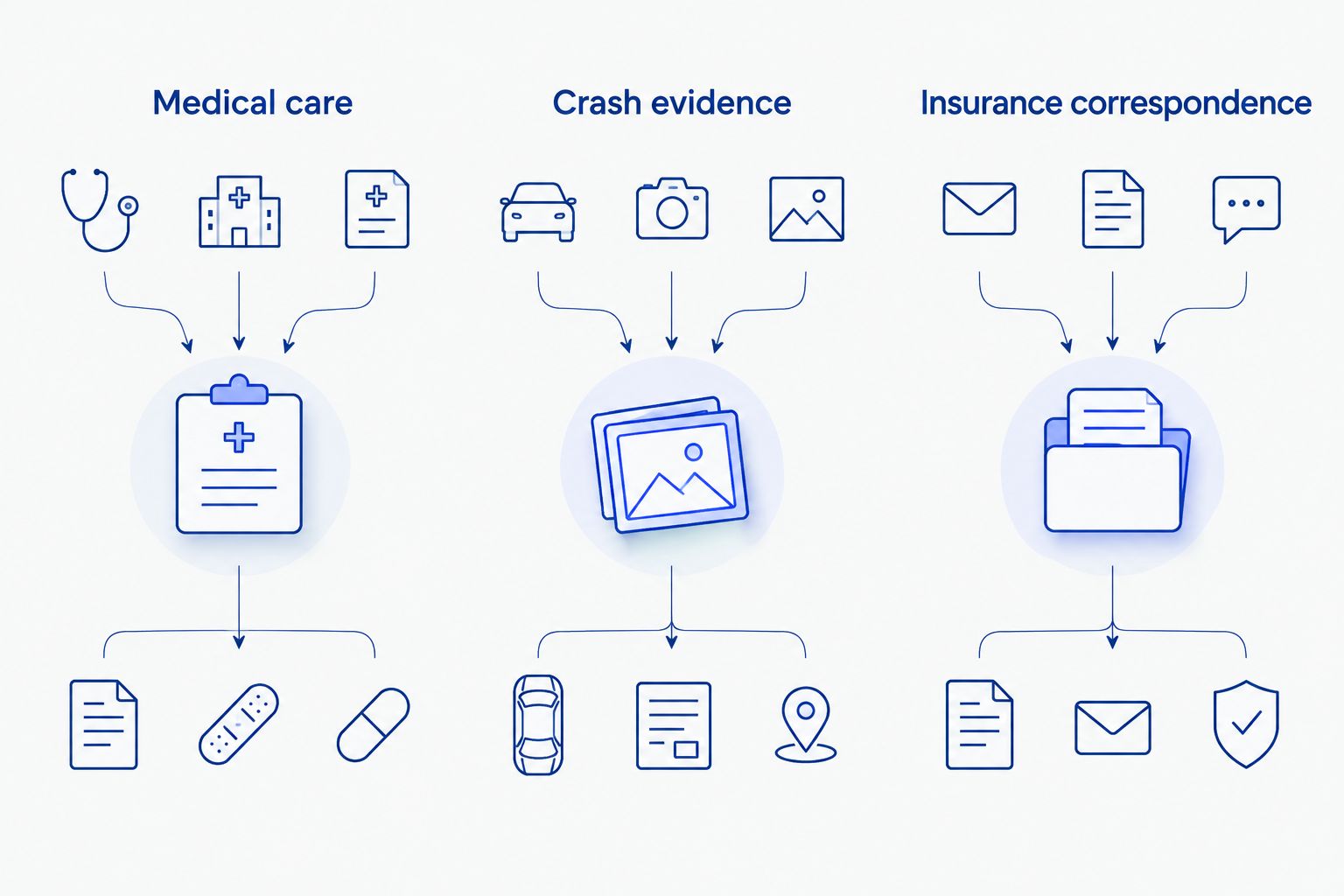
Create 3 folders labeled medical care, crash evidence, and insurance correspondence. Keep 2 copies of important digital records in separate secure locations. Maintain 1 dated timeline covering appointments, symptoms, work absences, and significant claim communications.
Write concrete observations rather than arguments. Describe the activity you could not complete and why. Do not exaggerate, stage photographs, or ask witnesses to change their accounts.
- Benefit: Organized records make it easier to explain what happened and locate supporting documents.
- Limit: A diary supports your account but does not replace clinical assessment or independent evidence.
Avoid debating the crash online. Preserve relevant existing messages and posts; ask for legal guidance before deleting or altering potentially relevant material.
Verdict: Skip scattered screenshots and dramatic claims; keep a consistent factual record.
What to bring to a California case evaluation in 2026
Bring what you have, even if the file is incomplete. Useful starting documents include photographs, medical discharge papers, insurance correspondence, available crash-report information, and towing records.
Explain your current concerns first: ongoing treatment, missed work, an approaching document deadline, or a motorcycle awaiting repair. If you are helping an injured relative, clarify your relationship and what assistance they need.
Ask Ledger Law these practical questions:
- What evidence needs attention before it changes or disappears?
- Which reporting or insurance tasks need an individual review?
- What does the proposed representation cover?
- How are attorney fees calculated, and how are case expenses handled?
- What expenses, if any, could remain your responsibility without a recovery?
A case evaluation should clarify the next decision, not pressure you into predicting a settlement. Read any proposed fee agreement and ask about provisions you do not understand.
Discuss your motorcycle injury claim
Explain the crash, your injuries, and the decisions you need help making.
How these priorities were chosen
The eight mistakes are ordered around health, evidence preservation, accurate communication, and informed decisions. They are not a ranking of law firms or a prediction about claim value. Start with urgent care, then address the evidence and paperwork that need attention.
FAQ
What’s the biggest mistake after a California motorcycle accident?
Delaying necessary medical care puts your health behind the claim process. Get appropriate assessment, then seek help preserving evidence and addressing paperwork.
Should I give an insurance adjuster a recorded statement?
Understand who the adjuster represents and what obligations apply before agreeing to a recorded statement. Your own insurer’s requests require a different review from requests by another party’s insurer.
Can I repair my motorcycle while an injury claim is open?
Address possible inspection needs before authorizing repairs that change relevant evidence. Also clarify storage arrangements rather than assuming the claim process pauses them.
What if I already made a mistake after the crash?
Tell your lawyer exactly what happened and preserve the documents or communications involved. Do not try to correct the problem by deleting evidence or changing your account.
What should I ask about lawyer fees and case expenses?
Ask how attorney fees are calculated and how expenses are paid under the proposed agreement. Specifically ask whether any expenses could remain your responsibility without a recovery.
Should I accept an early motorcycle accident settlement in 2026?
Review the release terms and your injury situation before accepting an early settlement. Understand which claims the agreement resolves rather than relying only on the amount offered.
Can a family member help organize my California motorcycle injury claim?
A family member can help gather records, track correspondence, and prepare questions. Medical decisions, access to private information, and legal authority need separate attention.
One last thing
Document the evidence you cannot personally collect. If pain prevents photographs or hospital care keeps you away from the motorcycle, record that fact and identify anyone who can help. For your 2026 recovery file, a clear note about an unfinished task is more useful than silently assuming someone else handled it.
Related guides
- Preserving evidence after a California lane-splitting crash
- Helmet use and a California motorcycle injury claim
- Uninsured motorist coverage for an injured Californian
- Reviewing an early Newport Beach crash settlement offer

Emery Brett Ledger brings 28+ years of experience to personal injury law. He founded & led The Ledger Law Firm in securing over $100 million in compensation for clients with life-altering injuries & complex claims. Prior results do not guarantee a similar outcome. Licensed in California, Texas, & Washington, Emery earned his law degree from Pepperdine University School of Law. His practice areas include car & truck accidents, wrongful death, catastrophic injuries, maritime claims, & mass tort litigation. He has been recognized by The National Trial Lawyers’ Top 100, Mass Tort Trial Lawyers Top 25, and America’s Top 100 Personal Injury Attorneys. Emery also received the 2025 Elite Lawyer Award & holds a perfect 10.0 Avvo rating with Platinum Client Champion status. His legal work has been featured on CNN, Forbes, NBC, & ABC.
Free Case Evaluation
Recent Posts
Emery Brett Ledger brings 28+ years of experience to personal injury law. He founded & led The Ledger Law Firm in securing over $100 million in compensation for clients with life-altering injuries & complex claims. Prior results do not guarantee a similar outcome. Licensed in California, Texas, & Washington, Emery earned his law degree from Pepperdine University School of Law. His practice areas include car & truck accidents, wrongful death, catastrophic injuries, maritime claims, & mass tort litigation. He has been recognized by The National Trial Lawyers’ Top 100, Mass Tort Trial Lawyers Top 25, and America’s Top 100 Personal Injury Attorneys. Emery also received the 2025 Elite Lawyer Award & holds a perfect 10.0 Avvo rating with Platinum Client Champion status. His legal work has been featured on CNN, Forbes, NBC, & ABC.