

What Is California Distracted Driving Law | Types, Penalties, Consequences Of Distracted Driving Law

- Distracted drivers cannot pay close enough attention to roadway conditions.
- Distraction happens in many forms. That includes using a phone, eating, or adjusting the navigation.
- Physical distractions, visual distractions, auditory distractions, and cognitive distractions are four types of distractions.
- California’s distracted driving law means a person could be fined and face points on their license for not following these rules.
- You can file a claim against a person who causes you to suffer losses because they were distracted.
Distracted driving is a serious violation of the promise every driver makes to keep everyone else safe on the road. Distractions mean you cannot focus on what’s happening on the roadway. They also mean that you’re more likely to cause an accident. California’s distracted driving law makes it clear. These types of actions aren’t safe or allowed.
Every driver has an obligation to operate the vehicle in a safe manner. When they fail, they put you at risk. If you’ve been hurt, let our distracted driving accident lawyer in California help you.
What Is Distracted Driving?
Distracted driving is any type of activity that limits a driver’s focus on the road. Distractions are just what they sound like. They’re limiting a driver’s ability to focus on changing road conditions. That puts people at risk. Distracted driving happens in various ways. But in all cases, they focus on the same thing. Anything that limits the driver’s ability to keep other people safe is a distraction.
4 Types of Distracted Driving in California:
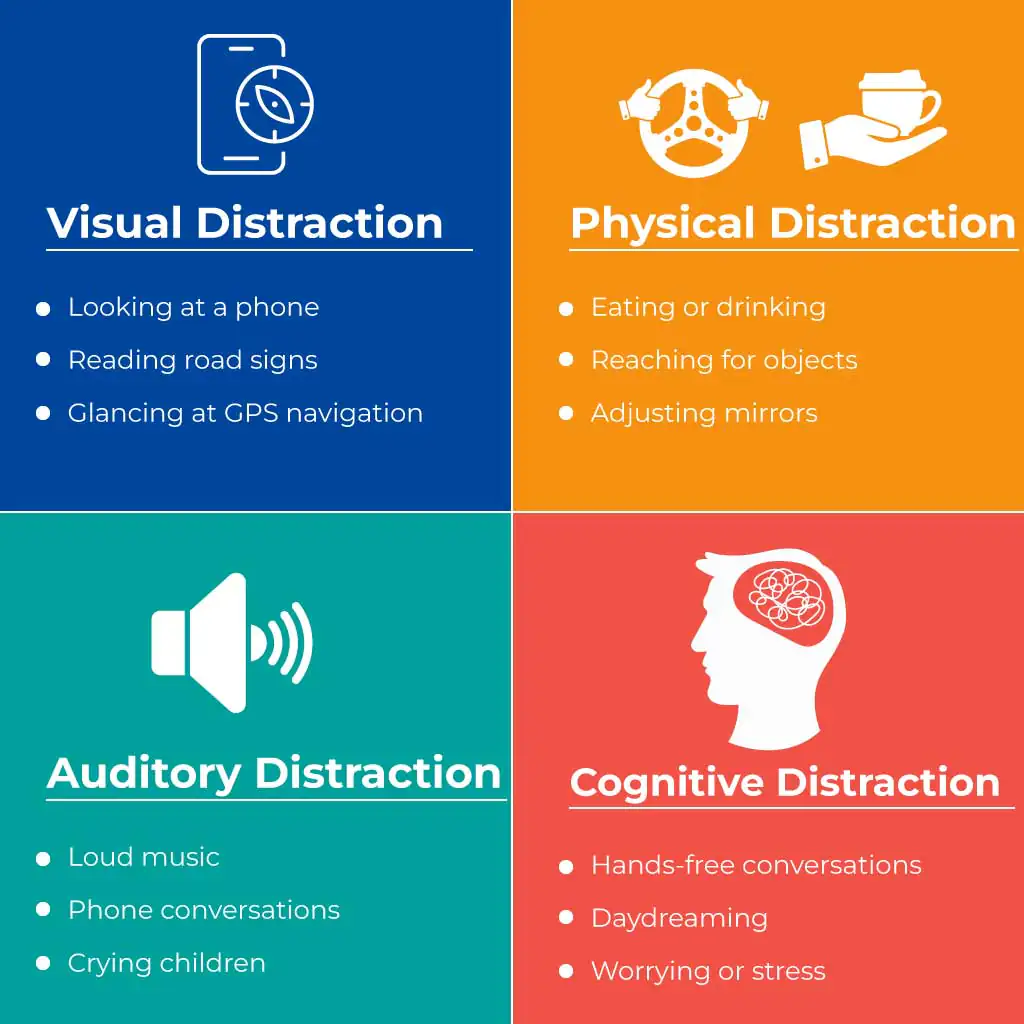
There’s plenty that can create distractions for a driver. The National Highway Traffic Safety Administration and the state of California break down distracted driving by how they impact others. The following are four classifications of distracted driving that are illegal in the state.
Visual Distractions:
Visual distractions take the driver’s eyes off the road. These are some of the most dangerous types of distracted driving. Examples of visual distractions include:
- Looking at a phone.
- Reading a sign.
- Adjusting the navigation by looking away.
Physical Distractions:
Physical distractions are often called manual distractions. They’re activities that take a driver’s hands off the steering wheel even for a brief amount of time. Some examples of physical distractions include:
- Eating.
- Drinking.
- Reaching for something on the floor.
- Adjusting mirrors.
Auditory Distractions:
Auditory distractions are those that involve sounds that take the driver’s focus off the roadway. That doesn’t mean every sound. Some sounds are more distracting to drivers. They also make it harder for the driver to hear. This is bad for emergency sirens or horns. Examples of some types of auditory distractions include:
- Listening to loud music.
- Engaging in a heated conversation with someone in the car or on the phone.
- Crying children in the backseat.
Cognitive Distractions:
Cognitive distractions are some of the most challenging to observe. They happen when a person is distracted because of what they’re thinking about rather than what they are doing. Some examples of cognitive distractions include:
- Talking to someone on the phone, even hands-free.
- Daydreaming.
- Worrying about something else.
Detailed Overview On California’s Distracted Driving Law:
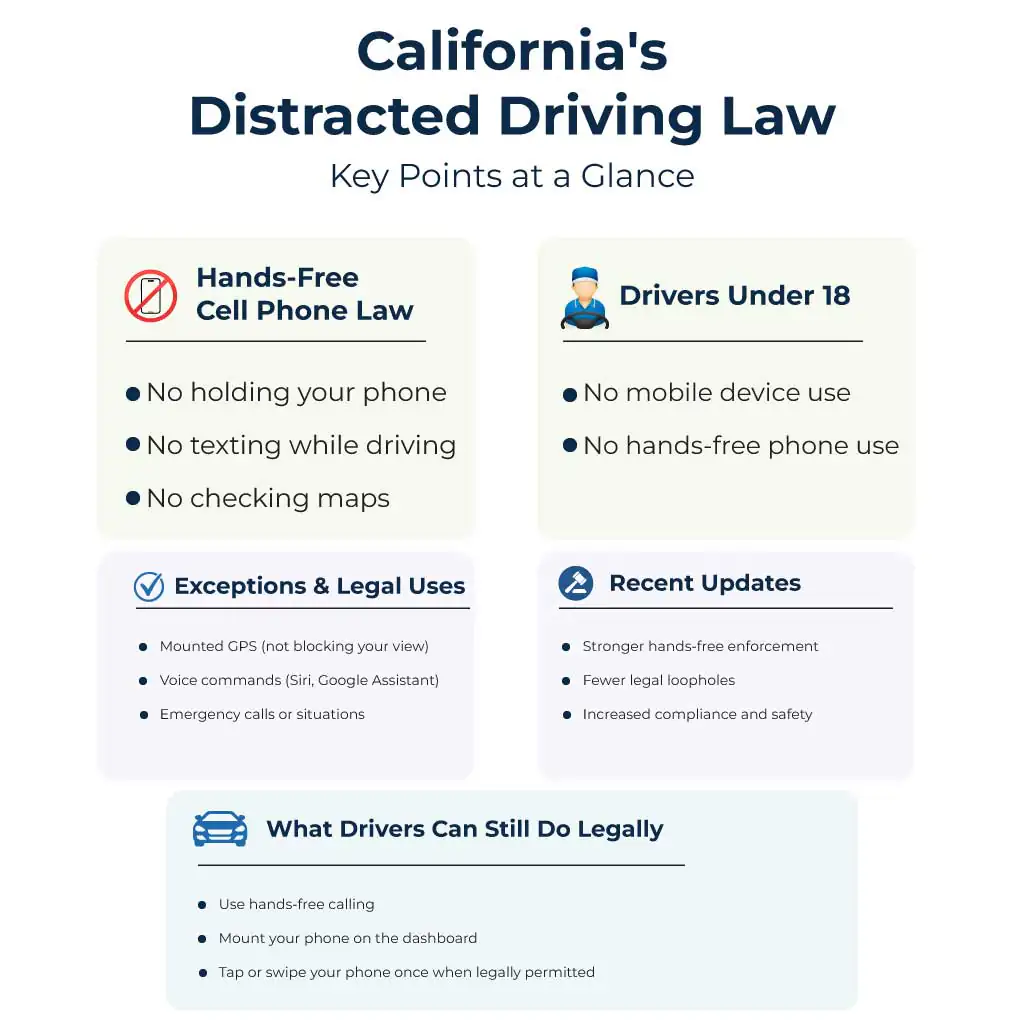
California’s distracted driving law is meant to help people stay safe on the road. Distraction means you’re not putting your best into monitoring changing road conditions. This law makes it clear what specific limitations apply in the state. This law prohibits holding or touching a cell phone for any reason. Consider the following details about how this rule works.
California Hands‑Free Cell Phone Law:
California follows a “no-touch” rule related to cell phones. It’s illegal to hold a phone in your hand for any reason. That means drivers can’t text, check maps, or even move it from one area to the next. This can lead to a citation.
Special Rules for Drivers Under 18:
Drivers under the age of 18 cannot use a mobile device for any reason. This includes using hands-free functions. They cannot use or engage with a phone for any reason.
Exceptions and Legal Uses of Mobile Devices:
There are some situations where there is leeway in using a phone or mobile device. For example, you can use a GPS device or a phone if it is mounted. The device cannot obstruct your view of the road. It cannot be placed in the center of the windshield.
You can use voice activation services. These include hands-free and voice-operated communication systems. Google Assistant and Siri are two examples. Drivers can also use their phone for emergency situations.
Recent Updates to California Distracted Driving Laws (2025–2026):
California clarified and updated the rules related to distracted driving laws to clarify the no-touch standard. This closed legal loopholes people were using, such as using them at stoplights or holding their phones.
What Drivers Can Still Do Legally:
Under the state’s laws, you can:
- Use hands-free systems to speak including built-in voice commands, Bluetooth, and speakerphone functions.
- You can mount your phone on the center console and dashboard.
- You can swipe or tap your phone one time.
What are the Penalties for Violating the No-Touch Law:
It’s illegal to focus your attention on anything but driving when you’re behind the wheel. There are several potential penalties that you could face for violating this law.
Fines for Violating the Statewide Handheld Device Ban:
Your first offense starts with a $20 fine. However, the costs are typically more than this, depending on the situation. Most people pay around $150 to $170 after all of the state and local court fees are added to this. Remember, that’s a first offense.
Driver’s License Points, Insurance, and Repeat Violations:
If you’re found to be guilty of subsequent offenses, the base fine starts at $50. This can increase fines to $250 to $300.
In addition to this, drivers can face points added to their license, which can increase insurance costs later. It can also lead to the loss of your license if you get too many points.
What Are the Consequences of Distracted Driving?
There are numerous potential risks that come from distracted driving:
- Fines that double with more violations (or more).
- Points added to your license.
- Insurance costs rise.
- Eventual loss of your driving privileges.
- Potentially harming another person.
What are the Steps Drivers Should Take to Stay Safe and Within the Law:
It’s your responsibility to know the law. Consider the following:
- Don’t use your phone. Keep it in the backseat to minimize the risk.
- Get a proper mounting system in place if you plan to use it.
- Learn and use speakerphone and voice-activated commands.
Conclusion:
Minimize the risks of fines and points by not using your phone behind the wheel. If someone causes an accident and you’re the victim, hire a distracted driving attorney to protect your rights. We’re here to help you.
1. How California’s Distracted Driving Law Affects Accident Liability?
A person is violating the law when they are distracted behind the wheel. That means they can be held responsible for the injuries and losses they cause to another person if an accident happens.
2. Is it always illegal to hold a phone while driving in California?
Yes. California’s laws make it illegal to touch or hold the phone even if you are not actively using it. These are some of the strictest laws.
3. Can I use my phone at a red light or in stopped traffic?
No. Under California’s laws, you cannot use your phone if you are stopped at a light or in traffic.
I am text block. Click edit button to change this text. Lorem ipsum dolor sit amet, consectetur adipiscing elit. Ut elit tellus, luctus nec ullamcorper mattis, pulvinar dapibus leo.
4. Are there any emergency exceptions to California's distracted driving law?
In an emergency, you can use your phone to call 911 and get help. You cannot use it for any other reason.
5. Do California's distracted driving rules apply differently to teen drivers?
Teens cannot use their phone at all, and that includes not using speakerphone or voice commands.
6. How do distracted driving tickets impact my insurance rates in California?
You could get points added to your license.
7. Can a distracted driving citation be used as evidence in a personal injury lawsuit?
Yes. A citation could show that a person was distracted behind the wheel. This can be used against you in a case.
8. Are rideshare and delivery drivers subject to different distracted driving rules?
Yes, all drivers are subject to the same rules as ride share. These drivers must use a mounted device and the one-swipe rule applies to them.
9. What non‑phone distractions can still lead to tickets under California law?
Any type of distraction behind the wheel can cause you to get a ticket. That includes eating and drinking, holding a pet, or reaching for something.
10. Is hands‑free phone use always considered safe and legal in California?
It’s encouraged to use these devices. However, those under the age of 18 cannot use them.
11. What should I do if I'm injured by a distracted driver in California?
If you’re hurt by a distracted driver in California, call the police to report the accident. Then, seek the help of an attorney to file a claim for compensation.

Emery Brett Ledger brings 28+ years of experience to personal injury law. He founded & led The Ledger Law Firm in securing over $100 million in compensation for clients with life-altering injuries & complex claims. Prior results do not guarantee a similar outcome. Licensed in California, Texas, & Washington, Emery earned his law degree from Pepperdine University School of Law. His practice areas include car & truck accidents, wrongful death, catastrophic injuries, maritime claims, & mass tort litigation. He has been recognized by The National Trial Lawyers’ Top 100, Mass Tort Trial Lawyers Top 25, and America’s Top 100 Personal Injury Attorneys. Emery also received the 2025 Elite Lawyer Award & holds a perfect 10.0 Avvo rating with Platinum Client Champion status. His legal work has been featured on CNN, Forbes, NBC, & ABC.
Free Case Evaluation
Recent Posts
- Punitive Damages in a Car Accident: When Can You Recover Them?
- Tailgating Injury: What Causes Tailgating, Road Rage & How to Stay Safe
- Waiting to Call a Lawyer Can Hurt Your Case: Evidence, Deadlines & Legal Risks
- What Is Property Damage in a Car Accident? Claims, Costs & Who Pays
- Bodily Injury & Property Damage: Coverage, Claims, Liability & Compensation
Emery Brett Ledger brings 28+ years of experience to personal injury law. He founded & led The Ledger Law Firm in securing over $100 million in compensation for clients with life-altering injuries & complex claims. Prior results do not guarantee a similar outcome. Licensed in California, Texas, & Washington, Emery earned his law degree from Pepperdine University School of Law. His practice areas include car & truck accidents, wrongful death, catastrophic injuries, maritime claims, & mass tort litigation. He has been recognized by The National Trial Lawyers’ Top 100, Mass Tort Trial Lawyers Top 25, and America’s Top 100 Personal Injury Attorneys. Emery also received the 2025 Elite Lawyer Award & holds a perfect 10.0 Avvo rating with Platinum Client Champion status. His legal work has been featured on CNN, Forbes, NBC, & ABC.