

Can I Lose My House Due to an At Fault Car Accident? Liability, Insurance, and Asset Protection Explained
You’ve been in a car accident, and you’re at fault for the collision. Technically, that means you’re responsible for paying the bills to help the other party heal and recover their lost property. Once this realization hits, it’s normal to ask, “Can I lose my house due to an at fault car accident?” as part of the restitution process.
The answer to the question of “If someone sues you can they take your house?” isn’t straightforward. Insurance and legal protection help you keep your home, but the odds of losing your home are dependent on your insurance coverage. In this article, we’re taking a look at what factors influence the risk of you losing your home after an at-fault car accident.
Understanding Liability in At-Fault Car Accidents
Being at fault in a car accident means you bear most or all of the responsibility for causing the collision. The result is that you’re held liable to pay for the injuries and property losses of all the people that were injured. It’s normal to ask “Can I lose my house due to at-fault car accident?” because you have to pay the bills of the injured party.
The types of damages you may be liable for include: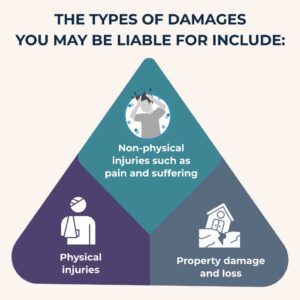
- Physical injuries
- Non-physical injuries such as pain and suffering
- Property damage and loss
These costs can exceed the maximum limits in your liability insurance. When this happens, the injured parties can sue you personally and potentially force you to sell your assets to pay off the debt.
Liability and Comparative Fault
After an accident, you’re assigned a certain amount of blame, or liability, for the accident. You may be assigned 75% of the fault, while the other party has 25% of the fault. Alternatively, you can be assigned 100% and the other party has 0% of the liability. An accident with more than two parties involved will result in each party sharing a reduced portion of the liability.
The amount of liability you’re assigned directly affects how much of the claim you’re responsible for. Partial responsibility lowers the risk of you losing your home, but doesn’t eliminate that risk entirely.
Personal Liability for Damages Exceeding Coverage
When your insurance doesn’t have enough to cover all the damages, you can be sued personally for the remaining amounts. Creditors want to get paid, and they can use the courts to force payment.
The purpose of a lawsuit by a creditor is to find out how much you have in assets and income. Your home is an asset, and it can be sold to settle the debt as part of a court judgment. The risk of loss is real, but a personal injury attorney can help mitigate that risk.
Typical Scenario Where You Could Lose Your House
You’re more likely to lose your home after an accident that caused a serious injury or death, and your insurance doesn’t have enough coverage. Another scenario is the court sets a judgment that’s more than your policy will pay. Debt collectors may go after unprotected assets and force their sale to get their money. Any one of these scenarios are a reality after an at-fault accident.
Insurance Coverage and Asset Protection
Insurance protects your assets and acts as an intermediary between you and the person you struck. Your policy provides you with coverage limits for specific types of injuries and property damage that you caused. The insurance pays the bills of the accident victim up to the limits of your policy. For example, you have a $15,000 limit for property damage, and the total property damage amount is $10,000. The insurance pays the $10,000 because it’s under your maximum limit.
One way to make sure you have more than enough coverage is to get an umbrella policy. The umbrella policy increases the maximum limits to $1 million in most cases. This amount of coverage reduces the risk of you losing your home to a lawsuit.
Homestead Exemptions: Your Home’s Shield
Most states have what’s known as a homestead exemption, which shields part of the equity in your home from a creditor. For example, your home is worth $300,000, but you only have $25,000 in equity. Your state’s homestead exemption is $50,000. Your home’s equity is shielded by the exemption, and a creditor can’t force you to sell your home. If your home’s equity exceeds your state’s exemption, the first $50,000 in equity is shielded by the exemption. However, you can be sued by the victim in your car accident case.
These exemptions vary state by state, and a lawyer can help you learn more about these and other methods to protect your assets.
Insurance Gaps and Umbrella Policies
A standard auto insurance policy meets the state’s requirements to legally operate your car. But it may not have enough money to cover the costs of an accident. It’s a good idea to review your insurance policy and increase your limits to protect your home.
Owning a home and other assets means you carry multiple insurance policies. Adding an umbrella policy increases your auto insurance policy limits as well as those of your other policies.
You may resist the cost of additional insurance because it’s an increase in your monthly bills. The trade-off comes in the form of gaining more protection for your home and assets in the event you’re in an at-fault accident.
Steps to Protect Yourself and Your Assets After an Accident
Review your insurance policies as soon as you can. You need to know what kind of coverage you have and the maximum limits on your policy.
After this step, contact a personal injury attorney to talk about representation. Retaining a lawyer means you have someone who can help you protect your assets.
You have options for protecting your assets and engaging in financial planning. A lawyer can go over your financial and asset portfolio, then suggest ways that you can keep your home and assets out of reach of a lawsuit.
Can They Garnish My Wages Instead?
Yes, but only after a court has decided that you’re responsible for the outstanding debt. However, it’s an alternative to having your home seized and sold to settle the judgment. Your wages can be garnished, or a lien can be put on your bank account.
Each state has a limit on how much can be garnished from your income. This is so you can maintain your lifestyle and pay your bills. A lawyer can help you minimize your exposure to this type of action.
Conclusion
You may be at risk of losing your house after an at-fault accident, especially if you have inadequate liability limits on your insurance policy. Review your insurance policy at the first opportunity, learn about your state’s homestead exemptions, and retain a personal injury lawyer for help with your case.
Engaging in proper planning can greatly reduce the risk of losing your home, even after an at-fault accident. Contact us at Ledger Law to speak to one of our attorneys and find out how we can help you keep your home. Our firm is staffed with attorneys who have successfully helped clients dealing with situations that are similar to yours. When it comes to saving your home after an at-fault car accident, Ledger Law is your best option.
FAQs for Can I Lose My House Due to an At-Fault Car Accident
If someone sues you can they take your house after a car accident?
Yes, but only after you lose a court case and the judgment forces you to sell your home.
Does homeowners insurance protect my house from car accident lawsuits?
No, your homeowners insurance will not protect your house from a car accident lawsuit.
What happens if my car accident liability exceeds my insurance coverage?
You may be sued by the accident victim for the money that can’t be recovered from your car’s insurance policy.
How do homestead exemptions protect my home from being taken in a lawsuit?
A homestead exemption provides you with set amount of money that you can use to protect the equity in your home.
Can an at-fault car accident result in wage garnishment instead of losing my house?
It depends on how much equity you have in your home, the homestead exemption, and if the court agrees to wage garnishment.
Should I consider an umbrella insurance policy to protect my home after an accident?
You should get an umbrella insurance policy before you get into an accident.
What steps can I take to protect my house after a serious car accident?
The best step to take is to consult a personal injury lawyer and find out how you can protect your home after a serious car accident.
Are there state-specific laws that prevent losing your home after a car accident?
Some states have very strong protections for homeowners who are involved in an at-fault car accident.
When should I contact a lawyer to protect my home after an at-fault accident?
You should contact a lawyer as soon as you are able to after an at-fault accident. Retaining a lawyer in the days following an accident can lead to a better outcome.

Emery Brett Ledger brings more than 27 years of experience to personal injury law. He founded & led The Ledger Law Firm in securing over $100 million in compensation for clients with life-altering injuries & complex claims. Licensed in California, Texas, & Washington, Emery earned his law degree from Pepperdine University School of Law. His practice areas include car & truck accidents, wrongful death, catastrophic injuries, maritime claims, & mass tort litigation. He has been recognized by The National Trial Lawyers’ Top 100, Mass Tort Trial Lawyers Top 25, and America’s Top 100 Personal Injury Attorneys. Emery also received the 2025 Elite Lawyer Award & holds a perfect 10.0 Avvo rating with Platinum Client Champion status. His legal work has been featured on CNN, Forbes, NBC, & ABC.
Free Case Evaluation
Recent Posts
- Do Cars Have Black Boxes? What a Car Black Box Records and How It Can Help After an Accident
- Can AI Chatbot Conversations Be Used Against You in a Personal Injury Case? What to Know About AI Chat Privacy and Privilege
- How to Win a Left Turn Accident Case: Fault, Right of Way, Evidence & Compensation
- What to Do After a Pedestrian Accident: 10 Essential Steps to Protect Your Health and Claim
- Who Is at Fault in a Self-Driving Car Accident? Liability, Insurance, and Self-Driving Car Crash Injury Claims
Emery Brett Ledger brings more than 27 years of experience to personal injury law. He founded & led The Ledger Law Firm in securing over $100 million in compensation for clients with life-altering injuries & complex claims. Licensed in California, Texas, & Washington, Emery earned his law degree from Pepperdine University School of Law. His practice areas include car & truck accidents, wrongful death, catastrophic injuries, maritime claims, & mass tort litigation. He has been recognized by The National Trial Lawyers’ Top 100, Mass Tort Trial Lawyers Top 25, and America’s Top 100 Personal Injury Attorneys. Emery also received the 2025 Elite Lawyer Award & holds a perfect 10.0 Avvo rating with Platinum Client Champion status. His legal work has been featured on CNN, Forbes, NBC, & ABC.
