

Car Insurance Liability Coverage California | What Does Liability Insurance Cover | Additional Coverage Options
- Auto insurance is required in California, but that on its own isn’t good enough. You also have to carry proof of it when driving.
- Forgot your proof of insurance at home? The state can stick you with a $200 fine for your first offense (it goes up to $500 if you do it again).
- State law says you have to have $30,000 for bodily injury (per person), $60,000 for bodily injury (per accident), and enough property damage insurance for $15,000 per accident.
- If you leased or took out a loan to buy your car, the lender or leasing company may require you to buy even more liability insurance.
There are almost six million vehicle crashes each year. Tens of thousands of these kill one or more people. Even more cause injuries ranging from broken bones to life-altering handicaps.
Hurt in a car accident? Our car accident lawyer page explains how The Ledger Law Firm handles these cases and how to ask for a free case evaluation.
Liability insurance doesn’t physically protect you from getting hurt when you’re driving. But it does pay the bills if you’re accused of causing an accident.
What’s New In Car Insurance Liability Coverage California 2025/2026?
Each state requires drivers to buy car insurance liability coverage. However, requirements vary by state. And sometimes states change their requirements for one or more reasons.
Up until the end of 2024, California only required drivers to have insurance covering:
- $15,000 for bodily injury or death (per person).
- $30,000 for bodily injury or death (per accident).
- $5,000 for property damage (per accident).
Clearly, this isn’t much. That’s why the Senate Bill 1107 raised the limits. It kicked in in 2025.
The new limits are much higher than the old ones. And they’re a lot higher than other state’s insurance limits. Keep this in mind if you live outside the state but plan to visit.
Overview of What is The Minimum Liability Coverage in California:
California’s new minimum liability coverage laws require drivers to buy:
- $30,000 for bodily injury or death (per person).
- $60,000 for bodily injury or death (per accident).
- $15,000 for property damage (per accident).
The state admits your insurance costs could go up as a result. However, the heightened coverage limits are also in your best interest.
Imagine you accidentally turn at the wrong time and hit a car. It’s a hybrid that costs $50,000 brand new and will cost $15,000 to fix. Under old coverage limits, you’d be on the hook for the extra $10,000. Now, it’s covered.
Why Did California Increase Minimum Insurance Coverage Limits?
It’s not hard to see why California raised its minimum coverage rates:
- The limits hadn’t changed for the last 50 years.
- Prices have gone up more than 470% since then.
- What cost $1 back then costs almost $6 today.
What Does Liability Insurance Cover in California?
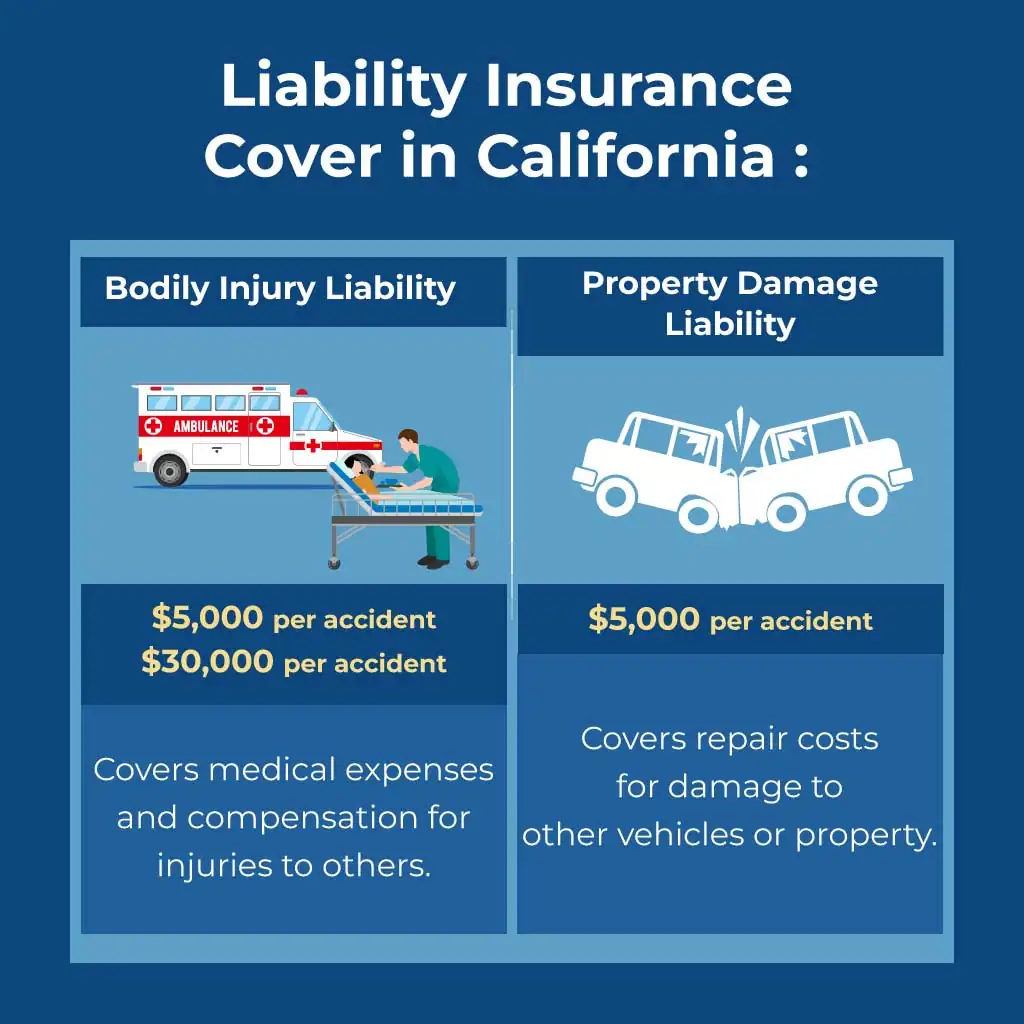
Liability insurance covers the other person’s damage if you crash into them, their car, or their property. There are two types of coverage in this category.
Bodily Injury Liability:
This covers:
- Medical expenses.
- Lost wages.
- Pain and suffering.
The other driver and the passengers in his/her car are covered
Property Damage Liability:
This covers:
- Fixing the other person’s property if you crashed into it (it’s usually a car, but also applies if you drive into someone’s fence, building, etc.)
- Replacing the other person’s property if it can’t be fixed.
California’s Minimum Auto Coverage Requirements:
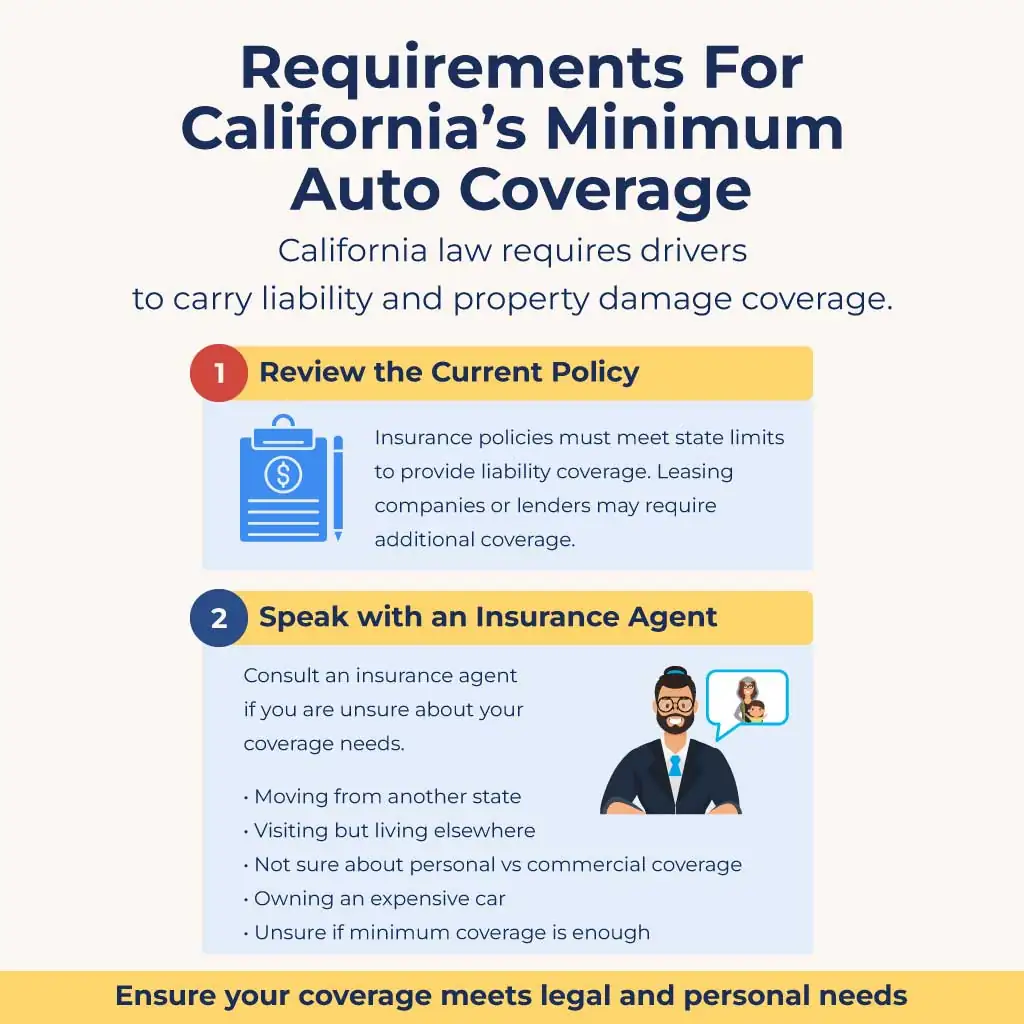
California law requires that all drivers buy liability and property damage coverage.
Review The Current Policy:
The current policy and the policy update doesn’t require that you buy new forms of insurance. Rather, it requires insurers to raise policy limits. Those that can’t, won’t be able to provide liability insurance.
However, remember that a leasing company or lender can require you to buy more insurance. This is legal since the company/lender would suffer a huge loss if your car is damaged or destroyed in a crash.
Speak with an Insurance Agent:
If you aren’t sure about your coverage requirements, talk to an insurance agent.
It’s especially important to do this if:
You just moved in from out-of-state
- You’re traveling through California but live elsewhere.
- You’re not sure if you need personal or commercial coverage.
- You have a very expensive car and want to make sure it’s completely covered.
- You’re worried the minimum insurance requirements aren’t enough for you.
Non-Compliance Penalties:
If you just forgot to carry proof of insurance with you, your fine will likely be between $100 and $500.
The penalties for not having enough coverage are a lot higher:
- $1,000 fine.
- Getting your vehicle impounded.
- Losing your right to drive (if you’re a repeat offender).
- Huge bills if you’re at fault for an accident.
- Sky-high insurance costs when you do get coverage because you have a bad record.
Additional Coverage Options:
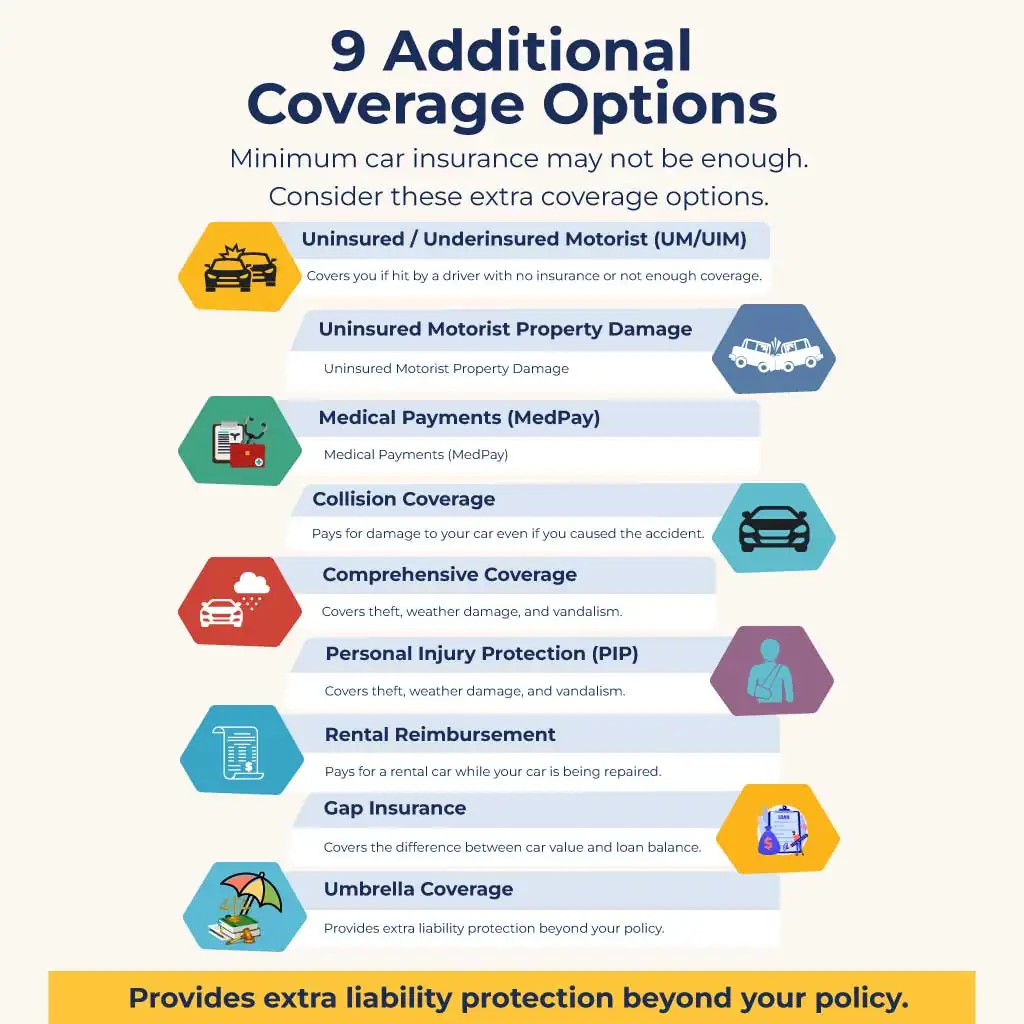
Minimum car insurance liability coverage in California is really the bare minimum. That’s why it’s not a bad idea to consider a few other coverage options.
Uninsured Motorist (UM) / Underinsured Motorist (UIM):
This type of insurance covers you if you’re hit by someone who’s either uninsured or underinsured.
Uninsured Motorist Property Damage:
Do you own an expensive vehicle? If so, this type of coverage is a smart option. It covers the cost of fixing or replacing your vehicle if the driver who crashed into your car doesn’t have insurance.
Medical Pay Coverage:
MedPay covers your medical bills if you’re in a crash. It kicks in if you’re the one at fault for the accident (because the other party’s insurance won’t pay for something its policyholder didn’t do).
Collision Coverage:
Collision coverage pays for property damage. Even if the accident is your fault.
Comprehensive Coverage:
This type of insurance compensates you if:
- Someone steals your vehicle.
- Someone vandalizes your vehicle.
- A natural disaster damages or destroys your vehicle.
Personal Injury Protection:
PIP is similar to MedPay, but it costs more and covers more. You can get compensation for:
- Medical bills.
- Lost wages.
- Funeral expenses.
- Survivor loss.
- The cost of having to hire someone to care for your home and/or kids while you’re recovering.
Rental Reimbursement:
Not having a car isn’t an option for many people. That’s why buying rental reimbursement insurance is a good idea. It covers the cost of renting a vehicle after a covered incident so you can get around while your car is in the shop, or you’re in the process of buying a new car.
Gap Coverage:
Did you just take out a loan to buy a new vehicle? If so, gap coverage is likely in order. It covers the cost of paying back your loan if, for any reason, your insurance payout is less than the remaining portion of the loan.
Umbrella Coverage:
Umbrella coverage increases the limits of your liability policy. If you’re held liable for an accident and the cost is higher than the limit of your liability coverage, umbrella insurance makes up the difference. It also pays for legal costs.
How the Ledger Law Firm Can Help With Liability Insurance Coverage in California?
Insurance is, sadly, a legal specialty. That’s because it’s not uncommon for insurers to actively look for ways to avoid paying compensation when they’re supposed to.
Our team at Ledger Law Firm won’t let insurance kick you when you’re low. If you’ve been hurt in a car accident and the insurer isn’t paying out, give us a call. We can:
- Talk with insurance agents so you don’t have to.
- Help you avoid making mistakes that could cost you compensation.
- Collect proof that you’re entitled to compensation.
- Work out a settlement.
- Represent you in court if it comes down to it.
Final Summary:
Insurance is a must. You need to have the minimum coverage required by California law if you’re driving in California.
But that doesn’t mean you have to settle for the bare minimum. There are multiple policy options that could serve you well in the event of a crash. Consider your needs and budget to make sure you’re properly covered.
And if you’re properly covered and insurance is giving you a hard time, call us. We can help you work out the mess so you get the compensation you’re legally entitled to.
1. How California's minimum auto insurance requirements affect drivers 2026?
- You’ll likely have to pay more for insurance.
- You’ll get more coverage if you’re in an accident.
2. Will my current policy automatically update new requirements for California?
Ask your insurance agent. Some may, some may not.
3. How much will a comprehensive claim raise my insurance?
That depends on:
- Your policy.
- Your claim history.
- Alleged fault (for example, if you always park your car in an area prone to thefts, your insurance company will notice and raise rates accordingly. In fact, it may even cancel your policy or at least refuse to renew it).
4. What happens if I don’t update my coverage by January 1, 2026?
You have to have minimal coverage required by California law. If you don’t update it, there are painful legal and financial consequences.
5. Is Basic Liability Coverage Enough for You?
That depends on:
- Your vehicle’s value.
- Your net worth.
- How safe your area is for drivers.
- Whether or not you own your car outright.
- Whether or not you have another vehicle you can rely on if something happens to your car.
6. When Do the New Rules Start?
The new rules kicked in January 1, 2025.
7. Why Do You Need Liability Insurance in California?
You need liability insurance to cover the other party’s costs if there’s a car accident.
8. What Are Insurance Liability Limits?
The limit is the maximum amount the insurer will pay out after an accident.
9. What Should You Do After an Uninsured Driver Accident in California?
If you can, get the other driver’s information. He or she is personally liable if at fault for the accident.
If you can’t get the other driver’s information, your MedPay or PIP insurance should kick in. Call your insurer and start the process of filing a claim.

Emery Brett Ledger brings 28+ years of experience to personal injury law. He founded & led The Ledger Law Firm in securing over $100 million in compensation for clients with life-altering injuries & complex claims. Prior results do not guarantee a similar outcome. Licensed in California, Texas, & Washington, Emery earned his law degree from Pepperdine University School of Law. His practice areas include car & truck accidents, wrongful death, catastrophic injuries, maritime claims, & mass tort litigation. He has been recognized by The National Trial Lawyers’ Top 100, Mass Tort Trial Lawyers Top 25, and America’s Top 100 Personal Injury Attorneys. Emery also received the 2025 Elite Lawyer Award & holds a perfect 10.0 Avvo rating with Platinum Client Champion status. His legal work has been featured on CNN, Forbes, NBC, & ABC.
Free Case Evaluation
Recent Posts
- Punitive Damages in a Car Accident: When Can You Recover Them?
- Tailgating Injury: What Causes Tailgating, Road Rage & How to Stay Safe
- Waiting to Call a Lawyer Can Hurt Your Case: Evidence, Deadlines & Legal Risks
- What Is Property Damage in a Car Accident? Claims, Costs & Who Pays
- Bodily Injury & Property Damage: Coverage, Claims, Liability & Compensation
Emery Brett Ledger brings 28+ years of experience to personal injury law. He founded & led The Ledger Law Firm in securing over $100 million in compensation for clients with life-altering injuries & complex claims. Prior results do not guarantee a similar outcome. Licensed in California, Texas, & Washington, Emery earned his law degree from Pepperdine University School of Law. His practice areas include car & truck accidents, wrongful death, catastrophic injuries, maritime claims, & mass tort litigation. He has been recognized by The National Trial Lawyers’ Top 100, Mass Tort Trial Lawyers Top 25, and America’s Top 100 Personal Injury Attorneys. Emery also received the 2025 Elite Lawyer Award & holds a perfect 10.0 Avvo rating with Platinum Client Champion status. His legal work has been featured on CNN, Forbes, NBC, & ABC.