

Drink Drive Limit California: Everything You Must Know About BAC

When you are behind the wheel in California, you must know the drink drive limit California. For most adults, Blood Alcohol Concentration (BAC) is limited to 0.08%, triggering an automatic DUI. Commercial drivers and rideshare operators face a 0.04% limit, as per the vehicle code 23152(d) & (e).
Plus, drivers under 21 must follow the “Zero Tolerance” with limits as low as 0.01%. So, you must understand the BAC test, how it works, and what you must do.
What is the BAC Test?
Blood Alcohol Concentration (BAC) is the scientific measure to determine the percentage of alcohol present in a person’s bloodstream. Law enforcement and the courts use it to judge the fault of the accused party in accidents.
It essentially proves impairment in DUI cases, expressed as a percentage (e.g., 0.08%). In California, drivers may be lawfully arrested on suspicion of DUI. In such cases, you have already consented to take a chemical test:
- Breath test
- Blood test
It determines your BAC level in California to know if you breached the BAC limit in California, or not.
How Is BAC Calculated?
BAC calculation doesn’t have a single universal method. Instead, it is measured through forensic testing. Also, in certain circumstances, authorities use conversion formulas. It determines the concentration of ethanol in the blood.

DUI Breath Tests
A DUI breath test is a rapid, non-invasive method to determine the alcohol concentration. It is used for roadside screening and post-arrest evidentiary testing.
How DUI Breath Tests Measure Blood Alcohol
Breathalyzer devices do not directly measure alcohol in the blood. Instead, they measure the alcohol concentration in the deep lung air. The alcohol vapor has a fixed proportional relationship to the alcohol circulating in the blood.
In California, this ratio is legally fixed at 2,100:1. Thus, 2,100 milliliters of deep lung air is equal to 1 milliliter of blood. It is known as the partition ratio. The machine mathematically converts the breath alcohol concentration into an estimated blood alcohol percentage.
Preliminary Alcohol Screening (PAS) Tests
The PAS test uses a small, handheld breathalyzer device at the roadside. Authorities use it mainly during traffic stops. For most adult drivers (over 21 and not on DUI probation), the PAS test is optional.
So, they can politely refuse the PAS test. However, if the driver is under 21 or on DUI probation, they must agree to the test. If they refuse the PAS test, their driver’s license could be suspended under California’s Zero Tolerance law.
Post-Arrest DUI Breath Tests
Once a driver is arrested for DUI, they must submit to an evidentiary chemical test. They will have two different choices:
- A breath test: It takes place in a police station and uses a stationary machine
- A blood test: A professional will collect and test the blood sample for alcohol
If the driver refuses this mandatory post-arrest test, their driving license will be suspended automatically for at least one year. It applies even if the PAS was taken earlier.
DUI Blood Tests
A DUI blood test is the most accurate method for determining BAC. During the blood test, first a licensed professional will first draw a sample of the driver’s blood. The sample is then sent to a state-certified laboratory for precise analysis.
Authorities can save a portion of the blood sample (a “blood split”). So, the defense attorney can request an independent retest at a separate lab. It is a powerful defense tool against potentially faulty government test results.
Can BAC be measured by a urine test?
A urine test is used rarely to determine the BAC in California DUI cases. Urine tests are less reliable than breath or blood tests. It can’t accurately determine the specific concentration of alcohol in the blood at the time of driving.
They are only authorized if both breath and blood testing are unavailable. A urine test is also suggested if the driver has a medical condition. The driver might have a breathing disorder or a clotting disorder. These prevent them from taking the other, more reliable tests, and so, the urine test remains the only option available.
BAC Calculator
Although you can estimate the BAC through a calculator, it can’t replace the forensic test. Many people believe that the Widmark Formula can give an idea about the BAC presence in blood. The Widmark Formula is a scientific method used to estimate a person’s BAC. Also, you can use our BAC calculator to determine the alcohol presence and whether or not you are subjected to DUI limits.
I am raw html block.
Click edit button to change this html
What Is the Legal Alcohol Limit in California?
The California legal BAC limit depends on the driver’s age, license type, and probationary status. These limits are codified under the California Vehicle Code (VC) and establish the “DUI per se” laws. So, the BAC level alone is sufficient to secure a conviction, regardless of observed driving impairment.
Vehicle Code 23152(b): Standard DUI
The 23152(b) regulates the most common DUI law for adult, non-commercial drivers. The legal limit is .08% BAC or higher. It applies regardless of whether your driving was actually impaired. It is the “per se” DUI law. A person could be charged with both VC 23152(a) for driving under the influence and VC 23152(b) after an arrest. However, they can only be punished for one.
First Offense Penalties (Misdemeanor):
- Jail Time: A minimum of 48 hours up to a maximum of six months in county jail.
- Fines: A minimum fine of $390 up to $1,000$. Also, there can be court-imposed penalties.
- Probation: Three to five years of informal or summary probation.
- DUI School: Three months of DUI schooling for a BAC under 0.2%.
- License Suspension: DMV could suspend the license for 6 months to 1 year.
- Ignition Interlock Device (IID): There could be a mandatory IID inclusion in the vehicle.

23152(d): Vehicle Code Commercial Drivers
23152(d) applies a stricter limit for drivers operating commercial vehicles. The legal limit is 0.04% BAC or higher. It recognizes the increased danger and responsibility for the large commercial vehicles.
First Offense Penalties:
- Commercial License Suspension: A mandatory one-year suspension or revocation of the commercial driving privilege.
- Other Penalties: The driver will also face penalties similar to a standard VC 23152(b) offense for a first-time misdemeanor DUI, including:
- Jail time of up to 12 months.
- Fines ranging from $290 to $1000.
- DUI school for 3 to 36 months.
Vehicle Code 23152(e): Passenger-Hire Drivers
The vehicle code 23152(e) applies to the passenger-for-hire drivers, targeting the rideshare or taxi drivers. The BAC limit is 0.08% or higher. It holds the passenger-carrying drivers to a higher safety standard.
First Offense Penalties:
- Misdemeanor Offense: Penalties are similar to those for a standard first-time VC 23152(b) DUI, including:
- Jail time could be up to 6 months.
- Fines of $390$ to $1,000$ plus assessments
- DUI school of months in a court-approved drug education program
- License suspension for 1 year.
Vehicle Code 23136: Underage “Zero Tolerance” Law
Vehicle Code 23136 defines California’s “zero tolerance” law. It applies to drivers under 21 years. The legal limit for BAC for those under 21 is 0.01% or higher.
For drivers under 21, any measurable amount of alcohol is a violation of the law. It applies regardless of actual impairment. Also, the zero-tolerance law is a civil violation, not a criminal one.
First Offense Penalties:
- License Suspension: An automatic one-year suspension of the driver’s license.
- No Criminal Conviction: This violation is generally not a criminal offense.
Vehicle Code 23140: Underage DUI with Higher BAC
The vehicle code 23140 defines a higher-level infraction for underage drivers. For people under 21, it is a 0.05% BAC level. In addition to the zero-tolerance law, it is an infraction, a low-level non-criminal offense.
First Offense Penalties:
- License Suspension: A one-year suspension of the driver’s license.
- Fine: $100 or higher fines.
- Alcohol Education: Must attend an alcohol education program of three months or longer (if the driver is at least 18 years old).
Vehicle Code 23154: DUI while on Probation
This Vehicle Code 23154 limits the BAC to 0.0% or higher for individuals who are already on probation for a prior DUI conviction. Thus, a person on DUI probation is prohibited from driving with any measurable amount of alcohol.
First Offense Penalties (when on probation):
- Probation Violation: Suspension of license and mandatory probation.
- Mandatory Jail Time: It could often be 48 hours of continuous imprisonment.
- Other Penalties: The driver may face the penalties for the VC 23154 violation, too.
Restrictions for people below the drinking age (under 21 years old)
Drivers under 21 years old have a BAC limit of 0.05% as per the VC 23140. Also, they must abide by the 0.01% Zero Tolerance limit, according to the VC 23136. The law discourages any alcohol consumption by young drivers.
Restrictions for people 21 years old or older
People over 21 have a 0.08% BAC limit. However, even a driver under 0.08% can be charged with DUI under Vehicle Code 23152(a). It applies if their driving ability is impaired by alcohol or drugs. The ” driving impairment” clause lets the state pursue a conviction for unsafe driving. It doesn’t depend on the BAC measurement.
Standard Drink Measurements
You must understand what constitutes a “standard drink.” The National Institute on Alcohol and Abuse and Alcoholism (NIH) states that a standard drink contains 0.6 fluid ounces or 14 grams of pure alcohol.
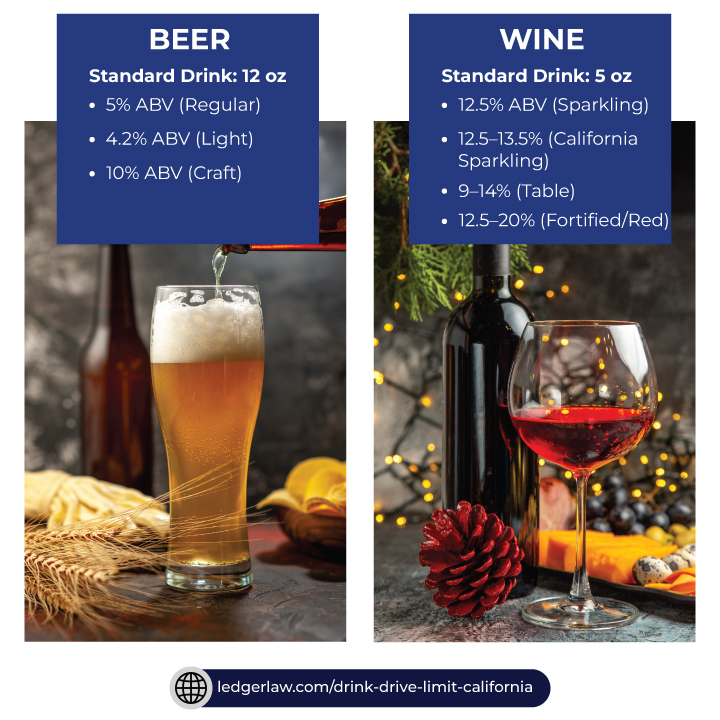
Beer:
A standard drink of beer is 12 ounces of alcohol. It contains 5% Alcohol by Volume (ABV). But stronger or craft beer may have a different ABV:
- Regular beer contains 5% ABV
- Light beers have 4.2% ABV
- Craft beers can contain 10% ABV
Wine:
Wine typically contains 5 ounces in a standard drink. The average ABV for sparkling wine will be around 12%. Again, the ABV will be higher on fortified or dessert wines. It affects the calculation.
- Standard Sparkling Wine has 12.5% ABV
- California Sparkling Wine has 12.5% to 13.5% ABV
- 9% to 14% of ABV for table wines
- Fortified and red wines contain 12.5% to 17% and even 20% ABV
Distilled Spirits:
A standard serving of liquor for vodka, whiskey, or gin is a 1.5-ounce shot. It contains around 40% ABV (80 proof). Mixed drinks or heavy-handed pours in a bar could include two or more standard drinks.
- 40.0 – 48.5 ABV for Gin
- 40.0 – 50.0 ABV for Vodka
- 45.0 – 50.5 ABV for Tequila
- Rum has the highest ABV of 40.0 – 95.0
Factors Affecting BAC
The California legal BAC limit is not dependent on the number of drinks consumed alone. The rate of alcohol absorption and metabolism differs among individuals. It depends on the body weight, gender, age, and strength of the drink. You must understand the factors to realize the California legal BAC limit.
Body Weight and Metabolism:
Overweight people generally have more water volume in their bodies. So, higher water dilutes the alcohol faster. So, their BAC will be lower than someone with less body weight. Also, their metabolism controls the alcohol processing and dilution rate.
Many people have more alcohol dehydrogenase enzyme in their bodies. So, their metabolic rate will be faster. It affects the process and elimination speed of the consumed alcohol.
Gender:
Women have a lower body weight and water content. However, their body fat percentage is higher than men. So, the alcohol is less diluted in a female’s body. It leads to a higher BAC from the same amount of alcohol. Additionally, women might have lower levels of alcohol dehydrogenase in their stomachs. So, the metabolism works more slowly, and the alcohol found in the bloodstream could be higher.
Rate of Consumption:
The faster alcohol is consumed, the faster the BAC will spike. The liver can get overwhelmed when a person drinks too much alcohol quickly. So, the liver takes time to metabolize it. It causes rapid and dangerous intoxication.
So, the person can easily reach the drink and drive limit in California.
Type and Strength of Alcoholic Beverages:
It is simple: the higher ABV the drink contains, the more intoxicating it will be. Spirits and wines have higher ABV. So, they introduce pure alcohol into the system much faster than lower-ABV drinks like light beer. That means, a person drinking light beer will reach the BAC limit later than a person drinking Gin.
Also, carbonated beverages accelerate alcohol absorption in the bloodstream. So, be aware of it.
Food Intake:
The food you intake also has a say about your BAC limit increase and decrease rate. There are many meals rich in fat and protein. If you consume such meals before or while drinking, it will significantly slow the alcohol absorption rate.
Thus, rich meals delay and lower the resulting peak BAC. When you drink on an empty stomach, alcohol can get absorbed into your blood much faster. So, the BAC limit will be much higher.
Blood Alcohol Chart for Males and Females
Males and females have different levels of BAC estimation within the same weight category. So, you must understand the variability of the BAC limit in California.
| Drinks Consumed (1 Hr) | Approximate BAC (Female) | Approximate BAC (Male) | Status (Adult 0.08% Limit) |
| 1 | 0.02% | 0.02% | Safe |
| 2 | 0.04% | 0.04% | Safe |
| 3 | 0.05% | 0.06% | Warning |
| 4 | 0.07% | 0.08% | Impaired (Male) |
| 5 | 0.09% | 0.10% | Impaired (Both) |
Consequences of Driving Over the Legal Limit
A conviction for driving over the California legal BAC limit can cause different consequences. It triggers immediate administrative penalties from the DMV. Also, the court can impose criminal penalties, including fines, jail, and probation.
DUI Charges and Penalties:
For a first-time DUI at 0.08% BAC offense, vehicle code 23152(b) has different penalties. It includes:
- A probation for three to five years.
- Fines range from $390 to $1,000. The total can be $1,800 or more, including the penalty assessments.
- The driver must attend a court-approved DUI School for 3, 6, or 9 months.
- Potential jail time for 6 months
The penalties increase exponentially for second, third, and felony DUI offenses.
License Suspension:
The arresting officer confiscates the driver’s license for an arrest of a BAC of 0.08% or higher. Also, the officer will issue a temporary license for 30 days. It starts the DMV’s Administrative Per Se (APS) action.
The driver can, of course, contest the suspension. For this, he must request a DMV hearing within 10 days of the arrest. Otherwise, their license will be automatically suspended for a minimum of four months. It applies to the first offense.
Insurance Consequences:
A driver must obtain a California Insurance Proof Certificate for the DUI conviction. It is known as an SR-22. The insurance company of the driver must file the details. SR-22 proves the driver has the minimum required liability coverage.
You must maintain an SR-22 for at least three years. Also, the insurance premium will increase dramatically whenever you violate the BAC limit. The premiums and fines can be huge, going well over a thousand dollars annually.
Legal and Financial Costs:
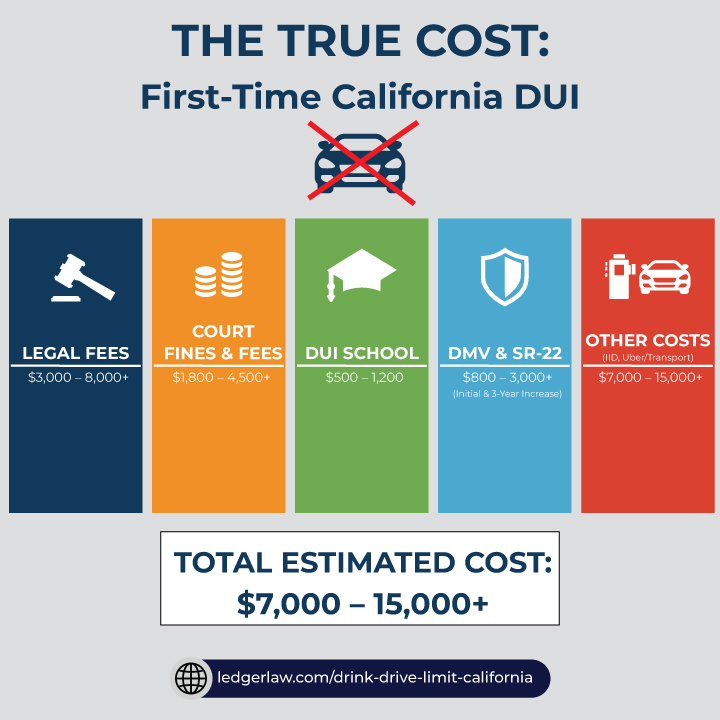
The overall cost of a DUI conviction is staggering. It includes:
- Attorney fees
- Court-imposed fines
- DUI program costs
- DMV fees for license reinstatement,
- Cost of installing an ignition interlock device (IID)
The total financial burden can easily exceed $10,000 to $15,000 for the first DUI. So, you must abide by the BAC limit in California.
Unreliable BAC Results
Even with the best machinery, Blood Alcohol Concentration (BAC) test results are not always infallible. Thus, you can challenge the BAC test result in court. A faulty machine, improper calibration, and the medical condition of the person can influence the BAC test. It will result in a wrongful DUI charge.
Causes of Unreliable BAC Results:
- Improper Calibration: The breathalyzer equipment might not be accurately calibrated.
- Faulty Machine: The machine may have faults due to improper maintenance.
- Improper Test Administration: The officer could fail to observe the driver for the required time before a breath test.
- Medical Conditions: Conditions like acid reflux, GERD, or diabetes can falsely elevate breath test readings.
- Residual Mouth Alcohol: Alcohol still present in the mouth from recent consumption, burping, or dental work.
- Sample Contamination: Improper handling or storage of blood samples, causing the rise of the BAC.
Factors That Impact Individual BAC
The rate at which alcohol enters the bloodstream and reaches the peak Blood Alcohol Concentration (BAC) isn’t similar. Many personal and situational variables influence the BAC limit and its speed to reach the peak.
Factors Influencing BAC:
- Body Weight
- Biological Sex (Gender)
- Rate of Consumption
- Food Consumption
- Metabolism and Genetics
- Medication and Health
- Hydration Level
1. What Blood Alcohol Level Is Lethal?
If the BAC level exceeds 0.30%, it could be dangerous for most people. So, it may lead to loss of consciousness. Also, the BAC levels around 0.40% or above are potentially lethal. You might suffer from respiratory depression, coma, and death from acute alcohol poisoning.
2. How Many Beers Is .08 Alcohol Level?
The 0.08% BAC level for beer depends on the person’s weight, metabolism, and rate of consumption. It could take approximately four to five standard 12-ounce beers for an average-sized male within two hours. For an average female, it could be three to four beers for an average-sized female.
3. How much can you drink and still drive in California?
The safest and most legally sound answer for the drink and drive limit in California is zero. Of course, the California legal BAC limit is 0.08%. However, you can be charged with a DUI if you are impaired below that level. If you consume any alcohol, you should use a designated driver or ride-sharing service.
4. How many drinks is a BAC of 0.08?
For an average adult male driver older than 21, a BAC of 0.08% is approximately four standard drinks. For females, it is three standard drinks. Also, this consumption must happen within one hour on an empty stomach. The number of drinks depends on the alcohol by volume (ABV) of the particular drink.
5. How many drinks are in a bottle of wine?
A standard 750ml bottle of table wine contains approximately five standard 5-ounce servings. The ABV could be from 7.5% to 15%. So, the actual drink required to reach the peak BAC will vary.
6. Can you refuse a BAC test in California?
Yes, you can refuse a post-arrest chemical test. However, the refusal could cause you mandatory penalties as per California’s implied consent law. Also, your license will be automatically suspended for a minimum of one year. The court and jury can impose additional punitive penalties.
7. How long does it take alcohol to leave the body?
On average, the body metabolizes alcohol at a rate of 0.015% to 0.02% per hour. You can’t accelerate it by drinking coffee, exercising, or taking a cold shower. A person who reaches 0.10% BAC will take five to seven hours to return to 0.00% BAC.
8. Do the BAC Limits in California have any exceptions?
No, the BAC limit doesn’t have any exceptions. The legal BAC limit is 0.08% for drivers. Also, 0.04% and 0.01% BAC limits apply for different circumstances. These BAC limits are strictly enforced. There are no exceptions for holidays, emergencies, or specific professions.
9. Are the BAC Measurements Really Accurate?
BAC measurements are generally scientifically reliable. However, the accuracy of the BAC test depends on the proper maintenance and calibration of the equipment. So, it strictly adheres to protocol, aka, Title 17 regulations. Blood tests are more precise than breath tests, but both are subject to human and mechanical error.
10. Are There Any Long-Term Consequences of a California DUI Conviction?
Yes, there are many long-term consequences for a DUI conviction in California. It extends far beyond the immediate fines and jail time. They include a permanent criminal record. Although it can be resolved, your DUI conviction remains recorded forever. Also, repeated convictions will increase your insurance costs (SR-22). Also, your professional licenses could be revoked. You must also attend a court-approved drug education center.
Contact The Ledger Law Firm
Did you or your loved one face DUI charges for the BAC level California? If so, your legal rights and future are at serious risk. Or, did you suffer an accident or injury from a DUI impaired driver?
The car accident attorneys at The Ledger Law Firm will scrutinize every detail of your case. We will analyze the PAS test procedure, the blood sample chain, and related factors. Also, we ensure you don’t become a scapegoat for the drink drive limit California. Don’t wait; contact The Ledger Law Firm for a confidential consultation to explore your defense options.

Emery Brett Ledger brings more than 27 years of experience to personal injury law. He founded & led The Ledger Law Firm in securing over $100 million in compensation for clients with life-altering injuries & complex claims. Licensed in California, Texas, & Washington, Emery earned his law degree from Pepperdine University School of Law. His practice areas include car & truck accidents, wrongful death, catastrophic injuries, maritime claims, & mass tort litigation. He has been recognized by The National Trial Lawyers’ Top 100, Mass Tort Trial Lawyers Top 25, and America’s Top 100 Personal Injury Attorneys. Emery also received the 2025 Elite Lawyer Award & holds a perfect 10.0 Avvo rating with Platinum Client Champion status. His legal work has been featured on CNN, Forbes, NBC, & ABC.
Free Case Evaluation
Recent Posts
- Do Cars Have Black Boxes? What a Car Black Box Records and How It Can Help After an Accident
- Can AI Chatbot Conversations Be Used Against You in a Personal Injury Case? What to Know About AI Chat Privacy and Privilege
- How to Win a Left Turn Accident Case: Fault, Right of Way, Evidence & Compensation
- What to Do After a Pedestrian Accident: 10 Essential Steps to Protect Your Health and Claim
- Who Is at Fault in a Self-Driving Car Accident? Liability, Insurance, and Self-Driving Car Crash Injury Claims
Emery Brett Ledger brings more than 27 years of experience to personal injury law. He founded & led The Ledger Law Firm in securing over $100 million in compensation for clients with life-altering injuries & complex claims. Licensed in California, Texas, & Washington, Emery earned his law degree from Pepperdine University School of Law. His practice areas include car & truck accidents, wrongful death, catastrophic injuries, maritime claims, & mass tort litigation. He has been recognized by The National Trial Lawyers’ Top 100, Mass Tort Trial Lawyers Top 25, and America’s Top 100 Personal Injury Attorneys. Emery also received the 2025 Elite Lawyer Award & holds a perfect 10.0 Avvo rating with Platinum Client Champion status. His legal work has been featured on CNN, Forbes, NBC, & ABC.
