

Guide to Lane Splitting in California: 2026 Laws, Safety, and Liability
Lane splitting has become a serious problem in California in the past few years. Earlier, people often saw a motorcycle gliding between rows of stalled traffic. It was a common sight on Golden State’s highways. But can motorcycles split lanes in California? Although lane splitting is a convenient system, it has always been a matter of debate among drivers.
Hurt while riding? Our motorcycle accident lawyer page explains how The Ledger Law Firm handles a rider’s claim in California, and our Newport Beach motorcycle accident page covers Orange County.
However, the state traffic law and safety studies have often backed and regulated the lane splitting practice. Road users must understand the problems of the split lane regulations for their safety and driving comfort.
We will explore the legalities, the history, and the practical safety of the lane-splitting feature in California.
Can Motorcycles Split Lanes in California?
Yes, motorcycles can split lanes in California. Vehicle Code section 21658.1 defines lane splitting as driving a motorcycle between rows of moving or stopped vehicles in the same lane.
Section 21658.1 lets the California Highway Patrol develop educational guidelines on lane splitting. Maybe a rider split lanes at high speed. Also, their lane splitting could endanger others. In such reckless lane splitting, the driver can still be cited for reckless driving.
Is It Legal to Lane Split in California?
We must look at California Vehicle Code (CVC) Section 21658.1 to know if lane splitting is legal in California or not. The law was passed and implemented over the last decade. It defines lane splitting as:
“Driving a motorcycle, as defined in Section 400, that has two wheels in contact with the ground, between rows of stopped or moving vehicles in the same lane, including on both divided and undivided streets, roads, or highways.”
The section defines lane splitting and lets the California Highway Patrol develop educational guidelines. The California Highway Patrol says lane splitting by motorcyclists is legal in California.
But, is it legal to lane split in California on every road?
The definition in section 21658.1 includes both divided and undivided streets, roads and highways. But the risks on city streets are significantly higher than on controlled-access freeways. It’s because of the turning cars and pedestrians are higher in city streets.
The “Gray Area” vs. The Law
Before the formalization of CVC 21658.1, lane splitting existed in a legal gray area. California didn’t specifically permit lane splitting. However, it wasn’t forbidden. Today, the California Highway Patrol says lane splitting by motorcyclists is legal in California.
Section 21658.1 lets the California Highway Patrol (CHP) develop educational guidelines on lane splitting. If the driver and motorcyclists disregard these guidelines, it could prove their negligence.
When Did Lane Splitting Become Legal in California?
People often ask when lane splitting becomes legal in California. On August 19, 2016, California formally recognized lane-splitting. Governor Jerry Brown signed Assembly Bill 51 (AB 51).
Previously, law enforcement authorities allowed lane splitting before AB 51. The law went into full effect on January 1, 2017.
So, the law let the CHP develop educational guidelines on lane splitting. A UC Berkeley study was influential in bringing the legislation. The study suggested lane splitting reduced the frequency of rear-end collisions. The CHP safety tips say danger increases as overall speed increases.
California Highway Patrol Lane Splitting Guidelines
The CHP doesn’t have a hard speed limit for splitting. The CHP safety tips for lane splitting include these points:
- The Speed Differential
Danger increases at higher speed differentials and as overall speed increases.
- Lane Choice
It is typically safer to split between the far left lanes than between the other lanes of traffic.
- The Total Environment
The CHP safety tips say to consider the total environment when lane splitting, including current roadway, weather and lighting conditions.
Can You Lane Split In California? Practical Tips For 2026
The California Highway Patrol says lane splitting by motorcyclists is legal in California. But the question is, should you? In 2026, the road looks different. Electric motorcycles have increased on California roads. The electric motorcycles operate near-silently. So, drivers are even less likely to hear you coming.
Anticipate the Gap
Did you see a large gap in one lane of stalled traffic? If so, expect a car to dart into it without a signal. It often causes lane-splitting accidents. As a rider, you must look two or three cars ahead to anticipate these movements.
What Happens in A Lane Splitting Accident?
Liability in a lane-splitting accident is not black and white. California follows a pure comparative negligence model for car accidents. Although lane splitting is legal, a jury or insurance company might find you partly at fault.
It could happen if you were traveling too fast. A jury might also find the driver partly at fault for changing lanes without a signal.
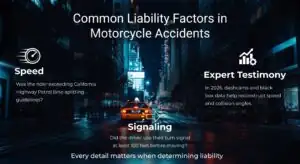
Common Liability Factors:
- Speed: Was the rider going faster than was safe for the conditions?
- Signaling: Did the driver use their turn signal at least 100 feet before moving?
- Expert Testimony: In 2026, many motorcycles and cars are equipped with dashcams or “black box” telematics. Traffic police use the black box data to reconstruct the speed and angle of the collision.
So, were you involved in an accident? You must document the point of impact immediately. Did the impact occur on the lane line? It suggests the car moved into your path. Did it occur in the center of a lane? If so, the other side may argue the rider was not splitting lanes.
Injured While Lane Splitting?
Motorcycle Laws In California Beyond Lane Splitting
Till now, we have discussed the motorcycle laws in California for lane splitting. But we must consider other statutes that affect lane splitting practice on roads.
CVC 22400: Impeding Traffic
The California Highway Patrol says intentionally blocking or impeding a motorcyclist in a way that could cause harm to the rider is illegal. It also says opening a vehicle door to impede a motorcyclist is illegal.
CVC 22517: The “Dooring” Law
The CVC 22517 prohibits anyone from opening a vehicle door on the side of moving traffic. They can only open the door when it is safe to do so. It protects riders splitting lanes on surface streets. It’s important because on surface streets, passengers might exit a rideshare vehicle in traffic.
Understand Lane Filtering and Sharing
The primary focus of the lane splitting law is regulation and safety guidelines. However, riders must understand the concepts of lane filtering and lane sharing. These are equally important for a safe and comfortable driving experience in California’s traffic ecosystem.
- Lane Filtering: Lane filtering refers to vehicles moving to the front of a line of stopped vehicles at a red light. In California, lane filtering is a subset of lane splitting and is legal.
- Lane Sharing: When two motorcycles share a single lane side-by-side, it is called lane sharing. Traffic police discourage lane sharing during splitting maneuvers. Because there would be no escape route for either rider.
- White-Lining: It is a slang term for splitting. Often, the biking community uses it to describe riding directly on the painted white dashed lines.
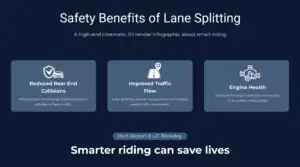
The Safety Benefits of Lane Splitting
Opponents often claim lane splitting is a suicidal attempt. Supporters of lane splitting point to these benefits:
- Reduced Rear-Ends: Motorcyclists are vulnerable to being crushed between two cars in stop-and-go traffic. Lane splitting saves them as they can escape from the crush zone.
- Improved Traffic Flow: Lane splitting reduces vehicle length and load in the main line of traffic.
- Engine Health: Many older motorcycles are air-cooled. So, these motorcycles may suffer from engine failure if they sit in 100-degree temperatures for longer. Splitting keeps air moving over the cooling fins.
FAQs About Guide to Lane Splitting in California
Can motorcycles split lanes in California in 2026?
Yes. The California Highway Patrol says lane splitting by motorcyclists is legal in California. California Vehicle Code (CVC) 21658.1 defines the practice as driving a two-wheeled motorcycle between rows of stopped or moving vehicles. The movement must be in the same lane. However, drivers must split lanes safely and prudently as per the rules.
Is it legal to lane split in California on residential streets?
The definition of lane splitting in CVC 21658.1 includes both divided and undivided streets, roads and highways. On residential streets there could be pedestrians, opening car doors, and vehicles turning from hidden driveways.
What is the difference between filtering and splitting?
In the 2026 riding community, the distinction is vital:
- Lane Splitting: The rider moves between rows of vehicles. The other vehicle might be either moving or stopped on freeways.
- Lane Filtering: The motorcycle moves through slow or stopped traffic to reach the front of a line at a red light.
The definition of lane splitting in CVC 21658.1 covers both stopped and moving vehicles. But other states, like Utah or Arizona, may only allow filtering at stoplights.
How fast can you go according to the California Highway Patrol lane-splitting guidelines?
The CHP does not set a rigid speed limit for lane splitting. However, its safety tips say danger increases at higher speed differentials and as overall speed increases.
When did lane splitting become legal in California?
Vehicle Code section 21658.1, which defines lane splitting, took effect on January 1, 2017. In August 2016, Governor Jerry Brown signed the Assembly Bill 51. Before this, lane splitting was allowed but not officially legal in California.
What are the primary motorcycle laws California lane-splitting riders must follow?
Beyond CVC 21658.1, riders must follow:
- CVC 21658: Maintain a single lane unless splitting.
- CVC 22350: The Basic Speed Law suggests that riders must never drive faster than is safe for conditions.
Who is at fault in a lane-splitting accident if the car didn’t signal?
California follows pure comparative negligence. If a driver fails to signal, it will be a violation of CVC 22107. If it strikes a splitter, the driver may be found at fault. Maybe the motorcyclist was riding too fast for the conditions. So, the court may assign a percentage of the fault to the rider. It will reduce their total compensation.
Can a driver be ticketed for blocking a motorcyclist who is lane splitting?
Yes, under CVC 22400 (The Minimum Speed Law, traffic police may issue a ticket for blocking a motorcyclist during lane splitting. It impedes the flow of traffic. Also, a driver can be cited for swerving or opening a door to block a rider. It is a sign of reckless driving or road rage, depending on the severity.
Is there a specific lane where lane splitting is safest?
The California Highway Patrol says it is typically safer to split between the far left lanes than between the other lanes of traffic. Drivers in these lanes are more aware of riders. So, they are less likely to make sudden exits across multiple lanes.
Do I need a special permit to lane split in CA?
No, you don’t need a special permit to split a lane in California. A valid Class M1 motorcycle license is enough. The DMV and CHP recommend completing a safety course for safe driving and lane-splitting on roads. The CHP says the training course is mandatory for riders under 21.
What should I do immediately after a lane-splitting accident to protect my rights?
- Safety first: Move to the side of the road if possible.
- Call 911: Ensure a police report is filed—this is critical for insurance.
- Document Evidence: Take photos of the tire marks and the position of the vehicles relative to the lane lines.
- Data Retrieval: In 2026, ensure you save any dashcam or electric motorcycle telematics data immediately.
Can you lane split in California during rain or low visibility?
The CHP safety tips say to consider the total environment when lane splitting, including current roadway, weather and lighting conditions.
How do the California Highway Patrol lane-splitting guidelines affect my insurance claim?
Insurance adjusters use the lane-splitting laws as a benchmark for reasonable behavior. Maybe your dashcam showed you were riding much faster than traffic. The insurance company may use the CHP safety tips to argue that you were negligent.
Is it legal to lane split past a semi-truck or large commercial vehicle?
The CHP safety tips say to avoid lane splitting next to large vehicles such as big rigs, buses and motorhomes. Large vehicles have massive “No-Zone” blind spots. Also, semi-trucks create aerodynamic turbulence that can pull a motorcycle toward the trailer.
Conclusion
California officially recognizes lane-splitting. Vehicle Code section 21658.1 defines it and lets the California Highway Patrol develop educational guidelines.
If you were hurt in a crash while lane splitting, contact The Ledger Law Firm for a free case evaluation.

Emery Brett Ledger brings 28+ years of experience to personal injury law. He founded & led The Ledger Law Firm in securing over $100 million in compensation for clients with life-altering injuries & complex claims. Prior results do not guarantee a similar outcome. Licensed in California, Texas, & Washington, Emery earned his law degree from Pepperdine University School of Law. His practice areas include car & truck accidents, wrongful death, catastrophic injuries, maritime claims, & mass tort litigation. He has been recognized by The National Trial Lawyers’ Top 100, Mass Tort Trial Lawyers Top 25, and America’s Top 100 Personal Injury Attorneys. Emery also received the 2025 Elite Lawyer Award & holds a perfect 10.0 Avvo rating with Platinum Client Champion status. His legal work has been featured on CNN, Forbes, NBC, & ABC.
Free Case Evaluation
Recent Posts
- Punitive Damages in a Car Accident: When Can You Recover Them?
- Tailgating Injury: What Causes Tailgating, Road Rage & How to Stay Safe
- Waiting to Call a Lawyer Can Hurt Your Case: Evidence, Deadlines & Legal Risks
- What Is Property Damage in a Car Accident? Claims, Costs & Who Pays
- Bodily Injury & Property Damage: Coverage, Claims, Liability & Compensation
Emery Brett Ledger brings 28+ years of experience to personal injury law. He founded & led The Ledger Law Firm in securing over $100 million in compensation for clients with life-altering injuries & complex claims. Prior results do not guarantee a similar outcome. Licensed in California, Texas, & Washington, Emery earned his law degree from Pepperdine University School of Law. His practice areas include car & truck accidents, wrongful death, catastrophic injuries, maritime claims, & mass tort litigation. He has been recognized by The National Trial Lawyers’ Top 100, Mass Tort Trial Lawyers Top 25, and America’s Top 100 Personal Injury Attorneys. Emery also received the 2025 Elite Lawyer Award & holds a perfect 10.0 Avvo rating with Platinum Client Champion status. His legal work has been featured on CNN, Forbes, NBC, & ABC.