

Timeline and Process: How Long Does A Personal Injury Case Take in Los Angeles | Factors Affects Settle Time

- The majority of the Los Angeles, California personal injury cases get settled within 6 months to 2 years.
- Most personal injury claims(95%) settle out of courts through mediation, discussions and negotiation after the discovery phase.
- Medical recovery and reaching out to MMI has an effect on settlement timing..
- Strong evidence such as medical records, police reports etc. speed up settlements and reduce insurance disputes.
- An experienced personal injury attorney can reduce delays, counter insurance tactics effectively.
If you’ve been injured in an accident, one of the first questions on your mind is probably how long a personal injury case takes in Los Angeles. Most cases settle somewhere between six months and two years. But some wrap up faster, and others drag on longer, depending on your injuries types – minor injuries or serious injuries, the insurance company’s cooperation, and whether you end up filing a lawsuit.
What Is a Personal Injury Lawsuit?
A personal injury lawsuit is a legal claim filed when the carelessness of another person harms you. In California, these claims fall under “negligence” law. Essentially, you’re seeking money you need to cover medical costs, lost income, pain, and any other damages an accident might have caused.
Many claims don’t turn into lawsuits. Many end up settling during negotiations with insurance companies. This means some cases never see a courtroom. A good personal injury lawyer will do everything they can to get your case resolved without a litigation process, saving you time and monetary costs.
Timeline Breakdown – How Long Does A Personal Injury Case Take In Los Angeles
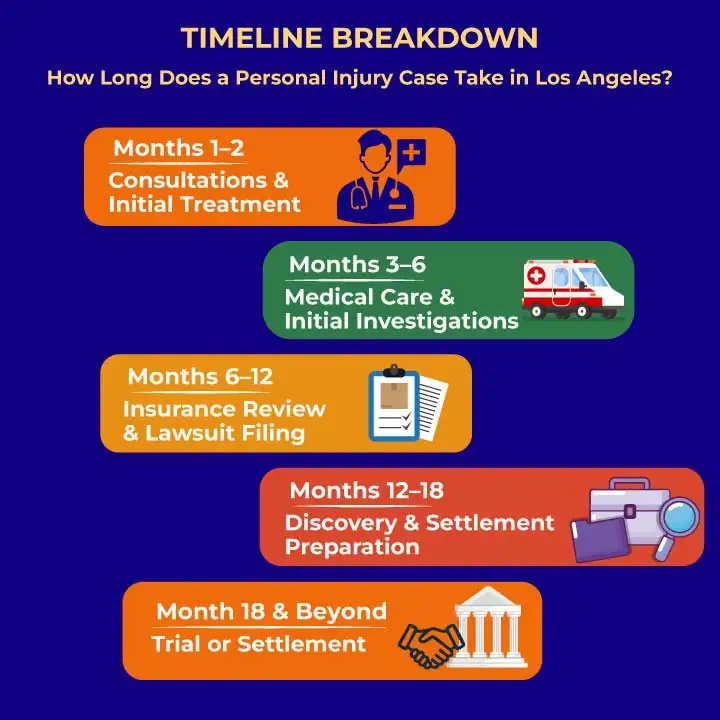
The time it takes to settle a personal injury case in Los Angeles will vary. It’s based on your individual situation. Below, you can see a basic breakdown of what to expect during every phase of your case.
Months 1-2: Consultations & Initial Treatment
Initial Consultations with Attorney
As soon as possible after your accident, which can be a car accident or slip and fall Accidents, you need to meet with a personal injury attorney. What you can expect at your consultation:
- Your personal injury attorney will go over the facts of your case.
- This will help them determine whether or not you have a viable claim.
- Your legal options are explained to you.
Many attorneys offer a free consultation.
Begin Medical Treatment
The most important thing after an accident is receiving the medical care you need. Insurance companies are known to look for gaps in treatments to justify denying or reducing a claim. If you wait too long, they’ve got a better chance of success if they try to argue that your injuries aren’t serious. Or worse, that they weren’t caused by the accident.
Primary Evidence Collection
As soon as they take your case, your legal team will start gathering evidence. This can include any of the following:
- Collecting police reports
- Photos from the accident scene
- Witness contact information
- Your initial medical records
- Any other evidence that can help your case.
Months 3-6: Medical Care & Initial Investigations
Medical Treatment Continued and Documentation
As the settlement process plays out, you’ll continue visits and treatments with your doctors and specialists. Be sure to keep every receipt, and follow any recommendations your medical team gives you. Most importantly, never skip an appointment. Your attorney needs all of this documentation for calculating your expenses and arguing your case.
Early Investigations by Attorney
During this phase, your lawyer will start digging deeper into the case. For example, they might:
- Visit the accident scene.
- Interview witnesses
- Obtain surveillance footage if there is any.
- Hire accident reconstruction experts or investigators.
Demand Package Preparation for Negotiation
Once you’re more medically stable, your attorney will prepare the demand package. This is a document that outlines everything about your case. It includes:
- Medical records
- Bills and expenses
- Proof of lost wages
- Detailed description of how the accident affected your life
Possible Initial Settlement Negotiations
If there’s a clear liability and your injuries are straightforward, your case can actually settle fairly quickly. Your attorney sends the demand package to the insurance company and negotiations begin. If a fair settlement amount is offered by the insurer, your case might be wrapped up during this phase.
Note: In the initial six months of a personal injury case, we should focus on the injured person’s recovery and the initial investigation.
Months 6-12: Insurance Review & Lawsuit Filing
Case Evaluation by Insurance
If your case didn’t settle early on, insurance adjusters may spend some time reviewing your demand package and investigating your claim. During this phase, they may do any of the following:
- Request additional documentation.
- Question the extent of your injuries.
- Dispute who was at fault.
The back-and-forth between your attorney and the insurance adjusters can take several months.
Maximum Medical Improvement (MMI)
MMI is the point where your condition has stabilized as much as it’s going to. Your doctors will determine when you’ve reached MMI. This is important because you need to know your full medical picture before you accept any fair settlement. If you settle too early, you can find yourself without the money you need for treatment in the future.
Filing a Lawsuit
In some cases, the negotiations stall or the insurance company refuses to give you fair compensation. This is when your attorney will file a lawsuit. As per California’s statute of limitations, you’ve got two years from the date of the accident to file a lawsuit.
Months 12-18: Discovery & Settlement Prep
Discovery – Independent Medical Examinations (IMEs)
During discovery, both sides exchange information and present evidence. Sometimes the defendant’s insurance company will require you to go through an Independent Medical Examination. They have their own doctor who examines you and uses the report as a key piece of evidence.
Expert Witness Preparation
Expert witnesses can help strengthen a case. For example:
- Medical experts can testify about your injuries and what future medical care might be needed.
- An accident reconstruction specialist can explain how an accident happened.
- Economists are sometimes used to calculate your lifetime earning losses.
Settlement Negotiations or Mediation
Just because a lawsuit has been filed doesn’t mean settlement discussions can’t continue. Cases are often resolved through mediation. This means a neutral third party will help both sides come to an agreement. In fact, more than 95% of personal injury cases are settled before trial.
Month 18 and Beyond
Trial
If your case doesn’t settle, it will go to trial. A trial can take anywhere between four days to two weeks. Complicated cases even longer. A judge or jury will hear the evidence presented by both sides, then decide who was at fault. How much compensation you deserve is also determined at this time.
Seek Compensation
Once you have a successful and fair settlement or verdict, you’ll usually receive your compensation within 30 days. Attorney fees and case expenses are deducted, and the rest goes to you. Remaining medical bills will be paid before you get your check.
What Factors Affect the Average Time to Settle a Personal Injury Case in Los Angeles county
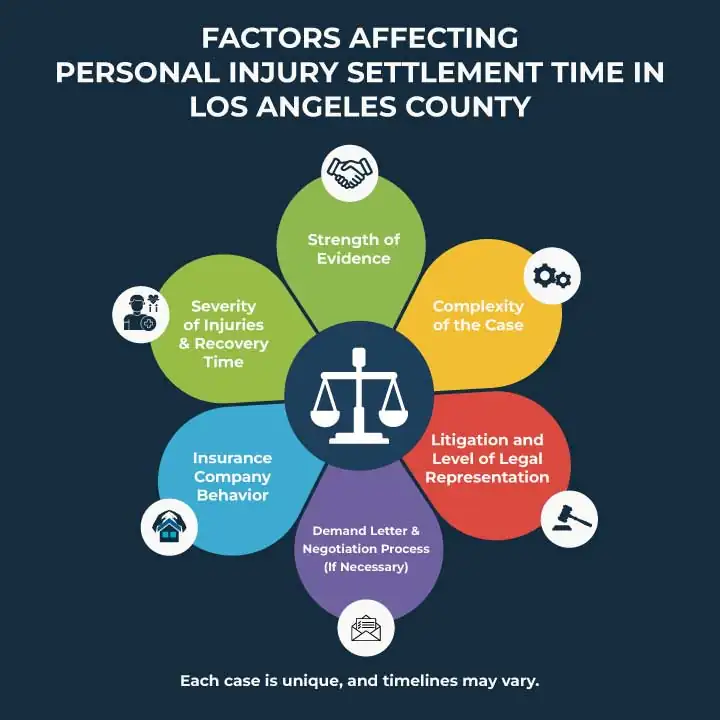
Understanding several key factors affecting personal injury case duration helps you keep your expectations about the timeline realistic.
Severity of Injuries & Medical Recovery
Your injuries directly determine your timeline. For instance, minor soft tissue damage heals in weeks. Cases like this settle faster. Serious injuries like traumatic brain injuries or spinal cord damage naturally get under extensive medical treatment, because you need months or even a few years of treatment.
This is important: You shouldn’t settle until you reach MMI. Settling too early means you might end up paying out of pocket for future costs of treatment you didn’t realize you would need.
Higher-value cases also take longer. This is because an insurance company will push back harder, and investigate more thoroughly, when more money is on the line.
Strength of Evidence
Solid evidence is key to getting a speedy settlement. When the liability is clear, an insurance company doesn’t have much room to argue. Some of the best evidence includes:
- Police reports that document the accident
- Medical records directly connecting your injuries to the accident
- Witness statements that will support your version of events
- Surveillance or dashcam footage showing what happened
The more evidence, the better.
Complexity of the Case
A simple case involving two drivers and a clear fault is usually resolved more quickly than multi-party accidents. These complex cases have more challenges because multiple insurance companies are almost always involved. With all of them pointing fingers at the others.
Commercial defendants have legal teams on hand to fight all claims. For example, a trucking company. They will inevitably contest liability and drag things out as long as possible. And if a case has expert witnesses, it can take longer, too.
Insurance Company Behavior
Insurance companies aren’t exactly known for being easy to work with. While some will act in good faith, others will use every delay tactic in the book. The simple fact is, if they can delay long enough, a lot of people will just give up. Some sketchy things that can happen with insurance companies:
- Offer quick lowball settlements hoping you’ll accept before you know your case’s true value.
- Dragging out negotiations to make your financial hardship more than you can handle.
- Dispute liability even when fault is obvious.
- Requesting unnecessary documentation over and over.
Having an experienced attorney nips all of this in the bud. Insurance companies know they can end up in court if they don’t behave fairly. And they do not want to go to court if they can avoid it.
Cooperation of the Parties Involved
Your cooperation matters, too. If you miss a medical appointment, it can create a gap in your records. And you can be sure the insurance company will try to use it against you.
- Stay in close contact with your legal team.
- Get any documentation and paperwork to them as soon as possible after they ask for it.
- Follow their advice closely. They know what they’re doing.
Demand Letter & Negotiation Process
In pre-litigation(once MMI is reached), your attorney will prepare and send the insurance a demand letter and start negotiating with them. Having a professionally prepared demand letter where the injuries and compensation requested is the most important thing. This can stop a lot of the arguments they throw up. After they get the demand letter, they’ve got 30 to 45 days to respond before engaging in negotiations. But negotiations can take weeks or months.
Litigation and Court Scheduling (If Necessary)
If your case ends up going to court, the congestion in the Los Angeles court system causes delays. Delays in personal injury cases happen due to court scheduling and the availability of judges. LA’s courts are notoriously busy, handling an enormous volume of cases. Cases have been known to sit on the docket for months before they get scheduled.
Also, continuances and scheduling conflicts can keep pushing back your trial date. This is why cases that go to litigation almost always take longer than those that get settled out of court.
Quality and Focus of Legal Representation
An experienced attorney has a huge impact on how quickly a case gets resolved. The team at The Ledger Law Firm focuses on personal injury cases. They’re the experts at building strong cases, and they’re not afraid to push back when insurance companies try to drag things out. In many cases, they have an established relationship with insurers, and this helps a lot.
When you have an accident, schedule your free case review with our team. We’ll take a look at your situation, lay out your options, and give you a realistic timeline for what you can expect.
1. How early should I begin my personal injury case in Los Angeles?
Get started as soon as possible after your accident. Within at least one to two weeks is best. You’ve got two years in California to file a lawsuit. But evidence can disappear and memories fade quickly.
2. Why is my personal injury settlement taking so long?
Some common reasons that cause a case to take longer include:
- Ongoing medical treatment
- Disputes over who was at fault
- Uncooperative insurance companies
- Backlogged court if your case is in litigation
As per recent reports, personal injury cases in Los Angeles can take up to 3 months to 3 years. But, the complex cases which require litigation can take 18-36 months or more.
3. What steps to avoid unnecessary delays in a personal injury claim?
Doing all of this will help you avoid delays in your case:
- Seek medical treatment immediately after your accident occurred.
- Attend all of your doctor appointments.
- Promptly give your attorney any documents they ask you for.
- Follow your treatment plan closely.
- Avoid any gaps in medical care.
4. Why do certain personal injury settlements take over two years to resolve?
This can happen when there are multiple responsible parties involved. In some cases, insurance companies use stall tactics to try to avoid paying, hoping to wear you down. And if you go to trial, this naturally takes longer.
5. Does the length of recovery affect when a personal injury case settles?
Absolutely. You should never settle until you reach maximum medical improvement so you know your full medical expenses. When you settle too early, you may not have the money you need for future medical expenses.
6. Does going to court speed up or delay a personal injury case?
If your case actually ends up going to trial, you can definitely expect significant delays because of LA’s backlogged court system. The good news is that most cases settle before reaching the courtroom.
7. How can I accelerate my personal injury settlement?
To speed up your settlement, follow all of these best practices:
- Stay on top of your treatment plan.
- Respond quickly to any requests from your lawyer.
- Gather strong evidence early on.
- Consider reasonable settlement offers.
Most importantly, work with an experienced attorney.
8. What is the typical timeline after sending a demand letter?
Usually, insurance companies respond within 30 to 45 days. Once that’s done, negotiations can take several weeks or months.
9. Is it possible to resolve a personal injury claim without going to court?
Yes. As it turns out, over 95% of personal injury cases settle out of court. Negotiation and mediation help resolve the majority of cases. Going to trial is usually a last resort. This is for when insurance companies refuse to play fair.
10. What should I do if my injuries need additional care after I settle?
Once you sign a settlement agreement, there’s no going back. That’s why waiting until you reach maximum medical improvement is so important, and why working with a good attorney makes all the difference.

Emery Brett Ledger brings 28+ years of experience to personal injury law. He founded & led The Ledger Law Firm in securing over $100 million in compensation for clients with life-altering injuries & complex claims. Prior results do not guarantee a similar outcome. Licensed in California, Texas, & Washington, Emery earned his law degree from Pepperdine University School of Law. His practice areas include car & truck accidents, wrongful death, catastrophic injuries, maritime claims, & mass tort litigation. He has been recognized by The National Trial Lawyers’ Top 100, Mass Tort Trial Lawyers Top 25, and America’s Top 100 Personal Injury Attorneys. Emery also received the 2025 Elite Lawyer Award & holds a perfect 10.0 Avvo rating with Platinum Client Champion status. His legal work has been featured on CNN, Forbes, NBC, & ABC.
Free Case Evaluation
Recent Posts
- Punitive Damages in a Car Accident: When Can You Recover Them?
- Tailgating Injury: What Causes Tailgating, Road Rage & How to Stay Safe
- Waiting to Call a Lawyer Can Hurt Your Case: Evidence, Deadlines & Legal Risks
- What Is Property Damage in a Car Accident? Claims, Costs & Who Pays
- Bodily Injury & Property Damage: Coverage, Claims, Liability & Compensation
Emery Brett Ledger brings 28+ years of experience to personal injury law. He founded & led The Ledger Law Firm in securing over $100 million in compensation for clients with life-altering injuries & complex claims. Prior results do not guarantee a similar outcome. Licensed in California, Texas, & Washington, Emery earned his law degree from Pepperdine University School of Law. His practice areas include car & truck accidents, wrongful death, catastrophic injuries, maritime claims, & mass tort litigation. He has been recognized by The National Trial Lawyers’ Top 100, Mass Tort Trial Lawyers Top 25, and America’s Top 100 Personal Injury Attorneys. Emery also received the 2025 Elite Lawyer Award & holds a perfect 10.0 Avvo rating with Platinum Client Champion status. His legal work has been featured on CNN, Forbes, NBC, & ABC.