

How Long Should A Personal Injury Case Take to Settle?: A Detailed Guideline

A question immediately pops into your mind when you suffer any personal injury, “How long should a personal injury case take to settle?” Although different factors, including the actual complexity of the personal injury case, control the timeline, it takes 6 to 18 months.
Out-of-court settlements can take a shorter time, given that you hire an expert personal injury attorney. It also depends on the settlement amount. Plus, your pre- and post-litigation process of the personal injury claims and cases will further determine the time.
How Long Should A Personal Injury Case Take To Settle?
The timeline for a personal injury case is rarely straightforward. However, you must understand the typical averages to manage your case procedure and expectations better. Most injury claims settle within 12 months of the incident. Nonetheless, complex injury cases, such as workplace injuries or seamen’s injuries, can go through the litigation process. So, it can easily span 2 to 5 years.
The Difference Between a “Claim” and a “How Long Does a Personal Injury Lawsuit Take?”
When you ask about the timeline for personal injury lawsuit, you must understand the difference between a claim and a lawsuit. It’s crucial to distinguish between them because they represent drastically different timelines:
- The Claim Phase: The claim is the pre-litigation process. During this time, your attorney files a claim directly with the at-fault party’s insurance company. The attorney will investigate, analyze evidence, communicate, negotiate, and make settlement demands. In most cases, an appropriate pre-litigation process settles the claim within 3 to 6 months.
- The Lawsuit Phase: In complex personal injury cases, pre-litigation and out-of-court settlements might not be resolved. So, your attorney will file a formal legal action in court. Once a case enters litigation, the time for personal injury lawsuit will increase significantly. It goes through legal procedures, such as discovery, and the time required to navigate packed court schedules.
From Quick Settlement to Lengthy Litigation
Rapid settlements can take 3 to 6 months for simple personal injury cases, including dog bites, drunk driving, etc. But complex personal injury cases, including premises and workplace injuries, can take years to settle.
- Rapid Settlements (3–6 Months): The personal injury cases typically involve easy-to-prove ones. Here, the liability is clear, such as a simple rear-end collision where the other driver was ticketed, minor or soft injuries, etc. Also, the medical treatment is complete and relatively inexpensive in these cases.
- Complex Cases (1 to 5 years): Many personal injury cases involve severe or catastrophic injuries. The claimant would require future care. Also, the fault could be hotly disputed. So, these cases will almost certainly proceed to the lawsuit phase. With over 400000 claims filed and 2% to 5% going to court, it could take years to settle the claim.
Types of Personal Injury Claims
When you are injured in an event or accident, you could be confused about its classification. Does it fall under the personal injury category or another type? So, let’s take a look at the primary types of personal injury claims that you can file for compensation. It includes:
- Motor Vehicle Accidents: It includes car, truck, motorcycle, bicycle, or pedestrian accidents.
- Slip and Fall Accidents (Premises Liability): Injuries due to dangerous or defective conditions on premises or properties of others. It includes wet floor, poor maintenance, etc.
- Medical Malpractice: Injuries or harm due to a healthcare professional’s negligence and error. You can claim compensation for their failure to provide proper treatment.
- Product Liability: Claims against manufacturers or distributors for defective or dangerous products, such as faulty tools, contaminated food.
- Wrongful Death: Surviving family members can file a wrongful death claim when a person dies due to the negligence or misconduct of another party.
- Dog Bites/Animal Attacks: When a pet or animal bites and injures you, the owner is held responsible.
- Construction Accidents: Workplace or job site injuries, often involving scaffolding, heavy machinery, or dangerous working conditions.
- Intentional Torts: Cases involve intentionally harmful acts. It could be assault, battery, or defamation, causing injury.
How To File A Personal Injury Claim?
The way you file your personal injury claims will largely determine the time required for it to settle. A properly arranged claim with appropriate documents and a claim breakdown is most likely to settle faster.
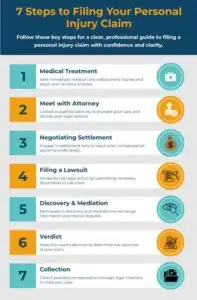
- Medical treatment: Record your immediate and ongoing care. Also, focus on fast recovery and thorough documentation of all injuries.
- Meet with an experienced personal injury attorney: Take a free initial consultation to discuss and evaluate your case. It will ensure retention of legal counsel.
- Negotiating a settlement: The pre-litigation phase, where the attorney presents a demand to the insurer. The attorney will further attempt to reach a fair agreement.
- Filing a personal injury lawsuit: The attorney files a formal claim in court if settlement negotiations fail.
- Discovery, mediation, and trial: The formal litigation process includes evidence exchange (Discovery). It also includes all attempts at Alternative Dispute Resolution (Mediation).
- Verdict: The court or jury will deliver the judgment if the case proceeds to a full trial.
- Collection: The final phase, when the attorney will secure and disburse the awarded claim.
The Timeline for Personal Injury Lawsuit: All Stages
The true timeline for personal injury lawsuit has a predictable progression. From the initial investigation to the time when litigation begins, you could divide it into five stages. The framework details the activities and explains why a lawsuit takes longer than a claim.
| Phase | Description of Activities | Estimated Duration |
| Investigation & Treatment | The attorney will collect evidence, document injuries, and complete all necessary medical care (reaching MMI). | 3 – 12 Months |
| Demand & Negotiation | Attorney prepares and submits the demand package; initial settlement offers are exchanged. | 1 – 3 Months |
| Litigation & Discovery |
|
6 – 18 Months |
| Mediation & Pre-Trial | Mandatory mediation or arbitration, expert witness reports, and pre-trial motions. | 3 – 6 Months |
| Trial & Post-Trial | Courtroom proceedings; jury verdict or judge’s ruling; potential appeals process. | 6 – 24+ Months |
Discover Your Settlement Timeline.
Initial Investigation and Medical Treatment (0-12 Months)
The primary investigation phase starts immediately after the incident. Your attorney will secure evidence. However, the lawyer must wait for you to reach Maximum Medical Improvement (MMI).
The MMI is the point where your condition has stabilized, and further recovery is unlikely. So, the personal injury lawyer can accurately document and evaluate your damage, recovery time, and expenses for past, present, and future medical care.
Demand Package and Negotiation (1-3 Months)
Once the injured person reaches the MMI, the attorney will compile a comprehensive demand package. This document includes:
- All medical bills and injury records
- Lost wage documentation,
- Details of your pain and suffering.
The insurance company typically takes 30-60 days to respond. Most minor personal injury cases will settle at this stage. However, if the insurer’s offer is unreasonable, the case progresses to the next phase.
Filing a Lawsuit and Discovery (6-18 Months)
Many times, the negotiations fail. So, your attorney files a lawsuit within the statute of limitations for a personal injury claim. The deadline for personal injury claims is typically 2 years. It starts from the date of your injury.
When the attorney files the lawsuit, the Discovery process begins. It is often the longest phase, taking 6 to 18 months. Discovery is the formal exchange of information between the parties and includes:
- Interrogatories: Written questions one party sends to the other.
- Requests for Production: Demands for documents, including medical records, financial statements, etc.
- Depositions: Sworn, out-of-court testimony from the parties and witnesses.
Mediation/ADR and Pre-Trial Motions (3-6 Months)
Most courts will focus on the mediation or ADR process first. So, both parties must attempt mandatory mediation before a trial date is set. Mediation is a highly effective, non-binding negotiation with a neutral third party.
Here, the mediator could be personal injury and insurance lawyers from both parties. Or, the court may appoint a government mediator. The majority of personal injury lawsuits will settle during the formal mediation stage. If mediation fails, the parties prepare for trial. So, they will begin the complex pre-trial motions and designate expert witnesses.
Trial and Appeals (6-24+ Months)
The trial stage usually only lasts a few days or weeks. However, with 3% to 5% of 400000 personal injury claims going to court, the number is staggering, 12000 to 20000, annually. So, it’s extremely difficult and time-consuming to secure a spot on a congested court docket.
It can take many months or even years. If the jury or judge rules in your favor, the defendant may file an appeal. So, the appeal can add another year or more to the overall timeline for personal injury lawsuit before final payment is made.
Once everything is settled, the court will deposit the money into your personal injury attorney’s account. They will take their share for the successful lawsuit and disburse the rest to your account.
Crucial Factors Determining How Long Do Injury Settlements Take?
From the severity of the personal injury to the clarity of the fault, multiple factors influence the time required for personal injury settlements.
Severity of Injuries and Length of Medical Treatment
It’s simple: the severe the injury is, the claim increases, too. It increases the time required for the medical treatment, physical recovery, and compensation amount. So, the actual time needed for settlement will increase, too.
- Minor Injuries: These cases involve minor soft-tissue injuries or standard broken bones with a predictable recovery timeline. So, the attorneys can close it through peaceful negotiation, once treatment is done.
- Catastrophic Injuries: Severe injuries like traumatic brain injury (TBI) or spinal cord injuries require lifelong care projections. So, it becomes tough to calculate future medical costs. It needs economic and medical experts. So, it can significantly extend the investigation and negotiation phases.
Clear vs. Contested Liability and Fault
Many times, the at-fault party is clear in a personal injury lawsuit. If there is contested liability, the settlement time increases. The defendant denies being at fault or argues that you were partially to blame.
The insurance attorney will use comparative negligence laws to minimize the payout. So, the case certainly moves into litigation. The court will analyze the evidence and witnesses to determine the fault percentage for both parties. It dramatically increases the time spent.
Also, in a multi-vehicle collision, there could be several parties legally at fault. It needs time to coordinate the defense and settle discussions among multiple parties. It slows down the resolution. Plus, trucking accidents or ride-sharing cars involve multiple parties. It increases the settlement time, too.
Insurance Company Tactics and Policy Limits
Insurance companies will try to delay payment. Often, financial pressure might force an injured party to accept a lowball offer prematurely. So, insurers deliberately delay the payout, even in minor claims.
Also, there are strict policy limits for the insurance claims for personal injuries. The estimated value of your injuries could exceed the defendant’s available insurance policy limits. So, the insurer will fight to avoid paying the maximum amount. Or else, you may have to pursue excess coverage.
Court Docket Congestion and Venue
With more than 40000 personal injury claims annually in the US, and 3% to 5% going to trial, the court is already overburdened with these cases. So, courts in large metropolitan areas or specific jurisdictions often have significant backlogs.
It increases the waiting time to get a trial date. You could have to wait from six months to three years. It will directly impact the final phase of the timeline for personal injury lawsuits.
How Long Do Injury Settlements Take? : Analyzed with Case Type
The nature of personal injury claims also determines the time required to settle. For instance, dog bite cases can settle within one to three months. However, truck accidents involving large trucking companies could take years.
| Case Type | Claim Settlement Time (Pre-Lawsuit) | Actual Lawsuit/Litigation Time (When negotiation fails) | Reason for Increased Timeline |
| Car/Motorcycle Accident | 6 – 12 Months | 1 – 2 Years | Generally, clear liability, but complex injuries or multiple vehicles extend the time. |
| Slip-and-Fall (Premises) | 9 – 18 Months | 2 – 3 Years | The defendant often protests the liability. It requires extensive discovery of maintenance records. |
| Truck Accident (Commercial) | 12 – 24 Months | 2 – 4 Years | Multiple parties, including the driver, the company, mechanic, need coordination. Also, federal regulations and high policy limits increase the timeline. |
| Medical Malpractice | 18 – 36+ Months | 3 – 5+ Years | Involves medical expert review and a complex legal standard of care as proof. |
| Dog Bite/Minor Injury | 3 – 9 Months | 9 – 18 Months | Clear liability and minor damages, leading to faster resolution unless the owner disputes ownership or the circumstances. |
Wrongful Death Cases
Wrongful death cases require years to settle because of their complexity. Wrongful death claims can come up from any case, including motorcycle accidents, premises and product liability, or pharmaceutical issues.
The valuation requires financial and non-financial loss. Settlement distribution may also require court approval. So, the settlements for wrongful deaths are lengthy.
FAQs About How Long Should A Personal Injury Case Take to Settle
Does my attorney’s case volume impact how long does a personal injury lawsuit take?
Yes, an attorney’s experience and resources can speed up the process. However, an overloaded attorney may cause delays. So, choose a firm with the capacity to handle your case effectively.
How long do injury settlements take after mediation is successful?
Once the mediation or negotiation is successful, the final process takes 4 to 8 weeks. It includes the time required to draft and sign the documents and receive the funds.
Does the value of my case affect how long a personal injury case takes to settle?
Yes. The higher the case value, the more the defendant’s insurance company will try to minimize and delay it. So, the settlement time extends substantially.
What is the cost of personal injury claims?
Initially, personal injury law firms offer a free case evaluation and work on a contingency fee basis. The final cost could be 20% to 40% of your final claimed payout, which you can settle with your lawyers.
What is the statute of limitations for personal injury settlements?
The statute of limitations for a personal injury claim is 2 years. However, for government entities, the personal injury claims have a 6-month notice period.
Conclusion
How long should a personal injury case take to settle? Although the settlement is a complex assessment, it takes 6 to 12 months to resolve. However, severe injuries, complex liability disputes, and court backlogs can extend the personal injury lawsuit to several years. You should hire a reputable personal injury law firm to speed up the litigation and negotiation process of personal injury claims.

Emery Brett Ledger brings 28+ years of experience to personal injury law. He founded & led The Ledger Law Firm in securing over $100 million in compensation for clients with life-altering injuries & complex claims. Prior results do not guarantee a similar outcome. Licensed in California, Texas, & Washington, Emery earned his law degree from Pepperdine University School of Law. His practice areas include car & truck accidents, wrongful death, catastrophic injuries, maritime claims, & mass tort litigation. He has been recognized by The National Trial Lawyers’ Top 100, Mass Tort Trial Lawyers Top 25, and America’s Top 100 Personal Injury Attorneys. Emery also received the 2025 Elite Lawyer Award & holds a perfect 10.0 Avvo rating with Platinum Client Champion status. His legal work has been featured on CNN, Forbes, NBC, & ABC.
Free Case Evaluation
Recent Posts
- Punitive Damages in a Car Accident: When Can You Recover Them?
- Tailgating Injury: What Causes Tailgating, Road Rage & How to Stay Safe
- Waiting to Call a Lawyer Can Hurt Your Case: Evidence, Deadlines & Legal Risks
- What Is Property Damage in a Car Accident? Claims, Costs & Who Pays
- Bodily Injury & Property Damage: Coverage, Claims, Liability & Compensation
Emery Brett Ledger brings 28+ years of experience to personal injury law. He founded & led The Ledger Law Firm in securing over $100 million in compensation for clients with life-altering injuries & complex claims. Prior results do not guarantee a similar outcome. Licensed in California, Texas, & Washington, Emery earned his law degree from Pepperdine University School of Law. His practice areas include car & truck accidents, wrongful death, catastrophic injuries, maritime claims, & mass tort litigation. He has been recognized by The National Trial Lawyers’ Top 100, Mass Tort Trial Lawyers Top 25, and America’s Top 100 Personal Injury Attorneys. Emery also received the 2025 Elite Lawyer Award & holds a perfect 10.0 Avvo rating with Platinum Client Champion status. His legal work has been featured on CNN, Forbes, NBC, & ABC.