

5 Steps – How To Sue For Medical Malpractice In Seattle | Lawsuit Filing Procedure And Legal Process

- Limited Time: In Washington State, the statute of limitations is generally three years from the date of the negligence act or one year from discovery.
- The Standard of Care: You must prove that a provider didn’t follow the “standard of care” expected from a competent professional.
- Expert Witnesses are Mandatory: A qualified medical expert must testify to your claim of negligence.
- Seattle-Specific Nuances: Local court rules in King County can influence the evidence presentation and mediation process.
- The Difficulty Level: Medical malpractice suits are the hardest to win due to technical complexity. So you need an expert attorney to fight your case.
The UW Medicine, Swedish Medical Center, and Seattle Children’s Hospital, among others, have made Seattle home to world-class medical facilities. Yet, medical malpractice in Seattle isn’t rare. There could be a surgical error, a misdiagnosis, or a medication mistake. Such unintentional mistakes can alter your life forever. So, you must know how to sue for medical malpractice in Seattle?
First, you must understand the types of medical malpractice. It helps you identify what has happened to you. You must then collect your diagnosis report, seek medical help, and document everything.
Also, you follow the rigorous legal standards. Your expert medical malpractice defense team will fight for you against the billion-dollar insurance companies and medical facilities. Ledger Law Firm is ready to assess your medical malpractice claim.
Different Types of Medical Malpractice:
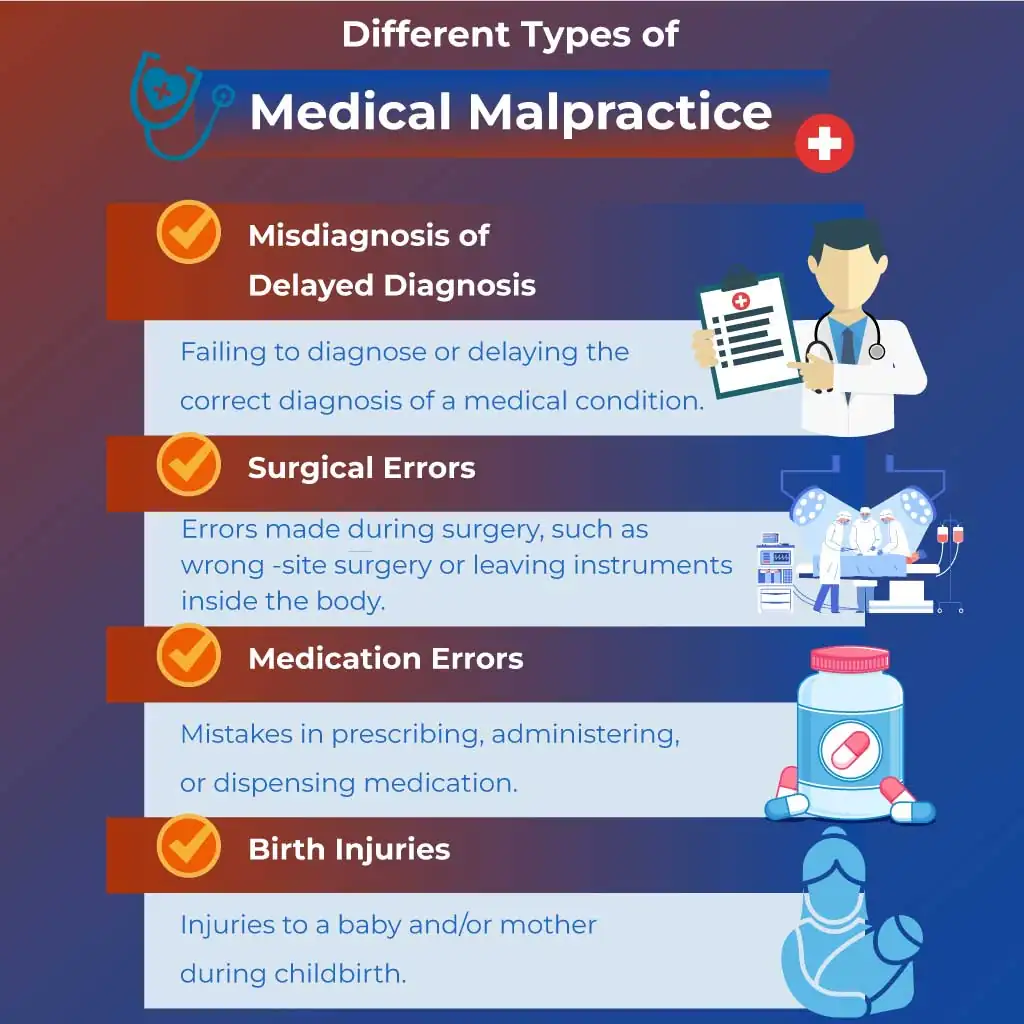
Medical malpractice happens for different reasons. Ideally, a healthcare professional should diagnose your sickness and treat it appropriately. However, when the physician or healthcare professional fails to treat you properly. Also, they might fail to follow the accepted standard in the medical community. It could harm the patient and worsen the sickness. Common types include:
- Misdiagnosis or Delayed Diagnosis: The professional fails to identify a condition, including cancer or a heart ailment. So, the misdiagnosis delays the treatment and hurts the patient more.
- Surgical Errors: The physician might operate on the wrong site, leave instruments inside a patient, or damage internal organs. It could be unintentional.
- Medication Errors: Many times, the doctor might prescribe the wrong dosage or a drug. So, the wrong prescription causes a dangerous interaction.
- Birth Injuries: There could be negligence during delivery. It could lead to cerebral palsy or other permanent disabilities.
- Failure to Treat: The medical might discharge a patient too early or fail to provide necessary follow-up care.
What Are The Steps – How to Sue for Medical Malpractice in Seattle?
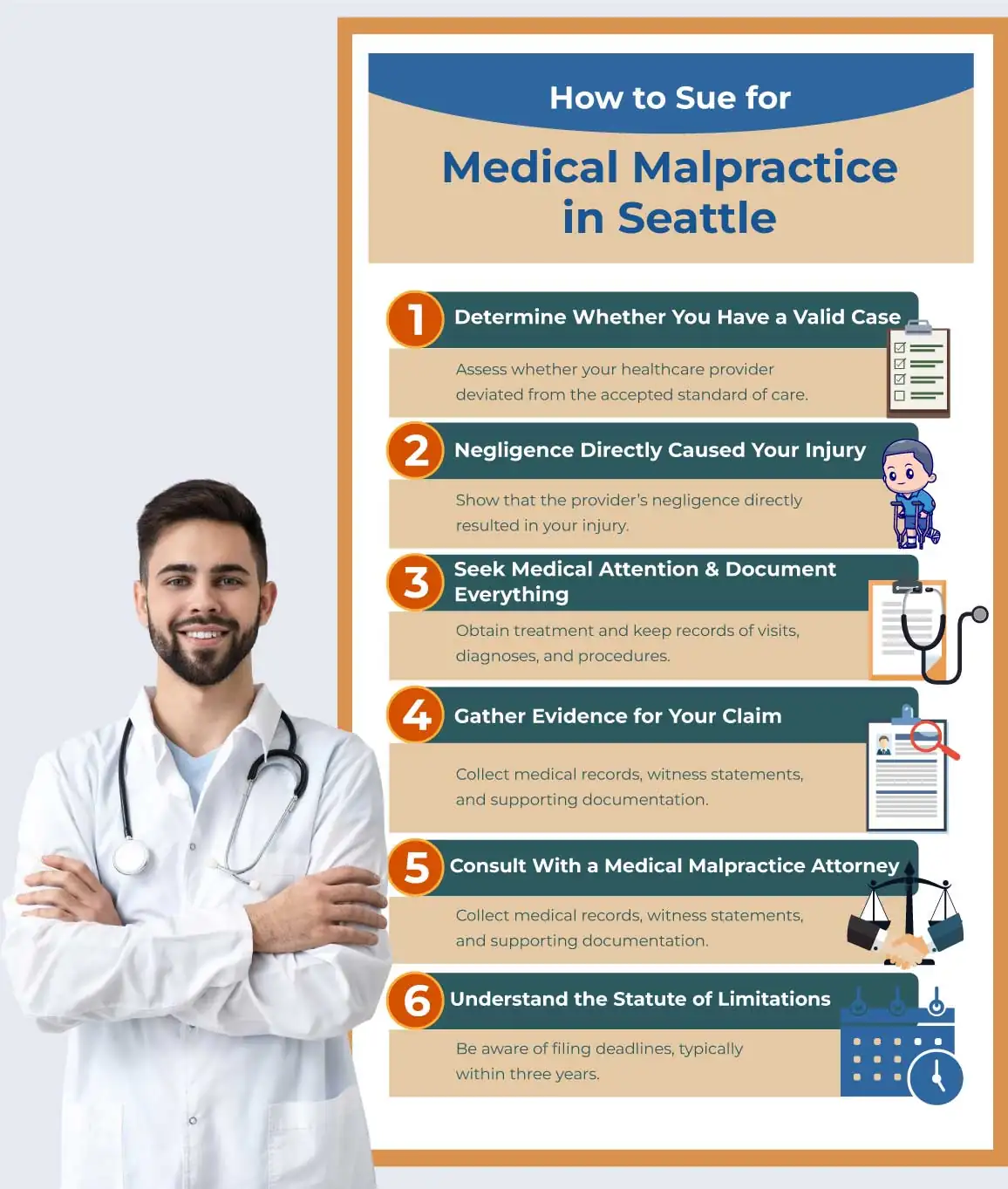
When you decide to file a lawsuit against a healthcare provider in Washington, you must be careful. It’s not enough to prove you were harmed. You also need a strategic legal approach for Seattle’s specific judicial requirements. From determining a medical malpractice case to seeking medical attention and gathering evidence, you must do everything step-by-step.
Determine whether you have a valid medical malpractice case:
You must first check your symptoms to assess the medical outcome. It is crucial since not all medical outcomes or worsening sickness are the result of malpractice.
To sue for medical malpractice, you must do two things:
- Prove that the doctor was negligent.
- The negligence directly caused your injury
Sometimes, there might be a disclosed risk of surgery and its reaction. If the patient knows about it, there might not be a case. But, in rare cases, the surgeon could be intoxicated or skipped a standard safety protocol. In such cases, you can file the case.
In Seattle, the standard of care defines “negligence.” It refers to the level of care a competent healthcare provider would provide under similar circumstances. You must show that your provider’s actions fell below the benchmark.
However, the standard of care and medical law in Washington is complex. So, a medical expert must review your medical records. The expert can confirm whether the mistake was preventable. The court may dismiss your claim as a simple “unfortunate medical result,” without the professional validation.
Seek medical attention & document everything:
Even when you are sick, prioritize your health. You must see another doctor when you suspect malpractice. It is necessary to correct and lessen the damage. It will create a “paper trail” of your medical records.
During your treatment:
- Document your symptoms
- Preserve the appointment dates
- Note down how the injury has affected your daily life.
- Maintain a journal of your pain levels
- Record any physical limitations you now face
You should always look for a second opinion from another doctor. It provides an unbiased medical record of your current condition. The Seattle jury considers contemporaneous notes and immediate follow-up care more important than memories recalled months later. So, the medical records are more than necessary.
However, a patient might experience medical gaslighting. The original doctor dismisses your concerns. So, your new provider must document your actual symptoms. These records are a vital comparison point against the allegedly negligent treatment.
Gather evidence for your medical negligence claim:
When you become a victim of medical negligence and malpractice, you must collect the evidence. It is the backbone of your lawsuit. In Seattle, you can request full medical records from any provider. You will need:
- Medical records and test results
- Prescription records
- Bills and proof of lost wages
- Photographs of physical injuries (if applicable)
You must connect the evidence to the 4 D’s of malpractice: Duty, Dereliction, Direct Cause, and Damages. It’s necessary to win your compensation claim.
Of course, medical records are essential. However, “soft” evidence is crucial too, including emails, text messages, or even discharge instructions that contain errors. In King County, defense attorneys examine every detail of the patient’s history. They will try to find alternative causes for your injury to divert the medical malpractice claim.
So, you must collect everything from the start, including insurance “Explanation of Benefits” (EOB) statements.
Consult with a Seattle medical malpractice attorney:
Medical malpractice cases are highly technical. So, you need a specialist attorney to deal with the medicals and their insurers. A Seattle-based attorney knows Washington State’s specific laws better regarding medical malpractice. Also, they can access the medical experts to validate your claim. Most work on a contingency fee basis.
A local attorney is familiar with the King County Superior Court rules. They also know the reputations of local hospitals and their insurance carriers. In Washington, like every US state, lawsuits often require a “mediation” phase. You must go through the mediation stage before the trial.
An experienced lawyer will negotiate with the medical insurer to maximize your settlement. The firm works on a contingency fee: the fee is a percentage of what is recovered. If there is no recovery, you owe no attorney fee, but you may still be responsible for court costs and case expenses.
Understand Statutes of Limitations in Seattle:
In Washington, the statute of limitations for filing a medical malpractice case starts when you are injured. Generally, you have three years to file a compensation claim. However, if you didn’t discover the injury-cause or malpractice right away, you may have one year from the date of discovery. You will lose your right to sue forever if you miss these two deadlines.
There is also a “statute of repose” for personal injury and medical malpractice cases. It usually limits claims to within eight years of the act. The statute of repose stays regardless of when you discover the injury or the mistreatment.
However, recently, the Washington Supreme Court has brought new rulings on this statute of limitations and repose. They have rephrased how these limits apply. It was especially focused on children or in cases of intentional concealment. Thus, it is dangerous to wait for the case. So, you must hire an expert Seattle attorney. They will “toll” (pause) the statute of limitations if you enter into a good-faith mediation agreement. So, you get more time to collect evidence and build your case.
How To File A Medical Malpractice Lawsuit in Seattle?
When you suffer from medical malpractice, you must file the lawsuit fast. Otherwise, the deadline may pass, and you lose the claim. The process of filing the malpractice lawsuit starts with finding the right attorney. You must also collect the evidence and submit it to your attorney.
Choose the right attorney:
When you look for a medical malpractice attorney, communicate properly. You must ask about their track record, specifically with medical negligence. The attorney shouldn’t be afraid to go to trial against large hospital networks, if necessary. Also, consider:
- The number of cases
- Compensation settlements
- Success ratio
- Communication process
- Fee structure
Prepare and submit the lawsuit documents:
Your attorney will file a “Complaint” in the King County Superior Court. For this, your will document must outline the wrongdoing of the healthcare provider and the damages you are seeking. In Washington, you may also need to file a “Certificate of Merit.” It depends on specific case requirements. In such cases, the expert confirms the medical malpractice case has a basis.
Deliver the complaint to the defendant:
When your attorney files the lawsuit, they must also officially serve it to the defendant, including the doctor or hospital. They then usually have 20 days to respond to the allegations and start the fight.
The Legal Process Behind A Medical Malpractice Lawsuit in Seattle:

The legal journey to get your compensation for medical malpractice is a marathon. You typically have to follow three main phases for a lawsuit for medical malpractice.
Discovery Phase – Collect Evidence:
The discovery phase is the longest part of the lawsuit. Both sides exchange documents, medical records, and take depositions. A deposition is a sworn statement when the opposing lawyers question witnesses and experts. So, the discovery phase uncovers the necessary evidence for the trial.
Negotiating Compensation and Mediation:
Almost 60% to 70% of the personal injury and medical malpractice cases are settled outside the court in Seattle. The jury asks both parties to go through the Mediation process. It is a common requirement in Washington. A neutral third party discusses with both sides settle. It is preferable as the mediation avoids the uncertainty of a trial. It also saves the time and money of the plaintiffs.
Courtroom Proceedings:
The attorney will take your case to trial if a negotiation fails. A judge or jury will hear testimony from both sides and decide if malpractice occurred and how much compensation (damages) should be awarded.
Comparative Overview: Malpractice vs. Standard Injury:
When you are seeking justice for medical malpractice, you must know the difference between the standard injury. Otherwise, the jury may reject your claims.
| Feature | Standard Personal Injury (e.g., Car Accident) | Medical Malpractice |
| Complexity | Moderate | Very High |
| Expert Witness | Often optional | Strictly Required |
| Statute of Limitations | Usually 3 Years | 3 Years (with discovery rules) |
| Pre-suit Requirements | Minimal | Often requires expert review |
| Defense Strategy | Negotiate fault | Aggressive denial of negligence |
How to Prove Negligence with The Ledger Law Firm?
You must connect the dots between a doctor’s action and your injury to prove negligence. The Ledger Law Firm focuses on building a “bridge of causation.” We utilize our connection with the medical professionals to review your files.
We will also testify to the claims on your behalf. Our attorneys will focus on the 4 D’s—Duty, Dereliction, Direct Cause, and Damages.
Final Thought:
You must learn how to sue a hospital for medical malpractice to maximize your claims. Medical malpractice can alter your life and cause heavy economic loss. So, Ledger Law Firm assesses your malpractice claim and prepares the document for it to ensure compensation.
We will protect patients from substandard care so they receive the care they are entitled to. Also, for malpractice and negligence, we will fight for your rights.
1. How hard is it to sue for medical malpractice?
The process and possibility of suing a medical professional for negligence or malpractice is difficult. Statistics show that physicians win the majority of medical malpractice trials. So, you must have a robust legal team and clear evidence to win the case.
2. How to sue a hospital for medical malpractice?
You must prove that the hospital’s employees were negligent. Or, you should prove that the hospital was negligent in its safety protocols. Often, doctors are independent contractors. So, suing a medical professional or doctor is different.
3. Can you sue a doctor for ignoring your symptoms?
Yes, you can sue a doctor for ignoring your symptoms, known as “medical gaslighting” or “failure to diagnose.” Might be the ignored symptoms worsen your condition. Also, it could miss the chance to treat the illness timely. In such cases, you can file the claim.
4. What are examples of medical negligence?
A few examples of medical negligence are:
- Leaving a sponge inside a patient during surgery.
- Giving a patient a drug they are allergic to (when it’s on their chart).
- Failing to order a standard screening like a mammogram or colonoscopy.
5. What does medical gaslighting mean?
Medical gaslighting means when a healthcare provider dismisses a patient’s physical symptoms. They do it on the basis that these symptoms are “all in their head” or related to psychological factors. So, it actually delays diagnosis.
6. What are the signs of medical gaslighting?
The signs of medical gaslighting are:
- The doctor interrupts the patient constantly
- They overlook basic diagnostic tests
- They ignore the symptoms without investigation
- You feel belittled or ignored during visits.
7. What Are the Five Elements Needed to Prove Medical Malpractice?
The five elements necessary to prove medical malpractice and negligence are:
- Duty of Care: An existing relation between the provider and the patient
- Breach of Duty: The provider failed to meet the standard of care.
- Causation: The breach caused the injury
- Proximate Cause: The injury was a result of the breach.
- Damages: The patient suffered actual harm, financial or physical
9. Why Are the 4 C’s — Care, Competence, Causation, and Compensation — Important in Malpractice?
The 4C’s are the framework for the medical negligence lawsuit. Did the Care meet the level of Competence expected? Did that care provide the Causation for the injury? If so, what is fair compensation?
8. What Are the 4 D’s of a Successful Medical Malpractice Claim?
The 4D’s of a medical malpractice claim are:
- Duty: The doctor had a standard of care procedure
- Dereliction: The doctor shifted away from that standard.
- Direct Cause: The shift caused your injury.
- Damages: You suffered measurable losses.
10. Which element of malpractice is hardest to prove?
The causation element of the malpractice is the hardest to prove. The defense argues that an underlying condition or an unavoidable complication caused the injury. The doctor wasn’t responsible for your sickness and worsening condition.
11. How Long Do You Have to File a Medical Malpractice Lawsuit in Seattle?
Generally, the statute of limitations is three years from the date of the negligent act for medical malpractice. For any hidden injury, you have one year left from the discovery date to file the claim.
12. How Much Can You Recover in a Medical Malpractice Case in Seattle?
There is no “cap” on economic damages for medical malpractice claims in Seattle.

Emery Brett Ledger brings 28+ years of experience to personal injury law. He founded & led The Ledger Law Firm in securing over $100 million in compensation for clients with life-altering injuries & complex claims. Prior results do not guarantee a similar outcome. Licensed in California, Texas, & Washington, Emery earned his law degree from Pepperdine University School of Law. His practice areas include car & truck accidents, wrongful death, catastrophic injuries, maritime claims, & mass tort litigation. He has been recognized by The National Trial Lawyers’ Top 100, Mass Tort Trial Lawyers Top 25, and America’s Top 100 Personal Injury Attorneys. Emery also received the 2025 Elite Lawyer Award & holds a perfect 10.0 Avvo rating with Platinum Client Champion status. His legal work has been featured on CNN, Forbes, NBC, & ABC.
Free Case Evaluation
Recent Posts
- Punitive Damages in a Car Accident: When Can You Recover Them?
- Tailgating Injury: What Causes Tailgating, Road Rage & How to Stay Safe
- Waiting to Call a Lawyer Can Hurt Your Case: Evidence, Deadlines & Legal Risks
- What Is Property Damage in a Car Accident? Claims, Costs & Who Pays
- Bodily Injury & Property Damage: Coverage, Claims, Liability & Compensation
Emery Brett Ledger brings 28+ years of experience to personal injury law. He founded & led The Ledger Law Firm in securing over $100 million in compensation for clients with life-altering injuries & complex claims. Prior results do not guarantee a similar outcome. Licensed in California, Texas, & Washington, Emery earned his law degree from Pepperdine University School of Law. His practice areas include car & truck accidents, wrongful death, catastrophic injuries, maritime claims, & mass tort litigation. He has been recognized by The National Trial Lawyers’ Top 100, Mass Tort Trial Lawyers Top 25, and America’s Top 100 Personal Injury Attorneys. Emery also received the 2025 Elite Lawyer Award & holds a perfect 10.0 Avvo rating with Platinum Client Champion status. His legal work has been featured on CNN, Forbes, NBC, & ABC.