

7 Steps On How to Sue for Wrongful Death in Seattle | Who Can Sue | Compensation Types

- Wrongful death lawsuits are civil cases, but the accused can be tried for criminal actions separately, in criminal court.
- Usually, only parents, children, and a surviving spouse can file a wrongful death lawsuit
- The standard of proof is lower than it would be in a criminal case. That’s why an accused person or company could be found innocent of criminal conduct and still be held liable for damages.
- Plaintiffs have to prove their case by showing the accused was either negligent or purposely did something wrong and that these actions (or lack of actions) caused the victim’s death.
- Family members can sue more than one person or company at a time if multiple parties can be blamed for the victim’s death.
One of the worst things you could ever hear is that your parents, husband/wife, or child died. Perhaps one of the only things that could make it even worse is knowing that you lost your loved one because someone broke the law, did something unethical, or was negligent in some way.
The law can’t bring back your lost family member. It only allows you to sue the guilty party for damages.
What is wrongful death?
All death feels wrong. But “wrongful death” in legalese means that someone could have stopped your loved one from dying.
Wrongful Death Lawsuits in Seattle:
The Revised Code of Washington (RCW) governs wrongful death claims in Seattle. You have three years from the time your loved one died to file your lawsuit.
Who Can Sue for a Wrongful Death?
Only the estate’s representative (as named in the will or by the court) can file the lawsuit.
There are two groups of people who can claim benefits if the lawsuit is successful. These are primary beneficiaries and secondary beneficiaries.
Primary Beneficiaries
- Husband or wife.
- Domestic partner, as long as he/she is registered with the state.
- Children (bio and adopted).
Secondary Beneficiaries
Secondary beneficiaries can only sue if there are no primary beneficiaries. People who fall under this category are:
- Parents.
- Siblings.
Parents, brothers, and sisters can only claim benefits if the victim:
- Was supporting them financially.
- Didn’t have a state-recognized spouse or kids.
What Type of Compensation is Available for a Wrongful Death in Seattle?
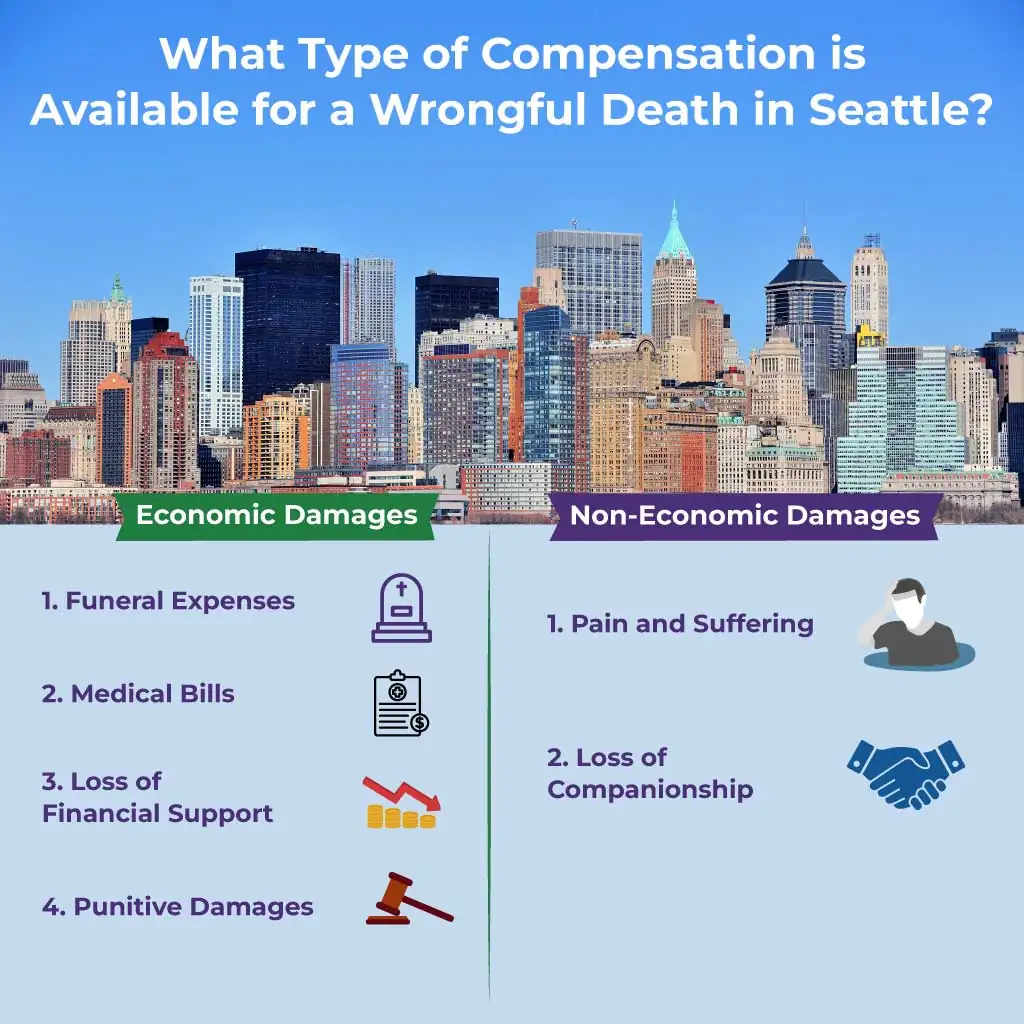
The law divides compensation into two parts.
Economic Damages:
- Funeral expenses.
- Medical bills.
- Loss of financial support.
- Punitive damages.
Non-Economic Damages
- Pain and suffering
- Loss of companionship
How To Sue For Wrongful Death In Seattle?

Suing for wrongful death isn’t easy but it can be done.
Step 1: Establish Legal Grounds for a Wrongful Death Claim:
You need to give the court a reason to give you compensation. You show grounds by:
- Showing proof the person’s death was caused because someone didn’t follow the law
- Showing proof that someone was careless or negligent (albeit not criminally)
Step 2: Determine the Legal Right Holders to File:
If you’re the estate representative named in the will, you can file the lawsuit. If there is no representative, the probate court will appoint one.
You have to be a primary or secondary beneficiary in order to claim benefits. If not, you’re usually out of luck.
Step 3: Understand the Statute of Limitations in Seattle:
You have three years from the time the person died to file your lawsuit.
The only exception to this rule is in the case when you find out the true cause of death long after someone died. Perhaps it looked like your grandfather died of an illness, but medical neglect played a role and you don’t realize this until after the guilty party is arrested in another case. Maybe a product was defective but this only came to light years later, after more people were injured or killed.
Step 4: Gather Evidence and Identify the Negligent Party:
Collect as much evidence as you can. Do it as soon as you can. A good lawyer can help you with this. You’ll need:
- Medical documents showing how and why the person died.
- Proof from the scene of death that shows what happened and how it happened.
- Proof (if it exists) that the other party has a track record of being careless, negligent, engaged in criminal actions, etc.
- Witness statements.
- Expert witnesses.
Step 5: Document Financial and Emotional Damages:
You also need to show how much emotional and financial damage you’re suffering. You do this with records showing:
- How much your loved one earned per year.
- How much your loved one would have likely earned in his or her remaining lifetime.
- What your loved one’s companionship meant to you.
- If you or your kids witnessed the death, how it affected you.
Step 6: Hire an Experienced Wrongful Death Attorney:
You don’t have to fight this battle alone. A good lawyer can:
- Help you collect evidence.
- Give you advice on how to avoid pitfalls that would ruin your case
- Deal with pesky insurance companies that want you to settle for less than you deserve
- Find expert witnesses.
- File your case in court.
- Reach a negotiated settlement.
- Represent you in court.
Looking for an expert in the field? Call Emery Brett Ledger from Ledger Law Firm. As an experienced expert with a winning track record, she can increase your chances of winning your suit.
Step 7: File the Lawsuit:
Once you have a case and someone to represent you, it’s time to file it in court.
Final Words:
No amount of money will bring your loved one back, but compensation helps a lot by:
- Covering your family’s expenses.
- Providing financially.
- Giving you the knowledge that the other party isn’t getting away with his/her/its actions or lack of action.
If your loved one died needlessly, get legal help as soon as you can. A good lawyer can tell you if you can file a suit and help you through the steps of doing so.
1. Can siblings sue for wrongful death?
Just as secondary beneficiaries if the victim didn’t have primary beneficiaries. The only exception would be if the person who died had adopted a younger sibling. The court would treat that sibling the same as a biological child.
2. Can a trust sue for wrongful death?
Yes, if the trust represents the deceased person.
3. Can I sue for wrongful death after a car accident in Seattle?
Yes, but you have to prove the other party caused the death because they:
- Didn’t do something they should have done
- Did something they shouldn’t have done
4. Can you sue a hospital for wrongful death in Seattle?
Absolutely. Medical malpractice suits are some of the most common wrongful death suits in Seattle.
5. Is there a time limit to sue for wrongful death in Seattle?
You have three years from the day of death.
6. How do you prove wrongful death?
You need clear evidence such as:
- Autopsy and other medical documents
- Photo/video evidence from the scene of death
- Witness testimony
7. How much can you sue for wrongful death in Seattle?
A good lawyer will never promise a certain amount. It depends on:
- The other party’s actions or lack of action
- The other party’s track record
- How much you depended on the victim’s financial/emotional support
- The other party’s level of fault for the accident
8. Why do you need a wrongful death attorney in Seattle?
You can. There is no law that says you have to hire a lawyer, but it’s a bad idea not to.
9. Are you ready to file a wrongful death lawsuit?
There is no “one-size-fits-all” answer to this question. You would need to ask your lawyer.
10. Can I sue for wrongful death without a lawyer in Seattle?
You can. There is no law that says you have to hire a lawyer, but it’s a bad idea not to.

Emery Brett Ledger brings 28+ years of experience to personal injury law. He founded & led The Ledger Law Firm in securing over $100 million in compensation for clients with life-altering injuries & complex claims. Prior results do not guarantee a similar outcome. Licensed in California, Texas, & Washington, Emery earned his law degree from Pepperdine University School of Law. His practice areas include car & truck accidents, wrongful death, catastrophic injuries, maritime claims, & mass tort litigation. He has been recognized by The National Trial Lawyers’ Top 100, Mass Tort Trial Lawyers Top 25, and America’s Top 100 Personal Injury Attorneys. Emery also received the 2025 Elite Lawyer Award & holds a perfect 10.0 Avvo rating with Platinum Client Champion status. His legal work has been featured on CNN, Forbes, NBC, & ABC.
Free Case Evaluation
Recent Posts
- Punitive Damages in a Car Accident: When Can You Recover Them?
- Tailgating Injury: What Causes Tailgating, Road Rage & How to Stay Safe
- Waiting to Call a Lawyer Can Hurt Your Case: Evidence, Deadlines & Legal Risks
- What Is Property Damage in a Car Accident? Claims, Costs & Who Pays
- Bodily Injury & Property Damage: Coverage, Claims, Liability & Compensation
Emery Brett Ledger brings 28+ years of experience to personal injury law. He founded & led The Ledger Law Firm in securing over $100 million in compensation for clients with life-altering injuries & complex claims. Prior results do not guarantee a similar outcome. Licensed in California, Texas, & Washington, Emery earned his law degree from Pepperdine University School of Law. His practice areas include car & truck accidents, wrongful death, catastrophic injuries, maritime claims, & mass tort litigation. He has been recognized by The National Trial Lawyers’ Top 100, Mass Tort Trial Lawyers Top 25, and America’s Top 100 Personal Injury Attorneys. Emery also received the 2025 Elite Lawyer Award & holds a perfect 10.0 Avvo rating with Platinum Client Champion status. His legal work has been featured on CNN, Forbes, NBC, & ABC.