

Is California A No-Fault State for Car Accidents?: Know Your Rights

Key Takeaways:
 California is an “at-fault” state: The driver who causes the accident is financially responsible for the damages and injuries.
Liability Insurance is Mandatory: All California drivers are required to carry a minimum amount of liability insurance.
Compensation for Injured Parties: You typically file a claim against the at-fault driver for physical injuries and property damages. The insurance company will compensate you for your injury and property damage.
Comparative Negligence: California follows a “pure comparative negligence” rule. It means you can still recover damages even if you are partially at fault. But your fault percentage will determine the compensation.
No No-Fault Insurance: You cannot purchase traditional no-fault insurance policies in California. You can get Medical Payments (MedPay) to cover your medical expenses, regardless of fault.

When car accidents happen in California, involved parties immediately ask, “Is California a no-fault state for car accidents?” No, California is not a no-fault state for accidents. The state operates under at-fault or tort insurance systems for car accidents. It means the at-fault driver is responsible for the physical and property damages sustained in the car accident.
Drivers require minimum liability insurance to cover damages during an accident. The injured party will receive compensation. Since California follows “Pure Comparative Negligence,” even the partially at-fault party will receive a percentage of the compensation.
Is California a No-Fault State for Car Accidents?
No, California is not a no-fault state for personal injuries, including car accidents. The automobile insurance policy in California focuses on the “At-Fault” strategy. According to it, the at-fault driver has to cover the expenses of the injured and their passengers, as well.
Also, the law suggests that all motor-vehicle owners in California carry a PIP. They also must provide proof of insurance annually.
What is the Difference Between a No-Fault and an At-Fault State?

Knowing California is an at-fault state isn’t enough. You must understand the key differences between no-fault vs. at-fault car accidents.
No-Fault State:
In a no-fault state, the driver’s insurance policy will cover medical expenses and certain other damages. It doesn’t depend on whether the driver was at fault. It eases the claims process and reduces litigation.
Also, a no-fault policy limits the ability to sue for minor injuries. However, there are usually “thresholds” for the no-fault policy. If the threshold is met, the injured party can step outside the no-fault system. Then, they can pursue a claim against the at-fault driver.
At-Fault State:
In an at-fault state, the at-fault person is responsible for the damages. So, he will compensate all injured parties for their damages. So, the injured party can file a claim with their insurance company to seek compensation. This system has a more rigorous process of proving fault. That’s why at-fault states like California often have a delayed compensation process.
| Feature | No-Fault State | At-Fault State |
| Primary Payer for Injuries | Your insurance (PIP/Medical Benefits), regardless of who caused the accident. | The at-fault driver is liable for the insurance. |
| Right to Sue | Limited; typically restricted to serious injuries or exceeding a “threshold” of medical expenses. | Generally unrestricted; you can sue the at-fault driver for all damages. |
| Coverage Focus | Personal injury protection (PIP) provides coverage for medical expenses and lost wages for policyholders. | Covers all damages caused to others. |
| Subrogation | Less common, as each insurer pays its policyholders. | Common; your insurer may seek reimbursement from the at-fault driver’s insurer. |
| Complexity of Claim | It is simpler for minor injuries as fault determination isn’t a must for the claim. | Often more complex, as you have to prove the fault before payout |
How is Fault Determined in California Car Accidents?
California follows strict polices to determine the at-fault party. Often, it can be more complex than people think. From negligence to major vs. minor accidents, determining the fault after an accident needs proof. The fault is determined through:
Negligence:
The California Department of Motor Vehicle (DMV) determines a driver’s negligence. It refers to a driver’s failure to act reasonably in specific conditions that a prudent person would exercise in regular situations. The failure directly leads to an accident.
Examples of negligent driving include:
- Speeding
- Distracted driving (e.g., texting while driving)
- Failing to yield the right-of-way
- Following too closely (tailgating)
- Driving under the influence of drugs or alcohol
- Ignoring traffic signals or signs
In California, negligence further includes violation of a traffic law or statute. This is often referred to as “negligence per se.”
How Fault Is Determined in Minor vs. Major Accidents
The process to determine the at-fault party is a long and complex process. Usually, the fault is determined through police reports, evidence, the driver’s admission, and insurance investigation. For major accidents, further investigation might be necessary.
Minor Accidents:
For minor accidents, an initial traffic police report should be enough. Also, drivers might exchange contact information and details of the accident. On top of it, in minor cases, the driver often admits fault and takes responsibility. It makes finding the party easy. Moreover, insurance companies review the available information to see who was at fault.
Major Accidents:
A comprehensive police investigation will determine the party at fault in the accident. The inquiry might include interviewing both parties, reviewing the vehicles, and traffic footage. Also, in complex scenarios, accident and forensic experts would reconstruct the accident scene.
Then, there will be medical record reviews and witnesses’ accounts. With it, the authority will decide who was at fault.
California’s Financial Responsibility Laws
California law mandates that all drivers carry minimum liability insurance coverage. It is part of the state’s financial responsibility laws. The law ensures that at-fault drivers can cover the damages they cause. According to CVC §16020:
“…every driver and every owner of a motor vehicle shall at all times be able to establish financial responsibility pursuant to §16021, and shall at all times carry in the vehicle evidence of the form of financial responsibility in effect for the vehicle.”
Minimum Auto Insurance Requirements in California
As of the current requirements, drivers in California must carry at least the following liability coverage:
- $30,000 for injury or death to one person
- $60,000 for injury or death to more than one person
- $15,000 for property damage
You must consult with your insurance provider to understand the insurance requirements. The amount depends on the severity of the bodily injury and property damage. The insurance provider will examine the claim and proceed further.
Can I Purchase No-Fault Insurance in California?
No, California does not offer traditional no-fault insurance policies. So, you can’t buy a no-fault insurance in California as it doesn’t exist in the state. Thus, you can recover damages from the other party through their liability insurance.
However, drivers in California can purchase additional coverages that provide some benefits regardless of fault:
- Medical Payments (MedPay) Coverage: MedPay is an optional coverage that pays for reasonable and necessary medical expenses for the drivers and the passengers. It covers ambulance fees, hospital stays, doctor visits, and X-rays. MedPay ranges from $5000 up to $25,000 or more.
- Uninsured/Underinsured Motorist (UM/UIM) Coverage: It protects you if you are hit by a driver who has no insurance (uninsured). Or if the driver doesn’t have enough insurance (underinsured) to cover the damages. UM/UIM is highly recommended since many California drivers don’t have insurance coverage.
The Role of Personal Injury Protection (PIP) in California
Personal Injury Protection (PIP) is a no-fault coverage for the no-fault states. It covers medical expenses, lost wages, and other out-of-pocket costs for the policyholder and the passengers. The PIP is available for both parties regardless of who caused the accident.
However, in California, PIP is generally NOT available since it is an at-fault state. The insurance provider of the at-fault party will compensate you. MedPay could be a good option for initial expenses until you get the payout.
What to Do If You’re Involved in an Accident in California?
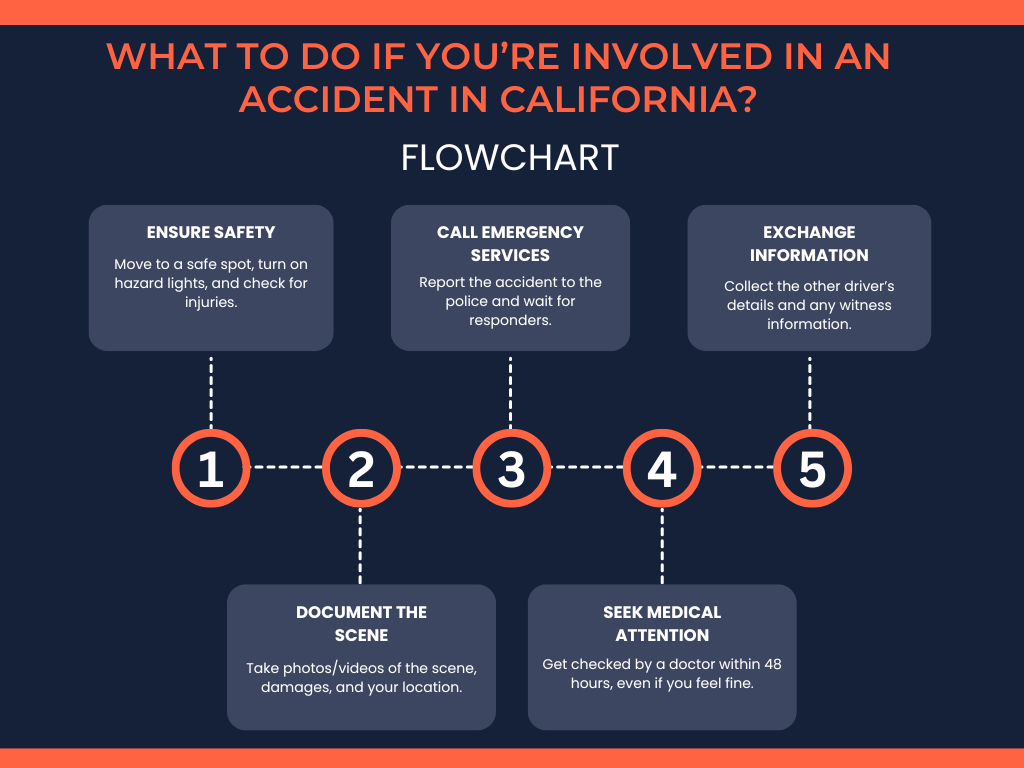 You can get involved in a car accident even without any fault. And during such a time, it’s natural to get panicked. So, keep your cool and ensure your safety, at first. Then, call the emergency and exchange information with the other involved party.
Ensure Safety and Check for Injuries:
✔️ Move your vehicle to a safe location if possible.
✔️ Turn on the hazard lights.
✔️ Check yourself for any injuries and damages. Do the same for passengers.
✔️ Call 911 for immediate help if anyone is injured.
Call Emergency Services (Police and Medical):
✔️ Call the police to report the accident. A police report can be invaluable for insurance claims.
✔️ Follow the instructions of emergency personnel when they arrive
Exchange Information:
✔️ Get their full name, contact information, insurance company name, and policy number, driver’s license number.
✔️ Also, preserve the vehicle make, model, and license plate number.
If there are witnesses, politely collect their names and contact information for further evidence
Document the Scene:
- Take Photos and Videos from all angles and all damages
- Documents the road conditions, traffic signs, skid marks, and debris.
- Take photos of any visible injuries.
- Note your location precisely, including street names, cross streets, and landmarks.
Do Not Admit Fault:
Be careful not to admit your fault. Even if you think you might be at fault for the accident, do not admit it to anyone. Be careful to exchange information with other drivers, police, or even your own insurance company immediately. They can use your statement for further action and prove your fault to reduce the compensation.
Report the Accident and Seek Medical Help:
Once you leave the accident scene, seek medical attention. It’s necessary even if there’s no visible injury. When you get a medical evaluation within 48 hours, you also get a medical record for use during the claim.
Also, report the accident to your insurance provider. It’s crucial since most policies follow a specific deadline for reporting cases.
Comparative Negligence in California
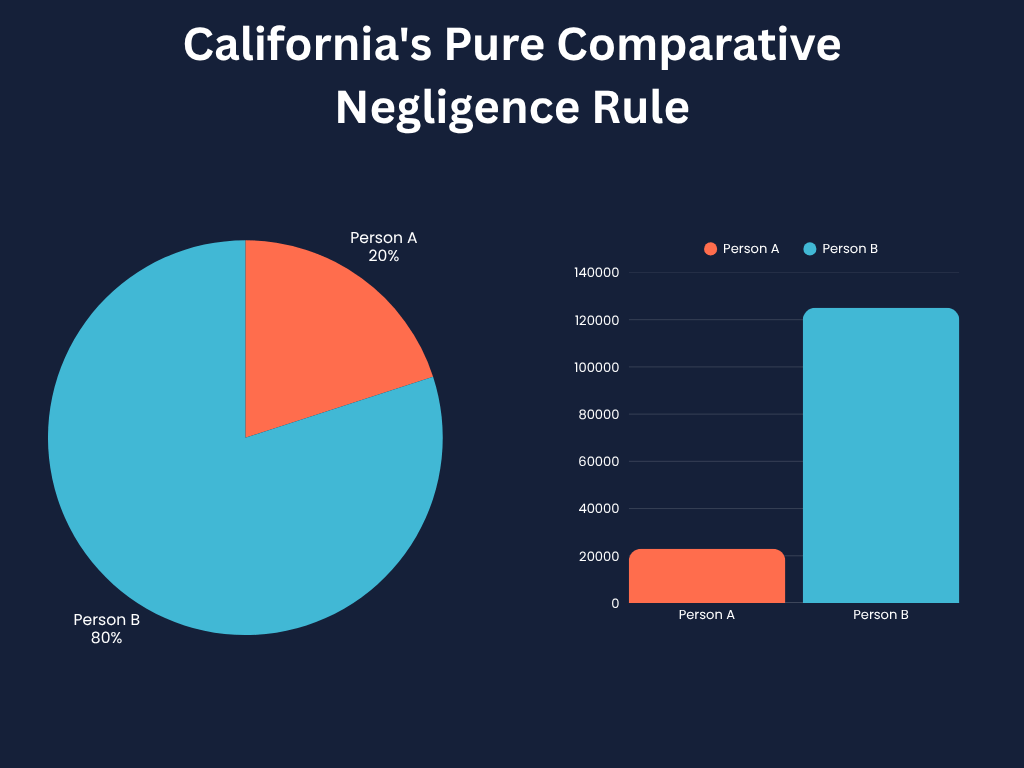
California operates under a “pure comparative negligence” rule. The negligence policy is crucial for car accident claims in the state. The policy directly impacts how much compensation you can receive if you are found to be partly at fault.
What it Means:
Under pure comparative negligence, your compensation percentage is determined by your fault percentage in the accident. For example:
- You suffered $100,000 in damages but are found to be 20% at fault. So, you will only get $80,000 from the other at-fault party.
- Even if you are 99% at fault, you could theoretically recover 1%.
The pure negligence policy doesn’t bar you from getting compensation entirely. It is different from “contributory negligence” states. Contributory negligence prevents you from making any claims, even if you have minimal fault on your part.
Insurance companies and courts will analyze the evidence to assign a percentage of fault to each party involved. Since it is a lengthy and complex process, the payout takes time.
What Happens If You’re Found Partially at Fault?
The Californian pure comparative negligence policy has multiple consequences. As explained above, your ability to recover damages from the other party is linked to the percentage of your fault in the accident.
However, irrespective of the fault percentage, your insurance provider will still cover the damages of the other parties. Also, most likely, your insurance premium will increase if you are found wholly or partially at fault in the accident.
What Happens to My Insurance After an Auto Accident in California?
Most people are concerned about their insurance premiums after a car accident in California. It depends on whether you were at-fault or no-fault during the accident. Also, it depends on the severity of the compensation claim.
First, the insurance company will investigate the accident, review the police and medical reports, witness assessment, and interrogate you. If you are not at fault, your insurance premium would likely stay unchanged. However, the premium might increase if you were involved in multiple accident scenes.
However, the scenario changes if you were at fault for the accident. Your premium will increase substantially during the next renewal. It will depend on:
- Your driving history
- The severity of the accident
- Insurance company’s specific policies
Types of Compensation in an At-Fault State
In an at-fault state like California, personal injury claims are substantial. The compensation expenses for all damages caused by the negligent driver. These damages can be broadly categorized as “economic” and “non-economic.”
Economic Damages (Quantifiable Losses):
Economic damages are tangible damages that could be directly assessed. It includes medical expenses, lost wages, property damages, and other out-of-pocket expenses.
Medical expenses include costs for ambulance service, hospital stays, doctor’s visits, surgeries, medications, and other related medical services. It even covers long-term medical expenses, if required. Then there is a payout for your lost wages and loss of income opportunities.
Property Damages include the cost to repair or replace your damaged vehicle. It also included your damaged personal property, such as a laptop and smartphone.
Non-Economic Damages (Non-Quantifiable Losses):
Non-economic damages are subjective losses. These are more difficult to assign a specific monetary value to, but are impactful. You can claim compensation for pain and suffering, mental anguish, emotional distress, and loss of consortium. However, you have to prove that these were a direct result of the accident.
How Long Does It Take for a Claim to Settle in California?
Typically, California requires a few weeks to months to settle the claims. However, in case of major accidents and involvement of multiple parties, compensation settlement might take years.
The time required to settle car accident claims in California depends on many factors. Is it a clear or a disputed fault? What is the complexity of the accident? If there is direct traffic footage and evidence, the lawsuit will be resolved soon.
Also, the policies of the insurance companies determine the time taken to settle claims. Some insurance companies might solve it within days, while others may willingly delay it. Also, your personal injury lawyer might suggest that you wait to reach “Maximum Medical Improvement” (MMI) before settling.
How Can a Personal Injury Lawyer Help After an Accident in California?
Technically, you can handle car accident claims yourself. However, insurance companies might lowball your claim. Also, handling the police, the involved parties, and the evidence is too much for you. That’s why you should hire an expert car accident lawyer to tackle everything.
A personal injury lawyer will determine the Statute of Limitations (SOL) for your accident. Also, he will be effective in proving fault and negligence of the other party. The personal injury lawyer will further assess the physical and property damages for you. It’s invaluable to file an accurate claim.
Once the compensation claim is filed, the lawyer will deal with the insurance adjusters on your behalf. Lawyers with good communication and negotiation skills will maximize your payout. It’s crucial since insurance adjusters might lowball you.
Also, if the at-fault party refuses to pay the claim or is uninsured, the lawyer will protect your rights through litigation.
What If the At-Fault Driver is Uninsured?
Almost 17% cars in California are uninsured. It raises a big concern for accidents: “What if the at-fault driver is uninsured?”
In such cases, you can get paid by the Uninsured Motorist (UM). However, your bodily injury coverage policy needs to include the UM to be eligible for payment. You can get up to $30,000 to $60000 for the Uninsured/Underinsured Motorist. At times, the insurance policy of the at-fault driver might be insufficient to cover your compensation claim. In such cases, your Underinsured Motorist (UIM) will cover the expenses. It will be up to your UIM policy limits.
You can file a lawsuit if you don’t have either UM or UIM. The personal injury lawyer will get you the compensation you deserve through court trials.
Proving Fault Under California Car Accident Laws
Since California is an at-fault state, you have to prove that the driver was at fault. Only then can you receive fair compensation. The process includes police reports, witness statements, traffic camera footage, and other relevant evidence.
- Police Reports: Police reports include officers’ observations, diagrams, witness statements, etc.
- Witness Statements: Objective accounts that give a neutral and detailed description of the accident.
- Traffic Camera Footage: Surveillance cameras from nearby businesses or traffic can capture the entire event. It is powerful evidence to prove who was at fault.
- Photographs and Videos: Pictures and videos are necessary to determine bodily injury and physical damage to the plaintiff and the vehicle.
- Medical Records and Bills: Medical records are the best proof of your injuries and the costs associated with your treatment.
- Driver Statements and Vehicle Event Data Recorders (EDRs): Drivers’ statements are always the primary source to prove who was at fault. Also, Modern vehicles have EDRs (“black boxes”) that record data like speed, braking, and steering inputs. It can also be used to prove the fault.
Common Mistakes to Avoid After a Car Accident:
 California traffic rules are stricter than you think. Also, insurance policies can lowball your insurance claims using your unintentional mistakes after a car accident. So, be aware of the mistakes to avoid after a car accident.
- Not Calling the Police: Even for minor accidents, call the police soon.
- Failing to Seek Medical Attention: Don’t delay seeking medical attention. Or else, the insurance company might claim that the injuries weren’t related to the accident.
- Admitting Fault: Never apologize or admit responsibility at the scene.
- Discussing the Accident on Social Media: Don’t share anything about the accident on social media to fall under strict scrutiny.
- Providing a Recorded Statement to the Other Driver’s Insurance: Never give a recorded statement to the other driver’s insurance company. You aren’t obliged to it.
- Signing Anything Without Legal Review: Do not sign any releases or settlement agreements without reviewing them.
- Not Documenting the Scene: Many people fail to take photos and videos of the accident scene, their injuries, and vehicle damage.
- Waiting Too Long to File a Claim: There are strict deadlines (statutes of limitations) for filing personal injury lawsuits.
Statute of Limitations for Filing a Car Accident Claim in California
The Statute of Limitations (SOL) in California is the deadline for filing a claim. It includes different timelines for personal injury and property damage claims.
- Personal Injury Claims: In California, you have two years of statute of limitations for filing a lawsuit and claiming compensation. The deadline starts from the date of the accident.
- Property Damage Claims: For property damage claims (damage to your vehicle), the statute of limitations is generally three years.
- Minors: If the injured party is a minor (under 18), the two-year statute of limitations typically begins once they turn 18.
- Government Entities: If the at-fault party is a government entity, you will get as little as six months of SOL.
How to Deal With Insurance Adjusters After an Accident
Insurance adjusters try their best to lowball the compensation amount. They seek ways to scrutinize your faults and give as little payout as possible. So, you need to be careful and tactful when handling the insurance adjusters.
Be polite in your communication, but always stick to the facts. Follow the instructions of your car accident lawyer and always speak according to his suggestions. Next up, never admit your fault for the accident. It can go completely against you.
Also, for injuries, accident incidents, and other details, don’t speculate. Just tell as much detail as you know about the accident. Show your documents and evidence to the insurance adjusters to prove your non-fault position.
Last but not least, consult an expert personal injury lawyer. The lawyer will negotiate with your insurance adjuster and ensure your peace of mind.
Frequently Asked Questions:
- Is California a no-fault state?
No, California is not a no-fault state. It follows an at-fault insurance system. So, the at-fault driver is responsible for paying the compensation from his insurance.
- What is the difference between a no-fault and an at-fault state?
In a no-fault state, each driver’s insurance covers their damages and medical expenses. In an at-fault state, the at-fault party compensates the injured party for damages.
- Can I file a claim if I am at fault in the accident?
Yes, you can file a claim for damages even if you are partially at fault for the accident. It’s because California has a pure comparative negligence policy.
- What does comparative negligence mean in California?
“Pure comparative negligence” rule means that even a partially at-fault party will receive compensation. The percentage of the fault determines the claim.
- Do I need a lawyer for my car accident claim in California?
Although legally not required, a car accident lawyer will ensure your maximum compensation. They can handle all the legal processes for the payout, allowing you to concentrate on injury recovery and mental peace.
Conclusion
California follows an at-fault insurance system for compensating victims of car accidents. That’s why proving our innocence in the accident is critical for maximizing the compensation. Regarding this, hire an expert personal injury lawyer to deal with the insurance adjusters.
Also, follow the statute of limitations for car accidents. Otherwise, your delays in filing the claim lawsuit will render your case null and void. So, be prompt and take the initiative instead of panicking after a car accident in California.

Emery Brett Ledger brings 28+ years of experience to personal injury law. He founded & led The Ledger Law Firm in securing over $100 million in compensation for clients with life-altering injuries & complex claims. Prior results do not guarantee a similar outcome. Licensed in California, Texas, & Washington, Emery earned his law degree from Pepperdine University School of Law. His practice areas include car & truck accidents, wrongful death, catastrophic injuries, maritime claims, & mass tort litigation. He has been recognized by The National Trial Lawyers’ Top 100, Mass Tort Trial Lawyers Top 25, and America’s Top 100 Personal Injury Attorneys. Emery also received the 2025 Elite Lawyer Award & holds a perfect 10.0 Avvo rating with Platinum Client Champion status. His legal work has been featured on CNN, Forbes, NBC, & ABC.
Free Case Evaluation
Recent Posts
- Punitive Damages in a Car Accident: When Can You Recover Them?
- Tailgating Injury: What Causes Tailgating, Road Rage & How to Stay Safe
- Waiting to Call a Lawyer Can Hurt Your Case: Evidence, Deadlines & Legal Risks
- What Is Property Damage in a Car Accident? Claims, Costs & Who Pays
- Bodily Injury & Property Damage: Coverage, Claims, Liability & Compensation
Emery Brett Ledger brings 28+ years of experience to personal injury law. He founded & led The Ledger Law Firm in securing over $100 million in compensation for clients with life-altering injuries & complex claims. Prior results do not guarantee a similar outcome. Licensed in California, Texas, & Washington, Emery earned his law degree from Pepperdine University School of Law. His practice areas include car & truck accidents, wrongful death, catastrophic injuries, maritime claims, & mass tort litigation. He has been recognized by The National Trial Lawyers’ Top 100, Mass Tort Trial Lawyers Top 25, and America’s Top 100 Personal Injury Attorneys. Emery also received the 2025 Elite Lawyer Award & holds a perfect 10.0 Avvo rating with Platinum Client Champion status. His legal work has been featured on CNN, Forbes, NBC, & ABC.