

Is Tylenol Safe for Infants’ Neurodevelopment? Autism Concerns and Potential Legal Claims

For nearly seventy years, Tylenol (acetaminophen) stood as a dependable medicine for pediatric care. Whether for fever, fussing after vaccination, headache, or teething, Tylenol is the first medication most parents reach for their kids. However, as we move through early 2026, a new debate has risen, “Is Tylenol safe for infants’ neurodevelopment?”
Not just in the USA, scientific debates across the globe have questioned the safe use of Tylenol during pregnancy and in kids. Also, US federal regulatory changes have put more pressure on the medicinal use of Tylenol. Several high-stakes legal battles have left many parents wondering: Is Tylenol medicine actually safe?
So, we will try to find out the current status of acetaminophen. We will explore the latest and past neurodevelopmental research and the controversial debate regarding Acetaminophen’s use during pregnancy. Also, we will see what physicians have to say about Tylenol for use in kids.
Is Tylenol Safe for Infants?
We have to understand the basics of acetaminophen to understand the safety issues of Tylenol. So, what is Tylenol or acetaminophen?
Acetaminophen is an analgesic (pain reliever) and antipyretic (fever reducer). As per Drug Bank, its details are:
- Description: A medication used to reduce fever and treat pain.
- DrugBank ID DB00316
- Modality Small Molecule
- Patents 37
- Indicated Conditions 59
Unlike ibuprofen (Advil or Motrin), acetaminophen is not an anti-inflammatory medicine. Tylenol (Acetaminophen is its main ingredient) works primarily in the central nervous system. So, it blocks pain signals and resets the body’s internal thermostat.
The body then feels relieved from the pain. Physicians recommend it to relieve pain and suffering due to high fever, headache, and other physical pains. Also, it has become a staple medicine among pregnant women to relieve pain.
Infant Tylenol Safety?
Current Medical Standing (2026)
As the debate about Tylenol’s safety keeps increasing, major medical bodies have researched it. These include the American Academy of Pediatrics (AAP) and the World Health Organization (WHO). As per their findings, Tylenol remains safe for infants when used correctly. However, the definition of “correctly” has shifted from “whenever the baby is uncomfortable” to “only when medically necessary.”
Earlier, there were no such preconditions on the use of Tylenol. However, this recent update as the “only when medically necessary,” has further sparked the debate.
Can Newborns Take Infant Tylenol?
The safety profile of Tylenol use for newborns (babies under 3 months) is very strict:
- 0–12 Weeks: You should never give Tylenol to a newborn. It is usable only when a pediatrician has specifically told you to apply Tylenol for newborns. A fever, 100.4°F or higher, in a newborn is a medical emergency. If you mask the fever with Tylenol, it can hide a life-threatening infection. So, doctors may not treat the newborn baby properly.
- Dosing is Everything: High doses of Tylenol might be harmful for the liver. On top of it, an infant’s liver is still developing. Thus, you must be conscious in using Tylenol for kids. If it is used beyond the recommended level, it could lead to toxicity. You must calculate the doses according to the child’s current weight, not their age.
Is Tylenol Safe for Infants’ Neurodevelopment?:The Autism and ADHD Concerns
The most significant controversy surrounding Tylenol today involves its potential link to neurodevelopmental disorders. It is specifically linked with Autism Spectrum Disorder (ASD) and Attention-Deficit/Hyperactivity Disorder (ADHD), which has sparked concerns among parents.
As of February 2026, the scientific community is largely divided into two camps about the safety of Tylenol and its neurodevelopmental problems:
- The “Association” Camp: Some researchers point to large-scale data about the use of Tylenol during pregnancy among women. They try to show that children exposed to frequent acetaminophen in the womb or early infancy have higher rates of ASD and ADHD diagnoses. The association camp further argues that Tylenol may cause “oxidative stress” or disrupt hormones that guide brain growth. So, the brain may not develop and cause ASD or ADHD issues.
- The “Confounding” Camp: In 2024, a landmark study of 2.5 million children in Sweden (the “Swedish Study”) changed the conversation about Tylenol and its associated link with child autism. Researchers looked at siblings where one child was exposed to Tylenol and the other wasn’t. They found that the increased risk disappeared when comparing siblings. The research suggests that the risk isn’t from the Tylenol itself. Instead, the risk came from the family’s genetics or the underlying illness, including severe infection.
We have to understand that there is a statistical “association” of Tylenol with childhood autism. However, there is currently no proven causal link between the use of Tylenol during pregnancy and autism in kids. Yet, we suggest pregnant women stay alert and follow the physician’s recommendation. Never take Tylenol more than the recommended dosage, and ensure you don’t take it for a long period as well.
The Theory of Harm
Some scientists believe that acetaminophen crosses the placental barrier during pregnancy. It also crosses the blood-brain barrier (in infancy). Thus, these scientists suggest Tylenol might interfere with brain development. It can cause:
- Inducing Oxidative Stress: Tylenol might damage brain cells through chemical reactions, in the rarest cases.
- Hormonal Disruption: The medicine interferes with the hormones that tell a baby’s brain how to grow and connect. So, the brain might not grow and work properly due to the interference.
- Metabolic Interference: Some children may have a genetic inability to break down acetaminophen safely. It could lead to a “toxic buildup” in the brain.
The 2024 “Swedish Study” vs. The 2025 “Mount Sinai Study”
In 2024, the Swedish Study completed a massive study of 2.5 million children in Sweden. It seemed to settle the debate about the safety of Tylenol among kids. The study looked at siblings, with two conditions:
- One child took Tylenol
- The other child didn’t take Tylenol
As the researchers analyzed the data, they found no link between Tylenol use and autism. They concluded that the “risk” was actually tied to the mother’s genetics or the previous illness she had. The cause of the autism was not the medicine itself.
However, in late 2025, a new study from Mount Sinai and Harvard used a “gold-standard” review method. They look at 46 different studies about Tylenol, its safety, and uses. They found that the higher-quality studies did show a 20% to 30% increased risk of ADHD and autism. It was especially apparent with prolonged use of Tylenol. These back-and-forth data differences and variations in scientific opinions have left the medical community in a stalemate.
The Pregnancy Debate—The New “Precautionary” Era
Perhaps the most sensitive part of the Tylenol and its safety debate involves pregnant women. For decades, people thought Tylenol was the only pain reliever that was safe during pregnancy. Aspirin and Ibuprofen are known to cause birth defects and heart issues in fetuses. But Tylenol didn’t have such controversies for decades. But now, with new research and studies, the opinion is at risk.
A Political and Medical Shift
In September 2025, the debate about Tylenol and its possible link to autism moved from the lab to the White House. High-level government officials, including HHS Secretary Robert F. Kennedy, issued warnings about Tylenol. They advised doctors to be more cautious about recommending Tylenol to pregnant women.
Expectant mothers now face a difficult choice:
- If they take Tylenol: They worry about unproven links to autism.
- If they don’t take Tylenol: When women remain sick with an untreated high fever during pregnancy, it can be dangerous too. It can cause birth defects like spina bifida and can lead to preterm labor.
- No other options: There are currently no other safe over-the-counter pain meds safe for pregnancy.
In 2026, the official advice from the FDA is, “Use Tylenol only if necessary, at the lowest dose, for the shortest time.” Most doctors now prescribe non-drug options first. It could be cold compresses for headaches or rest for minor aches.
What the New Labels Say
The new suggested labels for Tylenol do not say “This causes autism.” Instead, they will now include a “Notice to Physicians” and a “Precautionary Note” for consumers. These updates mean parents should be aware of the “body of evidence.” The new labeling further suggests that there might be a correlation with neurodevelopmental issues.
Global Disagreement
Interestingly, the United States is currently in a different condition. Till now, health agencies in the UK, Europe, and Australia have not changed their labels for Acetaminophen use. The health agencies, including WHO, continue arguing that Tylenol is still safe enough for pregnant women. The American move came from political pressure and legal fear rather than solid, reproducible science.
The Tylenol Autism Lawsuits (MDL 3043)
In the past few years, Tylenol and its manufacturer, Kenvue, originally Johnson & Johnson, have faced multiple backlashes and legal steps for their possible link to autism. It is now part of one of the largest “mass tort” litigations in U.S. history.
The History of the Lawsuit
The Tylenol lawsuits began in 2022. The claims were against the major manufacturers like Kenvue (Johnson & Johnson) and retailers like Walmart and CVS. The parents argue that these companies knew about the potential risks of using Tylenol during pregnancy. Yet they failed to warn mothers.
The 2024 “Death” of the Lawsuit
In December 2023, a federal judge (Denise Cote) ruled that the plaintiffs’ scientific experts about Tylenol’s association with autism were “unreliable.” She essentially said their science didn’t meet the high bar required for a courtroom. So, the court dismissed the plaintiff’s claim.
The 2025-2026 “Revival”
As of February 2026, the litigation is in a “waiting game”:

- The Second Circuit Appeal: Lawyers have appealed the judge’s dismissal. In late 2025, appellate judges were skeptical of the original dismissal. A decision is expected later this year.
- State Court Action: Lawyers are moving cases to state courts in California and Illinois. In these two states, the rules for “science” are sometimes more flexible, which could be a big boost.
- Potential Settlements: If successful, settlements for a child with severe autism could range from $300,000 to $500,000+.
A major breakdown came when Attorney General of Texas, Paxton, sued Tylenol manufacturer, saying:
“Big Pharma betrayed America by profiting off of pain and pushing pills regardless of the risks. These corporations lied for decades, knowingly endangering millions to line their pockets,”
Immediate Side Effects and Safety Risks
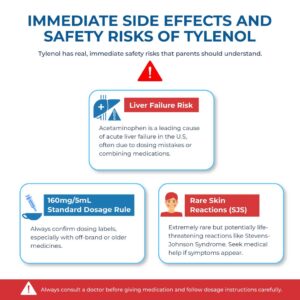
Besides the autism debate, Tylenol has real, immediate side effects. As a parent, you must know about these side effects.
- Liver Failure: Acetaminophen is the leading cause of acute liver failure in the United States. Primarily, dosing error is the main reason for it, as parents often use medication that also contains acetaminophen.
- The 160mg/5mL Standard: Always follow the 160mg per 5mL rule for mediation. So, if you buy off-brands or older medicines, check the labeling properly.
- Rare Skin Reactions: Conditions like Stevens-Johnson Syndrome (SJS) when using Tylenol are extremely rare. But it could be life-threatening. So, consult doctors if you see any symptoms of it.
FAQs About Is Tylenol Safe for Infants’ Neurodevelopment
Is Tylenol safe for my baby?
Yes, Tylenol is still a safer option to treat a high fever. Most doctors believe the advantage of treating high fevers and pain is more than the unproven link with autism.
Does Tylenol cause autism?
There is no scientific proof of a direct link between the use of Tylenol and autism. Some studies have only found a possible (not sure enough) statistical association between Tylenol and autism in kids. It requires more research findings.
What did the FDA change on the labels in 2025?
The FDA is going to add a notice with the new labels. It would suggest that some studies show a link between long-term use during pregnancy and autism/ADHD. The new labels will encourage parents to use Acetaminophen “judiciously.”
I took Tylenol every day while I was pregnant. Should I be scared?
Prolonged use of Tylenol, more than 4-7 days in a row, is not recommended. So, it should be safe if you use it for a short period following your doctor’s suggestion.
Can I give my 2-month-old Tylenol?
Consult your doctor to see if they recommend using Tylenol for your 2-month-old child. Usually, Tylenol isn’t recommended for children under 12 weeks.
What is the safest dose?
The safest dose of Tylenol depends on the user’s weight. A safe dose of Tylenol is typically 15mg for every 1 kilogram (2.2 lbs) of body weight. However, we suggest you to check the chart box for a better idea.
Is there a safer alternative?
For babies under 6 months, there is no other over-the-counter pain medicine. For babies over 6 months, Ibuprofen (Advil/Motrin) is an option. But its side effects can cause stomach upset.
Why are there so many Tylenol lawsuits?
The lawsuits claim that the company Kenvue, originally J&J, failed to warn pregnant women about the potential risk of autism. So, they have filed so many lawsuits, making it one of the largest in US history.
Can I get money from a Tylenol settlement?
As of early 2026, the court hasn’t declared any settlements for Tylenol cases. We are also waiting to see the updates about the Tylenol lawsuit and how the settlements work.
How many doses can I give in one day?
You are allowed to give 5 doses of Tylenol in 24 hours. Also, there should be 4 to 6 hours of gap between each dosage.
Conclusion
Is Tylenol safe for infants? Does it really cause any neurodevelopment in a child? These questions are still to be answered clearly. Although White House and the FDA have issued cautions about the use of Tylenol, many health organizations say it was politically motivated. So, we suggest you follow your doctor’s suggestion for using Tylenol.

Emery Brett Ledger brings more than 27 years of experience to personal injury law. He founded & led The Ledger Law Firm in securing over $100 million in compensation for clients with life-altering injuries & complex claims. Licensed in California, Texas, & Washington, Emery earned his law degree from Pepperdine University School of Law. His practice areas include car & truck accidents, wrongful death, catastrophic injuries, maritime claims, & mass tort litigation. He has been recognized by The National Trial Lawyers’ Top 100, Mass Tort Trial Lawyers Top 25, and America’s Top 100 Personal Injury Attorneys. Emery also received the 2025 Elite Lawyer Award & holds a perfect 10.0 Avvo rating with Platinum Client Champion status. His legal work has been featured on CNN, Forbes, NBC, & ABC.
Free Case Evaluation
Recent Posts
- Do Cars Have Black Boxes? What a Car Black Box Records and How It Can Help After an Accident
- Can AI Chatbot Conversations Be Used Against You in a Personal Injury Case? What to Know About AI Chat Privacy and Privilege
- How to Win a Left Turn Accident Case: Fault, Right of Way, Evidence & Compensation
- What to Do After a Pedestrian Accident: 10 Essential Steps to Protect Your Health and Claim
- Who Is at Fault in a Self-Driving Car Accident? Liability, Insurance, and Self-Driving Car Crash Injury Claims
Emery Brett Ledger brings more than 27 years of experience to personal injury law. He founded & led The Ledger Law Firm in securing over $100 million in compensation for clients with life-altering injuries & complex claims. Licensed in California, Texas, & Washington, Emery earned his law degree from Pepperdine University School of Law. His practice areas include car & truck accidents, wrongful death, catastrophic injuries, maritime claims, & mass tort litigation. He has been recognized by The National Trial Lawyers’ Top 100, Mass Tort Trial Lawyers Top 25, and America’s Top 100 Personal Injury Attorneys. Emery also received the 2025 Elite Lawyer Award & holds a perfect 10.0 Avvo rating with Platinum Client Champion status. His legal work has been featured on CNN, Forbes, NBC, & ABC.
