

Top 3 Tesla Accident Newport Beach and Nearby Locations: An In-depth Look
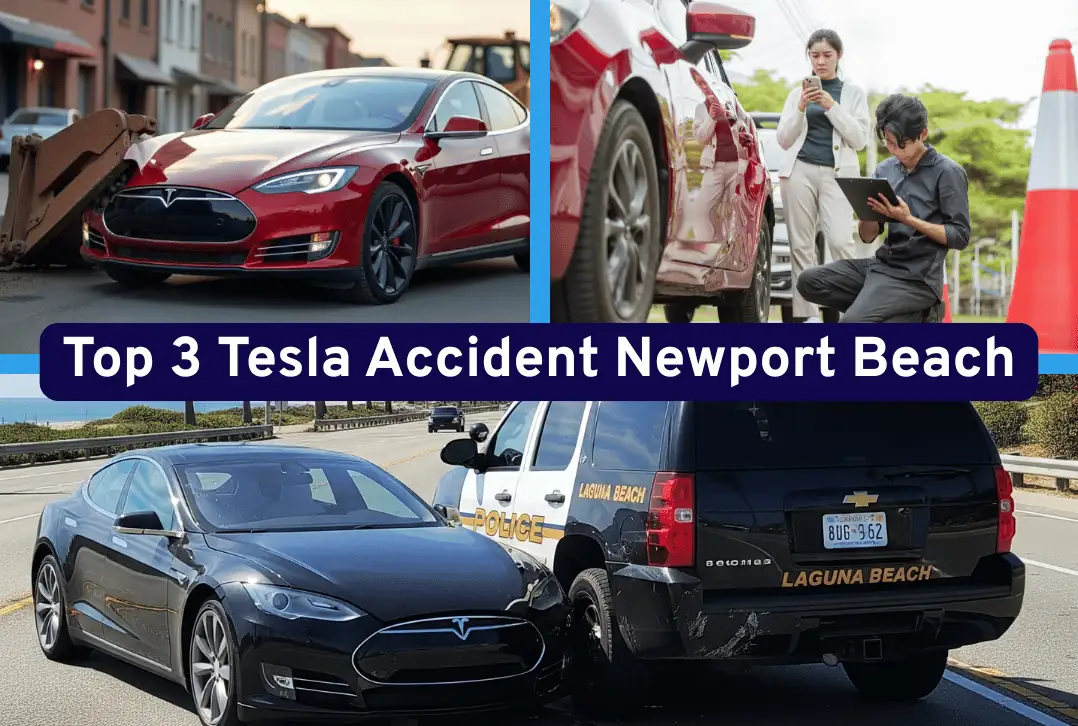
Newport Beach and its PCH have recently been the subject of arguments about automotive and EV safety. The top Tesla accident Newport Beach has further fueled the argument. No doubt, Tesla EVs have cutting-edge technology and a sleek design. Yet, in recent times, it has been part of a few high-profile accidents.
The May 2022 fatal collision and the Tesla hitting the back of a bus in 2021 were the two most infamous cases. Following it, federal authorities have started investigating Tesla’s safety features and autopilot system.

Top 3 Tesla Accident Newport Beach and Nearby Locations
Tesla is a relatively safer car to drive. However, in the recent past, Newport Beach has seen a few Tesla accidents. It has sparked a new argument about it.
The May 2022 Fatal Collision

On the morning of May 12, 2022, a Tesla S Plaid struck a curb at high speed. It then slammed into construction equipment. The accident took place on Pacific Coast Highway near Newport Boulevard.
All three occupants in the Newport Beach Tesla accident were killed immediately. It included Crystal McCallum, Andrew James Chaves, and Wayne Walter Swanson Jr. The crash also left three construction workers with minor injuries.
Both national and local attention were on the accident. People raised immediate questions about the role of the vehicle’s technology in the crash. The Newport Beach Police Department, along with federal agencies, launched a comprehensive investigation. The investigation concluded that speeding was responsible for the crash. It said, “in great excess of the speed limit.”
Data retrieved from the vehicle’s onboard computer confirmed that the Autopilot system was not engaged. Also, the driver was in full control.
The December 2021 Bus Crash
Another horrific Newport Beach Tesla accident took place on December 11, 2021. A Tesla Model S rear-ended a city bus directly. The accident was on East Coast Highway and Cameo Shores.
The Newport Beach Fire Department responded to the accident. It was later declared a multi-casualty incident. The front-end of Tesla was seen extensively damaged in the photos. The bus had only minor damage.
The crash prompted immediate discussion about driver-assistance systems of Tesla. Police started a probe into the Autopilot or Automatic Emergency Braking of the vehicle. The safety features were a major concern because it occurred in daylight and on a major road.
The 2018 Laguna Beach Police Car Crash

Although the 2018 Laguna Beach car crash was not entirely in Newport Beach, it was a talk of the town. In May 2018, a Tesla Model S crashed into a parked Laguna Beach Police Department SUV. It was only a few miles away from Newport Beach, Pacific Coast Highway (PCH).
Luckily, the police vehicle was unoccupied at the time. The Tesla driver sustained minor injuries. The driver told police that the car was in Autopilot mode. The incident on Laguna Canyon Road quickly gained attention.
This California Tesla car accident was among 28 nationwide accidents that involved the Tesla Autopilot system. The case is a key example of the challenges and limitations of the Autopilot.
| Accident Date | Location | Tesla Model Involved | Key Details | Autopilot Status |
| May 12, 2022 | Pacific Coast Highway near Newport Boulevard | Tesla S Plaid | Struck a curb at high speed, then slammed into construction equipment. | Not engaged |
| December 11, 2021 | East Coast Highway and Cameo Shores | Tesla Model S | Rear-ended a city bus directly. | Under discussion |
| May 2018, 2018 | Pacific Coast Highway, Laguna Beach | Tesla Model S | Crashed into a parked Laguna Beach Police Department SUV. | Driver claimed engaged |
Broader Investigations into Stationary Object Collisions
Beyond these specific Tesla accidents in Newport Beach, the nationwide trend of Tesla-involved accidents is under federal investigation. The National Highway Traffic Safety Administration (NHTSA) has investigated numerous crashes of Tesla vehicles.
In 28 cases, Tesla was allegedly operating on Autopilot and collided with stationary objects. It crashed into emergency vehicles and road barriers. These accidents show a key vulnerability in Autopilot and the object-detection system of Tesla.
Tesla’s Safety Features and Autopilot Investigations
The nationwide accidents of Tesla sparked an argument about its safety features and autopilot system. So, federal authorities have started investigations into it.
Core Safety Features and the Autopilot System
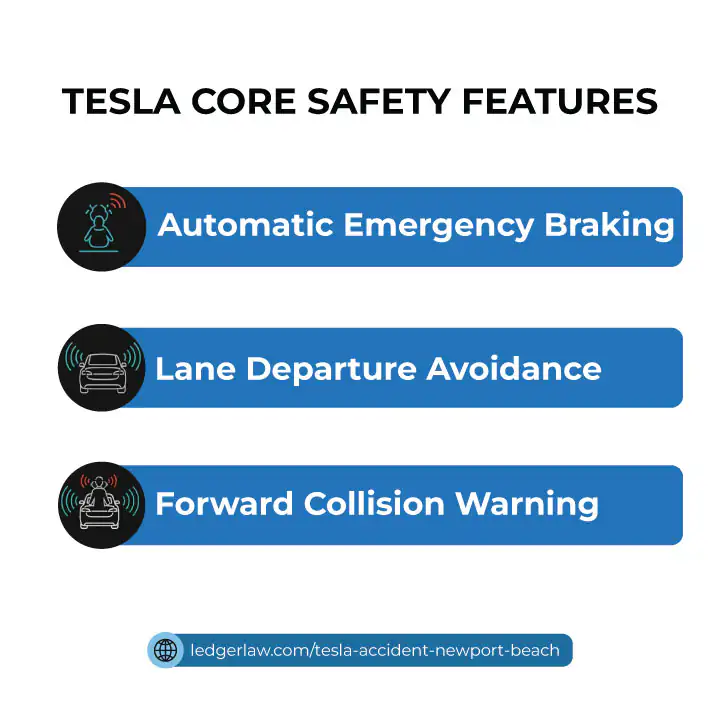
Tesla’s vehicles include technologies to prevent or mitigate the severity of accidents. It includes:
- Automatic Emergency Braking
- Forward Collision Warning
- Lane Departure Avoidance.
Also, its Autopilot or driver-assistance system includes Traffic-Aware Cruise Control and Autosteer. However, Tesla states that Autopilot is not a fully autonomous system. So, the drivers must be attentive and keep their hands on the wheel.
Federal Investigations and Scrutiny
The National Highway Traffic Safety Administration (NHTSA) has been investigating numerous Tesla crashes. The accidents involved advanced driver-assistance systems. The probe found that out of 34 alleged cases involving Autopilot, 28 were from Tesla.

Legal and Insurance Implications of Tesla Accidents
The claims involving driver-assistance systems like Autopilot are complex. The at-fault party involves multiple parties. Of course, the primary liability falls on the at-fault driver. However, victims and their legal teams often file cases against the vehicle manufacturer. It includes an investigation on:
- System malfunction
- Manufacturing defect
- Inadequate warnings
In some cases, lawsuits have been filed against Tesla. The outcomes of these cases depend on proving that the system was a contributing factor. In fact, on August 2, 2025, a Florida Jury ordered $329 million in compensation to a claimant. The Tesla Autopilot system was found responsible for the wrongful death.
What To Do If Involved in a Tesla Accident
Did you find yourself in a Tesla accident? If so, follow our suggested steps to ensure your safety and protect your rights. It’s also essential to maximize your compensation claims.
- Check for Injuries and Call for Help: Check for injuries. Call 911 if anyone is hurt.
- Secure the Scene: Move your vehicle to a safe location if possible. Also, turn on your hazard lights.
- Document the Scene: Document the scene thoroughly. So, take photos and videos of the damage, the road, and any other relevant details.
- Gather Information: Exchange information with all parties involved in the accident. Also, file a police report, especially for significant damage or injury.
- Retrieve Vehicle Data: Tesla is equipped with Event Data Recorders (EDRs). Some models have Sentry Mode footage. So, the vehicle data can be invaluable for an investigation.
- Contact Professionals: Contact your insurance provider and an attorney. It is particularly crucial if you suspect a vehicle defect caused the crash.
- Seek Tesla-Certified Repairs: Always repair the vehicle from a Tesla-certified repair center.
Frequently Asked Questions
- Was the Tesla Autopilot system involved in the May 2022 Newport Beach crash?
No, the National Highway Traffic Safety Administration (NHTSA) concluded that the Autopilot system was not engaged at the time of the collision. It was fully under the control of the driver.
- How do Tesla’s safety features compare to other vehicles?
Tesla’s vehicles have a reputation for high safety ratings. It includes both active and passive safety features. It includes a rigid body structure and a low center of gravity. Thus, Tesla has consistently received 5-star safety ratings from the NHTSA.
- How many fatal accidents have Tesla cars been in?
Till August 08, 2025, Tesla cars have been involved in 734 deaths. 59 of them were caused by the Autopilot system.
- What happens to the data after a Tesla accident?
Tesla cars are equipped with an Event Data Recorder (EDR). It records a snapshot of data (such as speed, braking, and system status) in a crash or near-crash event. It is possible to retrieve the data to determine the circumstances of an accident.
- How many car accidents are caused by Tesla?
In 2024, Tesla experienced 26.67 accidents per 1000. It was up from 23.54 from the last year, as Forbes reported. It was the highest accident record for any Auto brand in the USA.
- Are Tesla drivers covered by insurance after an accident?
Yes, most standard car insurance policies provide coverage for accidents involving Tesla. It doesn’t depend on whether or not a driver-assistance system was in use. Some insurers may even offer specialized policies or discounts.
- What should I do if I am involved in a Tesla accident?
The steps to follow after a Tesla car accident are similar to any car accident: ensure everyone is safe, call 911 if there are injuries, and document the scene with photos and videos. Also, then, exchange information with other parties. Moreover, seek legal counsel to protect your rights.
- Can Tesla’s Autopilot system prevent all accidents?
No. Autopilot is a driver-assistance system, not a fully autonomous one. The driver must remain attentive and prepared to take control at all times. The Autopilot system has limitations and cannot prevent every accident.
Conclusion
Tesla accidents Newport Beach suggest the importance of road safety and the application of the law. Like Tesla, more vehicles are now being automated. As Autopilot becomes more popular, stricter restrictions are necessary. Additionally, the technology should be improved to ensure better safety.
And if you suffer from any Tesla car accident, contact us at (949) 377-1111. We offer a free case evaluation on a contingency fee basis.

Emery Brett Ledger brings 28+ years of experience to personal injury law. He founded & led The Ledger Law Firm in securing over $100 million in compensation for clients with life-altering injuries & complex claims. Prior results do not guarantee a similar outcome. Licensed in California, Texas, & Washington, Emery earned his law degree from Pepperdine University School of Law. His practice areas include car & truck accidents, wrongful death, catastrophic injuries, maritime claims, & mass tort litigation. He has been recognized by The National Trial Lawyers’ Top 100, Mass Tort Trial Lawyers Top 25, and America’s Top 100 Personal Injury Attorneys. Emery also received the 2025 Elite Lawyer Award & holds a perfect 10.0 Avvo rating with Platinum Client Champion status. His legal work has been featured on CNN, Forbes, NBC, & ABC.
Free Case Evaluation
Recent Posts
- Punitive Damages in a Car Accident: When Can You Recover Them?
- Tailgating Injury: What Causes Tailgating, Road Rage & How to Stay Safe
- Waiting to Call a Lawyer Can Hurt Your Case: Evidence, Deadlines & Legal Risks
- What Is Property Damage in a Car Accident? Claims, Costs & Who Pays
- Bodily Injury & Property Damage: Coverage, Claims, Liability & Compensation
Emery Brett Ledger brings 28+ years of experience to personal injury law. He founded & led The Ledger Law Firm in securing over $100 million in compensation for clients with life-altering injuries & complex claims. Prior results do not guarantee a similar outcome. Licensed in California, Texas, & Washington, Emery earned his law degree from Pepperdine University School of Law. His practice areas include car & truck accidents, wrongful death, catastrophic injuries, maritime claims, & mass tort litigation. He has been recognized by The National Trial Lawyers’ Top 100, Mass Tort Trial Lawyers Top 25, and America’s Top 100 Personal Injury Attorneys. Emery also received the 2025 Elite Lawyer Award & holds a perfect 10.0 Avvo rating with Platinum Client Champion status. His legal work has been featured on CNN, Forbes, NBC, & ABC.