Texas Crash Report: How to Find, Verify, and Use Your CR-3 or Local Record

Start by identifying the record connected to your Texas crash
The CR-3 is the Texas Peace Officer’s Crash Report that officers use to report qualifying crashes to the Texas Department of Transportation, or TxDOT. TxDOT is the custodian of Texas crash records, so the first question is whether law enforcement investigated your collision and whether the event falls within the reporting rules.
In Texas, an investigating law enforcement officer must make a written report when a collision causes an injury, a death, or apparent property damage of $1,000 or more to one person’s property. The required report must be filed electronically with TxDOT no later than the 10th day after the collision. That filing rule describes the officer’s duty; it does not mean that the report will be available for you to download immediately.
Start with the basic facts you already have:
- The date and approximate time of the collision.
- The road, intersection, city, or county where it occurred.
- The agency that investigated it.
- The names of the drivers, if you received them.
- Whether anyone was injured and whether a commercial truck, delivery vehicle, or rideshare vehicle was involved.
Those details help you distinguish the record connected to your collision from a different event at the same location. If an officer investigated an injury crash, a death, or a crash involving apparent property damage of at least $1,000 to one person’s property, look first for the CR-3 rather than assuming a driver-completed form is the record TxDOT holds.
Separate a CR-3 from a driver or local-agency record
The CR-3 and Form CR-2 serve different practical purposes, and the record you received at the scene may not be the record available through TxDOT. If an investigated crash involved neither an injury nor property damage, the report did not need to be submitted to TxDOT. That situation can leave you with a local-agency record or another document instead of a TxDOT-held CR-3.
TxDOT says it no longer retains or provides copies of the Driver’s Crash Report, Form CR-2, and no longer hosts the form. If you received a CR-2 or a similar local-agency form after a crash that a police officer did not investigate, retain it for your records. Do not discard it merely because you cannot find a copy in the state system.
Local instructions can differ. For example, Fort Bend County says Form CR-2 is available online for a crash with no bodily injuries and estimated damage under $1,000, and it tells you to retain the completed form because TxDOT no longer accepts it from individuals. That county-specific description should not be treated as proof that every Texas agency uses the same process.
Use this branch when deciding what to seek:
- Police investigation with qualifying injury, death, or property damage: look for the CR-3 through the TxDOT process and keep any local paperwork with it.
- No police investigation or no qualifying condition: preserve the form or incident record provided by the local agency, and ask that agency how it keeps or releases records.
- A commercial-truck, delivery-van, or rideshare collision: keep the report connected to your own notes and other evidence because the state report may not contain every record held by a driver, employer, fleet, platform, or insurer.
Request the CR-3 through the official Texas channel
The TxDOT Crash Report Online Purchase System is the channel for obtaining a Texas crash report; use that system rather than an insurer or private crash-report website. Start from TxDOT’s crash-records information and follow the request instructions displayed there, because access methods and fees may change.
Plan for the information and choices the request process may present. Keep your crash date, location, investigating agency, and identifying details nearby so you can distinguish the correct event. The request process may offer a choice between a certified and uncertified copy.
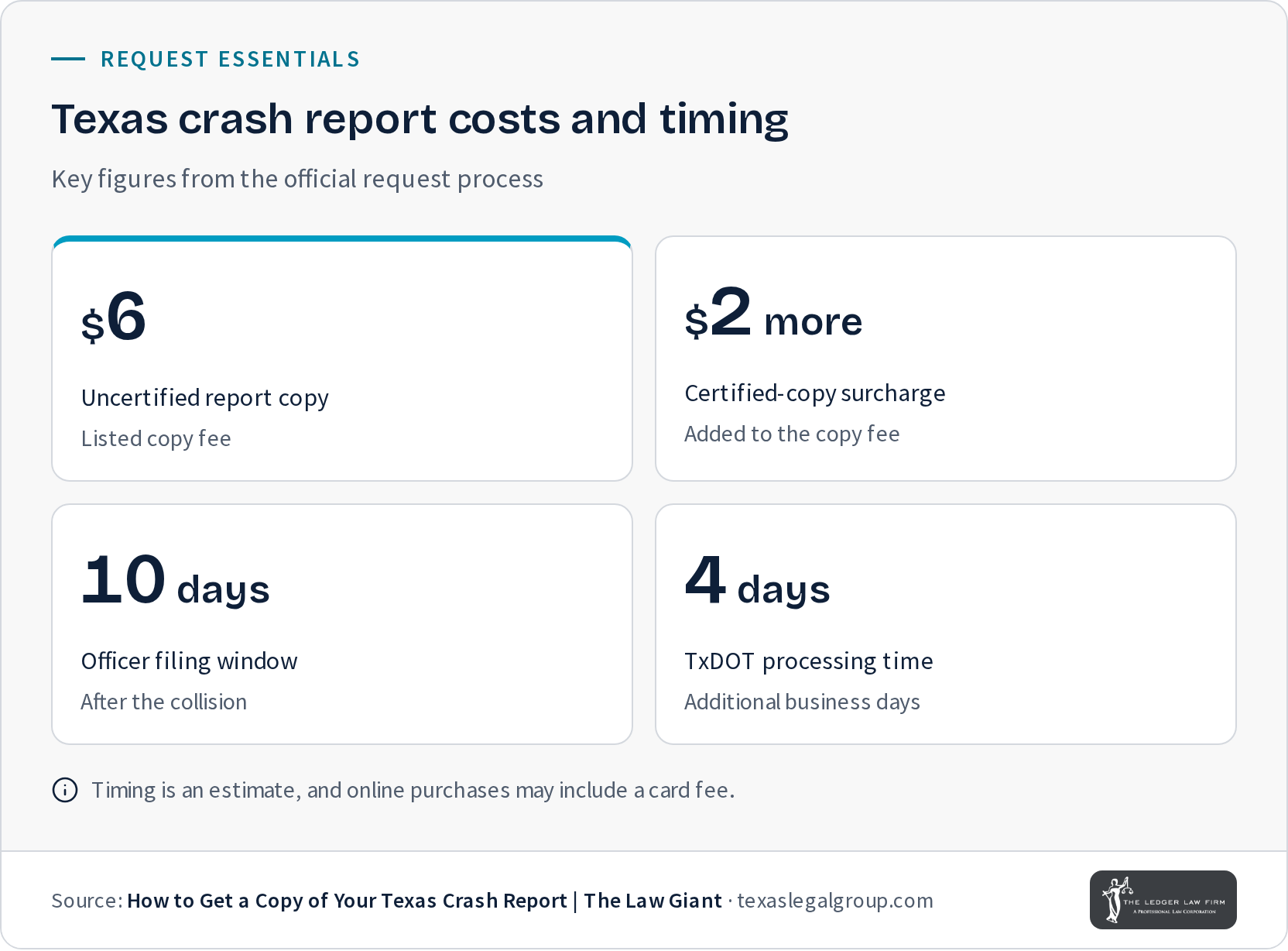
A copy costs $6, and a certified copy costs $2 more. Online purchases may also include a small card fee. Access to a full report can therefore depend on your relationship to the collision.
Timing also requires patience. The officer has no later than the 10th day after the collision to file a required report, and TxDOT may take up to 4 more business days to process it before it appears online. That is an estimate, not a promise of immediate availability. Handle medical needs, insurer notices, vehicle storage decisions, and other time-sensitive tasks without waiting for the CR-3 to appear.
Match the report to your collision before relying on it
A report-match check helps you avoid organizing your claim file around the wrong collision, an incomplete record, or a later supplement that you have not seen. Compare the report with your own records before relying on any description of what happened.
Check these points:
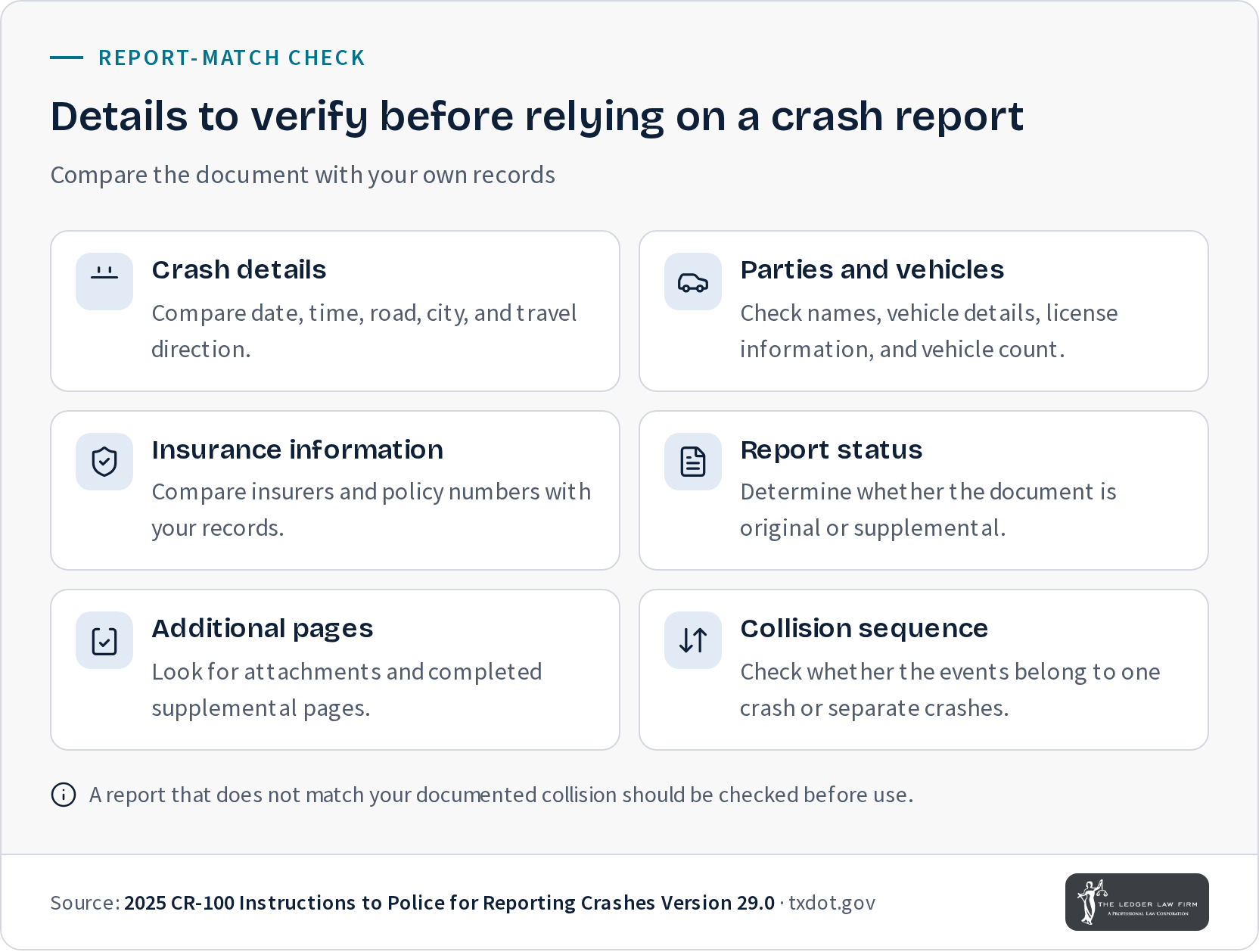
- Crash details: Compare the date, approximate time, road or intersection, city, and direction of travel with your notes, photographs, vehicle records, and messages.
- Involved parties and vehicles: Check names, vehicle descriptions, license information if shown, and the number of vehicles against what you remember and what your paperwork identifies.
- Insurance information: An unredacted report records each driver’s insurance company and policy number. Compare those entries with insurance cards, claim correspondence, and the information you received after the collision.
- Report status: Determine whether the document is an original report or a supplement. CRIS treats a report not marked “supplement” as an original report.
- Additional pages: A supplemental report must be completed in its entirety, including data fields completed on the original report. Look for pages or attachments that may be part of the same record.
- Collision sequence: Texas reporting instructions generally treat a chain reaction at one location and within a short time as one crash unless a stabilized situation establishes separate crashes. Events definitively separated by time or place are reported separately.
A Texas State University police page says a crash report can take up to 14 days from the crash date to appear online. Use that statement as a planning estimate rather than proof that your particular report will be available by a certain day. If the record does not match the date, location, parties, vehicles, or sequence you documented, pause before treating it as the record for your collision and contact the investigating agency about the discrepancy.
Read the report as an account, not a final fault decision
The CR-3 is an account prepared from an investigation, not a final answer to every question about responsibility, compensation, or the strength of a claim. Contributing factors and vehicle defects are recorded as the investigator’s opinion. The order in which contributing factors appear does not assign percentages of responsibility, and civil responsibility still requires the evidence and applicable law.
Read each entry for what it actually says:
- A listed contributing factor identifies an opinion recorded in the report; it does not mean that the factor caused a particular percentage of the collision.
- A vehicle-defect entry identifies the investigator’s opinion about that issue; it does not replace inspection records, repair records, photographs, testimony, or other relevant information.
- An officer’s opinion about who caused the crash is admissible only if the officer is qualified to give it. The report’s presence alone does not resolve every legal question.
- No single piece of evidence wins a case on its own. The CR-3 has to be considered with photographs, medical records, witness information, and other records that explain the event and its effects.
Preserve the report alongside the evidence that gives it context
An evidence file gives the report context that the report itself may not provide. Keep your own account and related evidence, and do not wait for the CR-3 before addressing an insurance notice, a vehicle-storage decision, or another deadline connected to the collision.
Create a simple file with these parts:
- Your account: Write down what you remember about the road, traffic, weather, signals, sequence of impacts, statements at the scene, and what happened afterward. Separate what you personally observed from what someone else told you.
- Scene and vehicle material: Preserve photographs, videos, repair estimates, towing or storage records, and correspondence about the vehicles. Keep the original digital files as well as copies.
- Medical material: Seek prompt medical evaluation because serious harm may not be obvious at the roadside. The evaluation can create a contemporaneous medical record connecting symptoms to the collision. Keep appointment information, instructions, bills, and records in the same organized file.
- Witness information: Keep names and contact details for people who saw the collision or its immediate aftermath, along with notes about what each person observed.
- Digital material: Your phone may contain photos, videos, call logs, texts, location history, and health data that help establish the crash timeline and its aftermath. Back up phone, camera, and app material, but preserve the original files because they may contain metadata showing when and where an image or video was created.
Commercial-truck crashes may involve dash-camera footage, driver logs, dispatch messages, GPS data, inspection records, maintenance files, and electronic-control-module data. Some commercial-truck records may be retained only for a limited period, so a preservation letter can formally demand that relevant evidence be kept intact. If a truck, delivery van, or fleet vehicle was involved, identify those possible records promptly instead of assuming the CR-3 will include them.
Keep a copy of the report with the rest of the file, but do not let the waiting period stop you from preserving evidence or responding to an insurer. The report is one dated document in a larger record.
Address errors through the investigating agency’s correction process
A suspected error in a crash report should be documented and directed to the investigating agency rather than silently edited in your own copy. Examples include a wrong name, insurer, vehicle description, crash detail, or other entry that does not match the records you kept.
Use this correction path:
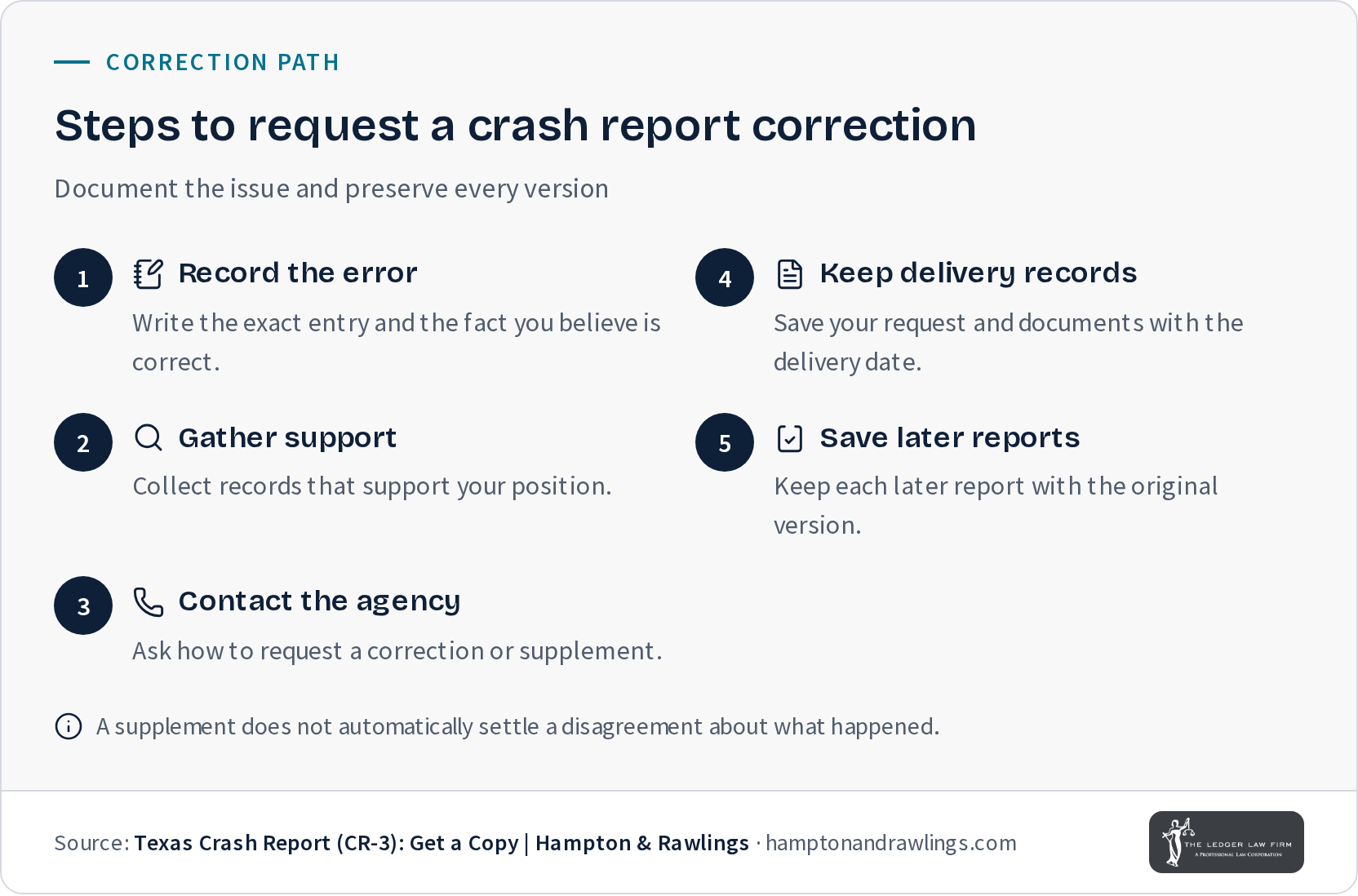
- Write down the exact entry you believe is wrong and the fact you believe should replace it.
- Gather the material that supports your position, such as photographs, insurance documents, vehicle records, witness information, or medical records.
- Contact the investigating agency and ask how to request a correction or supplement.
- Keep a copy of your request and every document you send, along with the date and method of delivery.
- Save any later report with the original so you can see what changed and when.
An amendment or additional information is submitted as a new report marked as a supplemental report, with a new date. Someone other than the officer who prepared the original report may modify it only through a written supplement that clearly identifies the person who originated the change. A supplemental report must be completed in its entirety, including any data field completed on the original report.
A supplement does not automatically settle a disagreement about what happened. Keep your own supporting evidence and record the agency’s response. If you need another copy, the listed fee is $6 for a copy and $2 more for a certified copy; online card fees may apply. Fees and instructions can change, so use the current request information when ordering.
Recognize when a qualified evaluation would clarify the next step
A qualified evaluation can clarify the next step when the report is only one part of a moving or disputed record. Consider seeking prompt qualified help when any of these conditions applies:
- Your health needs attention: For an urgent safety or medical concern, contact emergency services or the appropriate authority promptly and do not wait for the crash report. Seek prompt medical evaluation when symptoms may not be obvious after the collision.
- The collision involved a commercial vehicle: Identify possible dash-camera, driver-log, dispatch, GPS, inspection, maintenance, or electronic-control-module records while they may still exist. A preservation letter may be needed to demand that relevant evidence remain intact.
- The report does not match your records: Contact the investigating agency about a correction or supplement, keep copies of your communications, and bring the original and later versions together.
- An insurer or another party is asking you to make a claim decision: Keep your own account and evidence, and do not wait for the report before addressing an insurance notice, storage decision, or other deadline.
- The report’s language is difficult to interpret: Treat contributing factors and vehicle-defect entries as the investigator’s opinion, not as a percentage allocation or a complete legal analysis.
These branches call for different records and different questions. Organize the issue you need clarified instead of sending only an unexplained report.
Prepare your organized record for qualified review
An organized crash file should contain the report or local record, your match-check notes, the original and any supplement, your account of the collision, photographs and digital files, medical information, witness details, and a list of unresolved questions. Keep responding to urgent safety, medical, insurance, storage, and evidence-preservation needs while the report issue is being addressed.
A qualified professional decides what guidance fits your facts, the available records, and the decisions you may need to make. Bring the question that remains unanswered, not only the document that prompted it.

Emery Brett Ledger brings 28+ years of experience to personal injury law. He founded & led The Ledger Law Firm in securing over $100 million in compensation for clients with life-altering injuries & complex claims. Prior results do not guarantee a similar outcome. Licensed in California, Texas, & Washington, Emery earned his law degree from Pepperdine University School of Law. His practice areas include car & truck accidents, wrongful death, catastrophic injuries, maritime claims, & mass tort litigation. He has been recognized by The National Trial Lawyers’ Top 100, Mass Tort Trial Lawyers Top 25, and America’s Top 100 Personal Injury Attorneys. Emery also received the 2025 Elite Lawyer Award & holds a perfect 10.0 Avvo rating with Platinum Client Champion status. His legal work has been featured on CNN, Forbes, NBC, & ABC.
Free Case Evaluation
Recent Posts
- Texas Crash Report: How to Find, Verify, and Use Your CR-3 or Local Record
- What Is a Legal Tort After a Car Accident? Understanding Claims, Negligence, and Next Steps
- Tort Law and Slip-and-Fall Injuries: How to Decide Whether to Seek a Case Evaluation
- Tort Lawyer for a Slip and Fall: How to Decide Whether to Seek Help and Prepare for a Case Evaluation
- Suing After a Car Accident: How to Compare Your Options, Evidence, Timing, and Costs
Emery Brett Ledger brings 28+ years of experience to personal injury law. He founded & led The Ledger Law Firm in securing over $100 million in compensation for clients with life-altering injuries & complex claims. Prior results do not guarantee a similar outcome. Licensed in California, Texas, & Washington, Emery earned his law degree from Pepperdine University School of Law. His practice areas include car & truck accidents, wrongful death, catastrophic injuries, maritime claims, & mass tort litigation. He has been recognized by The National Trial Lawyers’ Top 100, Mass Tort Trial Lawyers Top 25, and America’s Top 100 Personal Injury Attorneys. Emery also received the 2025 Elite Lawyer Award & holds a perfect 10.0 Avvo rating with Platinum Client Champion status. His legal work has been featured on CNN, Forbes, NBC, & ABC.