

What Does Litigation Mean in a Personal Injury Case? Process, Costs & Legal Options

It’s a very common question. What does litigation mean in a personal injury case? Not every injury claim has to go to court. Litigation refers to filing a lawsuit. It’s the legal process of asking the court to settle a dispute. Most personal injury cases settle. That means the at-fault party’s insurance agrees to a settlement. If that doesn’t happen, you have to seek a lawsuit.
An attorney will help you avoid going to court if possible. A trial-ready attorney provides you with access to filing a lawsuit when it’s necessary.
What Does Litigation Mean? Understanding Litigation Meaning in Law
Litigation in law refers to the resolution of a legal dispute through formal court proceedings. Most often, this is the last step. Negotiations and settlements are common. If not, a mediation with a neutral third party could occur. Other alternative disputes happen outside of the court.
When Does a Personal Injury Case Go to Litigation?
Personal injury claims can go to court. This can happen if the insurance company refuses to pay you fairly. They may even deny the claim. Most disputes stem from fault, damage, or insurance coverage disputes. Even just filing a lawsuit doesn’t mean you’ll actually go to court. Most often, these are settled out of court before a trial has to happen.
 When an Insurance Company Denies or Disputes the Claim
 When an Insurance Company Denies or Disputes the Claim
Insurance companies may deny a claim. They may dispute any responsibility towards the victim. Most common disputes stem from:
- Liability
- Policy coverage
- Causation
- Severity of injuries
Strong evidence helps avoid these disputes. But insurance companies may attempt to deny them if possible.
When the Parties Disagree About Fault or Compensation
Disagreements over who caused the accident or how much it is worth can lead to litigation. Comparative negligence refers to the process of both parties carrying some level of fault. Agreeing on who is at fault and how much isn’t easy to do. Medical expenses, lost income, pain and suffering and other damages can often cause disputes.
Need Legal Guidance After an Injury?
The Personal Injury Litigation Process: What to Expect
The personal injury litigation process starts well before the case goes to court. It’s a process that involves filing and serving the other party, working through an answer and discovery phase, and then handling various motions. Settlements can then occur and, in rare cases, a trial can happen. There’s also the potential for an appeal.
Filing a Complaint and Starting the Lawsuit
A complaint is a general statement about what your claim is. It will include allegations, legal claims, and the requested damages. Every jurisdiction has its own formalities for this process. Most have a statute of limitations that requires you to act within a certain timeframe so your case is heard.
Service of Process and the Defendant’s Answer
The defendant is served with formal documentation. This is a notice from the court that you filed the lawsuit. Service of process isn’t complex, but it can be difficult if the other party is hard to find. The defendant will respond to this with an answer or another permitted filing. They may deny, admit, or contest the allegations.
Discovery – Gathering Evidence and Information
The discovery process is a formal and often long process in which an exchange of information happens between both sides. This often includes:
- Interrogatories of all involved
- Requests for documentation and specific details
- Request for admissions
- Depositions in which the other party can ask you questions
This process often includes an exchange of all evidence. That includes medical records, accident reports, photographs, witness information, employment records, and other relevant evidence. Both sides use this information to determine if there is reason to move forward or if settling may be an option.
Pre-Trial Motions, Hearings, and Settlement Discussions
Parties may ask the court for specific information or steps in the legal process. Settlement negotiations and mediation can often occur before or during this process. It’s often the case that, after the exchange of information, the defendant agrees to settle. This resolves the case in a settlement.
Trial – Presenting Evidence Before the Court
Other times, the case continues to move forward. No resolution occurs. Both parties want the court to decide. Personal injury litigation typically includes opening statements, evidence, witness testimony, cross-examination, and closing arguments. It’s a process that’s formalized to make the sharing of information with the judge and jury clear. The court then makes a decision based on the applicable law and details of the case.
Appeals After a Personal Injury Trial
It’s possible that the person found at fault or ruled against in the accident could seek an appeal. Victims can appeal decisions by the court just as defendants can. Typically, appellate procedures and deadlines differ by location. It’s not normal for an appeal to be a complete retrial of the case.
Litigation vs. Settlement in Personal Injury Cases
Litigation and settlement are two separate elements. Neither is best in every decision. Settlements happen without going to trial. It’s an agreement made between the two parties. Litigation occurs when the two parties cannot agree and the court must decide on a resolution. Settlements often continue even during litigation and can stop the process at any time.
Insurance companies and others at fault have to consider the cost of the litigation process, the time it takes, and other factors to determine if they should settle or move forward.
What Can You Expect During Personal Injury Litigation?
You can expect a good amount of back and forth. Most of the time, your attorney will handle the conversations and questions. There will be a process of document requests and exchanges. It is your obligation to provide for any requests in the discovery process.
You will have a deposition in which you could be questioned. Always be accurate and honest about these details. There is a likelihood of a court deadline and possible hearings before that occurs if your case moves forward.
Do You Need a Lawyer for Personal Injury Litigation?
You can represent yourself in these matters. It is rarely a good idea to do so. Your attorney handles all of the tasks necessary in this process including legal research, pleadings, evidence, discovery, negotiations, motions, and trial preparation.
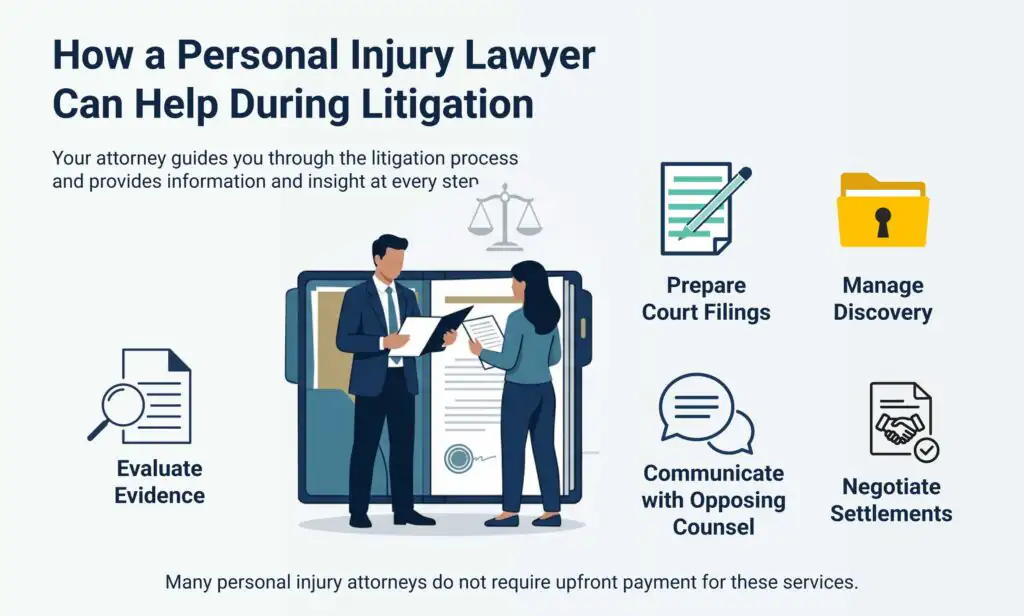
How a Personal Injury Lawyer Can Help During Litigation
Your attorney will guide you through the entire process, providing you with information and insight at every step. They will:
- Evaluate evidence
- Prepare court filings
- Manage the discovery process
- Communicate with opposing counsel
- Negotiate settlements
Your attorney isn’t likely to charge you anything for these services upfront.
What Factors Can Affect the Personal Injury Litigation Timeline?
How long does litigation take? That depends on: case complexity, number of parties, discovery disputes, court schedules, medical treatment, motions, settlement negotiations, and trial availability. Most of the time, the process of going to trial takes months to a year or more.
Key Takeaways About Litigation in Personal Injury Cases
- Litigation in a personal injury matter is the process of asking the court to make a decision because the parties cannot agree.
- Litigation is a formal court-based process.
- After filing a complaint, the case will go through discovery, settlement discussions, trial and the potential for an appeal.
Each location has different rules and procedural steps. That’s why having a local attorney matters.
Conclusion – Understanding What Litigation Means in a Personal Injury Case
The litigation meaning in law can be confusing. Litigation is very much an important part of the process of coming to an agreement with others. However, it’s complex because of the numerous legal aspects of the case.
With so much on the line, it is important to discuss your personal injury matter with an attorney. Go over what happened and the losses you have. Discuss the need to go to court.
Ledger Law has extensive experience handling these matters. Through years of proving our client’s deserve more, we can help you navigate the legal process. Ledger Law offers clients a free consultation to review their options.
FAQs About What Does Litigation Mean in a Personal Injury Case
What does litigation mean in law?
Litigation is the process of asking the court to decide on a disputed injury or loss.
What is the litigation process in a personal injury case?
The process begins with negotiations for a claim. A complaint is then filed, discovery happens, and there are often motions. Most cases settle at some point. If not, they will go to the court to decide.
How long does personal injury litigation take?
There’s no way to know this. It could take months to a year or longer. It depends on the factors of the case and the timelines set by the court.
What is the difference between litigation and settlement in a personal injury case?
Litigation requires the court, such as a judge or jury to make a decision. In settlements, both parties come to an agreement instead.
Do you need a lawyer for personal injury litigation?
Most cases benefit from having a personal injury attorney because of the complexities of filing a claim. You also have a lot on the line in these cases.
Can a personal injury case settle during litigation?
A personal injury case can settle at any time until the judge makes a decision.

Emery Brett Ledger brings more than 27 years of experience to personal injury law. He founded & led The Ledger Law Firm in securing over $100 million in compensation for clients with life-altering injuries & complex claims. Licensed in California, Texas, & Washington, Emery earned his law degree from Pepperdine University School of Law. His practice areas include car & truck accidents, wrongful death, catastrophic injuries, maritime claims, & mass tort litigation. He has been recognized by The National Trial Lawyers’ Top 100, Mass Tort Trial Lawyers Top 25, and America’s Top 100 Personal Injury Attorneys. Emery also received the 2025 Elite Lawyer Award & holds a perfect 10.0 Avvo rating with Platinum Client Champion status. His legal work has been featured on CNN, Forbes, NBC, & ABC.
Free Case Evaluation
Recent Posts
- Child Injured at School: Who Is Responsible, Who Pays & What Parents Should Do?
- What Does Litigation Mean in a Personal Injury Case? Process, Costs & Legal Options
- What Type of Accident Kills the Most Construction Workers? The Fatal Four Explained
- Average Payout for Pedestrian Hit by Car: Settlements, Compensation & Factors
- Lower Back Pain Car Accident Settlement: Compensation, Injury Types & Claim Factors
Emery Brett Ledger brings more than 27 years of experience to personal injury law. He founded & led The Ledger Law Firm in securing over $100 million in compensation for clients with life-altering injuries & complex claims. Licensed in California, Texas, & Washington, Emery earned his law degree from Pepperdine University School of Law. His practice areas include car & truck accidents, wrongful death, catastrophic injuries, maritime claims, & mass tort litigation. He has been recognized by The National Trial Lawyers’ Top 100, Mass Tort Trial Lawyers Top 25, and America’s Top 100 Personal Injury Attorneys. Emery also received the 2025 Elite Lawyer Award & holds a perfect 10.0 Avvo rating with Platinum Client Champion status. His legal work has been featured on CNN, Forbes, NBC, & ABC.
