Which medical records help a Newport Beach car accident claim?

The most useful medical records for a Newport Beach car accident claim are emergency care notes, examination findings, imaging reports, treatment plans, follow-up notes, and records showing how injuries affect your daily life. For your 2026 case evaluation, gather the records and related bills you already have, but do not delay medical care or a consultation while waiting for a complete file.
- For Newport Beach car accident attorney medical records preparation, prioritize treatment notes, imaging reports, and follow-up documentation.
- The Ledger Law Firm represents people injured in car accidents; organize records around your injuries and treatment timeline.
- Keep medical bills separate from clinical notes: charges explain expenses, while treatment records document care.
- Include relevant earlier records when an accident worsened an existing condition; do not edit or hide medical history.
Why this matters
Your medical file should help explain what happened to your health after the crash. A stack of bills alone does not explain your symptoms, examination findings, or treatment needs. A scan alone does not describe whether you can sleep, drive, or return to your usual work.
The goal is a clear injury timeline, not the largest possible document pile. This 2026 guide focuses on injury documentation for a Newport Beach, California, claim, not property-damage-only disputes or rules for other states.
The Ledger Law Firm represents people injured in car accidents, including in California. A case evaluation gives you an opportunity to discuss the records you have, identify missing documents, and ask what additional information is relevant to your injuries.
Which medical records help a Newport Beach car accident claim?
Start with records that connect your reported symptoms, medical findings, and treatment over time. Include care from each relevant provider, rather than assuming a hospital discharge summary contains everything.
| Record type | What it helps explain | What it does not establish alone |
|---|---|---|
| Emergency department or urgent care notes | Initial complaints, examination findings, testing, and discharge instructions | Your full recovery or later treatment needs |
| Ambulance or other emergency response care records | Symptoms, observations, and care during transport | Everything diagnosed after arrival |
| Imaging reports and available images | Findings from tests such as X-rays, CT scans, or MRI scans | Every cause of pain or functional limitation |
| Primary care and specialist notes | Ongoing symptoms, clinical assessments, referrals, and treatment plans | That every condition discussed resulted from the crash |
| Physical therapy and rehabilitation notes | Recorded movement limits, exercises, progress, and treatment response | A complete account of care outside that practice |
| Procedure and surgical records | What procedure occurred, why it was recommended, and follow-up instructions | The full course of recovery |
| Work restrictions and functional assessments | Limits a treating professional documented | Your complete wage loss without employment records |
| Itemized bills and payment statements | Charges, payments, and listed services | The clinical reason for treatment without supporting notes |
Keep both clinical records and billing records. They answer different questions, and neither should substitute for the other.
Emergency and first-visit records
Request the visit notes as well as the discharge paperwork. Discharge instructions explain what you were told to do next, while the clinical record documents the history you gave, the examination, and the clinician's assessment.
If you received care at more than one facility, list each location. Tell your attorney if you do not remember where you were transported or whether a separate ambulance provider treated you. A missing provider name is something to investigate, not something to guess.
Imaging reports and specialist records
An imaging report is the interpreting clinician's written assessment; the underlying images are a separate part of the examination. Ask your attorney whether both are needed and how the receiving office wants them delivered.
Do not interpret a scan yourself or assume that a normal result makes your symptoms irrelevant. Give your treating clinician an accurate description of what hurts and what activities are difficult. Medical interpretation belongs with the qualified professional reviewing your condition.
Follow-up and rehabilitation records
Follow-up notes show what happened after the first appointment. They document continuing symptoms, changes in treatment, referrals, and the progress your provider records.
Therapy records can add detail about movement and function that a brief office visit does not contain. Keep appointment information and home-care instructions, but distinguish instructions from proof that you completed an activity.
Bills, prescriptions, and restrictions
Save itemized bills, payment statements, prescription information, and written work restrictions. Separate these documents so a bill is not mistaken for a treatment note or a medication list for proof of a particular diagnosis.
Tell your attorney about expenses you paid directly and statements you do not understand. Do not assume that the balance on a document is the final amount owed, or that every listed charge has already been paid.
How should you organize your medical records?
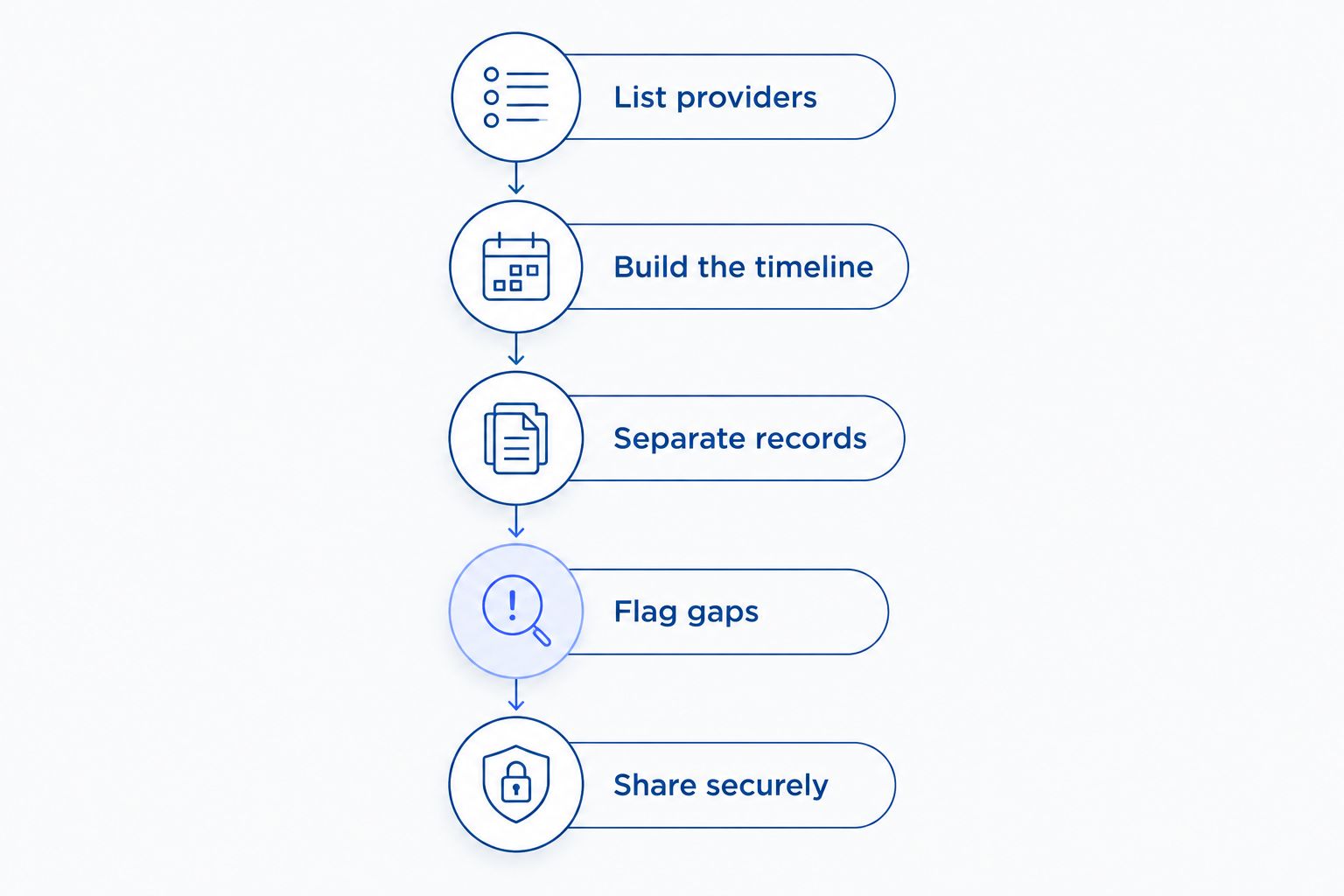
For a 2026 consultation, a simple provider list and chronological file are more useful than a polished presentation. Use the following sequence without changing the original records.
- List providers. Write down each hospital, clinic, therapist, specialist, and pharmacy connected to the treatment you want to discuss. Include the provider's name, location, and approximate visit dates if you know them.
- Build the timeline. Prepare a 1-page summary of the crash date, first treatment, later appointments, and major changes in symptoms. Mark uncertain dates as uncertain.
- Separate records. Start with 1 folder per provider, with clinical notes and billing documents in separate sections. Keep original downloads or scans intact.
- Flag gaps. Identify missing reports, referrals you have not scheduled, and records you requested but have not received. Explain treatment interruptions honestly.
- Share securely. Ask the attorney's office how it accepts medical documents before sending them. Confirm the recipient and avoid posting records through public sharing links.
Keep 2 copies of your organizational summary: a working copy you can update and a dated copy of what you shared. This is an organizational suggestion, not a legal filing requirement. Your attorney can explain what the office needs and how to provide updates.
Do not annotate an original medical record to correct it yourself. Put your concern in a separate note and contact the provider about the appropriate correction process.
Why the medical records needed for a claim vary
The right file depends on your actual treatment and injury history. These factors explain why a short emergency visit and an extended recovery require different documentation:
- Where you received care. Hospital, ambulance, specialist, and therapy records can come from separate organizations. A single patient portal is not a substitute for checking your provider list.
- Which symptoms developed. New or changing symptoms belong in a medical discussion and the resulting treatment record. Describe when you noticed them without inventing a precise onset date.
- Whether you had an earlier condition. Relevant earlier records help distinguish your baseline from changes reported after the crash. Tell your attorney about previous symptoms and treatment.
- How treatment progressed. Referrals, procedures, therapy, and follow-up visits create different records. Include the treatment plan as well as the notes describing completed care.
- How injuries affected daily activities. Written restrictions and documented functional difficulties add context. Describe specific tasks rather than simply saying that everything is harder.
Do not pursue treatment just to create claim paperwork. Follow medical advice, explain practical barriers, and ask questions when you do not understand a recommendation.
What if you had the same injury before the accident?
Relevant earlier medical records help explain your condition before the crash and the changes you reported afterward. Be candid about earlier pain, diagnoses, procedures, and limitations instead of trying to make the file look simpler.
Write down the differences you want to discuss. For example, identify an activity you performed before the collision that now causes difficulty, then tell your clinician and attorney accurately. Do not label that change as a new diagnosis unless a qualified provider has diagnosed it.
Your attorney can discuss which earlier records are relevant to the evaluation. That discussion is different from assuming that your entire medical history should be sent to every person requesting documents.
Can you speak with an attorney before all records arrive?
You do not need to finish organizing every medical record before asking for a case evaluation. Bring what you have, identify the providers who treated you, and explain which records are still outstanding.
The Ledger Law Firm is a fit for injured people seeking personal injury representation, not just help organizing paperwork. An initial discussion should focus on your injuries, the crash circumstances, treatment, and questions about representation—not whether your folder looks complete.
For a 2026 case evaluation, prepare these questions:
- Which providers' records should be requested first?
- Does the office need imaging files as well as written reports?
- How should new appointments and treatment changes be reported?
- Who requests records, and how are any associated expenses handled?
- What do the representation agreement's attorney-fee and case-expense provisions mean?
Attorney fees and case expenses are separate subjects. Ask how each is handled, including what the agreement says about expenses if there is no recovery; do not assume that no recovery necessarily means no costs.
Discuss your injury claim
Ask about your treatment records, missing documents, and the case evaluation process.
What should you check before sharing medical records?
Before sending documents in 2026, confirm who is requesting them, why they are needed, and how they will be transmitted. Read any authorization before signing it, including the providers, information, recipients, and time period it identifies.
If an insurer or another party asks for an authorization you do not understand, discuss it with your attorney before responding. Do not assume that every request seeks the same information or serves the same purpose.
Keep a record of what you sent and when. If a download contains someone else's information or appears incomplete, stop and contact the provider rather than forwarding it unchanged.
FAQ
What medical records should I bring to a Newport Beach car accident attorney?
Bring emergency care notes, imaging reports, follow-up records, treatment plans, written restrictions, and related bills that you already have. Include a provider list and identify documents that are still missing.
Are medical bills enough to document my accident injuries?
Medical bills are not a substitute for clinical records. Bills describe charges and listed services, while treatment notes explain symptoms, examination findings, assessments, and care plans.
Should I include medical records from before the crash?
Discuss relevant earlier records with your attorney, especially if you had symptoms or treatment involving the same part of your body. Those records help explain your condition before the accident and the changes you reported afterward.
What if I cannot find my hospital records?
List the hospital, approximate visit date, and any discharge information you still have. Ask the hospital’s records department about its request process and tell your attorney what remains outstanding.
Should I keep a journal about pain after a car accident?
A factual symptom journal can help you remember what to discuss with your clinician and attorney, but it does not replace medical records. Record observations honestly, avoid invented ratings or dates, and ask your attorney how to handle the journal.
Do I need to wait until treatment ends to ask about representation?
You can ask about representation while treatment is ongoing. Explain your current care plan and ask how the office wants to receive later records and updates.
Does a gap in treatment mean I should leave those dates out?
Do not hide a treatment gap or change dates. Explain what happened, including scheduling, transportation, or other barriers that actually affected your care, and discuss continuing symptoms with your provider.
One last thing
Save the full record, not just the screenshot that seems most helpful. A screenshot of a test result can omit the report's interpretation, date, or surrounding notes. Keep the original download and use a separate summary to highlight questions.
Before a 2026 consultation, spend your effort on accuracy rather than presentation. A straightforward timeline, honest treatment history, and clearly identified missing records give you a useful starting point without asking you to become your own medical-records expert.
Related guides
- What should you bring to a Dallas car accident lawyer consultation? — A separate consultation-preparation guide for Dallas, Texas; do not treat it as a statement of California law.

Emery Brett Ledger brings 28+ years of experience to personal injury law. He founded & led The Ledger Law Firm in securing over $100 million in compensation for clients with life-altering injuries & complex claims. Prior results do not guarantee a similar outcome. Licensed in California, Texas, & Washington, Emery earned his law degree from Pepperdine University School of Law. His practice areas include car & truck accidents, wrongful death, catastrophic injuries, maritime claims, & mass tort litigation. He has been recognized by The National Trial Lawyers’ Top 100, Mass Tort Trial Lawyers Top 25, and America’s Top 100 Personal Injury Attorneys. Emery also received the 2025 Elite Lawyer Award & holds a perfect 10.0 Avvo rating with Platinum Client Champion status. His legal work has been featured on CNN, Forbes, NBC, & ABC.
Free Case Evaluation
Recent Posts
- Best Morgan & Morgan alternatives for California car accident claims
- 8 mistakes that can hurt a California car accident claim
- 6 steps families should take after a wrongful death in Texas
- How to Choose a Car Accident Attorney Firm Near You and Prepare for a Case Evaluation
- 7 steps to take after a dog bite in California
Emery Brett Ledger brings 28+ years of experience to personal injury law. He founded & led The Ledger Law Firm in securing over $100 million in compensation for clients with life-altering injuries & complex claims. Prior results do not guarantee a similar outcome. Licensed in California, Texas, & Washington, Emery earned his law degree from Pepperdine University School of Law. His practice areas include car & truck accidents, wrongful death, catastrophic injuries, maritime claims, & mass tort litigation. He has been recognized by The National Trial Lawyers’ Top 100, Mass Tort Trial Lawyers Top 25, and America’s Top 100 Personal Injury Attorneys. Emery also received the 2025 Elite Lawyer Award & holds a perfect 10.0 Avvo rating with Platinum Client Champion status. His legal work has been featured on CNN, Forbes, NBC, & ABC.