

A Detailed Overview On Wrongful Death Damages In California | Who Can Seek Damages

- Eligibility and Standing: Only heirs, like spouses or children, can legally file a wrongful death lawsuit in California courts.
- Economic Loss Recovery: Families can claim financial losses, including funeral costs, lost future income, and essential household services.
- Non-Economic Damage Value: Compensation covers non-economic losses. It includes the loss of love, companionship, guidance, and necessary emotional support.
- 2026 Legal Changes: Recent “sunset” provisions will change survivors’ ability to recover for the decedent’s pre-death pain and suffering.
- Statute of Limitations: You must file the wrongful death claim within two years. However, government-related cases require action within six months.
When you lose a loved one, the experience can be earth-shattering. The experience can be even more painful if it happened for wrongful death. Thus, the wrongful death damages in California ensure economic stability for grieving families.
If someone in your family died due to wrongful death, you can seek accountability and financial stability through a wrongful death lawsuit. However, California law offers appropriate financial compensation for the loss.
You also must be careful about the statute of limitations for filing the lawsuit claim. Also, the new law change means that the victim’s family might not be eligible to claim non-economic damages.
What is Wrongful Death in California?
California Code of Civil Procedure §377.60 defines a wrongful death when a person dies due to the “wrongful act or neglect” of another party. It is a civil cause of action. Thus, the damage and compensation claims are separate from any criminal proceedings.
The death could result from a car accident, medical malpractice, a defective product, or an intentional act of violence. The law allows survivors to seek compensation for the personal and financial losses for the decedent’s absence. Also, the survivors must prove their eligibility to file a lawsuit for the wrongful death claim.
Who Can Seek Damages in a Wrongful Death Lawsuit?

California law defines who can seek compensation under wrongful death claims. It includes heirs, dependents, and minors.
Heirs:
The decedent’s surviving spouse or domestic partner and children are the first eligible and priority for the damage. However, at times, there may be no surviving children. So, the right to sue follows California’s laws of intestate succession. It is similar to the order of inheritance when there is no will. It can include parents or siblings.
A lawyer can help you analyze the heir’s eligibility for filing the wrongful death claim lawsuit. The Ledger Law Firm is here to assist you with the wrongful death compensations.
Dependents:
Next to the heirs, certain individuals may also file a lawsuit for the wrongful death claim. They can sue the negligent party. But they must prove they were financially dependent on the deceased. The group typically includes:
- A “putative” spouse; someone who believed in good faith they were married to the decedent.
- Children of a putative spouse.
- Stepchildren.
- Parents of the deceased.
Minors:
A minor can bring a claim for the wrongful death claim too. But they must reside in the decedent’s household for at least 180 days. The counting starts before the death of the deceased. Also, they must prove their dependence on the decedent for at least half of their financial support.
What Damages are Recoverable in Wrongful Death California?
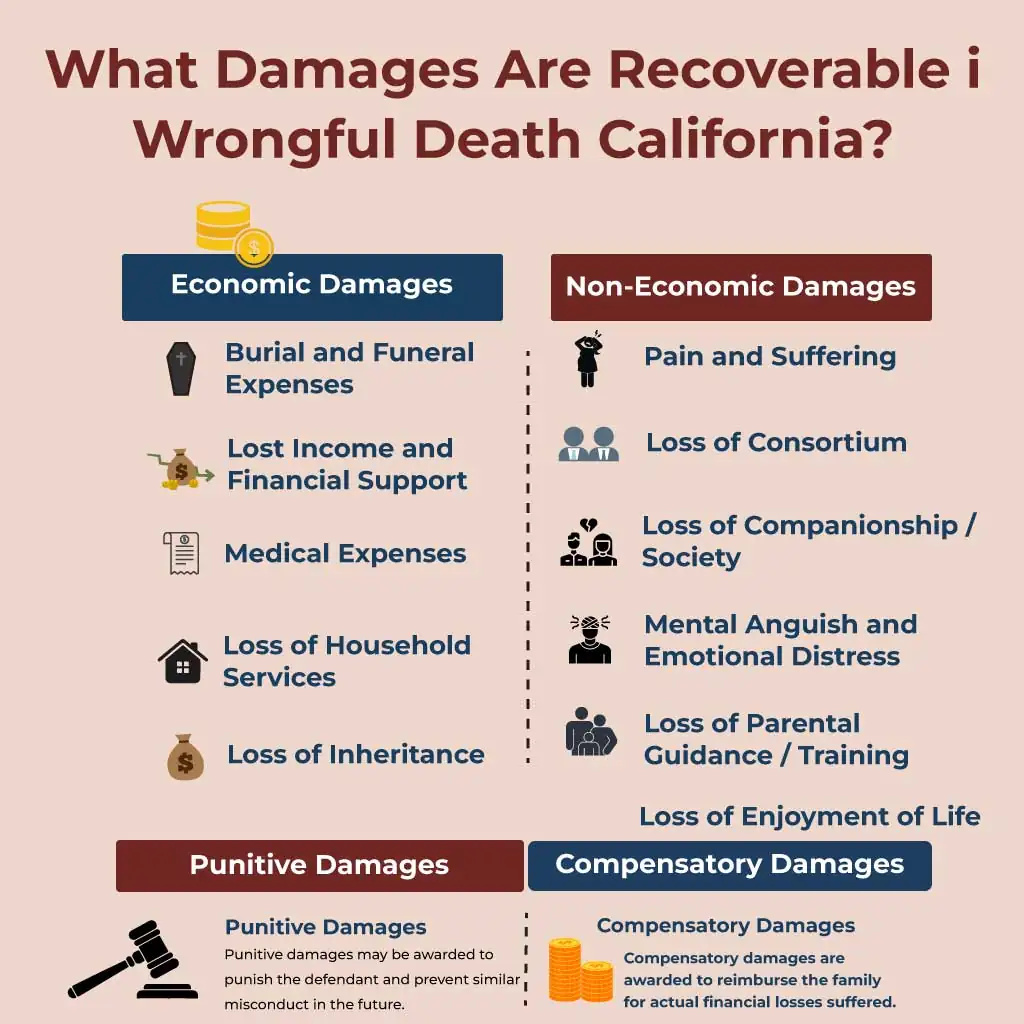
In a California wrongful death case, damages cover everything possible for the family. It actually compensates the survivors for their losses. Also, it is distinguished from a “survival action” (CCP § 377.34).
The survival action compensates the estate for losses the deceased suffered before they passed. You can recover both economic and non-economic damages in a wrongful death claim.
| Category | Description | Description |
| Economic | Tangible, objective financial losses. | Tangible, objective financial losses. |
| Non-Economic | Intangible, subjective lifestyle losses. | Intangible, subjective lifestyle losses. |
The family of a dead person can claim both economic and non—economic damages. The new law change might, however, bring some alternatives to it.
Economic Damages:
The jury or court can actually calculate the economic damages. The claims are the losses that result from the death. Economic damages involve hard numbers. Personal injury attorneys, financial experts, and life care planners will calculate the damages.
Burial and Funeral Expenses:
The survivor families can recover the actual costs of burial and funeral expenses. It includes expenses for funeral service, burial, or cremation. You can claim the cost of the casket, cemetery plot, and headstone.
Lost Income and Financial Support:
The lost income and financial support are the largest parts of economic damages. It includes the financial support the decedent would have contributed. The damage claim is equal to the family support he would provide during his remaining life. The expert will calculate their salary, bonuses, benefits, and potential career advancement.
Medical Expenses:
In a wrongful death claim, survivors can recover the cost of medical care. It includes the cost of medical care for the deceased for the injury. However, there is a condition for claiming the medical expenses. The survivor must prove that they were responsible for paying those bills.
Loss of Household Services:
The California wrongful death claim law recognizes that a family member provides value through labor. So, you can claim for the loss of household services. It includes childcare, cleaning, cooking, home maintenance, and yard work. You can recover the cost to hire professionals to perform these tasks.
Loss of Inheritance:
The loss of inheritance covers the loss of the additional wealth the decedent would have earned during his lifetime. The law recognizes that the decedent would have passed his earnings to his family members, had he lived to his life expectancy.
Non-Economic Damages:
Non-economic damages address the non-human loss. California has no fixed standard for non-economic damages. The jury must use its best judgment to determine a “just” amount.
Loss of Consortium:
Specifically for surviving spouses or domestic partners, this covers the loss of intimacy, sexual relations, and the unique emotional bond of a partnership.
Loss of Companionship/Society:
This compensates for the loss of the decedent’s presence in the family’s daily life—the conversations, shared experiences, and emotional support that have been permanently taken away.
Mental Anguish and Emotional Distress:
Although non-economic damages are broad, you have some limits. California law traditionally prevents heirs from recovering for their grief or sorrow. The limit applies to a standard wrongful death claim. Instead, the wrongful death claim focuses on the loss of the decedent’s comfort and society.
Loss of Parental Guidance and Training:
For surviving children, the loss of parental guidance and training is critical damage. It compensates for the loss of a parent’s mentorship and advice. It also covers the loss of the moral and intellectual training of the parents for the child.
Loss of Enjoyment of Life:
When a survivor loses his companionship, he may temporarily lose enjoyment in his life. So, the law compensates for the diminished quality of life of the survivors. It actually covers the damage of the person for the loss of their loved one. They fail to share their hobbies, milestones, and family traditions.
Punitive Damages:
Generally, punitive damages are not available in a California wrongful death lawsuit. In reality, punitive damage punishes the wrongdoer for their gross negligence. It doesn’t compensate the family.
However, there is a major exception to the punitive damage law. The death resulted from the felonious homicide of the convicted negligent party. So, the survivor will get punitive damage. Or, maybe the claim is joined with a survival action. It might involve malice, oppression, or fraud. So, the survivor might pursue punitive damages in such cases.
Compensatory Damages:
All the economic and non-economic damages fall under the umbrella of compensatory damages. The goal is simple: to make the plaintiffs whole again. It ensures at least financial stability through compensation. So, it accounts for every loss they have endured due to the defendant’s negligence.
How Damages are Calculated: At A Glance:
The damages calculation for a wrongful death claim is not as simple as adding up receipts. The court considers the shorter of the two life expectancies. It could be the life expectancy of the decedent or the survivor.
| Factor | Influence on Calculation |
| Life Expectancy | Based on health, lifestyle, and occupation at the time of death. |
| Earning Capacity | Historical earnings plus projected career growth and inflation. |
| Relationship Closeness | Evidence of a loving, supportive bond increases non-economic awards. |
| Retirement Age | Impacts the total duration of “lost income” calculations. |
The 2026 “Sunset” and the Return of Survival Action Limits:
January 1, 2026 saw a major shift in the wrongful death claims in California. Between 2022 and 2025, a SB 447 works as temporary law for the estates for wrongful death claims. SB 447 allowed the estates of deceased victims to recover damages for the decedent’s pain, suffering, or disfigurement.
It must occur before their death. The SB 447 law was a departure from decades of California history. It also significantly increased the value of many claims.
However, as of 2026, this “pilot program” has officially expired. This means:
- Reversion to Traditional Law: For most cases filed in 2026 and beyond, survival actions are once again limited to economic losses. So, estates can only recover medical bills and lost wages for the deceased. They can no longer claim for non-economic losses.
- The Impact on Settlements: Families can no longer seek compensation for the physical agony or emotional trauma. It includes the days or months before the passing of the dead person.
- Strategic Filing: The cases filed before December 31, 2025, deadline will follow the old rules. So, are you starting a claim now? If so, your wrongful death attorney must focus heavily on the Wrongful Death aspect. They shouldn’t focus on survival action anymore.
Pure Comparative Fault: When the Deceased is Partially Responsible:
California follows a “Pure Comparative Negligence” system. So, people are confused about their families and how much they can actually claim. They often ask,” Can I still sue if my loved one was partially at fault for the accident?”
The answer is yes, you can sue the negligent party, even if your loved one was partially at fault.
The jury assigns a percentage of fault to every party involved for the pure negligence model. So, even if the decedent was 10% at fault, the survivors can recover 90% of the total damages.
Might be, a jury determined the total damages is equal to $1,000,000. However, they found the deceased was 20% at fault for the accident. The decedent could be speeding during a collision, might be drunk, etc. So, the jury will reduce the final award by 20%. The family would receive $800,000.
Defense attorneys frequently use comparative fault to lower the payout. So, your wrongful death lawyer must prove that the at fault party was mostly responsible for the accident.
Statutes of Limitations: Critical Deadlines for 2026:
The wrongful death claim has a strict statute of limitations. If you miss the statute of limitations, you lose your right to sue forever. In California, the statute of limitation is two years. The countdown starts from the date of the death. However, there are special rules for medical malpractice or government entities.
- Medical Malpractice: You can claim against healthcare providers. You must file the lawsuit within one year of discovering the injury. Or you get three years from the date of injury.
- Government Entities: Did a government organization, employee or public property cause the death? If so, you must file a formal administrative claim within six months. Then, you can file the wrongful death lawsuit.
- The Discovery Rule: At times, the cause of death might not be immediately apparent. It could be a hidden toxic exposure. In such cases, the clock pauses until the family reasonably discovers the cause.
Conclusion:
A wrongful death claim in California allows the family to recover their economic and non-economic damages. The Ledger Law firm offers appropriate legal advocate for the surviving family members.
Once you reach us, we will analyze the case, find the negligence of the at-fault party and maximize your compensations.
1. How California Wrongful Death Claims Work?
In California wrongful death claim, the claimant files a lawsuit. He alleges that the defendant’s negligence or intentional act caused the death. The case proceeds through the discovery phase. Then, the negotiation process starts. If the wrongful death claim doesn’t settle out-of-court, it goes to trial. There the jury decides the award.
2. Who Can Sue for a Wrongful Death in California?
According to CCP § 377.60, primarily spouses, domestic partners, children, or dependent parents and stepchildren are eligible to file a wrongful death claim in California. You can contact the Ledger Law Firm to check your eligibility for the survivor list.
3. What Damages Can a Family Member Recover?
The survivor’s family can recover economic damages and non-economic damages. The aim is to provide every possible financial support to the survivor’s family.
4. How Are Damages in Wrongful Death Claims Calculated?
Attorneys use mortality tables, expert testimony from economists, and evidence of the decedent’s character to calculate the wrongful death claims. Also, they will involve the family to create a total valuation so that the family agrees to it.
5. What Is the Difference Between Economic and Non-Economic Damages?
Economic damages have a specific dollar value. It could be medical bills, lost wages, etc. On the other hand, non-economic damages are subjective. It could be the loss of a parent’s guidance.
6. What Factors Are Excluded When Calculating Wrongful Death Damages?
California generally excludes the survivors’ grief, sorrow, and mental anguish from the calculation for the wrongful death claims. The focus is on what the deceased provided to the survivors.
7. What Other Types of Damages Are Not Included?
The decedent’s own pain and suffering is generally not recoverable in a wrongful death filing. You can claim non-economic damages through a survival action lawsuit.
8. What Is the Cap on Wrongful Death Damages in California?
Most wrongful death claims have no cap in California. However, medical malpractice cases are subject to the MICRA cap. As of 2026, the non-economic damage cap for a medical malpractice wrongful death is $650,000.
9. How to Prove Your Damages in Your Wrongful Death Claim?
You can choose pay stubs, tax returns, receipts, and expert testimony. Also, day-in-the-life videos or testimony from friends and family describing your relationship with you are good options.
10. How to Hire the Right Wrongful Death Attorney?
Look for a firm with specific experience in California wrongful death statutes. Ledger Law Firm has recovered over 100M for personal injury and wrongful death claims. With 27+ years of experience, our personal injury attorneys will maximize your claims.

Emery Brett Ledger brings 28+ years of experience to personal injury law. He founded & led The Ledger Law Firm in securing over $100 million in compensation for clients with life-altering injuries & complex claims. Prior results do not guarantee a similar outcome. Licensed in California, Texas, & Washington, Emery earned his law degree from Pepperdine University School of Law. His practice areas include car & truck accidents, wrongful death, catastrophic injuries, maritime claims, & mass tort litigation. He has been recognized by The National Trial Lawyers’ Top 100, Mass Tort Trial Lawyers Top 25, and America’s Top 100 Personal Injury Attorneys. Emery also received the 2025 Elite Lawyer Award & holds a perfect 10.0 Avvo rating with Platinum Client Champion status. His legal work has been featured on CNN, Forbes, NBC, & ABC.
Free Case Evaluation
Recent Posts
- Punitive Damages in a Car Accident: When Can You Recover Them?
- Tailgating Injury: What Causes Tailgating, Road Rage & How to Stay Safe
- Waiting to Call a Lawyer Can Hurt Your Case: Evidence, Deadlines & Legal Risks
- What Is Property Damage in a Car Accident? Claims, Costs & Who Pays
- Bodily Injury & Property Damage: Coverage, Claims, Liability & Compensation
Emery Brett Ledger brings 28+ years of experience to personal injury law. He founded & led The Ledger Law Firm in securing over $100 million in compensation for clients with life-altering injuries & complex claims. Prior results do not guarantee a similar outcome. Licensed in California, Texas, & Washington, Emery earned his law degree from Pepperdine University School of Law. His practice areas include car & truck accidents, wrongful death, catastrophic injuries, maritime claims, & mass tort litigation. He has been recognized by The National Trial Lawyers’ Top 100, Mass Tort Trial Lawyers Top 25, and America’s Top 100 Personal Injury Attorneys. Emery also received the 2025 Elite Lawyer Award & holds a perfect 10.0 Avvo rating with Platinum Client Champion status. His legal work has been featured on CNN, Forbes, NBC, & ABC.