7 steps to take after a car accident in California

The essential steps to take after a car accident in California are to get safe, seek medical care, preserve evidence, complete required reports, notify your insurer, document your losses, and consider legal representation. This 2026 checklist explains what to do when you or someone you love is injured, without treating every crash or claim as the same.
- The steps to take after a car accident in California begin with safety, medical care, and preserving crash evidence.
- California DMV reporting is separate from notifying your insurer or speaking with police.
- Document injuries, missed work, and daily limitations before discussing a final settlement.
- Ledger Law represents injured people seeking personal injury representation in California.
Why this matters
After an injury crash, medical decisions, insurance questions, and reporting duties arrive together. Your health comes first; claim paperwork should not delay emergency treatment. Ask a trusted person to help organize records if your injuries make that difficult.
Ledger Law provides personal injury representation for people injured in car accidents. A case evaluation gives you an opportunity to discuss responsibility, available evidence, insurance issues, and whether representation fits your situation. It does not guarantee a particular outcome.
This guide addresses California accidents and California reporting rules. Do not apply its deadlines to Washington or Texas, even if an insurer or driver is based there.
What a useful accident checklist must cover
Use these priorities to decide what needs attention first:
- Immediate safety: Prevent further injury without putting yourself back in danger.
- Medical needs: Get care and describe symptoms accurately.
- Evidence: Preserve facts before vehicles move, witnesses leave, or records disappear.
- Reporting: Separate police, DMV, and insurance responsibilities.
- Financial impact: Track treatment expenses, missed work, and practical limitations.
- Legal decisions: Understand documents and settlement terms before signing.
The seven steps at a glance
These are practical priorities, not a rigid timetable. Emergency treatment comes before taking photographs or making an insurance call.
| Step | Action | Best for | Main benefit | Important limit |
|---|---|---|---|---|
| 1 | Get safe | Everyone at the crash scene | Reduces exposure to further danger | Do not enter traffic to collect evidence |
| 2 | Seek care | Anyone injured or experiencing symptoms | Addresses injuries and creates medical records | An insurance conversation is not medical advice |
| 3 | Save evidence | Anyone physically able to document safely | Preserves scene details and witness information | Photos alone do not establish the full claim |
| 4 | Report correctly | Drivers handling California reporting duties | Separates police, DMV, and insurer requirements | One report does not automatically replace another |
| 5 | Notify insurance | People reporting an injury claim | Starts the insurer's claim process | Different insurers have different roles |
| 6 | Track losses | Injured people missing work or needing care | Records the practical impact of injuries | A diary does not replace supporting records |
| 7 | Evaluate representation | Injured people facing disputed or complicated claims | Clarifies legal questions before major decisions | No lawyer can promise a result |
Start with Get safe and Seek care. Save evidence only when doing so is safe; Report correctly and Notify insurance are separate tasks.
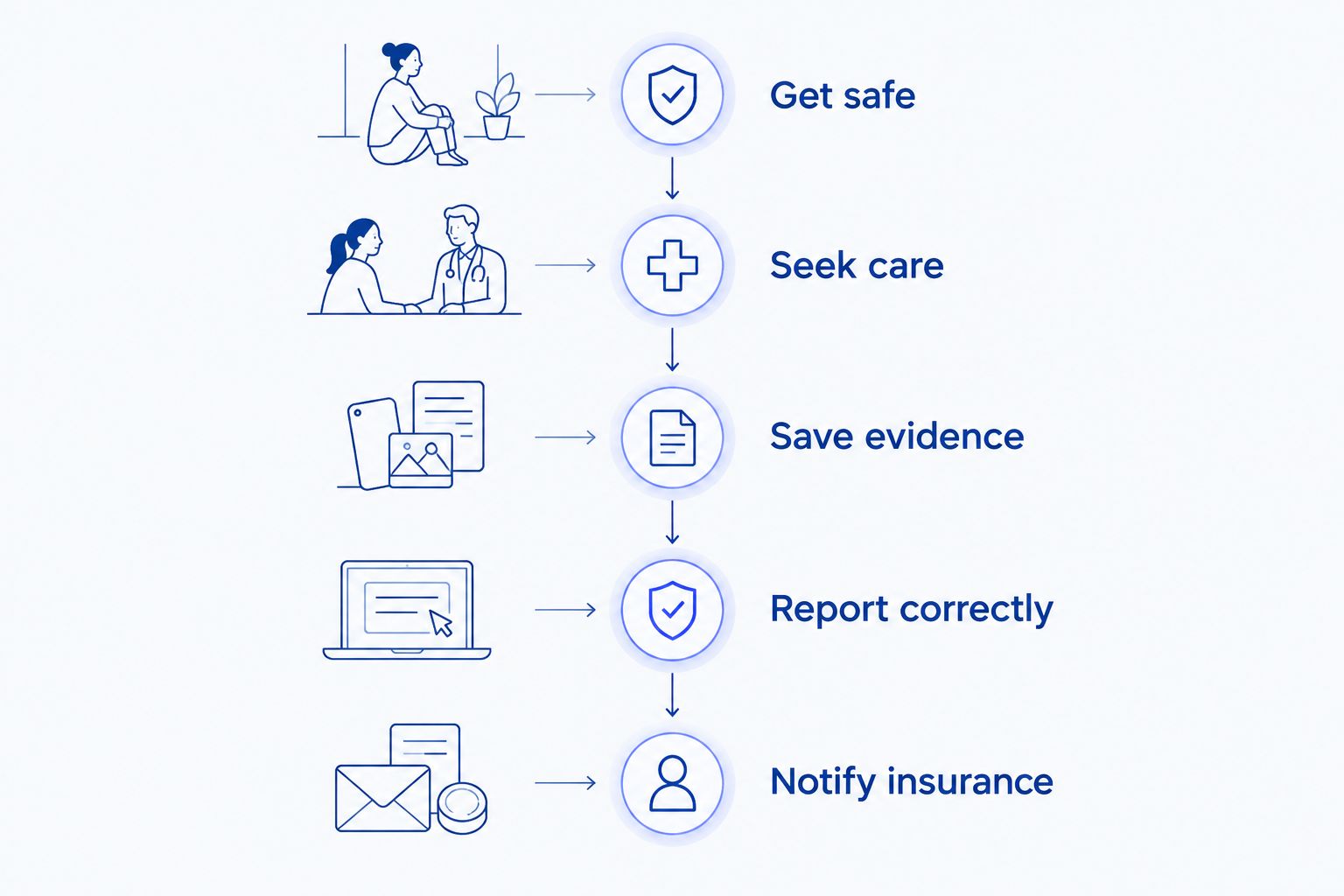
1. Get safe and request emergency help
Best for: everyone still at the accident scene.
Stop and assess immediate danger. Call 911 when someone needs emergency assistance, and give the dispatcher your location, known injuries, and hazards such as fire or vehicles blocking traffic.
Follow emergency instructions. If you can move yourself to a safer place without worsening an injury, do so; do not stand between vehicles or cross active lanes to retrieve belongings.
If someone appears seriously injured, avoid unnecessary movement unless immediate danger requires it. Let emergency responders direct the next steps.
- Benefit: Safety decisions reduce exposure to another collision or roadside injury.
- Limit: You cannot safely manage every hazard yourself. Tell the dispatcher what you see instead of trying to control traffic.
Recommendation: prioritize people over photographs, vehicle damage, and arguments about fault.
2. Seek medical care and describe your symptoms
Best for: anyone hurt, confused, dizzy, or experiencing new symptoms.
Get medical attention appropriate to your condition. Tell the clinician that you were in a car accident and explain what hurts, when symptoms started, and whether they are changing.
Do not minimize symptoms because you want to get home. Do not exaggerate them either. Accurate information helps your medical team assess your condition and creates a clearer record of what happened.
Keep discharge instructions, follow-up appointments, referrals, and prescriptions together. If transportation, scheduling, or another barrier prevents follow-up care, tell the provider and keep a note of the problem.
- Benefit: Medical records document evaluation, treatment, and reported symptoms.
- Limit: A medical record does not independently prove who caused the crash or resolve every insurance dispute.
Recommendation: make treatment decisions with your medical provider, not an insurance adjuster.
3. Preserve evidence without putting yourself at risk
Best for: injured people or trusted helpers who can document safely.
Exchange identifying and insurance information with the other driver. Record vehicle details and ask witnesses for contact information without coaching them about what to say.
If it is safe, photograph vehicle positions, damage, the surrounding roadway, traffic signals, debris, and visible injuries. Capture context as well as close-ups; a damaged bumper alone does not show how the collision occurred.
Save original photographs, dashcam files, messages, and any incident information you receive. Back them up without editing or deleting the originals. If nearby businesses or vehicles have cameras, note their locations and tell your lawyer promptly.
- Benefit: Contemporaneous evidence preserves details that later recollections cannot fully replace.
- Limit: Do not assume footage exists, remains available, or can be obtained simply because you saw a camera.
Recommendation: write a factual account while your memory is fresh, and separate what you observed from what you suspect.
4. Complete the correct California accident reports
Best for: drivers sorting out police and DMV obligations.
For your 2026 checklist, distinguish a police report from the California DMV's Report of Traffic Accident Occurring in California, known as SR-1. Reporting to your insurance company does not replace a required DMV report.
California DMV instructions require an SR-1 within 10 days when a collision causes injury, death, or property damage exceeding $1,000. An injury triggers the reporting requirement regardless of the property-damage amount. An insurance agent, broker, or legal representative can submit the report on your behalf.
California Vehicle Code section 20008 also addresses written reporting within 24 hours after a collision involving injury or death. Its officer-report exception matters: when an officer investigates and files the required report, a separate driver report under that section is not required. Confirm the reporting status rather than assuming a roadside conversation completed every duty.
- Benefit: Separating these requirements helps prevent an overlooked filing.
- Limit: A report number does not establish that the DMV received an SR-1.
Recommendation: keep copies and submission confirmations, and ask who is handling each report.
5. Notify insurance and understand who is asking questions
Best for: injured people beginning an insurance claim.
Notify your insurer promptly according to your policy's requirements. Provide accurate basic information and keep the claim number, adjuster's name, and correspondence in one place.
Your insurer and the other driver's insurer have different roles. Before a detailed interview or recorded statement, identify who the adjuster represents and what they are requesting. Your own policy can impose cooperation duties; do not assume every request from every insurer is optional or identical.
In 2026, the practical rule remains simple: do not guess about speed, injuries, or responsibility to fill a silence. Say when you do not know or do not remember. Ask for explanations of unfamiliar forms before signing them.
- Benefit: Prompt, accurate notice helps you address the claim process and policy requirements.
- Limit: An adjuster's assessment is not independent advice about your legal interests.
Recommendation: get advice before signing an injury release you do not understand, especially while treatment is ongoing.
6. Track treatment, missed work, and daily limitations
Best for: injured people whose accident affects work or everyday life.
Keep records showing what the injury has changed. Organize medical bills, treatment records, receipts, work restrictions, and employer communications rather than relying on a running total in your head.
Use a short, factual journal to describe limitations. Record interrupted sleep, difficulty driving, or tasks you need help completing when those problems actually occur. Include improvements as well as setbacks.
Ask your employer for documentation of missed time and earnings when relevant. Keep medical restrictions separate from your own observations so each record is clear about its source.
- Benefit: Organized records support a more specific discussion of injury-related losses.
- Limit: A receipt or journal entry does not automatically establish that an expense is legally recoverable.
Recommendation: document the impact honestly; do not use an online settlement estimate as a substitute for reviewing your circumstances.
7. Consider representation before major claim decisions
Best for: injured people facing disputed fault, serious injuries, or unclear coverage.
Consider a case evaluation when responsibility is contested, several vehicles are involved, treatment is ongoing, or an insurer requests a final release. Bereaved families can also seek advice about who has authority to act and which claims require attention.
Ledger Law represents people seeking California car accident injury representation. Bring your crash information, available medical records, insurance letters, and a list of questions. You do not need to answer every legal question yourself before asking for help.
For 2026 planning, California Code of Civil Procedure section 335.1 generally sets a 2-year deadline for personal injury lawsuits. Exceptions and other deadlines matter. Claims involving public entities can require earlier action, so do not treat that general period as permission to wait.
Ask Ledger Law to explain the proposed fee agreement and case expenses separately. A contingency fee ties attorney compensation to a recovery under the agreement; responsibility for expenses requires its own explanation. Do not assume no recovery always means no costs.
- Benefit: An evaluation identifies questions about evidence, deadlines, responsibility, and representation.
- Limit: Representation does not guarantee payment, a settlement amount, or a particular timeline.
Recommendation: understand the agreement before you sign and the release before you settle.
Discuss your injury claim
Prepare questions about evidence, deadlines, attorney fees, and case expenses.
How to use this checklist
These steps are ordered around immediate safety, medical needs, and preserving your ability to make informed decisions. They are not a ranking of legal strategies, and completing them does not establish fault.
If you are helping an injured relative, take over practical organization without guessing at their symptoms or speaking as though you witnessed the crash. Keep their documents accessible and record who is handling each task.
FAQ
What’s the first thing I should do after a California car accident?
Get to safety and request emergency help when needed. Medical care takes priority over photographs, insurance calls, and discussions about fault.
Do I need to report a California accident to the DMV if police responded?
Police involvement does not replace a required California DMV SR-1 report. DMV instructions require reporting within 10 days when a collision causes injury, death, or property damage exceeding $1,000.
Should I see a doctor if I feel okay after the crash?
Seek medical advice if you have symptoms, injury concerns, or uncertainty about your condition. Describe the collision and any changes accurately, and follow emergency responders’ instructions.
Do I have to give the other driver’s insurer a recorded statement?
Do not assume a request from the other driver’s insurer carries the same duties as a request from your own insurer. Identify who is asking, review applicable obligations, and get advice before a detailed recorded interview if you are unsure.
How long do I have to file a California car accident injury lawsuit?
California generally allows 2 years for a personal injury lawsuit under Code of Civil Procedure section 335.1. Exceptions and earlier requirements, including those involving public entities, make an individual deadline review important.
Does a contingency fee mean I will never owe case expenses?
No. Attorney fees and case expenses are different, and the written agreement should explain responsibility for each. Ask what happens to expenses both with and without a recovery.
What should I bring to a California car accident case evaluation?
Bring available crash information, medical documents, insurance correspondence, photographs, and work-loss records. Prepare questions about deadlines, communication, fees, and expenses; do not delay asking for help solely because some records are missing.
One last thing
A police report, an SR-1, and an insurance claim serve different purposes. Completing one does not mean the others are finished.
For your 2026 records, keep a simple task list showing what was submitted, when it was submitted, and who has the confirmation. That small organizational step helps you avoid treating an unfinished task as complete.
Related guides
- What should you bring to a Dallas car accident lawyer consultation? — A preparation guide for a Texas consultation, not a source of California reporting rules or deadlines.

Emery Brett Ledger brings 28+ years of experience to personal injury law. He founded & led The Ledger Law Firm in securing over $100 million in compensation for clients with life-altering injuries & complex claims. Prior results do not guarantee a similar outcome. Licensed in California, Texas, & Washington, Emery earned his law degree from Pepperdine University School of Law. His practice areas include car & truck accidents, wrongful death, catastrophic injuries, maritime claims, & mass tort litigation. He has been recognized by The National Trial Lawyers’ Top 100, Mass Tort Trial Lawyers Top 25, and America’s Top 100 Personal Injury Attorneys. Emery also received the 2025 Elite Lawyer Award & holds a perfect 10.0 Avvo rating with Platinum Client Champion status. His legal work has been featured on CNN, Forbes, NBC, & ABC.
Free Case Evaluation
Recent Posts
- Best Morgan & Morgan alternatives for California car accident claims
- 8 mistakes that can hurt a California car accident claim
- 6 steps families should take after a wrongful death in Texas
- How to Choose a Car Accident Attorney Firm Near You and Prepare for a Case Evaluation
- 7 steps to take after a dog bite in California
Emery Brett Ledger brings 28+ years of experience to personal injury law. He founded & led The Ledger Law Firm in securing over $100 million in compensation for clients with life-altering injuries & complex claims. Prior results do not guarantee a similar outcome. Licensed in California, Texas, & Washington, Emery earned his law degree from Pepperdine University School of Law. His practice areas include car & truck accidents, wrongful death, catastrophic injuries, maritime claims, & mass tort litigation. He has been recognized by The National Trial Lawyers’ Top 100, Mass Tort Trial Lawyers Top 25, and America’s Top 100 Personal Injury Attorneys. Emery also received the 2025 Elite Lawyer Award & holds a perfect 10.0 Avvo rating with Platinum Client Champion status. His legal work has been featured on CNN, Forbes, NBC, & ABC.