What should you bring to a Seattle car accident consultation?

Bring your crash report or report number, photographs, insurance correspondence, medical records you already have, and information about missed work to a Seattle car accident lawyer consultation. Add a short timeline and your questions about treatment, insurance, attorney fees, and case expenses. You do not need a complete file before asking for help—tell the lawyer what is missing rather than delaying the conversation.
- For a Seattle car accident lawyer consultation, bring crash evidence, medical records, insurance letters, and missed-work information.
- The Ledger Law Firm represents injured people seeking personal injury legal help in Washington.
- Bring available documents; identify missing records instead of postponing your case evaluation.
- Ask separately about attorney fees, case expenses, communication, and who will handle your claim.
What should you bring to a Seattle car accident consultation?
Use this checklist for a Seattle, Washington, consultation in 2026. Start with documents that explain how the collision happened, what injuries you experienced, and which insurers have contacted you. The Ledger Law Firm represents people injured in car accidents and other personal injury matters in Washington, California, and Texas.
| What to bring | What it helps explain | If you do not have it |
|---|---|---|
| Crash report or report number | The reported crash details and responding agency | Bring the agency name and any officer information you saved |
| Photos, video, and witness details | The scene, vehicles, visible injuries, and possible witnesses | Identify who might have copies |
| Insurance cards and correspondence | Coverage information, claim numbers, and insurer requests | Bring the messages or contact details you have |
| Medical records and bills | Treatment received, symptoms, and charges | List providers and appointment dates |
| Work and income records | Time missed and changes to your ability to work | Write down missed dates and employer contacts |
| Timeline and questions | Your account of events and immediate concerns | Prepare a short written summary before the meeting |
Keep vehicle-damage photographs with the crash evidence, but do not let repair paperwork crowd out the injury information. The consultation should address your health, your losses, and whether legal representation fits your situation.
Why this matters
A useful consultation connects the collision to what happened afterward. A photograph shows one part of the story; treatment records, a symptom timeline, and missed-work information explain different parts. Bringing them together gives the lawyer a clearer starting point without requiring you to know which documents have legal significance.
Your job is to describe what happened accurately, not prove the entire claim at the first meeting. Separate what you personally remember from what someone else told you. If an answer is uncertain, say so rather than filling the gap.
This guide addresses preparation for an injury consultation in Seattle, Washington, in 2026. It does not apply California or Texas rules to a Washington collision. Ask the lawyer to confirm the law and deadlines that apply to your particular circumstances.
How should you organize your consultation materials?
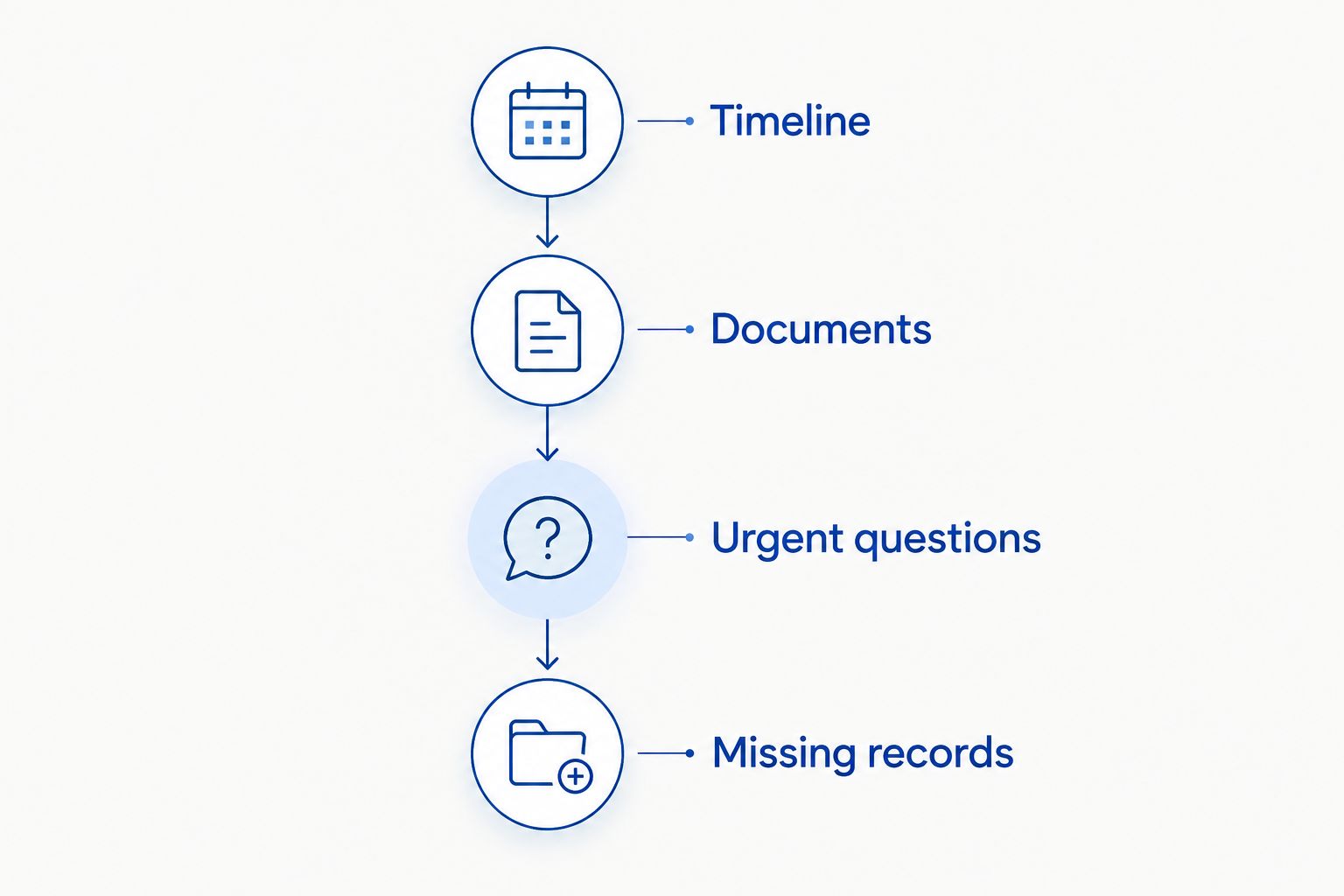
Start with a 1-page timeline
Write the crash date, approximate time, location, and direction you were traveling. Describe what you saw and felt in ordinary language. Include whether police or emergency responders attended and where you first received care.
Then add what happened after the collision: when symptoms appeared, which appointments you attended, and when insurers contacted you. A 1-page timeline is a preparation tool, not a limit on your story. Bring additional notes if you need them.
Keep the documents in 1 folder
Use 1 folder, physical or digital, with clearly named sections for the crash, insurance, treatment, and work. Keep originals intact and bring readable copies when practical. Ask the office how it accepts digital files before sending sensitive medical or financial information.
You do not need special software or a polished presentation. Clear labels such as medical bills and insurer letters are more useful than an elaborate filing system that takes energy away from your recovery.
Mark urgent questions
Put notices with response dates, appointment concerns, and documents you have been asked to sign at the front. Bring the entire notice, including attachments, rather than only the paragraph that worries you. Tell the lawyer about any approaching date when you arrange the meeting.
Do not assume a consultation automatically pauses an insurer's request or a legal deadline. Ask what needs attention immediately and who is responsible for handling it.
Identify missing records
Make a short list of records you cannot locate and who might hold them. Include the responding police agency, treatment providers, witnesses, or a business with a possible recording. Describe the source without claiming the record exists if you have not confirmed it.
For your 2026 consultation checklist, distinguish between documents you possess and documents you want help locating. That distinction prevents a missing record from being mistaken for evidence already reviewed.
Which crash and insurance records should you bring?
Crash evidence: show the scene without reconstructing it
Bring photographs and recordings in their original form when available. Include the collision scene, vehicle positions, road conditions, and visible injuries. Keep edited or annotated copies separate so the lawyer can distinguish your explanation from the original material.
Add witness names and contact details you already collected. If a passenger, nearby business, or another driver has relevant material, identify that person or source. Do not put yourself at risk by returning to an unsafe roadway to complete your file.
Insurance records: include requests as well as responses
Bring your insurance information, claim numbers, adjuster contact details, and correspondence from every insurer involved. Include emails, letters, text messages, and any written explanation of a payment or denial. If you gave a recorded statement, note when it happened and to whom.
Show the lawyer any release, medical authorization, or settlement document you received, whether signed or unsigned. Explain what you have already agreed to. An injury consultation is the time to review unresolved paperwork, not hide an earlier decision because you are worried it was a mistake.
These records help frame the discussion, but they do not establish coverage by themselves. Ask the lawyer to review the actual policy language and correspondence before drawing conclusions about your claim.
Which medical and work records matter?
Medical information: describe the injury and its effects
Bring discharge instructions, visit summaries, prescriptions, bills, and other treatment records already in your possession. List the providers you have seen and any scheduled follow-up appointments. Explain ongoing symptoms and activities that have become difficult.
Be candid about earlier injuries or symptoms involving the same body area. Describe what was different after the collision without trying to make a medical diagnosis yourself. An accurate history gives the lawyer a better basis for discussing the records that need review.
Keep your medical decisions with your treating professionals. A consultation prepares you to discuss a legal claim; it does not replace an examination or treatment advice.
Work information: document changes, not just totals
Bring pay records, missed-shift information, employer correspondence, and work restrictions you have received. If you are self-employed, bring existing records that show canceled work or changes to your schedule. Separate documented income information from estimates you have not checked.
Describe changes in your duties as well as complete absences. For example, explain whether you stopped performing a particular task or needed help completing it. The lawyer can then discuss what supporting documentation is relevant rather than treating every work disruption as the same kind of loss.
Why consultation preparation varies
Your Seattle car accident lawyer consultation does not need to look like someone else's. Focus your preparation on these factors:
- Treatment stage: An initial visit and ongoing treatment produce different records. Bring what exists now and identify upcoming appointments.
- Available crash evidence: Some people have photographs and witness contacts; others have only a report number and their own account.
- Insurance activity: An unanswered introductory letter raises different immediate questions from a proposed release or disputed claim.
- Employment situation: An employee's missed-shift record differs from a self-employed person's canceled-job records.
- Who is attending: An injured person, a supporting family member, and a bereaved relative bring different information and concerns.
For a consultation in 2026, use the date shown on each document rather than relying on memory alone. Keep older records when relevant; do not discard them simply because they predate the crash.
What should you ask about attorney fees and case expenses?
Ask how attorney fees are calculated and what events trigger payment. Then ask separately about case expenses, including who advances them, how they are recorded, and what you would owe if there is no recovery. A fee arrangement and responsibility for expenses are separate questions.
Before hiring The Ledger Law Firm or another attorney, request a written agreement and read the provisions addressing both. Do not assume a consultation itself creates representation. Confirm whether the firm has accepted the matter and what work, if any, it has agreed to perform.
Write down 3 questions before the meeting: Who handles my claim? How will I receive updates? What happens next? Those 3 questions keep the discussion focused on the working relationship as well as the accident.
A case evaluation helps you assess fit, responsibilities, and unresolved issues. It does not guarantee a recovery or establish a settlement amount. Ask for an explanation of uncertainty rather than a promise.
Discuss your injury claim
Review your concerns and ask about representation for a Washington car accident injury.
Can I attend without a police report or complete medical records?
Yes—bring the records you have and identify what is missing. A report number, provider list, appointment summary, or insurer email still gives the discussion a concrete starting point. Tell the office ahead of time if you have no documents at all.
Do not confuse an incomplete file with an unimportant injury. Explain your symptoms, treatment, and immediate concerns directly. Ask which missing records deserve attention first and whether you or the attorney would obtain them if representation begins.
Can a family member come to the consultation?
Ask the office before bringing a support person. Explain whether that person is helping you remember events, manage documents, or communicate because of your injuries. Also ask whether any part of the discussion should take place privately.
If you are attending for someone who cannot participate, explain your relationship and circumstances when scheduling. Bereaved families should say that the consultation concerns a fatal collision so the conversation can address the appropriate representation questions. Do not assume that being a relative automatically authorizes you to act for another person.
What should I leave the consultation knowing?
Leave with a clear understanding of the proposed next step, who is responsible for it, and whether representation has begun. Ask which documents still need review and whether any time-sensitive issue needs immediate attention. If a point remains unclear, request a plain-language explanation before signing an agreement.
A useful consultation also makes the limits clear. The lawyer should distinguish facts already supported by your records from questions that require investigation. Your 2026 preparation notes should end with an action list, not a guessed settlement figure.
FAQ
What should I bring to my first Seattle car accident lawyer consultation?
Bring available crash evidence, insurance correspondence, medical records, missed-work information, and a short timeline. Add your questions and identify records you have not obtained.
Should I postpone my consultation until treatment ends?
You do not need to wait for treatment to end to ask about representation. Bring current records, explain ongoing symptoms, and identify upcoming appointments.
Can I bring documents on my phone?
Ask the office which digital formats it accepts before the meeting. Keep original photographs, messages, and recordings, and confirm a suitable method for sharing sensitive records.
Do I need to know what my injury claim is worth?
No, you do not need a settlement estimate to attend a consultation. Focus on accurate facts, your treatment, and the effect of the injuries on your life.
What should I ask before signing a fee agreement?
Ask how attorney fees and case expenses work separately, including your responsibility if there is no recovery. Confirm who will handle the matter and whether the agreement establishes representation.
Should I bring an insurance release I have already signed?
Yes, bring the signed release and related correspondence. Tell the lawyer when you signed it and what happened afterward so the document can be reviewed in context.
Does this checklist apply to a Dallas accident consultation?
The document categories are useful preparation, but this article addresses Seattle, Washington. A Texas consultation needs a separate discussion of the applicable law and deadlines.
One last thing
Bring the document you least understand. An unfamiliar insurance letter, an unexplained bill, or paperwork you are embarrassed about can belong at the center of the discussion. You do not need to interpret it correctly before asking for help.
The Ledger Law Firm is a fit for injured people seeking personal injury representation in Washington. Use the consultation to explain your situation, ask direct questions, and decide whether the proposed attorney-client relationship meets your needs.
Related guides

Emery Brett Ledger brings 28+ years of experience to personal injury law. He founded & led The Ledger Law Firm in securing over $100 million in compensation for clients with life-altering injuries & complex claims. Prior results do not guarantee a similar outcome. Licensed in California, Texas, & Washington, Emery earned his law degree from Pepperdine University School of Law. His practice areas include car & truck accidents, wrongful death, catastrophic injuries, maritime claims, & mass tort litigation. He has been recognized by The National Trial Lawyers’ Top 100, Mass Tort Trial Lawyers Top 25, and America’s Top 100 Personal Injury Attorneys. Emery also received the 2025 Elite Lawyer Award & holds a perfect 10.0 Avvo rating with Platinum Client Champion status. His legal work has been featured on CNN, Forbes, NBC, & ABC.
Free Case Evaluation
Recent Posts
- Best Morgan & Morgan alternatives for California car accident claims
- 8 mistakes that can hurt a California car accident claim
- 6 steps families should take after a wrongful death in Texas
- How to Choose a Car Accident Attorney Firm Near You and Prepare for a Case Evaluation
- 7 steps to take after a dog bite in California
Emery Brett Ledger brings 28+ years of experience to personal injury law. He founded & led The Ledger Law Firm in securing over $100 million in compensation for clients with life-altering injuries & complex claims. Prior results do not guarantee a similar outcome. Licensed in California, Texas, & Washington, Emery earned his law degree from Pepperdine University School of Law. His practice areas include car & truck accidents, wrongful death, catastrophic injuries, maritime claims, & mass tort litigation. He has been recognized by The National Trial Lawyers’ Top 100, Mass Tort Trial Lawyers Top 25, and America’s Top 100 Personal Injury Attorneys. Emery also received the 2025 Elite Lawyer Award & holds a perfect 10.0 Avvo rating with Platinum Client Champion status. His legal work has been featured on CNN, Forbes, NBC, & ABC.