Reasons to Get a Lawyer After a Car Accident: A Fact-Based Decision Guide

Build a question-to-record review before seeking legal help
After a car accident, start by naming the claim question you cannot answer from the records and communications you have. Three questions can organize an initial review: what evidence bears on fault, what documented losses need to be addressed, and what response is needed to an insurer’s communication or offer. This approach gives you a concrete list of issues to take to an evaluation.
Use the unresolved issue to determine which records and questions belong in the review: responsibility, treatment and losses, an insurer’s communication or offer, or added crash complexity. The records and communications do not determine eligibility, claim value, or compensation; they clarify what to ask during an evaluation.
Use those questions to build a focused review:
- Fault and evidence: Is responsibility disputed? Gather police reports, witness statements, photos, videos, surveillance footage, medical records, and expert testimony that may help establish fault and damages. In a complex crash involving multiple vehicles or a commercial truck, an attorney may consult an accident reconstructionist.
- Losses: Which medical bills, hospital bills, examination costs, vehicle or personal-property repairs, and lost wages can you document? We advise contacting a lawyer if you have serious injuries, significant damages, or need compensation decided in court.
- Insurance communications: Has an insurer challenged the account or made an offer that does not fully cover the damages? A lawyer may help assess the offer and negotiate. Speak carefully with insurers; avoiding recorded statements may help protect your rights and reduce the risk of misunderstanding or adverse use of your information.
If one of these questions remains unresolved, bring the specific question and the records behind it to an initial evaluation. Legal help may assist with evidence, insurance negotiations, and possible legal proceedings.
A car accident can be stressful even when the physical damage appears limited. Give yourself permission to separate the immediate need to report the crash and obtain care from the later decision about legal help. The practical question is whether unresolved facts or losses make it harder for you to protect your position and assess the available options.
You can begin by writing down what happened in your own words, preserving the records you already have, and noting every question you cannot answer. Those questions—not a general assumption that hiring a lawyer is always necessary—should guide your next step.
Use injury and financial impact as the first screening point
Injuries that require medical treatment are an early reason to consider legal guidance. If you were injured, especially seriously enough to need medical treatment, consulting a lawyer may help you address medical expenses, lost wages, and pain and suffering. The need for treatment also creates records and questions about how the crash affected your work, daily activities, and continuing care.
Do not judge the seriousness of an injury only by what you could feel at the scene. Instead, keep the medical records, bills, prescriptions, treatment summaries, and work information that show what happened after the collision. A lawyer can then examine the connection between the crash, the treatment, and the losses you are asking an insurer or another party to consider.
Financial impact is another screening point. We describe economic damages as including medical bills, hospital bills, examination costs, vehicle or personal-property repairs, and lost wages. These categories give you a practical way to organize the consequences of the crash without trying to calculate a final claim value on your own.
Create separate records for each type of loss:
- Medical charges, treatment invoices, prescriptions, and related out-of-pocket expenses.
- Pay information and dates when the injury caused you to miss work.
- Vehicle repair estimates, repair invoices, towing records, and transportation expenses.
- Damage to personal property connected with the collision.
- Other receipts that show money you paid because of the accident.
A list of expenses is not automatically proof that another party must pay them. It gives you a clearer starting point for discussing what happened and what remains unresolved.
Property damage alone does not answer whether you need a lawyer. A collision involving an expensive vehicle, significant repair costs, questions about coverage, or disagreement about responsibility may require more review than a straightforward repair claim. We advise contacting a lawyer when damages are significant, and general guidance identifies significant property damage as a circumstance that may create more complex legal issues.
If there was no bodily injury and the vehicle damage is limited, clearly documented, and accepted by the relevant insurer, you may have fewer issues to resolve. That is a fact-dependent observation, not a rule about your legal rights. If the amount, responsibility, coverage, or repair decision remains contested, an evaluation can help you identify the specific question rather than guessing from the repair estimate alone.
The first screening point is the combined effect of the injury and the loss. A modest expense may be difficult to evaluate when treatment is continuing, while a large repair bill may still involve a relatively narrow dispute. Look at the full record: physical harm, medical care, missed work, property damage, and the way each item connects to the crash.
Write down what has already happened and what remains uncertain. That short inventory can show whether you need help understanding a claim, responding to an insurer, or preparing for a more formal dispute.
Treat disputed fault as a separate reason to seek help
Disputed fault creates a different problem from simply documenting your losses. If another driver, insurer, or report says you caused the crash, legal help may assist with gathering evidence, negotiating with insurers, and preparing for possible legal proceedings. The disagreement can affect both how the collision is described and how the resulting damages are considered.
Start by separating what you personally observed from what someone else has alleged. Record the direction of travel, traffic conditions, visible damage, statements made at the scene, and the sequence of events while the details are still available to you. Do not change your account to make it sound more certain than your memory allows.
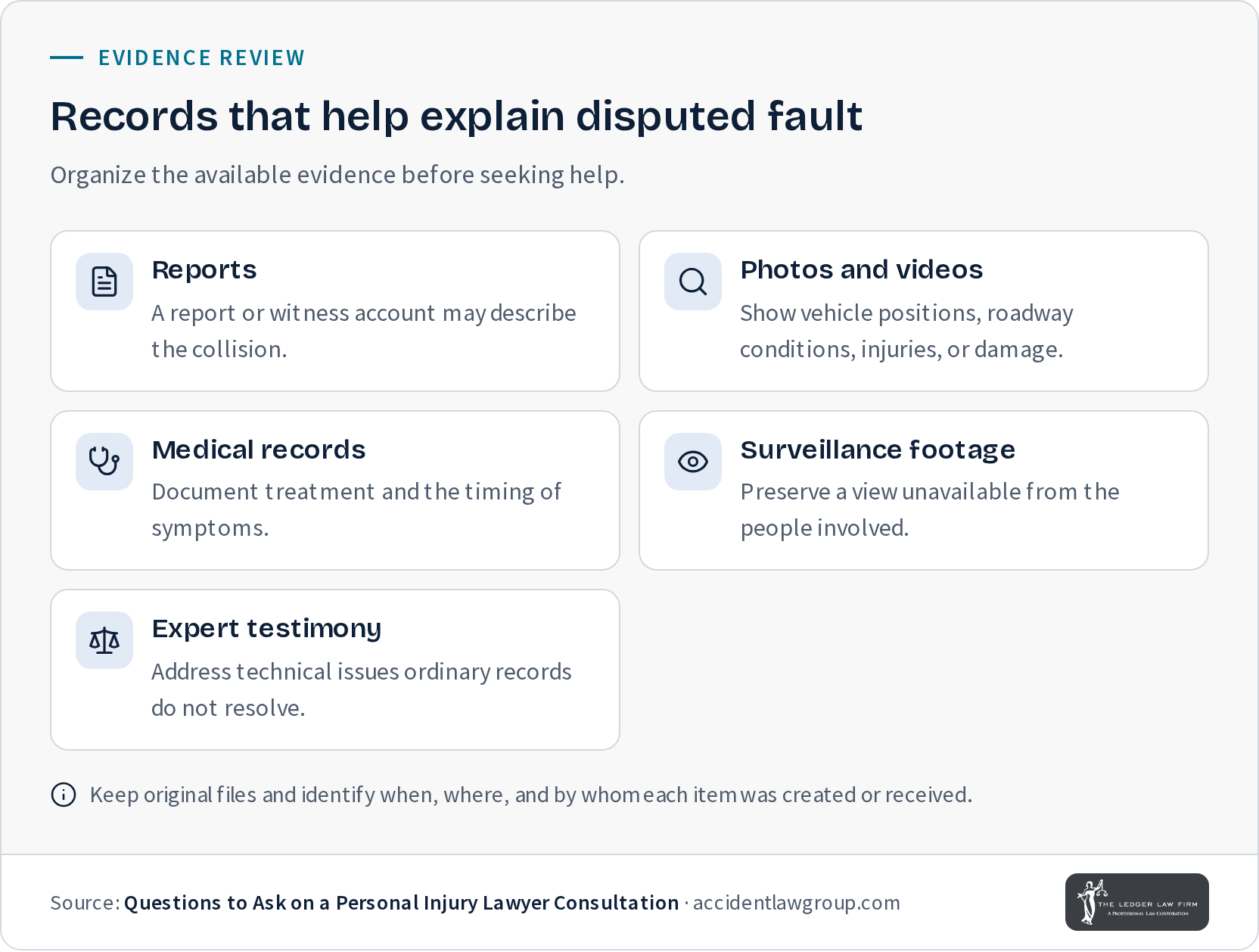
Evidence that may help establish fault and damages includes police reports, witness statements, surveillance footage, medical records, and expert testimony. When fault is disputed, photos, videos, and medical records may strengthen your car-accident case.
The useful question is not whether you have a single perfect piece of proof. It is whether the available records fit together:
- A report or witness account may describe the collision.
- Photographs and videos may show vehicle positions, roadway conditions, visible injuries, or property damage.
- Medical records may document treatment and the timing of symptoms.
- Surveillance footage may preserve a view that is unavailable from the people involved.
- Expert testimony may address a technical issue that the ordinary records do not resolve.
Keep the original files and identify when, where, and by whom each item was created or received. That context can matter when the information is later assessed.
If you challenge fault, promptly reporting the accident to authorities and insurers may help avoid complications in the claims process. Reporting does not require you to adopt another person’s version of events. You can provide a careful account, identify disputed points, and preserve communications about the disagreement.
If an insurer has already assigned responsibility to you, save the letter, email, estimate, recorded explanation, or other communication that shows how that conclusion was presented. Bring the complete exchange to a consultation instead of relying on memory. A lawyer can then see what was said, what was omitted, and what question remains open.
A disputed-fault claim does not automatically mean that you will win or that another party will accept responsibility. It means the collision requires a closer look at the evidence and the applicable rules. Contacting a lawyer may be especially useful when you cannot explain the disagreement from the records you have or when the insurer’s position affects your ability to address your losses.
Recognize when the crash involves added complexity
Multiple vehicles, uninsured motorists, or significant property damage may make a crash claim more complex. Each added circumstance can create another factual question: which impact caused which damage, whose insurance may respond, what each person reported, or how the losses should be documented.
That complexity does not automatically decide whether you need representation. It does make a simple one-insurer, one-driver explanation less likely to capture every issue. List every vehicle, driver, passenger, insurer, witness, and property owner connected to the crash. If you do not know who may be involved, record that uncertainty rather than filling the gap with an assumption.
Commercial-truck involvement is another reason to ask how the crash would be investigated. In complex crashes involving multiple vehicles or commercial trucks, an attorney may consult an accident reconstructionist. That possibility matters because the physical sequence of a collision may require a technical review rather than a conclusion based only on the first account.
You should not assume that a commercial-truck crash follows the same practical path as a simple passenger-vehicle collision. Record the type of vehicle, the company or service associated with it if known, the identifying information available at the scene, and every insurer or representative who contacts you. The evaluation can then focus on the actual vehicles and evidence involved.
Use complexity as a reason to obtain clarity, not as a reason to predict the result. A claim involving several parties may still resolve after the facts are organized, while a two-vehicle crash may become difficult when fault or injuries are contested. The relevant question is whether the number of parties, vehicles, coverage questions, or technical issues has made it harder for you to understand who must address what.
When that answer is yes, preserve the information you have and ask for a case-specific evaluation.
Preserve the evidence before deciding what the claim needs
Evidence preservation should begin before you decide exactly what legal help you need. Before a consultation, gather accident details, medical records and bills, photos and videos, insurance information, communications, witness information, lost-income records, expense and property-damage records, and a timeline with your questions.
A practical preservation list includes:
- The date, location, weather or roadway details you remember, and a short description of the collision.
- Photographs or videos of the scene, vehicles, injuries, signs, hazards, and surrounding conditions.
- The incident or police report, if you received one.
- Medical records, bills, prescriptions, treatment summaries, and appointment information.
- Names and contact information for witnesses and people involved.
- Emails, letters, text messages, claim numbers, and messages from adjusters.
- Pay records, missed-work dates, repair estimates, receipts, and transportation expenses.
Keep copies in a place where the original files and dates remain identifiable.
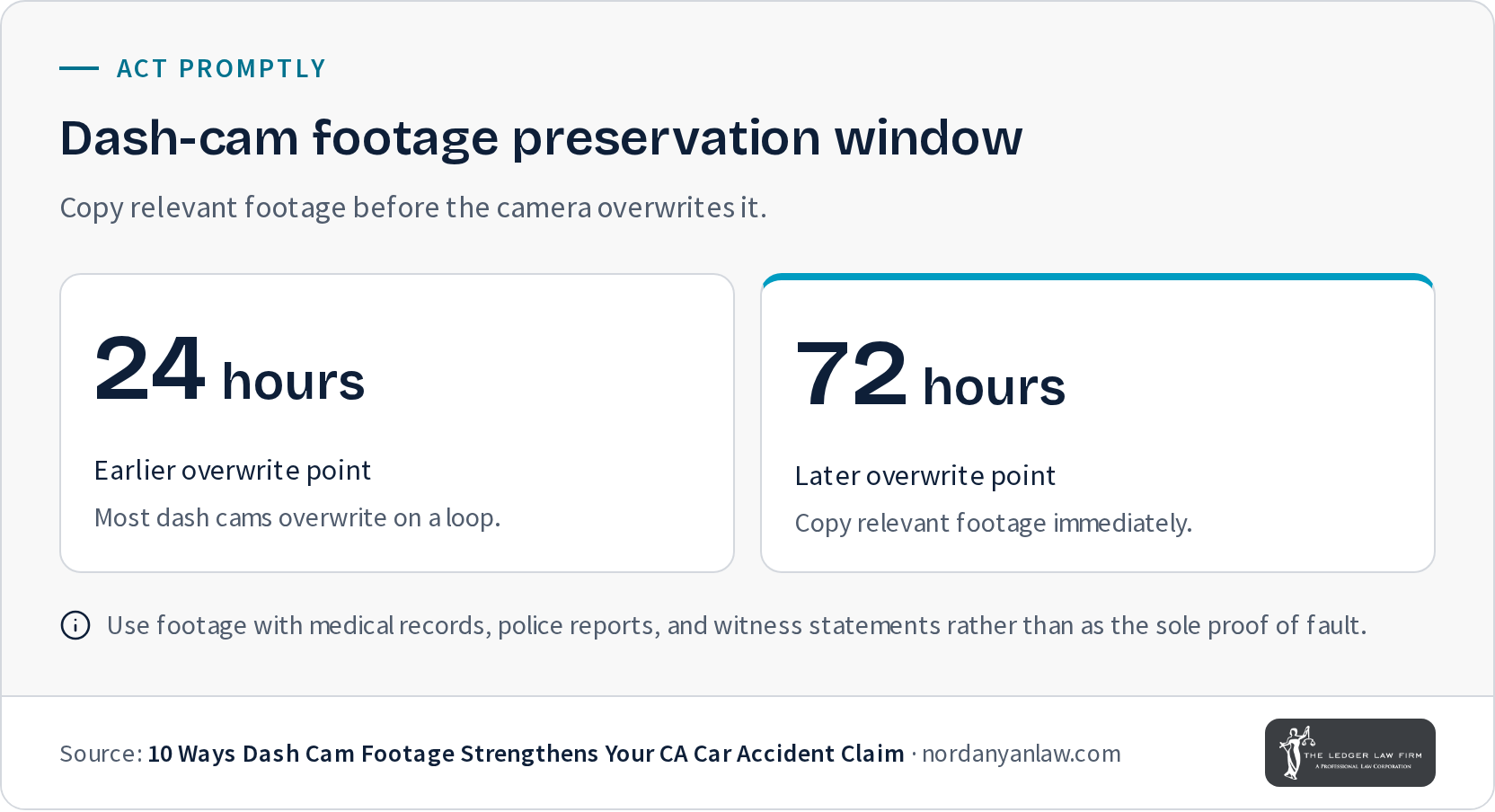
Dash-cam footage deserves prompt attention. Most dash cams are described as overwriting stored footage within 24 to 72 hours on a loop, so copy relevant footage to external storage immediately after an accident. Do not wait until an insurer or lawyer asks for it if you have access to the device or file.
In California, dash-cam footage is generally described as admissible in civil courts and insurance proceedings, subject to authentication requirements. That description does not mean every clip will resolve fault or be accepted without questions about its source, continuity, or accuracy. Preserve the original file, keep a working copy, and note how and when you obtained it.
Use dash-cam footage as part of an evidence package with medical records, police reports, and witness statements rather than as the sole proof of fault. A video may show one angle or one moment while leaving other issues unresolved. Pair it with the surrounding records and keep the relationship between the footage and the collision clear.
The same principle applies to photographs and messages. Do not select only the images or statements that support your preferred account. Preserve the complete set that may help explain the sequence, the damage, the injuries, and the communications that followed.
Acting quickly after a crash may help protect your insurance claim and support your ability to seek financial compensation. Prompt action means preserving files, reporting the accident as appropriate, recording contact information, and keeping communications together. It does not mean rushing into a statement that you do not understand or accepting an offer before you know what it covers.
If evidence may disappear, take the preservation step first. If a document or conversation is confusing, save it and write down your question. Those two habits give an initial evaluation a more reliable starting point.
Handle insurer communications as a decision factor
Speak carefully with insurers. Guidance on disputed-fault claims says avoiding recorded statements may help protect your rights and reduce the risk that information will be misunderstood or used adversely. You can listen to what the adjuster is requesting, record the request, and ask what deadline or document is involved rather than answering beyond what you know.
Do not guess about speed, distance, medical details, or fault to make a conversation sound complete. If you do not remember, say that you do not remember. Keep copies of written questions, responses, claim numbers, and any request for a recorded statement.
Reporting and negotiating are separate decisions. You can report the collision and preserve your position while you determine what additional information is needed to respond to a disputed responsibility finding.
An insurer’s delay, disputed liability position, incomplete offer, or repeated request for information may justify an evaluation. They may be reasons to discuss the communication during an evaluation.
Create a communication log with the date, sender, subject, request, response, and next deadline for each contact. Keep the language neutral and attach the related documents. If you cannot tell what action the insurer expects from you or what a proposed settlement would resolve, take that uncertainty to a lawyer before treating the exchange as finished.
Understand what an attorney may help investigate
A case review may organize those materials around two separate questions:
- What evidence helps explain who or what caused the collision?
- What evidence helps explain the injuries, treatment, lost income, repairs, and other losses?
Keeping those questions separate can reveal a gap in the record. A clear collision account does not by itself document the full financial effect, and complete medical bills do not by themselves establish responsibility. Ask how the available evidence addresses both parts.
Ask whether a technical review is relevant when the sequence, impact, position, or movement of the vehicles remains disputed. It is not an automatic step in every case, and you should ask whether the facts justify that type of review before assuming it will be used.
A consultation can also identify practical obstacles such as disputed liability, minimal insurance coverage, pre-existing injuries, and gaps in treatment. Ask how each issue could affect the way your records are understood and what additional information would address the concern.
You can ask during a consultation whether your case is likely to settle or proceed to trial. Treat the answer as an explanation of possible paths, not as a prediction. The answer may depend on the facts, the available evidence, the parties involved, the insurance position, and the jurisdiction.
One consultation source states that 95% of injury cases settle before trial; ask how that general statement applies to your case rather than treating the percentage as a forecast. A lawyer should be able to explain what would make negotiation, filing, or further investigation relevant to the particular dispute.
Our auto-accident lawyers investigate collisions and gather case evidence; an initial evaluation can help identify which issue needs review. If you contact us, describe the crash, the injuries or losses, the fault question, the evidence you preserved, and the insurer communications you received. That information gives the initial conversation a concrete set of issues to examine.
Keep California-specific rules separate from general guidance
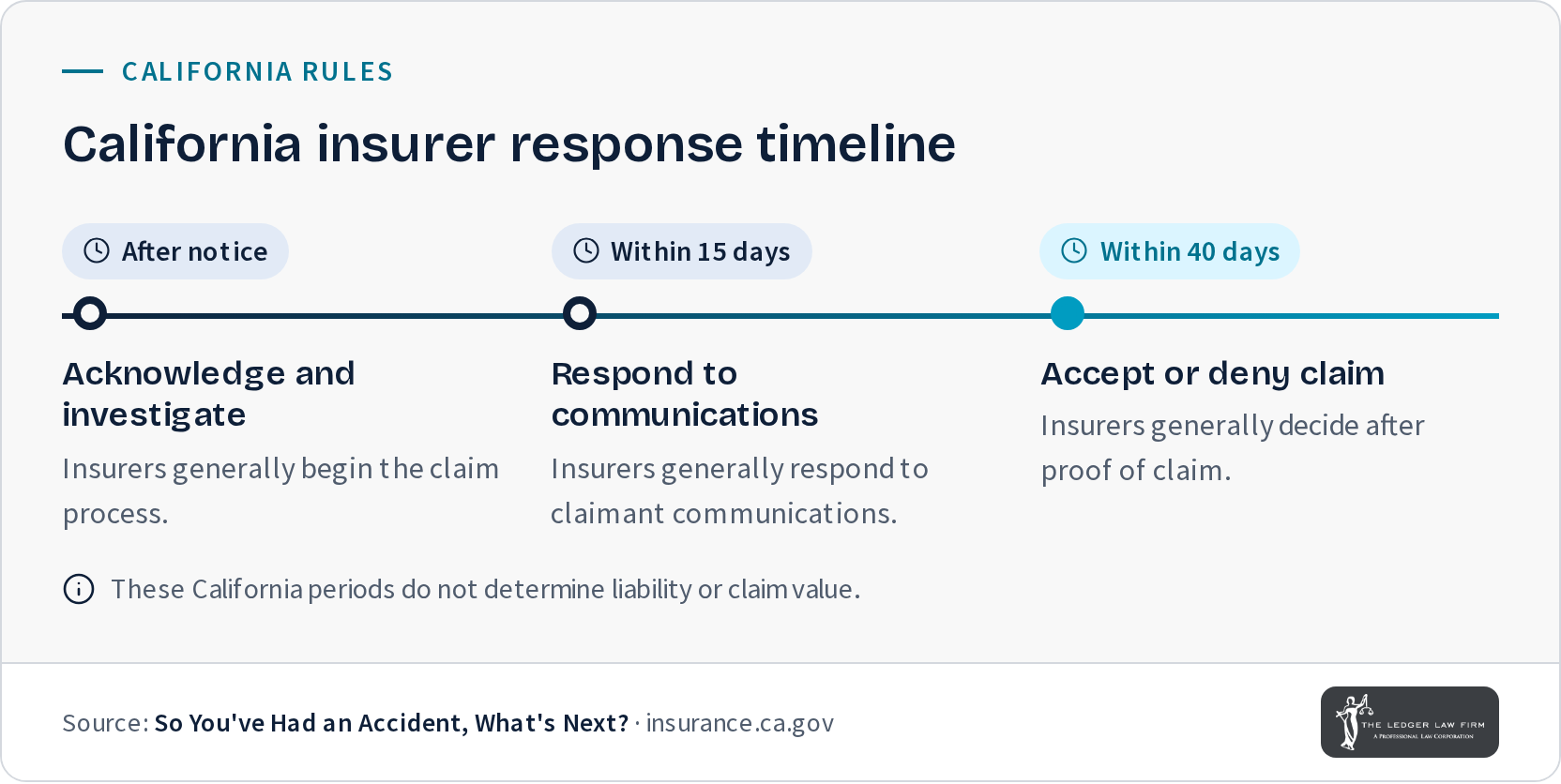
California insurance provisions should not be treated as nationwide rules. In California, insurers are generally required to acknowledge a claim, begin investigating, provide forms and instructions, and provide reasonable assistance immediately but no later than 15 days after receiving notice of claim. The timing described here applies to California and includes the condition that the insurer has received notice of the claim.
In California, insurers are generally required to respond to communications from you immediately but no later than 15 days. Keep the communication and the date it was sent so you can describe the sequence accurately. A deadline in a general description does not resolve whether a particular communication qualifies, whether an exception applies, or what remedy may be available.
In California, insurers are generally required to accept or deny a claim immediately but no later than 40 days after receiving proof of claim. Proof of claim can involve documentation supporting the claim and the amount of loss, so keep estimates, reports, bills, and other records together.
These provisions may help you identify a communication question, but they do not determine liability or the value of your injuries and losses. If you live elsewhere, do not carry these California time periods into your claim. The applicable insurance and civil rules depend on the jurisdiction and the facts.
Fee and cost questions also need a clear jurisdictional and contractual frame. California State Bar guidance says contingency fees generally involve a percentage of money received if you win or settle; if you lose, the lawyer does not receive payment, but you may still owe some or all court costs and other expenses. Ask for the percentage, the treatment of costs, and the terms in writing before accepting representation.
Do not assume that the word contingency answers every financial question. Ask which expenses may be charged, when they may be charged, and how the fee is calculated in the written agreement. The agreement, not a general description, controls the arrangement you are considering.
Timing rules can also change the decision. A California source states that a personal-injury lawsuit generally must be filed within two years from the date of injury, while a claim against a public body generally requires a written claim within six months after the claim arises. Different facts, parties, claim types, and legal rules can affect how a deadline applies.
Do not wait for a deadline question to become urgent before gathering your records. Write down the crash date, injury date if different, dates of notices and communications, and any public entity or government vehicle connection. Ask a qualified lawyer how the timing rules apply to your situation rather than treating these general periods as a personal legal conclusion.
California examples are useful for showing why location matters, not for replacing case-specific analysis. If your crash occurred in another state, or if different states and parties are connected to the event, identify that at the beginning of any evaluation. Keep state-specific insurer provisions, deadlines, and fee questions labeled by jurisdiction so they are not accidentally applied more broadly.
Prepare a focused packet for an initial evaluation
A focused packet helps an initial evaluation begin with facts instead of scattered recollections. A focused packet can organize the materials you may want to discuss during an initial evaluation.
You do not need to create a polished legal file. Put the materials in a simple order:
- Write a short account of the collision and list the people, vehicles, insurers, and witnesses involved.
- Add the incident report, photographs, videos, and other scene information.
- Arrange medical records, bills, prescriptions, and treatment dates.
- Add pay records, missed-work dates, repair estimates, receipts, and transportation expenses.
- Place insurer letters, emails, texts, claim numbers, and recorded-statement requests together.
- Finish with a timeline and the questions you want answered.
Label uncertain information as uncertain. That is more useful than presenting a guess as a fact.
Use the evaluation to ask focused questions about the problem your crash presents. You can ask:
- How would you investigate fault and damages in this case?
- Which records, witnesses, photographs, or footage need further attention?
- What challenges might arise from disputed liability, minimal insurance coverage, pre-existing injuries, or gaps in treatment?
- Does the number of vehicles or the involvement of a commercial truck change the investigation questions?
- Is the likely path negotiation, a possible filing, or further factual review?
- Is the case likely to settle or proceed to trial, and what facts affect that assessment?
A question list gives you a way to compare the explanation you receive with the records you brought. It also helps you notice which issues remain unanswered after the conversation.
Ask financial and communication questions before agreeing to representation. Ask how the percentage is calculated, which costs are separate, and what the written agreement says.
Also ask who will communicate with you, how insurer contacts will be handled, what information you should preserve, and what the next step would be if the firm does not take the case. The purpose is to understand the proposed working arrangement, not to assume that a general fee label answers every cost question.
Your timeline should connect events without trying to decide the legal conclusion. Include the crash, reports, medical visits, missed work, repair activity, insurer contacts, offers, and any new symptoms or expenses you recorded. Add the date for each document and identify whether the information came from you, a witness, a medical provider, an insurer, or another person.
Bring questions that the packet cannot answer. A missing report, an unavailable witness, a disputed statement, or a damaged device may be more important than an extra copy of a bill. Tell the lawyer what is missing and what you have already tried to obtain.
The packet is a practical aid for the conversation. It gives you a place to put the facts, documents, losses, communications, and questions that need review. It does not establish liability, prove every loss, or determine what your claim is worth before a qualified lawyer examines the applicable law and the complete circumstances.
Use the evaluation to clarify options, not promise an outcome
We offer a free consultation with an auto-accident lawyer.
General information cannot determine your individual legal rights or the value of your claim. A qualified lawyer must assess those issues using the facts, records, jurisdiction, and applicable law in your situation.
If your crash presents unresolved injury, loss, fault, evidence, or insurance questions, organize the available information and take the next step that gives you a clearer answer. Keep every document, preserve time-sensitive footage, and avoid treating a general rule as a decision about your case.
Questions to ask before requesting a case evaluation
When may you not need a lawyer after a car accident?
A lawyer may be less necessary when there are no injuries, property damage is limited and documented, fault is clear, coverage is not disputed, and the insurer accepts the claim without unresolved questions. That is only a fact-dependent starting point, not a rule about your rights. If treatment, significant losses, disputed responsibility, or difficult insurance communications develop, an evaluation may be useful.
What should you do before responding to a car accident settlement offer?
Save the complete offer and compare it with your medical bills, lost-income records, repair costs, and other documented losses. Identify what the offer includes and whether treatment or other expenses are still continuing. If the offer does not appear to cover your losses or its terms are unclear, consider obtaining legal guidance before accepting or rejecting it.
How should you organize evidence for a disputed car accident claim?
Separate evidence about fault from evidence about damages. Fault evidence may include the police report, photographs, videos, witness information, surveillance, and vehicle damage; damages evidence may include medical records, bills, lost-income records, repair estimates, and receipts. Preserve original files, note their dates and sources, and keep the complete record rather than only the items that support one version of events.
Does a commercial vehicle involved in a crash change whether legal help may be useful?
It can create additional investigation questions, particularly when several vehicles are involved or the sequence of impact is disputed. Record the vehicle and company information, preserve communications and available evidence, and ask how the facts would be investigated. In a complex crash, an attorney may consult an accident reconstructionist, but that is not automatic and depends on the circumstances.

Emery Brett Ledger brings 28+ years of experience to personal injury law. He founded & led The Ledger Law Firm in securing over $100 million in compensation for clients with life-altering injuries & complex claims. Prior results do not guarantee a similar outcome. Licensed in California, Texas, & Washington, Emery earned his law degree from Pepperdine University School of Law. His practice areas include car & truck accidents, wrongful death, catastrophic injuries, maritime claims, & mass tort litigation. He has been recognized by The National Trial Lawyers’ Top 100, Mass Tort Trial Lawyers Top 25, and America’s Top 100 Personal Injury Attorneys. Emery also received the 2025 Elite Lawyer Award & holds a perfect 10.0 Avvo rating with Platinum Client Champion status. His legal work has been featured on CNN, Forbes, NBC, & ABC.
Free Case Evaluation
Recent Posts
- Reasons to Get a Lawyer After a Car Accident: A Fact-Based Decision Guide
- Should you give a recorded statement after a Dallas injury crash?
- How can uninsured motorist coverage help an injured Californian?
- Can you bring a Seattle car injury claim if fault is disputed?
- Do I Need a Lawyer for a Car Accident Settlement in California?
Emery Brett Ledger brings 28+ years of experience to personal injury law. He founded & led The Ledger Law Firm in securing over $100 million in compensation for clients with life-altering injuries & complex claims. Prior results do not guarantee a similar outcome. Licensed in California, Texas, & Washington, Emery earned his law degree from Pepperdine University School of Law. His practice areas include car & truck accidents, wrongful death, catastrophic injuries, maritime claims, & mass tort litigation. He has been recognized by The National Trial Lawyers’ Top 100, Mass Tort Trial Lawyers Top 25, and America’s Top 100 Personal Injury Attorneys. Emery also received the 2025 Elite Lawyer Award & holds a perfect 10.0 Avvo rating with Platinum Client Champion status. His legal work has been featured on CNN, Forbes, NBC, & ABC.