Can you bring a Seattle car injury claim if fault is disputed?

Yes. You can bring a Seattle car injury claim even when fault is disputed, and sharing fault does not automatically prevent recovery under Washington law in 2026. Your share of responsibility reduces recoverable damages, so evidence about both the crash and your injuries matters. An insurer's accusation is not a court's final decision about fault.
- Washington allows injured people to pursue car accident claims despite disputed or shared fault.
- Seattle car accident lawyer fault reviews should address crash evidence, injury records, and comparative fault.
- Preserve original photos, witness details, medical records, and insurance correspondence before evidence disappears.
- Ledger Law represents injured people seeking personal injury legal representation in Washington.
Why this matters
A disputed-fault claim raises separate questions: who caused the collision, whether it caused your injuries, and what losses those injuries created. Winning an argument about a traffic signal does not, by itself, prove your medical expenses or missed work.
Ledger Law represents people injured in car accidents in Washington. Ledger Law is for injured people seeking personal injury representation, including Washington car accident claims. Representation does not guarantee recovery; responsibility, injury evidence, insurance coverage, and legal defenses still require review.
This 2026 guide addresses Seattle crashes under Washington law. California and Texas claims require separate legal analysis; do not apply another state's fault rules to a Seattle injury claim.
Can you bring a Seattle car injury claim if fault is disputed?
Yes. Washington's comparative-fault rule, stated in RCW 4.22.005, reduces damages in proportion to the injured person's fault rather than automatically barring the claim. You still need evidence supporting another party's responsibility and connecting the collision to your injuries.
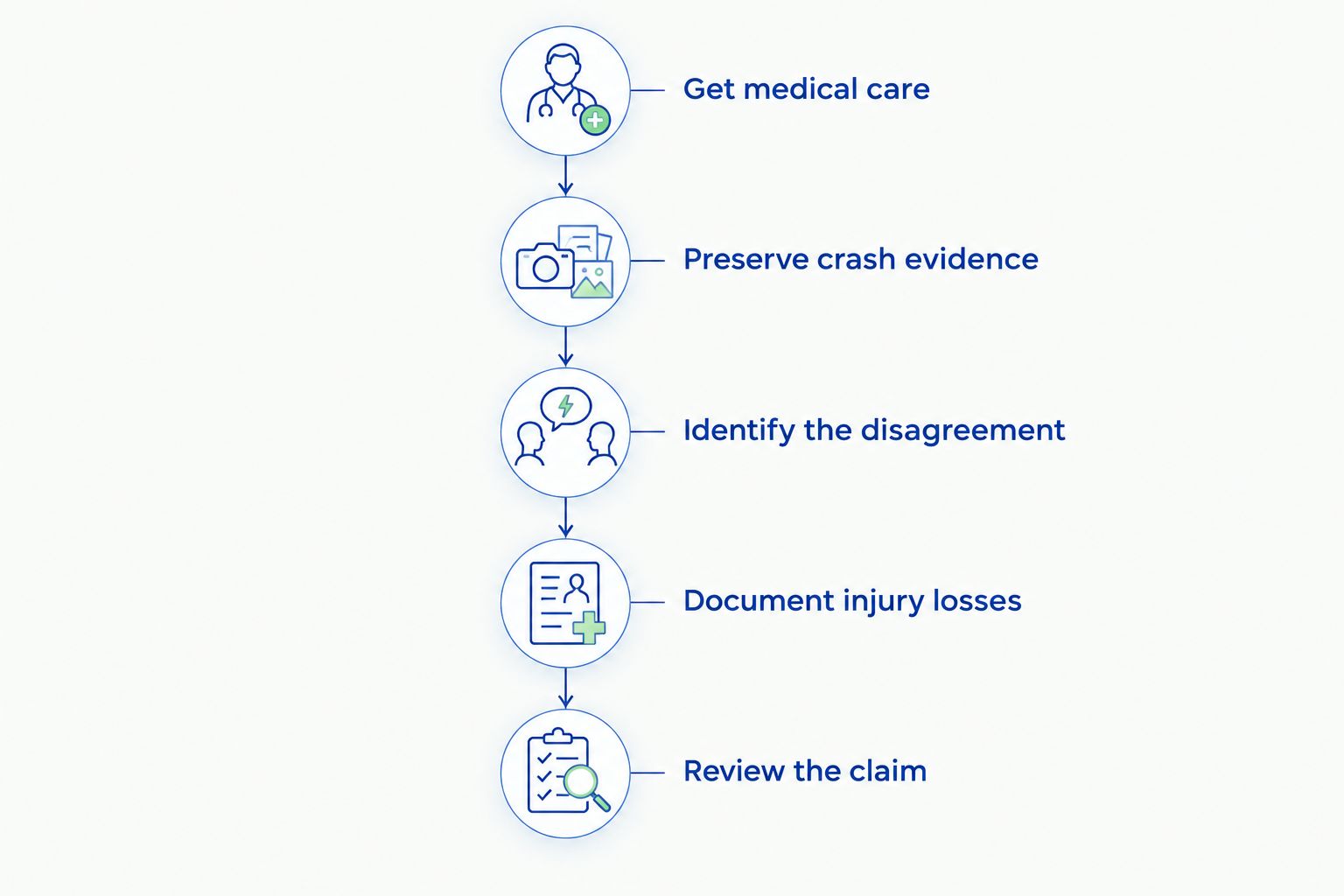
Start with these practical steps:
- Get medical care. Describe your symptoms and how the collision happened. Tell the clinician about relevant previous injuries, too.
- Preserve crash evidence. Keep original photographs, video, witness information, and the collision report information.
- Identify the disagreement. Ask what conduct the insurer attributes to you and what evidence supports that position.
- Document injury losses. Save medical records, bills, work restrictions, and records of missed earnings.
- Review the claim. Discuss fault, coverage, deadlines, and settlement consequences before signing a release.
You do not need to settle the fault argument before gathering records or discussing representation. Early organization gives a lawyer something concrete to evaluate instead of competing recollections alone.
Shared fault: your claim is not automatically barred
Washington follows pure comparative fault. Under RCW 4.22.005, an injured person's contributory fault reduces compensatory damages proportionately but does not bar recovery.
Being assigned more than 50 percent of the fault does not automatically eliminate a Washington injury claim. That differs from rules that impose a percentage-based cutoff. A claim still requires proof of another party's legally significant responsibility and resulting harm.
The percentage is not necessarily established by an adjuster's opening position. Evidence, negotiations, and—when a case reaches that stage—the court process determine how the dispute develops. Do not accept a percentage merely because it appears in an insurer's letter.
For a Seattle crash evaluated in 2026, separate allegations from established facts. A statement that you were speeding requires support, just as a statement that the other driver ran a light does.
Disputed fault: conflicting accounts require supporting evidence
When drivers disagree, focus on facts that distinguish their accounts. Where were the vehicles before impact? What movements did witnesses actually see? Does a photograph show the final resting position or the moment of collision?
Different records answer different questions:
| Evidence | What it helps establish | Important limitation |
|---|---|---|
| Dashcam or nearby video | Vehicle movement and the collision sequence | The recording may omit an approach or have an obstructed view |
| Witness accounts | What someone independently observed | A witness may have seen only part of the event |
| Scene and vehicle photographs | Road conditions, damage, and vehicle positions | Photographs alone do not always establish speed or timing |
| Collision report | Recorded observations, statements, and investigation details | The report does not automatically resolve civil liability |
| Medical records | Symptoms, treatment, and reported injury history | Medical records do not independently establish who caused the crash |
Keep originals rather than only edited clips or screenshots. If you crop an image for easier viewing, retain the full version. Context can matter as much as the detail you first noticed.
Why fault assessments vary
Fault assessments differ because evidence and the legal significance of each driver's conduct differ. A useful review addresses these factors:
- The collision sequence. An initial impact and a later impact can involve different conduct and injuries.
- Visibility and positioning. Sight lines, lane location, lighting, and obstructions affect what a driver could observe.
- Traffic controls. Signals, signs, and right-of-way obligations need to be connected to the actual vehicle movements.
- Independent evidence. Video and witnesses can support or contradict either driver's account.
- Causation. A driving mistake matters to the injury claim when it contributed to the collision or resulting harm.
- Multiple participants. Additional drivers create additional questions about responsibility and available coverage.
A multi-car collision needs more than a single label such as rear-end accident. The guide to who can be liable for injuries in a Seattle multi-car crash addresses that separate issue.
What should you save while the insurer disputes fault?
Create a crash file containing the original evidence and a short timeline. Record what you personally remember, identify information you learned later, and mark anything you do not know. Do not turn an uncertain memory into a confident statement.
Save claim numbers, adjuster names, letters, emails, photographs, witness details, and information identifying nearby cameras. Request preservation of relevant recordings promptly; recording systems do not retain footage indefinitely. Keep a copy of your requests and any replies.
Your injury file should include treatment dates, provider information, medical bills, work restrictions, and documentation of missed earnings. Note practical changes such as difficulty sleeping, lifting, driving, or completing household tasks without exaggerating their severity.
Keep the two files connected but distinct. A strong crash photograph does not explain why you missed work; a medical bill does not establish which driver entered the intersection first.
What should you say to the insurance adjuster?
Give accurate information and distinguish observations from assumptions. If you do not know another vehicle's speed or the distance between vehicles, say so rather than guessing. Ask the adjuster to explain any fault allegation in writing.
Before a recorded statement, clarify which insurer is requesting it, the purpose of the statement, and any obligations under your own policy. Your duties to your own insurer can differ from your position when speaking with the other driver's insurer.
A lawyer can review a statement request without telling you to ignore legitimate policy obligations. Do not delete messages, alter photographs, or conceal an unfavorable fact. Address difficult evidence directly so your claim can be evaluated accurately.
How long do you have to bring a Seattle injury lawsuit?
Washington generally provides 3 years to file an ordinary negligence lawsuit for personal injury under RCW 4.16.080(2). Accrual rules, exceptions, the identity of the defendant, and other claim requirements can affect the analysis. Claims involving government entities require separate attention to claim-presentment rules.
For a claim you are reviewing in 2026, establish the actual collision date and identify every potentially responsible party. Do not calculate a deadline from the date an adjuster denied responsibility unless a lawyer confirms that calculation applies.
Insurance negotiations do not, by themselves, extend the filing deadline. A claim can remain under discussion while the time to sue runs out. Ask for a specific deadline assessment rather than assuming the insurer will warn you.
What should you ask during a case evaluation?
Bring enough information to discuss both the injury and the fault dispute. You do not need a perfectly assembled binder before asking for help. Identify missing records so the conversation can address how to obtain them.
Ask these questions:
- What evidence supports the insurer's position, and what contradicts it?
- What additional records would help explain the collision?
- Which insurance policies require review?
- What filing deadlines and notice requirements apply?
- How would attorney fees and case expenses be handled?
- What would signing the proposed release give up?
Ledger Law represents injured people in Washington, California, and Texas. For this Seattle claim, ask for a Washington-specific evaluation rather than a prediction based on another state's rules.
A case evaluation helps identify legal issues; it does not establish a settlement value or guarantee representation. The attorney-client agreement should explain the scope of work and financial terms before you proceed.
Discuss your Seattle injury claim
Ask about disputed fault, injury evidence, filing deadlines, and representation terms.
Should you accept a settlement while fault is disputed?
A fault dispute does not automatically make a settlement unacceptable. The decision depends on the evidence, your injury documentation, applicable coverage, and the rights the release would surrender. Compare the written terms with your actual circumstances, not just the adjuster's description.
An early payment can require a final release while treatment needs remain unresolved. Ask whether the document releases bodily injury claims, property damage claims, other parties, or multiple categories together. Do not assume the heading tells the whole story.
Review attorney fees and case expenses separately. A contingency-fee arrangement concerns how attorney compensation depends on recovery; responsibility for expenses depends on the agreement. Do not assume that no recovery necessarily means no costs.
Can you still claim if you were partly responsible?
Yes. Washington's pure comparative-fault rule allows an injury claim despite partial responsibility, with damages reduced proportionately. The practical question is what evidence supports each person's share of fault and the injury losses being claimed.
Does a traffic ticket decide your injury claim?
No. A traffic ticket does not automatically decide a separate civil injury claim. The citation, the underlying evidence, and any related court disposition require legal review rather than an assumption that the ticket ends the dispute.
Can you bring a claim if the other driver denies everything?
Yes. The other driver's denial does not prevent you from presenting an injury claim. Independent evidence becomes especially important when the drivers disagree about the basic collision sequence.
FAQ
Can I make a Seattle injury claim if the insurance company blames me?
Yes. An insurer’s fault allegation does not automatically prevent a Washington injury claim. Ask what evidence supports the allegation and preserve records that address the disputed conduct.
Can I recover if I was more than 50 percent at fault in Washington?
Washington’s pure comparative-fault rule does not automatically bar recovery because your fault exceeds 50 percent. Recoverable damages are reduced proportionately, and you still need a supported claim against another responsible party.
Do I have to prove fault before speaking with a car accident lawyer?
No. You can discuss representation before the fault dispute is resolved. Bring the collision information, insurer correspondence, and available injury records so the lawyer can assess the issues.
What if the collision report gets an important fact wrong?
Identify the specific disputed fact and preserve evidence addressing it. Ask the investigating agency about its correction or supplemental-information process, and discuss the discrepancy with your lawyer.
How long do I have to sue after a Seattle car accident?
Washington generally allows 3 years for an ordinary negligence personal injury lawsuit under RCW 4.16.080(2). Exceptions, accrual issues, and government-claim requirements need individual review; insurance negotiations alone do not extend the deadline.
Should I stop treatment while the insurer investigates fault?
Make treatment decisions with your healthcare provider, not according to the insurer’s fault investigation. Keep records of symptoms, recommendations, treatment, and any barriers to obtaining care.
Does hiring a lawyer guarantee that the insurer will change its decision?
No. Hiring a lawyer does not guarantee a changed fault decision or a recovery. Representation provides legal assistance with evidence, applicable rules, negotiations, and litigation when appropriate.
One last thing
Preserve the evidence that challenges your account, too. An unfavorable photograph, earlier injury record, or inconsistent message is something your lawyer needs to understand—not something to remove from the file. Your 2026 claim should rest on a complete, accurate record rather than only the documents that seem helpful.
Related guides
- How should you organize medical bills after a Seattle car crash?
- What should you bring to a Seattle car accident consultation?
- What can an injured passenger claim after a Seattle car crash?

Emery Brett Ledger brings 28+ years of experience to personal injury law. He founded & led The Ledger Law Firm in securing over $100 million in compensation for clients with life-altering injuries & complex claims. Prior results do not guarantee a similar outcome. Licensed in California, Texas, & Washington, Emery earned his law degree from Pepperdine University School of Law. His practice areas include car & truck accidents, wrongful death, catastrophic injuries, maritime claims, & mass tort litigation. He has been recognized by The National Trial Lawyers’ Top 100, Mass Tort Trial Lawyers Top 25, and America’s Top 100 Personal Injury Attorneys. Emery also received the 2025 Elite Lawyer Award & holds a perfect 10.0 Avvo rating with Platinum Client Champion status. His legal work has been featured on CNN, Forbes, NBC, & ABC.
Free Case Evaluation
Recent Posts
- How can uninsured motorist coverage help an injured Californian?
- Can you bring a Seattle car injury claim if fault is disputed?
- Do I Need a Lawyer for a Car Accident Settlement in California?
- How do Texas wrongful death and estate claims differ?
- Who can an injured California car passenger bring a claim against?
Emery Brett Ledger brings 28+ years of experience to personal injury law. He founded & led The Ledger Law Firm in securing over $100 million in compensation for clients with life-altering injuries & complex claims. Prior results do not guarantee a similar outcome. Licensed in California, Texas, & Washington, Emery earned his law degree from Pepperdine University School of Law. His practice areas include car & truck accidents, wrongful death, catastrophic injuries, maritime claims, & mass tort litigation. He has been recognized by The National Trial Lawyers’ Top 100, Mass Tort Trial Lawyers Top 25, and America’s Top 100 Personal Injury Attorneys. Emery also received the 2025 Elite Lawyer Award & holds a perfect 10.0 Avvo rating with Platinum Client Champion status. His legal work has been featured on CNN, Forbes, NBC, & ABC.