Should you give a recorded statement after a Dallas injury crash?

Do not agree to an immediate recorded statement to the other driver's insurer after a Dallas injury crash; first identify the caller, understand the request, and get advice about your injury claim. Requests from your own insurer need separate attention because your policy can include cooperation duties, so postponing a recording is not a reason to ignore claim notices or deadlines.
- Ledger Law’s Dallas car accident lawyer recorded statement guidance starts with identifying the insurer before answering injury questions.
- Your own insurance policy can require cooperation; ask which provision supports the request before refusing.
- Preserve the request, describe only what you know, and avoid guessing about fault or recovery.
Why this matters
An insurance interview can move from basic contact information to questions about pain, earlier injuries, and how the collision happened. A recorded answer preserves your words, including an estimate you later discover was wrong.
This 2026 guide addresses Dallas, Texas injury claims—not California or Washington claims. If you are preparing for legal advice, organize the request alongside the materials described in what to bring to a Dallas car accident lawyer consultation.
You can be truthful without guessing, accepting someone else's description, or answering before you understand the question. The immediate goal is an accurate claim record, not a polished account delivered under pressure.
Should you give a recorded statement after a Dallas injury crash?
Do not treat every request as the same. The caller's role, the coverage involved, and the wording of your policy determine what needs review before you respond.
| Request | Best for | Benefit of responding | Main concern | Next move |
|---|---|---|---|---|
| Other driver's liability insurer | Providing verified information after preparation | Gives the insurer your account | Questions can seek admissions about fault or injuries | Ask for the request in writing and review it before agreeing |
| Your own auto insurer | Addressing your policy's claim requirements | Supports communication about your coverage claim | A blanket refusal can conflict with policy duties | Identify the policy provision, scope, and response date |
| Formal examination request | Handling a specifically identified policy procedure | Addresses a distinct claim requirement | It is not necessarily an ordinary adjuster interview | Have the written notice and policy reviewed promptly |
These are different situations, not interchangeable choices. Do not assume advice about the other driver's insurer also applies to your own insurer. A request described as routine still deserves a clear explanation of who wants the statement and why.
Before agreeing, ask these 3 questions
Use these 3 questions to establish the purpose of the call. They are preparation steps, not a substitute for reviewing your policy.
- Who do you represent? Get the caller's name, company, contact information, and claim number. Confirm whether the company insures you, the other driver, or another person involved.
- What are you requesting? Ask whether this is a recorded interview, a written account, a claim form, or a formal examination. Ask what subjects the interviewer intends to cover.
- What requires a response? Request the policy provision or other stated basis, any written notice, and the proposed response date. Save the answer rather than relying on your memory of the call.
Do not provide sensitive information merely because someone knows the crash date. Verify an unexpected caller through contact details you already have in your insurance records.
For a request received in 2026, keep the original email or letter with its date and attachments. A screenshot of only the first paragraph can leave out the deadline or the explanation of what the insurer wants.
What should you do before a recorded interview?
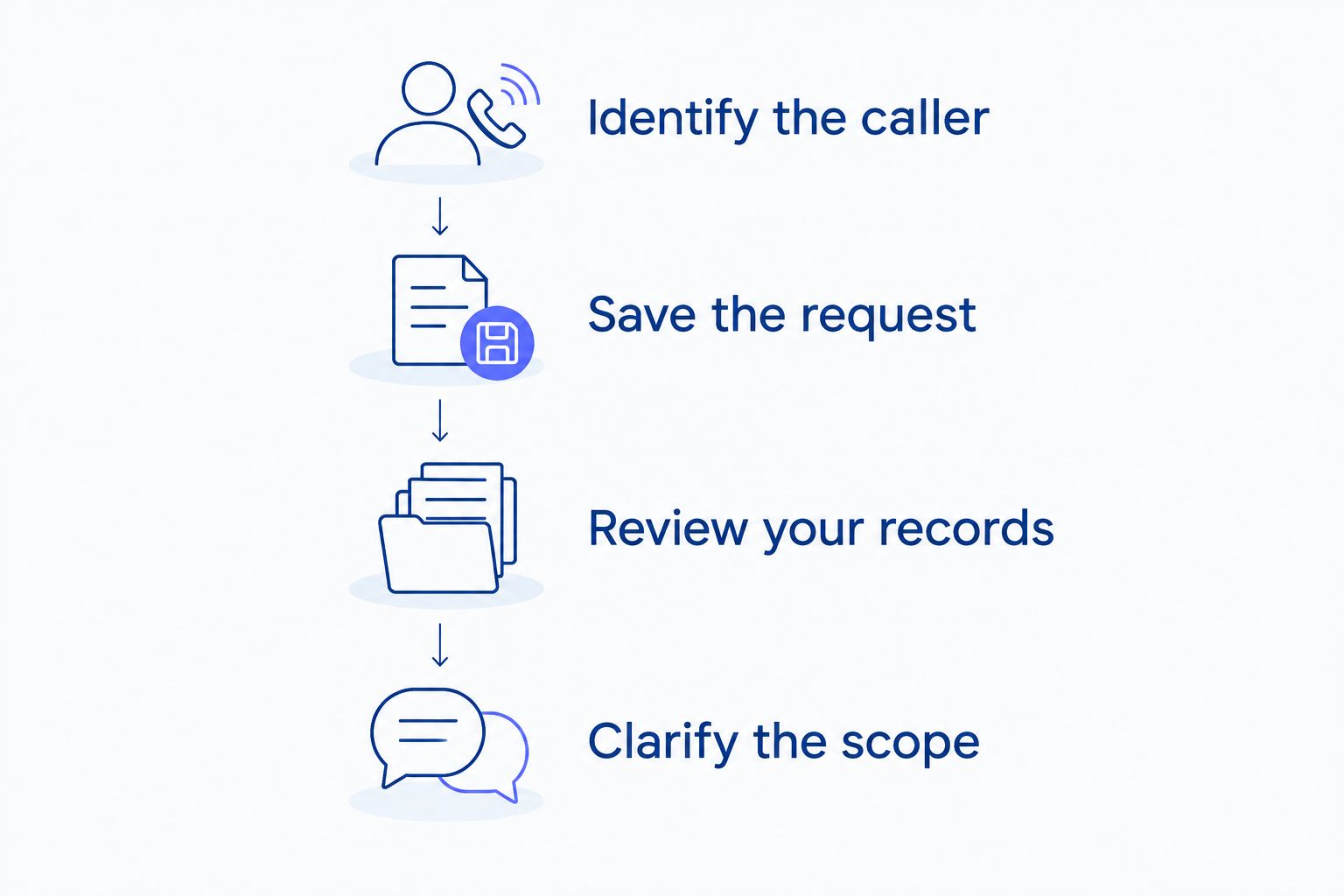
Prepare in this order. The process helps you separate what you personally remember from information you learned afterward.
- Identify the caller. Confirm the company, its role, and the claim involved. Keep separate notes if several insurers contact you.
- Save the request. Preserve letters, emails, voicemails, and any consent language. Write down a verbal request's date and the caller's contact details.
- Review your records. Gather photographs, your treatment timeline, available crash documents, and earlier correspondence. Mark facts you do not know rather than filling in gaps.
- Clarify the scope. Ask about the topics, recording method, participants, and whether you can obtain a copy. Discuss unresolved concerns with a lawyer before committing.
A short preparation sheet is better than a rehearsed story. Keep your own observations separate from a passenger's account, a police report, or a conclusion you reached later.
Why the right response varies
The decision is not simply whether recording is good or bad. These factors change what you need to resolve before participating:
- The insurer's role. Your own coverage claim and a claim against another driver's insurer raise different questions.
- Policy language. Review the actual cooperation and examination provisions rather than relying on a general description.
- The request's form. An informal phone invitation deserves different preparation from a written notice identifying a formal procedure.
- Your condition. Pain, fatigue, medication effects, or difficulty concentrating are reasons to discuss scheduling and participation concerns.
- Unresolved facts. Missing photographs, uncertain vehicle positions, or an incomplete treatment history call for careful answers—not invented details.
- Existing representation. Tell your lawyer about the request and confirm how claim communications should be handled.
Delaying has a practical downside: unanswered requests can leave claim questions unresolved. Respond to scheduling and document requests appropriately while you obtain advice; do not simply disappear from the claim process.
How should you answer questions about the crash and your injuries?
Describe what you know, distinguish estimates from observations, and say when you do not remember. You do not need to produce a speed, distance, or sequence that you cannot accurately recall.
If a question combines several assumptions, ask the interviewer to separate them. For example, a question about whether you saw a vehicle before changing lanes also assumes a particular movement occurred. Answer the facts you remember instead of adopting the entire premise.
For injuries, distinguish your symptoms from a diagnosis. You can describe where you hurt, what treatment you received, and what your clinician told you without declaring that recovery is complete or predicting future care.
Keep these boundaries clear:
- Describe earlier symptoms honestly without deciding for yourself whether they explain the current injury.
- Explain current activity limits accurately; do not exaggerate or minimize them.
- Say when treatment is ongoing or an evaluation remains unfinished.
- Ask for clarification when a question uses a medical term you do not understand.
- Request a break if you cannot concentrate or need to address a health concern.
Accuracy matters more than sounding certain. Review records to refresh your memory, but do not present something from a document as something you personally witnessed.
Keep treatment, work, and insurance records separate
Create separate folders for medical care, missed work, and insurance communications. This organization helps you locate support for an answer without mixing a treatment note with an adjuster's description of events.
For medical care, preserve discharge instructions, appointment records, bills, and treatment recommendations you receive. Note symptoms in your own words, including changes over time, rather than trying to write a medical conclusion.
For work, save relevant schedules, absence communications, and earnings records. Record what happened and when; do not estimate a final income loss before the supporting information is available.
For insurance communications, retain the original request, your response, and notes of later calls. In your 2026 claim file, distinguish the date of the collision from the date each document was created or received.
Do not edit original photographs, delete messages, or discard an earlier account because a later version seems clearer. Preserve the original and explain a correction separately.
Does advice from another state apply to a Dallas statement?
Use Texas-specific advice for a Dallas injury claim. A discussion of insurance recorded statements framed around a Georgia accident does not establish your duties under a Texas insurance policy or resolve the handling of your Dallas claim.
The distinction matters when a search result sounds directly relevant but discusses another jurisdiction. Identify the state, the insurer's role, and the policy involved before applying its conclusions to your situation.
As you compare advice in 2026, look for a clear distinction between practical interview preparation and an actual legal requirement. A general warning about recordings is not a reason to disregard a written policy notice.
What if you already gave a recorded statement?
An earlier statement is something to review, not a reason to assume your injury claim is over. Save everything you have about the interview and tell a lawyer what concerned you.
Ask whether a recording or transcript is available. Write a separate note identifying the question, your remembered answer, and the specific correction or clarification you believe is necessary.
Do not send repeated explanations while trying to repair an answer from memory. Review the actual wording if available, compare it with reliable records, and discuss how to address a material error accurately.
If you answered while injured, exhausted, or having trouble understanding the questions, document that context truthfully. Do not invent an explanation or ask another witness to change an account to match yours.
Can you decline the other driver's insurer but cooperate with yours?
Treat the requests separately rather than giving every caller the same answer. Identify the basis for each request and review your own policy before deciding how to respond.
You can ask to arrange a later discussion without declaring that you will never cooperate. If an insurer says participation is mandatory, request the explanation and supporting provision in writing for review.
When does a lawyer's review matter most?
A review is particularly relevant when you have significant injuries, disputed fault, several insurers, an unclear policy request, or concerns about an earlier interview. Bring the request itself—not just a summary of what you think the adjuster wanted.
Ledger Law is best suited to injured people seeking personal injury representation in Texas, rather than help with vehicle damage alone. A case evaluation is an opportunity to discuss the collision, your injuries, available records, and the statement request without assuming a particular result.
Ask Ledger Law how communications would be handled if you retain the firm. Also ask for the written terms governing attorney fees and case expenses; do not assume that an arrangement tied to recovery automatically eliminates every possible expense.
You can contact Ledger Law to discuss representation. Include the request's response date so the conversation addresses the immediate issue as well as the underlying injury claim.
FAQ
Should I give the other driver’s insurer a recorded statement after a Dallas crash?
Do not agree immediately; identify the insurer, request the purpose in writing, and obtain advice about your injury claim. Avoid guessing about fault, injuries, or recovery.
Can I refuse a recorded statement to my own insurance company?
Do not issue a blanket refusal before reviewing your policy and the request. Your coverage can include cooperation duties, and a formal examination request needs separate attention.
What should I say if an adjuster calls while I am receiving treatment?
Explain that you cannot address the interview then and ask for the request in writing. Keep the caller’s details and arrange an appropriate response rather than ignoring later correspondence.
What if I do not remember my speed or the exact crash sequence?
Say that you do not remember rather than inventing an answer. Clearly identify an estimate as an estimate and separate your observations from information supplied by someone else.
Is it too late to speak with a lawyer after giving a statement?
You can still seek advice after giving a statement. Preserve the recording or transcript if available, identify your specific concern, and bring supporting records to the consultation.
Can Ledger Law review a recorded statement request involving a Dallas injury?
You can discuss a Dallas injury claim and its statement request with Ledger Law when seeking personal injury representation. Bring the written request, insurance information, and available injury records so the discussion addresses your situation.
One last thing
Ask what proceeding the insurer is actually requesting before you focus on whether it is recorded. A casual interview and a formal examination are not interchangeable simply because both preserve your answers.
For a Dallas injury claim in 2026, give Ledger Law the complete notice, including attachments. The wording of the request is more useful than a remembered description of the call.
Related guides
- How a Dallas lawyer can investigate a hit-and-run injury
- Can a Dallas car accident lawyer help after an uninsured crash?
- What families should bring to a Texas wrongful death consultation

Emery Brett Ledger brings 28+ years of experience to personal injury law. He founded & led The Ledger Law Firm in securing over $100 million in compensation for clients with life-altering injuries & complex claims. Prior results do not guarantee a similar outcome. Licensed in California, Texas, & Washington, Emery earned his law degree from Pepperdine University School of Law. His practice areas include car & truck accidents, wrongful death, catastrophic injuries, maritime claims, & mass tort litigation. He has been recognized by The National Trial Lawyers’ Top 100, Mass Tort Trial Lawyers Top 25, and America’s Top 100 Personal Injury Attorneys. Emery also received the 2025 Elite Lawyer Award & holds a perfect 10.0 Avvo rating with Platinum Client Champion status. His legal work has been featured on CNN, Forbes, NBC, & ABC.
Free Case Evaluation
Recent Posts
- Should you give a recorded statement after a Dallas injury crash?
- How can uninsured motorist coverage help an injured Californian?
- Can you bring a Seattle car injury claim if fault is disputed?
- Do I Need a Lawyer for a Car Accident Settlement in California?
- How do Texas wrongful death and estate claims differ?
Emery Brett Ledger brings 28+ years of experience to personal injury law. He founded & led The Ledger Law Firm in securing over $100 million in compensation for clients with life-altering injuries & complex claims. Prior results do not guarantee a similar outcome. Licensed in California, Texas, & Washington, Emery earned his law degree from Pepperdine University School of Law. His practice areas include car & truck accidents, wrongful death, catastrophic injuries, maritime claims, & mass tort litigation. He has been recognized by The National Trial Lawyers’ Top 100, Mass Tort Trial Lawyers Top 25, and America’s Top 100 Personal Injury Attorneys. Emery also received the 2025 Elite Lawyer Award & holds a perfect 10.0 Avvo rating with Platinum Client Champion status. His legal work has been featured on CNN, Forbes, NBC, & ABC.