What Is the Average Personal Injury Settlement for a Slip-and-Fall Claim?

An average cannot answer what your claim may be worth
A slip-and-fall claim does not have one settlement amount that applies to every case. The injury, documented losses, property circumstances, evidence, responsibility questions, and applicable law can differ substantially from one incident to another. A premises-liability case must therefore be evaluated on its specific facts rather than measured against a universal figure.
A settlement average can provide limited context, but it cannot tell you what your claim may recover. It cannot establish that a property owner may be responsible, show that your losses are connected to the fall, or determine whether a particular offer reflects your circumstances. The more useful question is whether you can organize enough information about the fall, its consequences, and the property condition to justify an individualized evaluation.
Your review should keep three questions separate:
- What happened at the property?
- What injury, expenses, income effects, and other consequences followed?
- What facts may connect the property condition to the fall and the resulting harm?
That structure keeps a published figure from becoming an unsupported prediction. It also gives you a practical way to decide whether your records and unanswered questions warrant a case evaluation.
The answer you need is not a number copied from a different incident. You need to understand which facts may affect the claim, which losses you can document, and which responsibility questions remain open. Start there before comparing your situation with any advertised outcome.
Use published figures as limited context, not a promise
Published settlement figures describe selected examples, not a valuation of your slip-and-fall claim. One premises-liability discussion states that every case is different, while one published scenario table uses roughly $10,000 for minor harm in a wet-floor slip-and-fall example. The same table says that treatment, disability, or substantial proof of liability can increase the value in that example.
The wet-floor figure does not establish a floor, ceiling, or expected result for your case. It does not replace a review of your injury, medical care, income loss, property damage, proof of the condition, or the questions surrounding responsibility. A minor injury in one setting may raise different questions from a serious injury involving continuing treatment or lasting limitations.
Use a published figure as a prompt for better questions rather than as a target. Ask yourself:
- What injury did the example involve?
- What facts supported responsibility?
- Which losses were documented?
- Did the example concern a similar property setting?
- Did the example involve continuing treatment or disability?
If those details are unavailable or materially different from yours, treat the figure as background only. Organize the facts of your own incident instead.
A comparison becomes less useful as the underlying facts move further apart. The property setting, injury severity, treatment, documented losses, evidence, and responsibility issues all affect the questions that an evaluation must address. Do not turn a selected example into a personal benchmark simply because its dollar figure appears familiar.
Start with the injury and its documented consequences
The injury and its documented consequences are central to any general discussion of potential compensation. The extent and seriousness of an injury can affect potential compensation, and more serious injuries often lead to higher settlement offers. That relationship does not produce a reliable multiplier or predict an individual result.
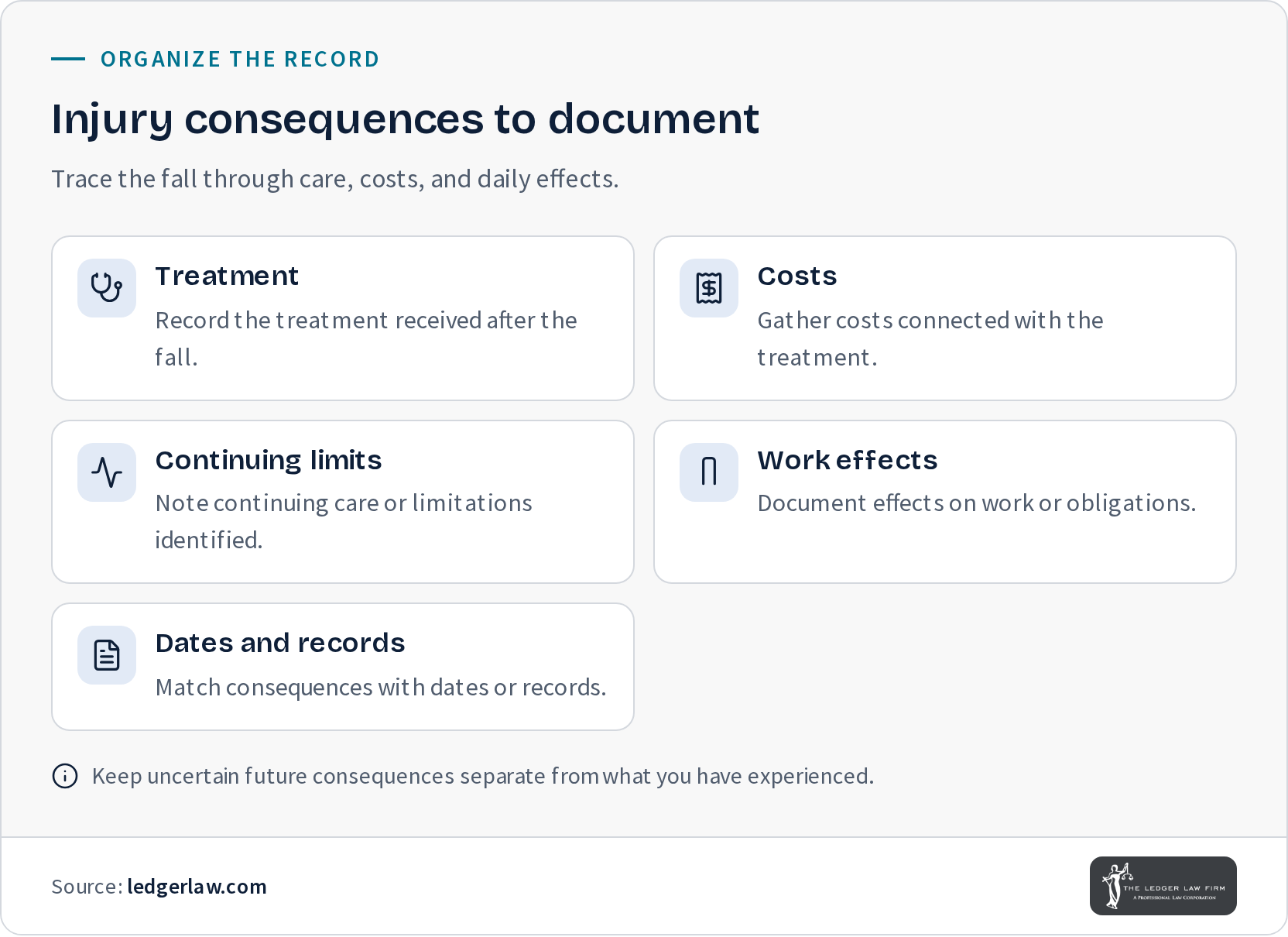
Your injury record should show more than a diagnosis by itself. Organize the treatment you received, the costs connected with that treatment, and the way the injury affected ordinary activities or work. The purpose is to present the consequences in a traceable sequence: the fall, the injury, the care, and the losses that followed.
A useful injury review asks concrete questions:
- What treatment occurred after the fall?
- What costs have already been incurred?
- What continuing care or limitations have been identified?
- How did the injury affect work or other documented obligations?
- Which consequences can you describe with dates or records?
The answers do not determine compensation on their own. They give an evaluation a clearer factual starting point.
An injury label alone does not establish the seriousness, duration, or financial effect of your particular claim. Keep descriptions of symptoms and limitations factual, and distinguish what you have already experienced from care or consequences that remain uncertain. That distinction prevents a general discussion of severity from becoming a prediction about your recovery.
Separate measurable losses from other claimed harm
Economic damages are losses with an easily ascertainable quantitative value. We identify examples such as medical bills, lost wages, and vehicle damage in those terms. For a fall, your organized economic record may include medical bills, documented lost income, and property-damage expenses connected with the incident.
Other claimed harm does not fit the same simple accounting exercise. Potential compensation may include pain-and-suffering losses along with medical bills, lost income, and property-damage expenses, depending on the claim. Potential does not mean automatic recovery, and the category does not supply a fixed amount.
Keep the categories separate when you prepare your information:
- Medical bills and related treatment costs.
- Income you can document as lost.
- Property-damage expenses connected with the incident.
- A dated description of pain, limitations, and other consequences.
This separation distinguishes amounts supported by invoices or wage records from harm that requires a fuller factual assessment.
A simple loss record can list the date, category, amount or description, and document supporting it. Keep paid amounts separate from estimates or projected expenses. For pain, limitations, and other consequences, describe what changed, when it changed, and how the change affected your activities without assigning a value you cannot support.
A list of losses is not the same as an entitlement to every listed item. Each potential component still depends on the facts of the incident and the applicable law. Use the list to organize questions for an evaluation, not to add the categories together as a predicted recovery.
Medical costs can include the present and the expected
Current medical costs show one part of the financial effect of an injury. Current and future medical costs can affect a settlement amount, and higher medical bills often result in larger settlement offers.
Expected medical costs require careful separation from costs already incurred. A treatment plan, continuing symptom record, or other medical information may raise questions about future care, but a general article cannot decide whether a particular future expense is related, necessary, or recoverable. Keep projected costs identified as projected rather than presenting them as paid losses.
Your medical-cost file can be arranged in a simple order:
- Bills already received.
- Payments or balances shown on those bills.
- Treatment dates and the care associated with each date.
- Information describing care that may still be expected.
- A short explanation of how each item relates to the injury.
A clear sequence helps an evaluation distinguish documented costs from unresolved questions about future care.
Medical expenses should not be treated as an automatic settlement formula. Higher bills may affect negotiations, but injury seriousness, proof supporting fault, and other case circumstances also matter. Preserve the records without trying to turn them into a settlement prediction. For organization, distinguish care already received from care that has only been discussed or anticipated, and distinguish an invoice or payment record from a description of symptoms. Keep treatment dates aligned with the corresponding bills and note when a record does not explain the connection to the fall. This does not establish that a future expense will be recoverable; it simply makes the medical-cost portion of the review easier to examine alongside injury severity, responsibility, causation, and other documented losses.
The property setting changes the questions to examine
The property setting can affect the questions raised by a premises-liability claim. The type of property involved is one factor that may affect a premises-liability settlement. A fall in a store, apartment building, office, parking area, or another setting may involve different facts about the condition and the circumstances surrounding the incident.
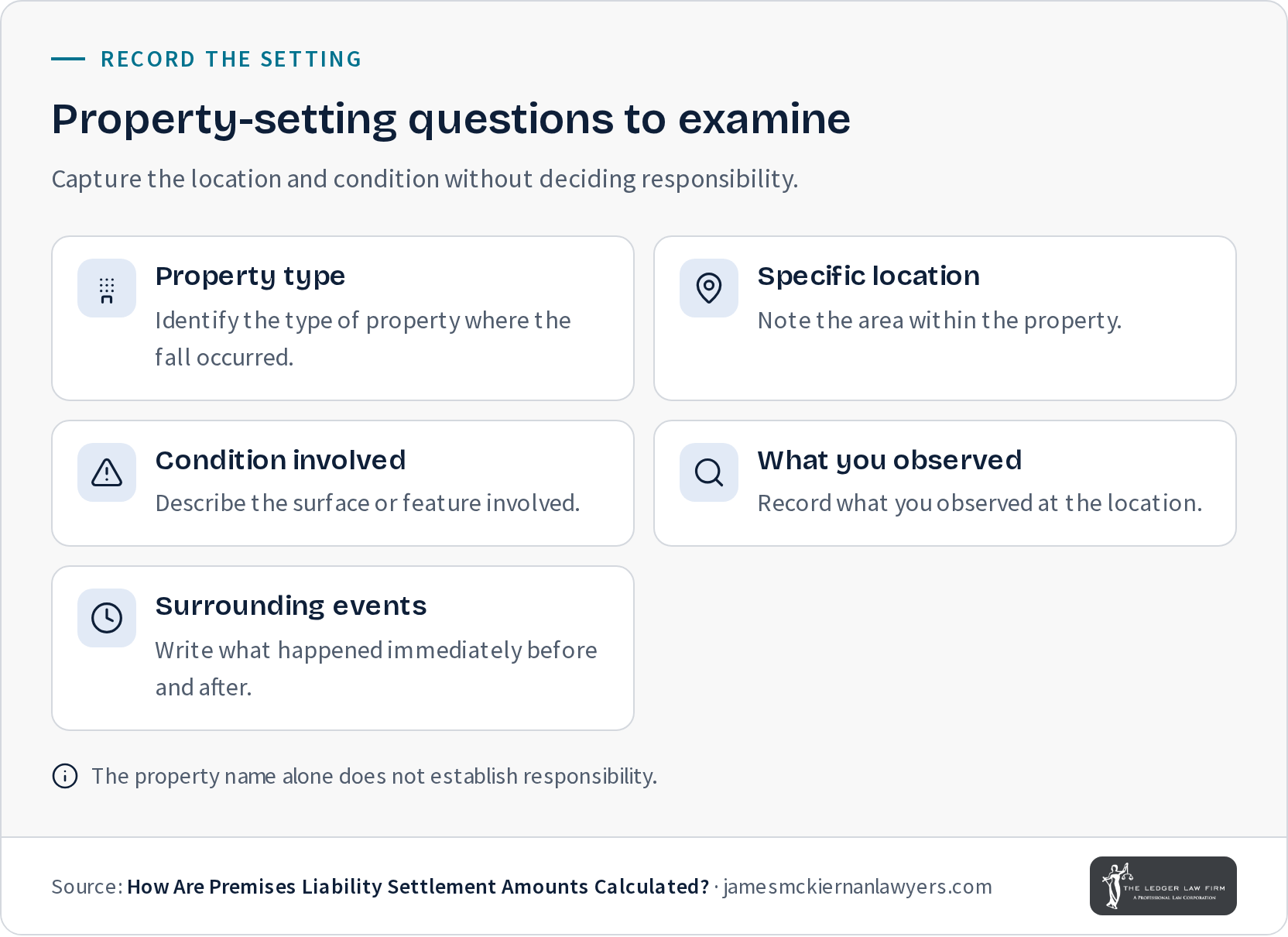
Your property-setting record should identify where the fall occurred and describe the condition you believe contributed to it. Note the area, the surface or feature involved, what you observed, and what happened immediately before and after the fall. Those details help frame the responsibility and causation questions without deciding them in advance.
The property name alone does not establish responsibility. The evaluation still has to examine the condition, the surrounding circumstances, and the available proof. Treat the setting as a starting point for identifying questions, not as a shortcut to a liability conclusion or settlement amount.
Write down the property setting while the details remain available to you. Include the location within the property and the condition involved, then keep that description with your medical and loss records. A specific account is more useful than a general label such as a store fall or property accident.
Responsibility requires more than showing that a fall occurred
A fall establishes that an incident occurred, but it does not by itself establish a property owner’s responsibility. A property owner’s potential responsibility depends on whether the owner breached a duty of reasonable care and whether that breach caused the resulting harm. Both the condition or conduct and its connection to the injury must be examined.
The property-condition question asks what made the location unsafe and what facts may show a failure of reasonable care. Your account may need to describe the condition itself and the circumstances surrounding the fall. This general framework does not determine whether a breach occurred in your case.
The responsibility question also requires a connection between the alleged breach and the harm. A condition can be relevant to the fall without resolving every question about the injury, the losses, or the applicable law. Keep the description of the condition separate from the medical and financial record so each part can be examined clearly.
Organize facts that may help answer four questions:
- What condition did you encounter?
- Where and when did the fall occur?
- What facts describe how the fall happened?
- What harm followed the fall?
This organization does not decide liability. It gives the evaluation a factual account instead of a conclusion such as the owner was negligent.
Prepare a factual account rather than a legal conclusion. Describe what you saw, where you were, how the fall happened, and what injury followed. An evaluation can then examine whether those facts support a potential responsibility theory under the law that applies.
Causation links the condition to the injury and losses
Causation asks whether the property condition and the fall are connected to the injury. A property owner’s potential responsibility depends on whether a breach of reasonable care caused the resulting harm.
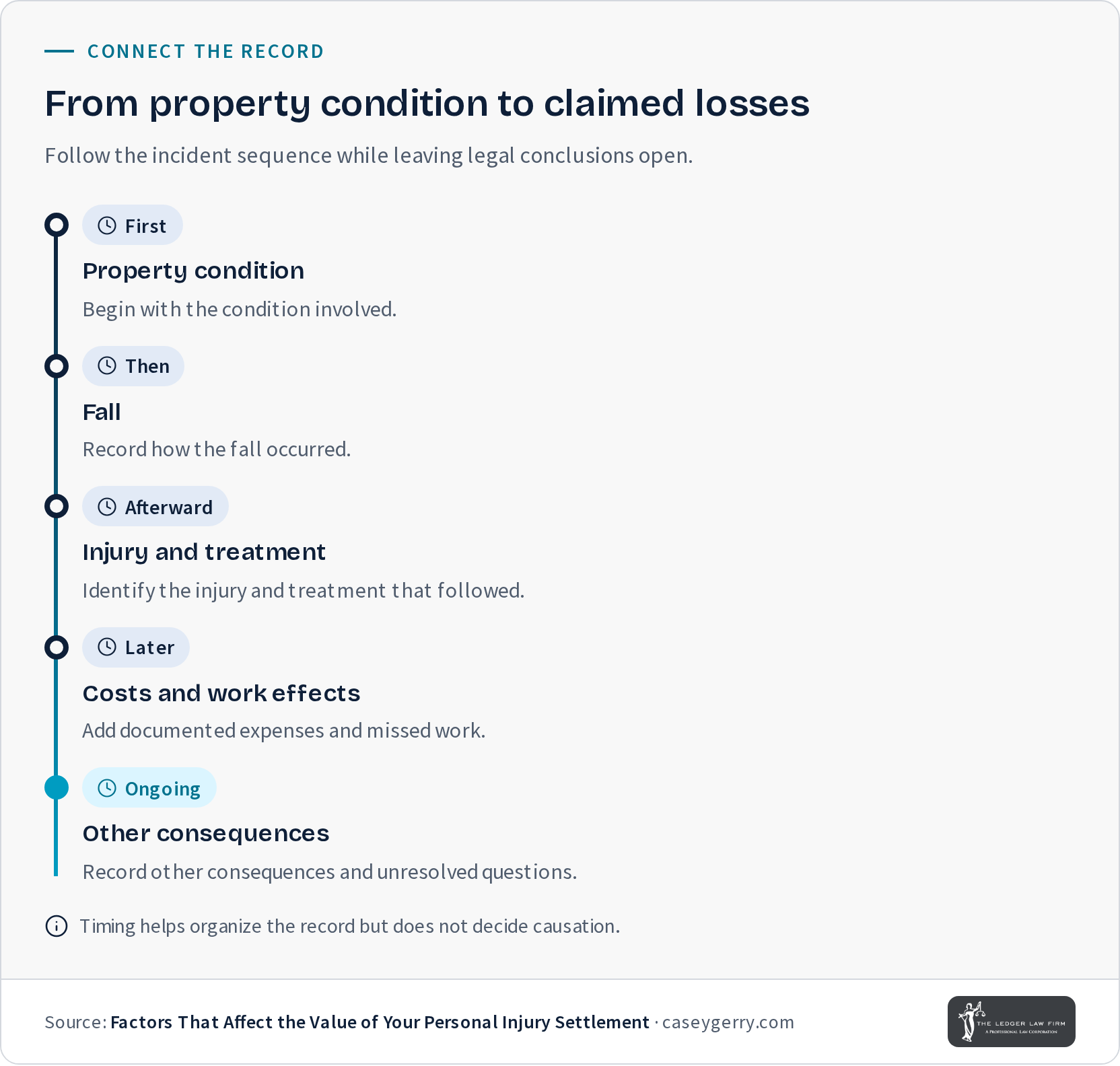
Your records should make the sequence understandable without overstating what it proves. Start with the property condition and the fall, then identify the injury, treatment, costs, income effects, and other consequences. The sequence helps an evaluation ask whether the claimed losses are connected to the incident and whether the available information supports that connection.
A symptom or expense that appeared after a fall still requires case-specific review. Timing can be part of the factual record, but timing alone does not decide causation. Keep descriptions, bills, and treatment information together while leaving the legal conclusion open for individualized analysis.
Create a simple incident-to-loss timeline. Place the fall first, followed by treatment, documented expenses, missed work, and other consequences in the order they occurred. Mark the difference between what you know from a record and what you remember but cannot currently document. Use the timeline to identify gaps or questions rather than to assign a value to the claim.
Preserve the records that can support an evaluation
An evaluation is easier to begin when your records show the incident, its consequences, and the facts bearing on responsibility. The strength of the evidence supporting fault can also affect negotiations, so preserve information about the incident separately from the financial record. Treat preservation as a way to keep the account traceable, not as a way to decide who is legally responsible. Begin with a dated incident entry while the sequence is available to you: identify the property area, the condition you observed, what happened immediately before and after the fall, and when the first consequences appeared. Keep that account distinct from later interpretations about breach, causation, or recoverability. Then connect each later record to the event without changing the record’s original wording. This approach makes it easier to see what is documented, what is based on memory, and what remains an unanswered question.
Use an incident-to-loss preservation checklist rather than placing every document in one undifferentiated file. Keep the original item where possible and add a short note explaining its date, category, and connection to the fall:
- Incident account: Record when and where the fall occurred, the part of the property involved, the condition you observed, what happened immediately before and after the fall, and when the account was written.
- Injury and treatment: Keep treatment information, invoices, appointment dates, and records describing continuing symptoms, limitations, or other consequences. Mark which items concern care already received and which concern care that remains uncertain.
- Income effects: Preserve records that document time away from work or another measurable income effect. Note the period covered and keep estimates separate from amounts supported by a record.
- Property-related loss: Retain receipts, estimates, or other available records for damage connected with the incident. Identify whether an amount is paid, estimated, disputed, or still being investigated.
- Responsibility and causation: Keep communications and other available information that may bear on the property condition, the circumstances of the fall, the connection between the fall and the injury, or the losses being described. Do not rewrite these materials to make them sound more conclusive.
- Open questions: For each missing, unclear, or conflicting item, write the question it raises instead of filling the gap with an assumption.
A short index can show the item, date, category, location, and open question. That index is not a valuation and does not establish responsibility. It simply lets an evaluation distinguish the incident account from the injury record, the measurable losses, and the information that may support or weaken a responsibility or causation theory. Preserve incomplete material as well as favorable material, because its significance can only be assessed in the context of the full record.
Where available, add incident-specific material to the index rather than relying only on a general description:
- Scene records: Preserve photographs or video of the location, condition, lighting, signage, or surrounding area that you already have. Note when and by whom each item was created, and keep the original file where possible.
- Incident reports: Keep any report prepared by the property, a business, an employer, or another person after the fall. If you know an incident report was created but do not have a copy, record that fact and request it where appropriate. Do not replace the original wording with your own summary.
- Surveillance information: Note whether cameras appeared to cover the area, where they were located, and whether you or someone else has identified potentially relevant footage. If footage may exist, record the request or communication seeking its preservation or availability. The absence of footage should be recorded as an open question, not treated as proof of either responsibility or innocence.
- Witness information: Preserve names and contact details for people who saw the fall, the condition, or what happened immediately afterward, if that information is available. Record what each person may have observed without presenting a remembered statement as an established fact.
- Notice and inspection information: Keep communications, notices, inspection records, maintenance records, or similar materials that are available and may bear on the condition or when it was observed. Identify whether the material concerns the condition before the fall, the incident itself, or a later response.
- Footwear: Preserve the shoes worn at the time of the fall and record which pair they were. Avoid altering the condition of the footwear before it can be considered with the rest of the incident record, and note any uncertainty about its condition or use.
For each item, record whether it is in your possession, has been requested, was unavailable, or is still being located. This status makes the difference between an absent record and a record that has not yet been sought. It also prevents a checklist from implying that every category exists in every incident. The point is not to collect material indiscriminately or to prove responsibility by the existence of a document. The point is to preserve the facts as they are, show what information may connect the condition to the fall, and identify gaps that an evaluation must address.
Use one folder or digital location for the records, with a separate section for each category. Label each item by date and keep the original wording where possible. If a document concerns more than one category, place a copy or note in each relevant section so the relationship is easy to follow.
Add a short explanation to records that may otherwise be difficult to interpret. Identify what the document is, what date it concerns, and how it relates to the fall, injury, or loss. A concise explanation makes it easier to distinguish a treatment expense from an income loss or a fact bearing on responsibility.
A preserved document does not automatically establish responsibility or recoverability. Records become useful when their relationship to the fall, the injury, or the claimed loss can be explained. Keep uncertain items in the file and identify the question they raise rather than discarding them or treating them as conclusive.
Evidence strength affects the negotiation position
Evidence strength can affect how a premises-liability claim is handled in negotiation. Strong proof supporting fault may improve settlement prospects, while weak evidence may contribute to a lower offer or litigation.
The central evidence question is whether the available information supports the account of the property condition, the fall, and the resulting harm. Your incident description, medical records, loss documentation, and information bearing on responsibility should fit together without unexplained gaps. A gap does not automatically defeat a claim, but it identifies an issue that an evaluation may need to examine.
A settlement offer should be considered against the evidence and losses that support the claim, not against an internet average alone. A lower offer may reflect disputed fault, incomplete proof, questions about causation, or disagreement about the losses. A higher offer is not automatically adequate simply because it exceeds a published example.
Before treating negotiations as a value test, identify what each side appears to accept and dispute. Compare those points with your records, then preserve unanswered questions for case-specific review. Avoid presenting uncertain facts as established simply because doing so might make the claim sound stronger.
To make that comparison more precise, use a “what this record shows / what it does not show / what remains to be checked” note for each important item. This keeps a document from being used beyond its actual content. For example, a treatment invoice can identify a charge and date, but it does not by itself establish what caused the injury or who was responsible for the property condition. A photograph can preserve the appearance of a location, but it does not by itself answer when the condition began or connect that condition to every claimed consequence. A witness account may address what someone observed, while a wage record addresses a different question. These distinctions do not weaken or prove a claim on their own; they clarify the question each item may help an evaluation examine.
Then make a second list for the points raised in the negotiation. For each accepted point, identify the record supporting it. For each disputed point, write the competing descriptions without choosing one merely because it favors your position. For each missing point, record whether the gap concerns the condition, the sequence of events, the injury, a documented loss, or the applicable law. This creates a more useful review than collecting documents without explaining their relevance. It also helps distinguish an incomplete file from evidence that points in different directions.
A practical comparison can use the same order as the incident itself. Begin with what was observed at the property, then the account of how the fall occurred, then the records describing treatment and its timing, and finally the consequences that are supported by separate documentation. At each step, note whether the information is firsthand, recorded by someone else, or based on an estimate. Do not convert an estimate into an established amount, and do not convert a remembered detail into a verified event. The purpose is to show where the account is clear and where further review may matter.
When an offer or negotiation position changes, update the worksheet rather than rewriting the underlying history. Record the date of the communication, the point that appears to have changed, and the evidence or unresolved issue connected with it. This does not tell you whether an offer is adequate, and it does not predict what a different path would produce. It gives you a disciplined way to ask whether the discussion is moving because of stronger support, a disagreement about responsibility, a question about the claimed consequences, or some other case-specific issue. Keeping those reasons separate helps prevent a published average from replacing the evidence review.
Gross claimed damages are not the same as recovery
A total of claimed losses is not the same as an individualized recovery. Each category remains subject to the facts, proof, responsibility questions, and applicable law.
Economic damages can be added from identifiable records, but that arithmetic describes the documented amounts rather than the final result. We identify medical bills, lost wages, and vehicle damage as examples of losses with an easily ascertainable quantitative value. A fall-related claim may require a different property-damage record, and the category should reflect what actually occurred.
Pain-and-suffering losses do not become predictable merely because economic losses are documented. Pain and suffering may be a potential component of compensation, but no universal calculation for that category applies to every claim. Keep this category described factually through the injury’s consequences rather than assigning a number without individualized support.
Use this distinction when comparing any figure with your situation. Ask whether the number refers to a selected outcome, a claimed total, a particular category of loss, or an actual resolution under similar facts. If the comparison does not answer those questions, it should not become your recovery estimate.
Negotiation and trial present different tradeoffs
Settlement and trial involve different considerations. Settlement typically resolves a case faster than trial, although speed alone does not determine whether settlement is appropriate. Trial expenses can be high, and settling may avoid those costs; those costs can affect the compensation ultimately received.
| Consideration | Settlement | Trial |
|---|---|---|
| Pace | Typically resolves a case faster than trial. | Generally requires comparison with the slower trial process. |
| Expenses | May avoid some trial expenses. | Expenses can be high and may affect the compensation ultimately received. |
| Evidence | The strength of proof can affect the offer and negotiation prospects. | The evidence and unresolved factual disputes remain part of the case assessment. |
| Decision | Speed alone does not determine whether settlement is appropriate. | The possible costs, risks, and factual questions require case-specific review. |
Settlement can provide a defined resolution without requiring the full trial process, but the amount and terms still require careful case-specific consideration. A faster resolution may matter if you need certainty or want to avoid additional trial expense. Those practical advantages do not establish that an offered amount fairly addresses your documented losses.
Potential trial costs and the evidence presented are part of a case-specific assessment. A practical comparison should therefore separate the amount being discussed from the path used to resolve the claim. Begin by identifying which losses are documented and which responsibility or causation facts remain disputed. Then consider whether settlement would provide a defined resolution sooner and whether avoiding some trial expenses matters in light of the documented losses. If trial remains under consideration, identify the evidence that would need to address the disputed facts and the expenses that could affect the compensation ultimately received.
This comparison does not require treating settlement as automatically better or trial as automatically more valuable. A faster path may reduce the time spent pursuing the claim, but speed alone does not establish that an offer addresses the claim fairly. Likewise, continuing toward trial does not by itself establish a particular result. The useful decision record is a side-by-side account of the documented losses, evidence strengths and gaps, disputed responsibility questions, expected costs, and the practical importance of a defined resolution. Keeping those considerations separate helps prevent an internet average or a single offer from becoming the only measure of the decision.
Treat speed as one consideration, not the deciding rule. Compare the available path with the strength of your proof, the losses you can document, the questions about responsibility, and the costs that may affect the final amount. Preserve the records and questions needed for that comparison.
California mediation has specific limits
California mediation has specific characteristics that should not be generalized to every jurisdiction. In a California personal-injury case, mediation is described as voluntary and confidential. A mediation result becomes binding only if both sides sign a written settlement agreement.
Voluntary participation means the process depends on the parties’ participation, and confidentiality does not by itself determine whether the underlying claim is supported. These points answer different questions: participation concerns whether the parties enter the process, confidentiality concerns how the mediation is treated, and the written-agreement condition concerns when the result becomes binding. None of those procedural points supplies a settlement value or resolves responsibility and causation. The description is limited to the California mediation principles identified here and should not be treated as a general rule for incidents in other jurisdictions.
The written-agreement condition is a practical boundary for California cases. A discussion during mediation should not be treated as a binding settlement merely because the parties exchanged proposals or reached an informal understanding. The binding effect described for California mediation depends on both sides signing a written settlement agreement.
If your incident occurred outside California, do not assume this California description controls your case. Keep the jurisdiction visible when you organize questions about mediation, settlement, or trial. An evaluation must apply the law and procedures relevant to the place and circumstances of your claim.
The case evaluation should test unanswered questions
A case evaluation should examine the facts that an average cannot resolve. Because each premises-liability case is evaluated on its specific facts, the review should address the injury, documented losses, property condition, responsibility, causation, evidence strength, and possible resolution path. The purpose is to identify what can be supported and what remains uncertain, not to promise a settlement figure.
Bring questions that keep the analysis in separate parts:
- What facts describe the condition and the fall?
- What information may bear on whether reasonable care was breached?
- What connects the condition and fall to the injury?
- Which medical costs, income losses, property-damage expenses, and other consequences are documented?
- Where is the evidence strong, and where are important facts still unresolved?
- How might negotiation, mediation, or trial affect the practical path?
The strength of the evidence supporting fault may affect settlement prospects, while weaker evidence may contribute to a lower offer or litigation. That makes evidence gaps part of the evaluation, not a reason to fill them with assumptions. Mark each unresolved point clearly and attach the record or description that may help answer it.
Before requesting an evaluation, arrange your information in the order that the questions arise:
- Incident account and property condition.
- Injury, treatment, and medical costs.
- Documented income effects and property-damage expenses.
- Other consequences that you can describe factually.
- Responsibility, causation, and resolution questions that remain open.
This order helps connect each loss to the incident without treating the packet as a settlement calculation.
An individualized recovery requires review of your facts and the law that applies to them. A general article cannot decide liability, calculate your potential recovery, or determine whether you qualify for a particular legal remedy. Use the evaluation to address those case-specific questions with the records you have preserved. A useful result is not necessarily a number at the first conversation. It may instead clarify which facts appear documented, which responsibility or causation questions remain open, which losses need better support, and which records or communications should be located or preserved.
Before the evaluation, separate facts you directly observed from conclusions you have drawn about fault or recovery. Mark projected costs as projected, distinguish a witness account from your own recollection, and identify records that are missing rather than filling the gap with an assumption. During the review, ask which parts of the account are accepted, disputed, or still unknown. That structure helps you judge what further information is needed and keeps the evaluation focused on the incident, its consequences, the available evidence, and the law that applies rather than on an unsupported average.
Request a free case evaluation with the record you have
A published settlement figure cannot value your individual slip-and-fall claim. Organize the incident account, injury and treatment records, documented losses, information bearing on responsibility and causation, and questions about the available resolution path. A qualified legal professional must determine individual suitability and assess the facts under the applicable law.
We keep clients informed throughout the process and consult with them along the way about their personal injury lawsuit. Provide the information you have about the fall, the property condition, your injury, and the documented consequences so the initial discussion can focus on the questions that remain.
Frequently Asked Questions About Slip-and-Fall Claims
What is the average personal injury settlement for a slip-and-fall claim?
There is no reliable universal average for these claims. Published examples, including a roughly $10,000 figure for minor harm in one wet-floor scenario, are limited context rather than a prediction, floor, or ceiling. Injury severity, documented losses, property circumstances, proof of responsibility, causation, and applicable law must be reviewed together.
Can medical bills be used to calculate a slip-and-fall settlement?
Medical bills help document economic losses, but they do not determine the final recovery by themselves. Keep current expenses separate from projected care and organize treatment records, income effects, property-damage expenses, and other consequences. Potential compensation may include non-economic harm, but each category depends on the facts and applicable law.
What must be shown to hold a property owner responsible for a fall?
A fall alone does not establish responsibility. The available facts must be reviewed to determine whether a property owner or occupier breached a duty of reasonable care and whether that breach caused the injury and claimed losses.
Should a premises-liability case be settled or taken to trial?
That choice depends on the evidence, disputed responsibility and causation issues, documented losses, costs, uncertainty, and the need for a defined resolution. Settlement typically resolves a case faster and may avoid some trial expenses, while trial can involve greater expense and uncertainty. Speed or the possibility of a larger result should not alone determine the decision.
Does California law apply to every slip-and-fall claim?
No. California-specific rules and procedures do not automatically govern incidents elsewhere. The location of the fall and the applicable law must be kept separate from general settlement information, particularly when evaluating mediation, responsibility, damages, or the available resolution path.
Is a claimed settlement amount the same as the money the injured person will receive?
No. A claimed total may include documented economic losses and other potential categories, but it is not the same as an individualized recovery. The final amount, if any, depends on the facts, supporting evidence, responsibility questions, applicable law, and the terms of resolution. The supplied information does not establish fees, liens, taxes, or a net-recovery calculation.

Emery Brett Ledger brings 28+ years of experience to personal injury law. He founded & led The Ledger Law Firm in securing over $100 million in compensation for clients with life-altering injuries & complex claims. Prior results do not guarantee a similar outcome. Licensed in California, Texas, & Washington, Emery earned his law degree from Pepperdine University School of Law. His practice areas include car & truck accidents, wrongful death, catastrophic injuries, maritime claims, & mass tort litigation. He has been recognized by The National Trial Lawyers’ Top 100, Mass Tort Trial Lawyers Top 25, and America’s Top 100 Personal Injury Attorneys. Emery also received the 2025 Elite Lawyer Award & holds a perfect 10.0 Avvo rating with Platinum Client Champion status. His legal work has been featured on CNN, Forbes, NBC, & ABC.
Free Case Evaluation
Recent Posts
- What Is the Average Personal Injury Settlement for a Slip-and-Fall Claim?
- How should you organize medical bills after a Seattle car crash?
- What should families bring to a Texas wrongful death consultation?
- How do California wrongful death and survival actions differ?
- The Ledger Law Firm for a Truck Accident: Deciding Whether to Request an Evaluation
Emery Brett Ledger brings 28+ years of experience to personal injury law. He founded & led The Ledger Law Firm in securing over $100 million in compensation for clients with life-altering injuries & complex claims. Prior results do not guarantee a similar outcome. Licensed in California, Texas, & Washington, Emery earned his law degree from Pepperdine University School of Law. His practice areas include car & truck accidents, wrongful death, catastrophic injuries, maritime claims, & mass tort litigation. He has been recognized by The National Trial Lawyers’ Top 100, Mass Tort Trial Lawyers Top 25, and America’s Top 100 Personal Injury Attorneys. Emery also received the 2025 Elite Lawyer Award & holds a perfect 10.0 Avvo rating with Platinum Client Champion status. His legal work has been featured on CNN, Forbes, NBC, & ABC.