Car Wreck Lawyers Near Me: How to Choose a Nearby Attorney and Prepare for a Case Evaluation

Start with the limits of a nearby-lawyer search
A nearby-lawyer search should answer more than who appears closest to you. The useful question is whether a lawyer can examine the collision record, address the legal questions tied to the state where the wreck occurred, and explain what would happen next without promising fault, compensation, or a particular result. Distance can affect meeting options and communication, but a search listing does not establish that a firm is physically nearby, handles your type of collision, or is available in your jurisdiction.
A practical search starts with four filters:
- Jurisdiction: Identify the state where the collision happened before relying on general information. Insurance duties, reporting requirements, and claim rules can differ by state.
- Case fit: Look for a practice that can discuss the questions your record raises, including responsibility, injuries, financial losses, and insurance communications.
- Evaluation scope: Ask what the initial conversation will examine and what it will not decide.
- Communication: Ask who will communicate with you, how questions will be handled, and what information the lawyer needs first.
These filters turn a location search into a work-and-fit comparison.
Professional recognition, trial experience, ratings, and published results can be comparison factors, but a directory label does not establish that a lawyer fits your facts or will produce a particular outcome. Examine what each lawyer can explain about the work your collision may require, then keep the comparison tied to your record rather than to a ranking or slogan.
Protect the collision record before choosing counsel
The collision record becomes harder to evaluate when video, documents, physical evidence, or witness memories disappear or become less reliable. Preserve relevant material promptly while the details remain available. Preservation does not prove who was responsible; it gives you a clearer collection of information to discuss.
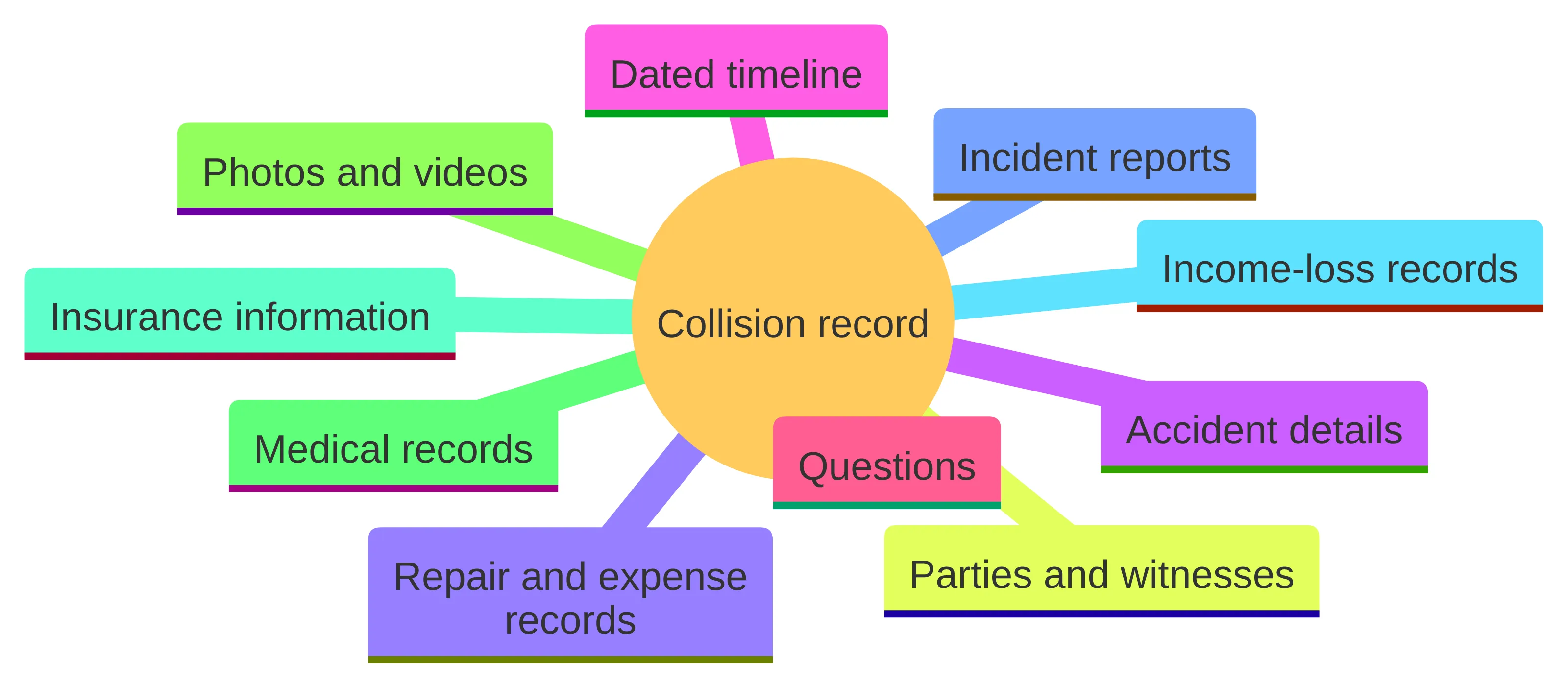
A collision record can include more than photographs of vehicle damage. Gather the following items in one place:
- The date, location, and your concise account of what happened.
- Police or incident reports, if available.
- Names and contact information for the other parties and witnesses.
- Photos or videos of the scene, vehicles, visible conditions, and injuries.
- Medical records, treatment summaries, bills, prescriptions, and related documentation.
- Insurance details, claim numbers, letters, emails, text messages, and adjuster communications.
- Pay stubs, employer records, missed-work dates, and other income-loss records.
- Repair estimates, receipts, transportation costs, and other expense records.
The list is a working file, not a requirement to solve the legal questions yourself.
A dated timeline can connect the collision, communications, treatment, work interruptions, expenses, and other developments without forcing you to rely on memory during a call. Keep original files when possible, label copies with dates, and mark gaps as questions rather than filling them with guesses. A lawyer can then see which parts of the account are documented and which parts need further review.
Use the timeline as a question map, not only a list of dates. Beside the collision entry, note which record may clarify sequence or conditions; beside treatment entries, note which record documents care or continuing limitations; beside work or expense entries, identify the supporting record. For an insurer communication, record what was requested and whether you responded, without treating the request as proof of fault or a deadline determination. If a record or witness is missing, label it as unavailable and note the reason known to you rather than filling the gap with an assumption. This format lets the lawyer see what is documented, what remains uncertain, and which follow-up questions deserve attention.
Prompt preservation is especially useful when a recording, physical condition, or witness account may change. Save what you have before comparing lawyers, and tell the lawyer which evidence may no longer be available. That detail can affect the questions the evaluation needs to address.
Know what a case evaluation can examine
A case evaluation may examine who was involved, what reports and records exist, what caused the collision, who may be responsible, and what evidence and insurance information are available. The evaluation is a way to organize unresolved questions. It does not establish responsibility, eligibility, compensation, or a legal outcome.
Medical records can document what was injured, what treatment was necessary, and whether limitations may continue. Records can also help connect the treatment history to the losses you want discussed, while leaving the legal significance of those facts for a qualified attorney to assess.
Depending on the facts and applicable law, losses may extend beyond medical bills to wage loss, future care, reduced earning capacity, or lost normal activities. Possible losses may include medical expenses, lost wages, pain and suffering, and other losses depending on how an injury affected daily life. These categories are questions to document, not a forecast of what your claim is worth.
Depending on the case, lawyers may consult accident-reconstruction, biomechanics, or injury-evaluation experts about causation and damages. You can ask what questions that type of review would address and what information would support it.
A first evaluation also has boundaries. It may identify questions that need more records, jurisdiction-specific research, or additional discussion; it does not replace an individualized legal assessment. A useful conversation leaves you with clearer questions and a defined explanation of what the lawyer can evaluate next.
To make the evaluation more productive, say explicitly which conclusions you are not asking the packet to make. It can show that a treatment record exists, that a witness has been identified, or that an insurer sent a request; it cannot by itself establish causation, responsibility, eligibility, or compensation. Ask the lawyer to distinguish facts that are documented from issues that need investigation and from legal questions that depend on the applicable jurisdiction. That distinction helps prevent an organized file from being mistaken for a completed claim assessment.
Treat insurance contact as information to handle carefully
Insurance companies investigate claims while an attorney may be developing the injured person’s claim. Documentation supporting major losses and arguments can strengthen a settlement demand. For that reason, keep every letter, email, text message, claim number, and request connected to the collision instead of treating an adjuster’s call as an isolated conversation.
Insurance communications belong in the evaluation packet. Include the sender, date, subject, claim number, and a short note about what the message requested or said. Ask the lawyer how those communications fit into the review of your facts, and separate what the insurer has requested from what you know about the collision itself.
Insurance and reporting requirements vary by jurisdiction. Illinois guidance describes reporting, information-sharing, witness, and insurer-contact steps after a qualifying collision, while New York guidance describes no-fault benefits of up to $50,000 for medical expenses and lost wages regardless of fault. Neither example should be generalized nationwide. Identify the state where the collision occurred and ask for advice tied to that state’s rules.
A careful insurance discussion should answer practical questions without turning general information into a decision about your case:
- What communications should be preserved for review?
- Which facts about the collision and injuries remain unclear?
- What state-specific issue needs attention?
- What documents would help explain the request or response?
- What does the proposed legal review cover before any representation agreement is signed?
Keep the questions factual. Do not assume that a payment, denial, request, or conversation decides fault or claim value.
Before discussing an insurer message, add a short jurisdiction note to the packet: state where the collision occurred, whether that location is confirmed, and which questions about reporting, coverage, or the message remain open. Then separate the insurer’s position or request from the underlying collision evidence. A request for records, a payment position, or a denial is part of the communications history; it is not by itself a determination of responsibility or claim value. If a response is pending or the request is unclear, flag it for the case-specific review rather than guessing at what the law requires. This triage helps the lawyer focus on the applicable state rules and the records needed to discuss the communication.
Compare lawyers by the work your collision may require
A useful lawyer comparison matches the work to the unresolved parts of your collision. Ask each practice the same questions about:
- Evidence: How would the lawyer organize reports, photographs, medical records, witness information, and insurance material?
- Responsibility: How would the initial review examine the cause of the collision and the people or entities who may be responsible?
- Losses: How would the discussion account for treatment, income loss, future care, reduced earning capacity, or effects on normal activities when those issues are relevant?
- Insurance: How would the lawyer review communications and available coverage information without assuming that one state’s rules apply everywhere?
- Additional review: If the facts require it, would the lawyer consider accident-reconstruction, biomechanics, or injury-evaluation expertise?
Concrete answers give you more to compare than a general promise to help.
Our auto-accident work includes interviewing witnesses and obtaining their official statements. Ask any practice you contact whether witness information will be gathered, preserved, and evaluated as part of the proposed review. The answer should describe a work step, not promise that witness evidence will establish responsibility.
We keep clients informed throughout the personal-injury process and consult them along the way regarding their lawsuit. Communication should be part of your comparison: ask who will update you, how you can raise questions, and how your decisions will be included in the process. Treat those answers as terms to understand, not as a guarantee about the result.
Peer recognition, ratings, trial experience, and published results can help you create a comparison list, but directory methodologies and labels should not replace questions about fit. Use the same criteria for every lawyer, write down the answers, and choose the next conversation based on the work and communication you can actually evaluate.
Ask how representation would be defined before signing
An initial evaluation and a representation agreement are different points in the process. A retainer agreement and a contingency agreement govern the representation, so the terms deserve attention before you sign. An initial conversation can help you understand what questions remain, but it does not by itself establish that the firm represents you.
Before signing representation or contingency agreements, review their terms and ask the lawyer about your rights, fees, and responsibilities. You can also ask:
- What services and decisions does the proposed representation cover?
- Who will communicate with you and with insurers or opposing counsel?
- How will case costs, documents, expert review, and other work be handled?
- What responsibilities remain with you?
- What happens if the scope of work changes?
Write down the answers and compare them with the agreement itself. If a term is unclear, ask for an explanation before signing rather than relying on a verbal assumption.
No agreement can promise that the other side will accept responsibility or that compensation will be available. The purpose of this step is narrower: understand the proposed relationship, its terms, and the work you are being asked to authorize.
Assemble a usable evaluation packet
An evaluation packet should let you explain the collision in order and locate the records behind your answers. Use one folder, digital or physical, with clear names and a short index. Include the following items:
- Index: A short map of the digital or physical folder and where each record group is stored.
- Open items: A note identifying missing records, unavailable witnesses, unanswered requests, or dates that need confirmation.
- Timeline and questions: Important dates, developments after the collision, and the questions you want answered.
- Agreement notes: If you have spoken with a lawyer, record the proposed scope, fee questions, and terms that remain unclear.
The packet’s immediate use is simple: it gives you a structured way to answer what happened, what changed afterward, what has been documented, and what remains uncertain. Mark missing records plainly and add questions beside the relevant category. Do not create facts to fill a gap; identify the gap for discussion.
Present the packet in the same order each time: location and date; a concise collision account; injury and treatment changes; work, expense, or property effects; insurance communications; and missing records or witnesses. For each category, identify one known fact, the record supporting it, and the question that remains. For example, an insurer message can be paired with the request it made and the document you have—or do not have—that bears on the request. This method gives the attorney a quick distinction between documented information, your recollection, and an unresolved gap. It also keeps the evaluation focused on what can be examined next rather than on an unsupported estimate of a claim’s value.
Medical records can document the injury, necessary treatment, and whether limitations may continue, while documented support for major losses can strengthen a settlement demand. Put those records beside your timeline rather than separating medical, work, and insurance information into unrelated piles. The arrangement helps you explain how the collision affected your life without treating documentation as a guarantee of recovery.
Compare Case-Evaluation Scope, Communication, and Agreement Terms
Compare lawyers by what their case evaluations would address: the evidence and insurance information each would examine, the discussion of responsibility and potential losses under applicable law, and the communication, fees, and responsibilities described for the representation. Before requesting that review, note the state where the wreck occurred, make a short timeline, separate the records you have from gaps, and list the two or three questions that matter most. A qualified attorney must decide whether your circumstances support representation and what legal options apply; this guide cannot make that individual determination for you.
Use the information you have gathered to decide whether requesting an individualized evaluation is the next step.
Questions to resolve before requesting an evaluation
What should I gather for an initial case evaluation with a car wreck lawyer?
For an initial evaluation, consider gathering details about the collision, police reports, medical records, photographs or videos, insurance information, communications with insurers, witness information, income-loss records, and a timeline of events.
How can I preserve evidence after a car accident?
Preserve relevant evidence promptly, including video, documents, physical evidence, and witness accounts, as these may become less reliable over time.
What types of damages can I claim after a car accident?
Depending on the facts and applicable law, potential damages may include medical expenses, lost wages, pain and suffering, and other losses related to how the injury has affected your daily life.
What factors should I consider when comparing car wreck lawyers?
When comparing lawyers, consider their experience with similar cases, communication style, fee structure, and how they plan to handle evidence and insurance communications.
What is the purpose of a case evaluation with a lawyer?
A case evaluation helps organize unresolved questions about the accident, including who was involved, what evidence exists, and what insurance information is available, but it does not guarantee any legal outcomes.
How do insurance requirements vary by state after a car accident?
Insurance and reporting requirements differ by jurisdiction; for example, some states have no-fault insurance laws that provide immediate coverage for medical expenses and lost wages, while others may have different reporting obligations.
What should I ask a lawyer during an initial consultation?
During an initial consultation, ask about their experience with your type of case, how they will communicate with you, what documents you need to provide, and the terms of their representation agreement.

Emery Brett Ledger brings 28+ years of experience to personal injury law. He founded & led The Ledger Law Firm in securing over $100 million in compensation for clients with life-altering injuries & complex claims. Prior results do not guarantee a similar outcome. Licensed in California, Texas, & Washington, Emery earned his law degree from Pepperdine University School of Law. His practice areas include car & truck accidents, wrongful death, catastrophic injuries, maritime claims, & mass tort litigation. He has been recognized by The National Trial Lawyers’ Top 100, Mass Tort Trial Lawyers Top 25, and America’s Top 100 Personal Injury Attorneys. Emery also received the 2025 Elite Lawyer Award & holds a perfect 10.0 Avvo rating with Platinum Client Champion status. His legal work has been featured on CNN, Forbes, NBC, & ABC.
Free Case Evaluation
Recent Posts
- Attorneys for Work Injuries: How to Decide Whether to Contact One and Prepare for an Evaluation
- Injury Attorneys Dallas: How to Decide Whether to Contact a Car Accident Lawyer
- Personal Injury Lawyer Greenville South Carolina: How to Decide Whether to Seek Help After a Slip and Fall
- Lawyers for Wrongful Death: How to Choose One and Prepare for a Case Evaluation
- Injury Attorney in LA: How to Decide Whether to Seek a Case Evaluation After a Crash
Emery Brett Ledger brings 28+ years of experience to personal injury law. He founded & led The Ledger Law Firm in securing over $100 million in compensation for clients with life-altering injuries & complex claims. Prior results do not guarantee a similar outcome. Licensed in California, Texas, & Washington, Emery earned his law degree from Pepperdine University School of Law. His practice areas include car & truck accidents, wrongful death, catastrophic injuries, maritime claims, & mass tort litigation. He has been recognized by The National Trial Lawyers’ Top 100, Mass Tort Trial Lawyers Top 25, and America’s Top 100 Personal Injury Attorneys. Emery also received the 2025 Elite Lawyer Award & holds a perfect 10.0 Avvo rating with Platinum Client Champion status. His legal work has been featured on CNN, Forbes, NBC, & ABC.