Should You Contact a Vehicle Collision Attorney? A Practical Decision Guide
Check whether a response or release needs legal review
Before sorting the rest of the collision record, check whether an insurer has requested a response or whether you have been asked to sign a release. If your injuries are significant or fault is unclear, consider getting legal advice before signing a release; the need and effect depend on the applicable jurisdiction and claim.
If no release is at issue, focus first on the information needed for the next conversation: the crash account, insurance communications, injury and loss records, and evidence about responsibility. Keep missing material marked as missing rather than treating an assumption as a fact. A qualified attorney can review the remaining questions under the applicable law; this guide cannot determine responsibility, coverage, compensation, or outcome.
A collision case can contain several separate questions:
- Responsibility: What facts may show how the crash happened, and could more than one party share liability?
- Insurance: Which policy or insurer may respond, and is the issue legal responsibility, available coverage, or both?
- Injury and loss: What treatment, bills, missed work, and property damage need to be documented?
- Evidence: Which records, photographs, witnesses, or statements can support your account?
- Decision point: Do you need qualified legal review before responding to an insurer or signing a release?
Your answers depend on the crash facts and the law of the applicable jurisdiction. A case evaluation can examine evidence, insurance information, responsibility, potential losses, communication, fees, and representation responsibilities.
Write one sentence describing the issue you want addressed. For example: “I do not know which insurer should handle my injury claim,” or “The other driver disputes responsibility, and I have medical bills and missed work.” That sentence gives the first conversation a purpose without pretending that the result is already known. If several issues overlap, list the two or three questions that matter most and take them into the evaluation.
This approach also gives you a boundary for deciding whether a conversation would be useful. You do not need to predict liability or calculate a settlement before asking for a review. You do need to describe what happened, what has changed since the collision, what insurers have requested, and what remains unclear.
Separate responsibility from available insurance
On the question-to-record map, give responsibility and available insurance separate entries. For responsibility, note the facts and records bearing on who may be liable under the applicable law. For insurance, note each policy, insurer, claim number, and coverage question. After an uninsured crash, this separation keeps responsibility distinct from a possible path to payment.
Then mark where the entries intersect: an insurer may dispute coverage, or coverage may exist while the parties disagree about who caused the collision. The map should show that overlap without treating either question as resolved.
Your claim may involve more than one insurance relationship. The National Association of Insurance Commissioners’ auto-insurance guide published in 2022 explained that, in no-fault states, your own insurer generally pays injury benefits for you and your passengers regardless of fault. The guide also stated that state rules may allow claims against an at-fault driver for serious injuries while vehicle damage is handled through the at-fault driver’s insurer.
Those rules vary by state. Treat the no-fault description as a starting question, not as a nationwide answer about your injury claim or vehicle damage.
Use the insurance record to sort the question before drawing a conclusion:
- Identify every insurer, policy, claim number, and request you have received.
- Separate statements about what happened from statements about what coverage may be available.
- Note whether an insurer has requested records, proposed a settlement, disputed responsibility, or identified a coverage issue.
- Record the state where the collision occurred and the state connected to each policy, if you know it.
- Ask a qualified attorney to review responsibility and coverage together when the two cannot be separated from your injury or loss claim.
If the other driver was uninsured, ask specifically how responsibility and available insurance should be analyzed under the law that applies to your crash. A review can explain whether the facts suggest a practical path to payment, but it cannot promise that a claim will succeed.
Use the collision evidence to identify what can be answered
Attach each item to the question it can help examine instead of treating a collection of evidence as an answer. Photographs, witness statements, and expert testimony may help evaluate responsibility and the extent of losses. Photos and video may help explain the scene, vehicles, visible injuries, and potential witnesses; a crash report or report number can explain reported details and the responding agency.
For each item, note what it may show, whose account or record it represents, and what remains unconfirmed. An insurance message may show what the insurer is asking for or disputing. The map connects evidence to a question while leaving legal conclusions for review under the facts and applicable law.
A written collision account should preserve the sequence rather than merely label someone as responsible. Write down what happened in order, including the actions you remember, the other vehicle’s actions, and what occurred immediately afterward. Add the weather and road conditions, then describe the injuries and vehicle or property damage as specifically as you can.
Keep the account separate from conclusions such as “the other driver was completely at fault.” Your account records your recollection. Responsibility remains a question for review under the facts and applicable law.
Use gaps in the evidence as questions, not as reasons to abandon the review. If you do not have a crash report, note the responding agency and any officer information you saved. If you do not have photographs or witness contact details, write down who may have copies or what you remember about possible witnesses. If fault remains unclear, ask what additional information would help evaluate responsibility and whether the available record is enough for a meaningful review.
Do not recreate missing details from guesswork. Mark the gap, identify its possible source, and explain how the missing item relates to the issue you want addressed.
Document injuries, losses, and property damage separately
Give injuries and treatment, financial effects, and vehicle or property damage separate entries on the map. Medical records and bills can document treatment, symptoms, and charges. Work and income records can document missed time and changes in your ability to work. Economic damages can include medical and hospital bills, examination costs, personal-property repair expenses, and accident-related lost wages.
For each entry, mark the records you have, the gaps, and the question those materials may help a qualified attorney examine. Keeping these categories distinct makes it easier to tell treatment, financial effects, and repair issues apart during an initial review.
Create three short sections in your records:
- Injuries and treatment: List symptoms, providers, appointments, records, bills, and changes you have noticed in your condition.
- Financial effects: List missed work, changes in your ability to work, out-of-pocket medical costs, and other documented expenses.
- Vehicle and property damage: Keep photographs, repair estimates or bills, insurer correspondence, and information about the damaged property.
Use the records you have and mark the gaps plainly. A missing bill or incomplete work record is a question to bring to the evaluation, not a reason to fill in an amount from memory.
Separate documentation does not determine what you may recover. It gives qualified legal counsel a clearer way to examine treatment, losses, property damage, and the connection between the collision and the claimed harm. Keep factual records distinct from estimates, assumptions, and conclusions about what the case is worth.
If your symptoms, treatment, work status, or expenses change, preserve the new record with its date and source. Do not turn an early estimate into a fixed account of the loss.
Recognize when legal review may be especially useful
Use the map to flag an issue for legal review when the records leave a material question unresolved. The flags can include:
- Significant injuries or a disputed connection between the crash and your condition.
- Unclear fault, conflicting accounts, or evidence pointing to more than one possible responsible party.
- An insurer disputing coverage, responsibility, the extent of the loss, or a practical path to payment.
- An apparently uninsured other driver or insurance that does not clearly address the loss.
- A requested release while injury, responsibility, or financial consequences remain uncertain.
A personal-injury case may involve multiple defendants sharing liability, depending on the facts and applicable law. A flag identifies a question for review; it does not establish that more than one party is responsible or predict the result.
If injuries are significant or fault is unclear, consider getting legal advice before signing a release. The source supporting this caution arose in a Florida context, so the need for advice and the effect of a release depend on the applicable jurisdiction and claim. Keep the proposed release, related correspondence, and your current injury and loss records together for review.
Do not assume that its effect is the same in every state or for every collision.
A legal evaluation is not limited to asking whether you have a case. Ask whether the attorney will examine the evidence, insurance information, responsibility, potential losses, communication expectations, fees, and responsibilities involved in representation. If the unresolved issue is narrow and the records are clear, you may need focused advice. If several issues overlap, a broader review may be appropriate.
The practical test is whether an unanswered question affects what you should do next. If it does, identify the records connected to that question and bring them to the conversation.
Treat policy coverage and state rules as unresolved questions
Add policy coverage and jurisdiction as a separate layer of the map. For each coverage entry, note the policy label, relevant terms or exclusions, deductible if shown, reported facts, and state connections that may affect the analysis. The National Association of Insurance Commissioners’ guide published in 2022 described collision coverage as generally paying for damage to your car from a collision, certain impacts, or a rollover, subject to policy terms. It described comprehensive coverage as generally addressing specified noncollision damage such as theft, weather events, fire, animal impacts, and some windshield damage, also subject to policy terms.
Keep the coverage label, the policy language, and the state-law question distinct. The map should identify what still needs review rather than turn a general description into a conclusion about payment.
State rules can change how an injury claim and vehicle-damage claim are handled. The 2022 guide explained that no-fault states generally use a person’s own insurer for injury benefits regardless of fault, while also describing possible claims against an at-fault driver for serious injuries and separate handling of vehicle damage. That description is not a substitute for the law governing your crash.
Identify the state where the collision occurred and ask which rules apply before relying on a general insurance explanation. If more than one state is connected to the collision, the vehicles, or the policies, record those connections for review.
Keep these questions open until the policy and jurisdiction have been reviewed:
- What coverage is identified in each available policy?
- Is the dispute about responsibility, coverage, the amount of loss, or more than one of those issues?
- Which state’s law applies to the collision and the claim?
- What facts or documents would change the analysis?
- What should you understand before responding to an insurer or signing a release?
Do not convert a coverage label into a conclusion about payment. Policy language, exclusions, claim facts, and applicable law can all affect the answer.
Build a gap-first triage packet
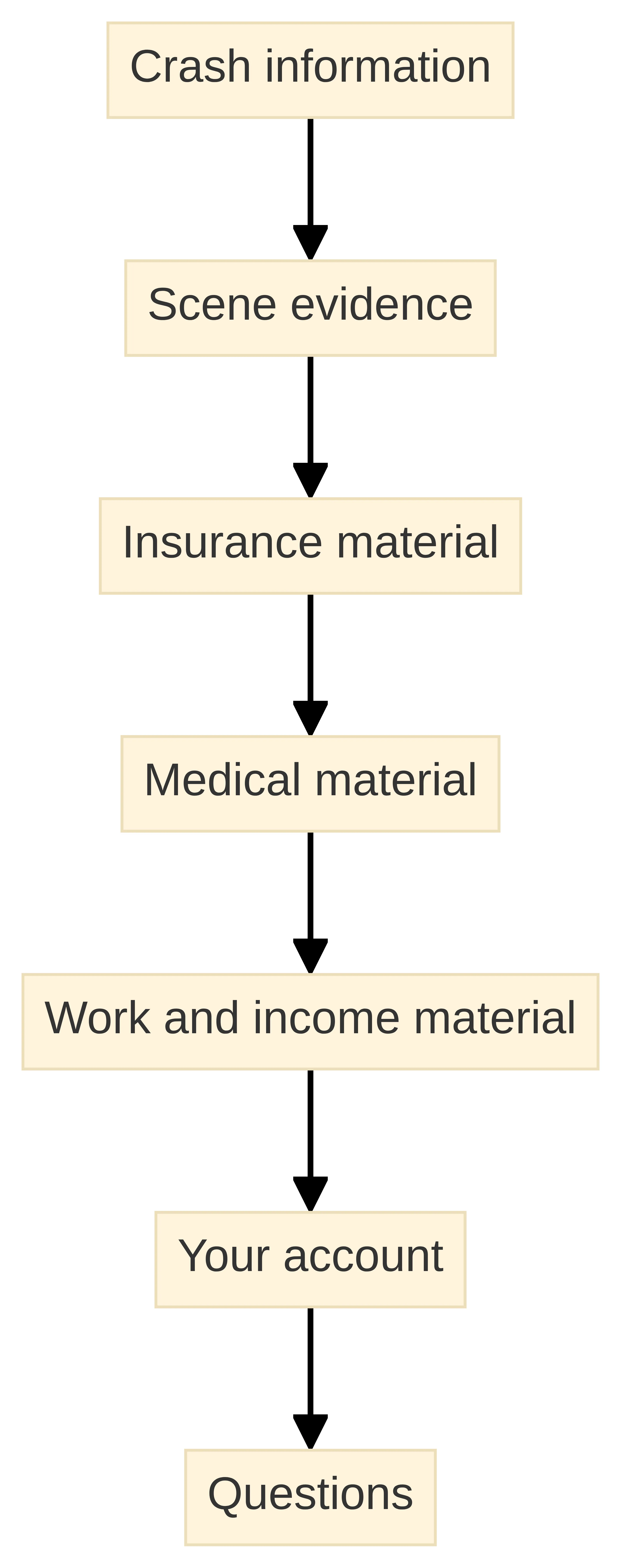
The triage packet is a gap-first working record of what happened, what changed, what has been requested, what records bear on each unresolved question, and what is still missing. The packet shows which parts of the available record need explanation without creating a complete case file. Keep the records themselves, your notes, and unresolved questions distinguishable.
Add a short cover page with the collision date if known, the state where it occurred, the main issue you want addressed, and the two or three questions that matter most. For each issue, identify the records you have and mark the gaps. The resulting packet defines the questions for an initial review without replacing the underlying records.
Gather the following items when they are available:
- Crash information: The crash report or report number; if unavailable, the responding agency and any officer information you saved.
- Scene evidence: Photos, video, witness details, vehicle photographs, and information about anyone who may have copies.
- Insurance material: Insurance cards, claim numbers, letters, emails, texts, recorded requests, and other correspondence.
- Medical material: Medical records, bills, provider names, appointment dates, symptoms, and treatment information.
- Work and income material: Missed dates, employer contact information, income records, and changes in your ability to work.
- Your account: A short timeline covering the event sequence, weather and road conditions, injuries, and vehicle or property damage.
- Questions: The two or three issues you most need a qualified attorney to address.
Missing records do not prevent you from preparing. Write “not available” beside the item, identify who may have it, and record the date or event connected to the gap. For example, if you do not have the crash report, note the agency. If a witness has the video, note the witness’s contact information. If a medical bill is missing, list the provider and appointment date.
Take the packet with the gaps clearly marked so the initial conversation can focus on what the gaps mean and what information may be needed next. Do not delay a request for review solely because the packet is incomplete; describe what you have and what you are still trying to obtain.
Take the map into the initial evaluation
Bring the question-to-record map to the initial conversation. For each unresolved question, show the state where the crash occurred, the records you have, the main insurance issue, and the injuries, losses, or property damage documented. Then ask what the available information can establish, what remains uncertain, and which gaps matter to the review.
Identify the source of each important item—your memory, a crash report, a witness, a photograph, an insurer’s communication, or another record. Keeping recollection, documented facts, and assumptions separate helps the attorney respond to a defined set of questions rather than a general request for help.
Ask focused questions such as:
- What evidence would you examine first to evaluate responsibility?
- How would you separate the insurance question from the responsibility question?
- Which injury, treatment, work, income, and property records matter to the review?
- What information is missing, and how could the gap affect the analysis?
- What would you need to know about the state where the collision occurred?
- What communication, fees, and responsibilities would apply if representation were considered?
- If a release or settlement communication has arrived, what should be understood before responding?
These questions ask for the scope and conditions of the review. They do not require you to predict liability, compensation, or the outcome.
Compare consultations by the work each attorney would actually examine rather than by a broad promise of help. Ask how the attorney and team would handle evidence, insurance information, responsibility, potential losses, communication, fees, and representation responsibilities.
If technology is used in legal services, the ABA’s 2024 guidance described competence as including an understanding of the benefits and risks of that technology and emphasized protection of representation-related confidential information unless informed consent permits disclosure. The governing rule and its enforceability depend on the jurisdiction. You can ask what information would be handled by technology, who would review it, and how confidentiality would be addressed if that question matters to your decision.
Keep firm-specific process information separate from general guidance
Our auto-accident work includes interviewing witnesses and obtaining their official statements. We handle both first-party and third-party claims in auto-accident cases. When insurance gives our clients a hard time, we can help address the issues and pursue compensation they are legally entitled to receive.
Those are descriptions of our work, not a prediction about what any particular collision claim will establish. Your facts, records, insurance, and applicable law determine what questions can be addressed in your matter.
We keep clients informed throughout the process and consult them along the way regarding their personal-injury lawsuit. You can use the initial conversation to ask how communication would work in your matter, who would handle the stages of the case, and what information you would be expected to provide.
Ask for concrete explanations about communication, responsibility, fees, and the records needed from you. The answers should be tied to the representation being considered rather than assumed from a general description of legal services.
Our process information should remain separate from the general questions that apply to any collision evaluation. First identify the unresolved issue, then provide the records and gaps that relate to it, and finally ask what review would address responsibility, insurance, losses, communication, fees, and responsibilities.
Our ability to discuss those topics does not decide whether your facts support representation or determine the result. It gives you subjects to address while deciding whether a case evaluation fits the question you need answered.
Choose the next step from the packet's unresolved entries
After the packet is sorted, use its unresolved entries to choose the next conversation. If the issue is evidence, organize the account, crash information, photographs, video, and witness details. If the issue is injury or loss, separate treatment, bills, work records, and property damage. If the issue is insurance, collect the policies and correspondence and distinguish coverage from responsibility.
If the unresolved entries concern a significant injury, unclear fault, an uninsured driver, multiple possible responsible parties, or a proposed release, legal review may help you understand what the available record can support. If no single category is clear, take the short list of questions and the records connected to each one into the evaluation.
A qualified attorney must decide whether your circumstances support representation and which legal options apply. Your rights, any applicable time limits, available compensation, responsibility, and the effect of a release depend on the facts and the governing jurisdiction. No general guide can predict your eligibility, liability, settlement value, deadlines, or outcome.
Prepare the information you have, mark the gaps honestly, and use the initial review to define what should be answered next. If that review fits your unresolved collision questions, submit the requested contact and incident details through the evaluation form.
Questions to resolve before requesting a vehicle collision attorney evaluation
What types of problems can a vehicle collision attorney help address?
A vehicle collision attorney can assist with various issues, including injuries, medical bills, lost wages, property damage, insurance disputes, and determining potential fault in the accident.
How can I prepare for an initial consultation with a vehicle collision attorney?
Gather relevant documents such as the crash report, medical records, insurance correspondence, photographs, and a written account of the incident. This preparation will help the attorney understand your situation better.
When should I consider hiring a vehicle collision attorney?
Consider hiring an attorney if you have significant injuries, unclear fault, disputes with insurers, or if you are being asked to sign a release while uncertainties remain regarding your case.
What information should I provide during a case evaluation?
During a case evaluation, provide details about the collision, including the sequence of events, injuries sustained, medical treatment received, and any correspondence with insurance companies.
What should I do if the other driver is uninsured?
If the other driver is uninsured, it’s important to separate legal responsibility from available insurance. Consult an attorney to understand your options for pursuing an injury claim.

Emery Brett Ledger brings 28+ years of experience to personal injury law. He founded & led The Ledger Law Firm in securing over $100 million in compensation for clients with life-altering injuries & complex claims. Prior results do not guarantee a similar outcome. Licensed in California, Texas, & Washington, Emery earned his law degree from Pepperdine University School of Law. His practice areas include car & truck accidents, wrongful death, catastrophic injuries, maritime claims, & mass tort litigation. He has been recognized by The National Trial Lawyers’ Top 100, Mass Tort Trial Lawyers Top 25, and America’s Top 100 Personal Injury Attorneys. Emery also received the 2025 Elite Lawyer Award & holds a perfect 10.0 Avvo rating with Platinum Client Champion status. His legal work has been featured on CNN, Forbes, NBC, & ABC.
Free Case Evaluation
Recent Posts
Emery Brett Ledger brings 28+ years of experience to personal injury law. He founded & led The Ledger Law Firm in securing over $100 million in compensation for clients with life-altering injuries & complex claims. Prior results do not guarantee a similar outcome. Licensed in California, Texas, & Washington, Emery earned his law degree from Pepperdine University School of Law. His practice areas include car & truck accidents, wrongful death, catastrophic injuries, maritime claims, & mass tort litigation. He has been recognized by The National Trial Lawyers’ Top 100, Mass Tort Trial Lawyers Top 25, and America’s Top 100 Personal Injury Attorneys. Emery also received the 2025 Elite Lawyer Award & holds a perfect 10.0 Avvo rating with Platinum Client Champion status. His legal work has been featured on CNN, Forbes, NBC, & ABC.