

Child Abuse Compensation Claims Guide: How to Seek Compensation for Child Abuse

Seeking child abuse compensation claims is a path toward finding some level of peace after a terrible experience. When a child suffers through harm or active neglect, the legal system provides a way to fight back. We know that no amount of money fixes the past, but it helps fix the future.
This guide to child abuse compensation claims explains how survivors can get compensation for child abuse to handle the fallout. Legal action allows victims to recover for physical pain and the heavy emotional weight they carry. We help you use child abuse
What Is Child Abuse?
Child abuse is a violation of a child’s safety and/or basic dignity by an adult. It may be a caregiver, but not always. It’s a range of behaviors that cause deep harm to a child. California law defines these acts to help protect those who cannot protect themselves.
Abuse isn’t just about physical strikes, or visible bruises on the skin. Sexual abuse isn’t necessarily visible to the human eye. And abuse can also be deep emotional scarring or the failure to provide a child with the basic necessities they need to live.
Types of Child Abuse
Different types of harm lead to legal claims, and each requires a specific look at the evidence.
- Physical abuse: This includes hitting, shaking, burning a child, or anything else that results in bodily injury.
- Emotional abuse: Patterns of behavior that attack the mental health and feelings of self-worth of a child. Can include constant belittling or shaming.
- Sexual abuse: Any behavior of a sexual nature.
- Neglect: Failing to provide food, clothing, medical care, education, and supervision.
The Importance of Seeking Justice After Child Abuse
Filing a claim isn’t just about going through the system. Survivors can get justice for the harm someone did to them. Just as important, it can stop an abuser or organization from harming other children.
When the negligence of a school or group is exposed, it forces them to make actionable change. For an individual’s case, it can also give financial support needed for long-term healing, and professional therapy and care if needed.
Who Can Make Child Abuse Compensation Claims?
The law allows several people to step forward to start a legal case. Who can file depends on the age of the survivor and the current situation of the victim. In every case, we look to see who has the legal standing to make a claim.
- Survivors: Adults abused as children can file a claim when they reach a certain age. Recent law changes have made this much easier for older survivors to do.
- Parents or guardians: Adults, filing on behalf of a minor child.
- Estates of victims: When the survivor has died, their legal estate might be able to file a claim. Often done to provide for the family left behind or to settle accounts.
Understand Your Legal Rights and Options
What Compensation Can Be Claimed for Child Abuse?
Your attorney will ask for payment for the specific ways a victim was harmed. These are called damages, and they fall into a few different buckets based on your life impact. We look at the bills that have been paid and the pain still felt.
Financial damages cover things like lost wages if someone couldn’t work because of the trauma. Emotional damages look at the pain and suffering that doesn’t have a clear price tag. Medical damages focus on the physical healing and the doctors you had to see.
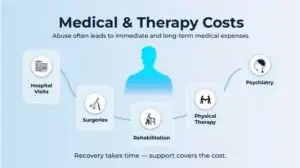
Medical and Therapy Costs
Abuse very often leads to medical and therapy costs, both immediate and long-term. Claims can cover lots of things, including (but not limited to):
- Hospital visits
- Surgeries
- Rehabiliation
- Physical therapy
- Psychiatry
Psychological therapy is also a major part of these costs for most survivors. Ongoing counseling is often needed for years to deal with the mental impact of the abuse. We include the cost of specialized therapists and mental health programs in your claim.
Emotional Trauma and Psychological Damage
Abuse carries a huge mental weight. It can lead to:
-
- Anxiety
- Depression
- PSTD
- Other mental disorders
Any of these change how you live your life, how you interact with other people. Extensive damage can affect your career or education if they make you unable to finish school or function at a job.
Besides being just wrong on so many levels, there’s a financial cost to interrupted education or being unable to work. Emotional trauma is much more difficult to prove than visible physical abuse, but we work with experts who can demonstrate how trauma changes your brain. All of this affects your future.
Loss of Education or Future Opportunities
As we’ve mentioned, abuse can drastically impact whether or not a child can function in a school or work environment. Or in some cases, even if you are physically able to do a job or attend school.
Abuse can derail the education of a child. Beyond not attending school regularly, it often leads to lower grades. Or dropping out of school altogether. Children who can’t focus on learning often miss out on future career opportunites, and higher earning potential. We’ll calculate all of your stolen opportunities into the claim.
How Much Compensation Can Be Awarded for Child Abuse?
It’s different for every situation. The courts look at how bad the abuse was, plus how much evidence we have.
The impact on your daily life and your ability to work will play a huge role in the final amount. We never promise a specific dollar figure because the legal process has many moving parts. Our goal is to get the highest amount possible to cover all your needs.
Historic Child Abuse Compensation Claims
It’s very common for survivors to be unable to talk about their abuse until they’re a lot older. To compensate for this, California has updated laws that can help for older child abuse cases. You may be able to file for abuse that happened thirty or forty years ago.
State laws like the California Code of Civil Procedure 340.1 have made time limits longer. Some federal laws also give survivors options. We’ll check to see if your case falls under any of the newer laws.
Child Abuse Claims Against Institutions
Many people think of abuse in terms of what happens inside a child’s home. But very often, institutions can be fertile ground for an abusive environment. If your abuse happened in an institution, you can sue the group, not just the abuser.
- Schools: Teachers or staff members who abuse students create a liability for the whole school district. Schools have a high duty to keep your children safe while they are learning.
- Religious organizations: Religious leaders and workers at the institution who abuse their power.
- Foster care systems: Whether an individual foster home or organizations that run them.
- Youth programs: Scandals you may have heard of include the Boy Scouts, or sports leagues. This type of abuse has even occurred at the elite levels.
Abuse in Foster Care, Schools, and Religious Institutions
Institutional liability happens when a group is negligent in how they hire or watch their staff. If they were aware of it and did nothing to stop it or they didn’t report it they broke the law. We look for internal memos or past complaints that show the group was aware of the risk.
Lack of supervision is a common theme in these institutional cases across California. When schools leave a child alone with someone they know is a predator, the school is at fault, too. We’ll fight to make sure these groups compensate you and change the way the do business.
Criminal Injuries Compensation Authority (CICA) Claims for Child Abuse
Government programs like this can help provide money to victims of violent crime. In California, we have a similar program called the California Victim Compensation Board (CalVCB). This board helps victims pay for bills that insurance doesn’t cover.
You can apply even if the abuser hasn’t been to court yet. It’s a separate path from a civil lawsuit that helps with immediate needs like funeral costs or therapy. We can help you fill out the application to get this state support.
Child Neglect and Legal Claims for Compensation
It’s easy to overlook neglect. There are plenty of cases on file where a caregiver or parent genuinely loved their children and perhaps never hit them or emotionally abused them, but neglected them to the point where they were harmed.
In short, neglect is when a caregiver doesn’t make sure a child has what they need to survive. This can be the basics like food and shelter. But also medical care, the safety they need to grow and thrive. And don’t discount supervision. Not making sure children are supervised so they can’t harm themselves, and others can’t harm them, is a crime.
The legal system looks at the standard of care that a child should have received. If that standard wasn’t met, the child has a right to be paid for that failure, the same as with other types of abuse.
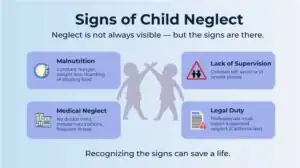
Signs of Child Neglect
It can be difficult to spot neglect unless it’s painfully obvious. Here are some of the signs?
- Malnutrition: Children who are always hungry, maybe losing weight. Hoarding or stealing food.
- Lack of supervision: Unsupervised children, showing up in places children shouldn’t be alone.
- Medical neglect: Not going to the doctor when they’re sick, vaccinations don’t happen on time. A child who seems sick a lot.
The California Child Abuse and Neglect Reporting Act mandates that some professionals immediately report if they have a suspicion a child is being abused or neglected.
How to Make a Child Abuse Compensation Claim
The best route is to go with a lawyer who specializes in child abuse and neglect cases. We’re trained in all the ins and outs of the law. We’ll listen carefully to your story at your first appointment so we can give you the best advice.
Once we take your case, we’ll start getting the evidence together. Medical records, witness statements. Anything else that may help your case. Then we’ll file the paperwork with the court to start the legal clock. From that point on, we start negotiating with the other side.
The Importance of Hiring a Specialist Child Abuse Lawyer
This type of case isn’t like a car accident or a situation where you slip and fall at a grocery store. You need an attorney who’s equipped to handle heavy emotions and can navigate complex privacy laws.
A specialist knows where to find the evidence that institutions try to hide from the public. We handle the hard conversations with insurance companies so you don’t have to. We focus 100% on making sure your case will stand up in court and get the results you need.
Why Expert Legal Support Matters in Child Abuse Compensation Claims
The legal system is loaded with deadlines and rules that can be confusing. Any of these can damage a case before it even gets a good start. With an expert on your side, you’ve just got a better chance to get the justice you deserve. This frees you or your child up to focus on healing.
Expert support also means having a team that knows the true value of your claim. We don’t let insurance companies lowball you with small offers that don’t cover your future. We fight for the full amount you deserve for everything you have been through.
Conclusion – Understanding Child Abuse Compensation Claims
The biggest tool in your arsenal is knowledge. And when you know your rights, you can fight in a court of law. You’ve got a clear path to get the support and money you need for rebuilding your life on your terms.
If you are looking for help, Ledger Law is the best option for these sensitive cases. At Ledger Law, we specialize in high-stakes injury and abuse cases with a focus on California law. We treat every client with the respect they deserve while fighting like hell for their rights in court.
FAQs About Child Abuse Compensation Claims Guide
What are child abuse compensation claims?
Legal cases where a survivor can ask for money from someone who has harmed them, an individual or a group. Claims can cover the costs of things like therapy and medical bills.
Who is eligible to file a child abuse compensation claim?
Adult survivors, parents of minor children, and legal guardians. Estates can also file a claim if the victim is deceased.
How much compensation can be awarded for child abuse claims?
It varies widely based on the severity of the harm that was done to the victim. Evidence also plays a huge role.
What types of damages are included in child abuse compensation?
Money for medical care, therapy, lost wages, emotional suffering. Also, lost education and future career opportunities.
Can adults file compensation claims for historic child abuse?
Yes. The state of California has extended time limits so adults can file for abuse that happened in the past.
How do I start a child abuse compensation claim?
Speak with a lawyer who handles these types of cases. They’ll help you gather records and file legal paperwork.
Can institutions be held liable in child abuse compensation claims?
Yes. This includes schools, churches, youth groups, etc…
What evidence is needed to prove a child abuse compensation claim?
Medical records, witness testimony, police reports, and expert opinions. Any evidence you have helps, too.
Is there a time limit to file child abuse compensation claims?
There are, but the statutes of limitations are longer for child abuse cases. It varies by the type of abuse.
Do I need a lawyer to pursue compensation for child abuse?
You don’t have to have a lawyer, but it’s highly recommended because of how complex these laws are. Your attorney will handle the legal fight so you can focus on recovery.

Emery Brett Ledger brings 28+ years of experience to personal injury law. He founded & led The Ledger Law Firm in securing over $100 million in compensation for clients with life-altering injuries & complex claims. Prior results do not guarantee a similar outcome. Licensed in California, Texas, & Washington, Emery earned his law degree from Pepperdine University School of Law. His practice areas include car & truck accidents, wrongful death, catastrophic injuries, maritime claims, & mass tort litigation. He has been recognized by The National Trial Lawyers’ Top 100, Mass Tort Trial Lawyers Top 25, and America’s Top 100 Personal Injury Attorneys. Emery also received the 2025 Elite Lawyer Award & holds a perfect 10.0 Avvo rating with Platinum Client Champion status. His legal work has been featured on CNN, Forbes, NBC, & ABC.
Free Case Evaluation
Recent Posts
- Punitive Damages in a Car Accident: When Can You Recover Them?
- Tailgating Injury: What Causes Tailgating, Road Rage & How to Stay Safe
- Waiting to Call a Lawyer Can Hurt Your Case: Evidence, Deadlines & Legal Risks
- What Is Property Damage in a Car Accident? Claims, Costs & Who Pays
- Bodily Injury & Property Damage: Coverage, Claims, Liability & Compensation
Emery Brett Ledger brings 28+ years of experience to personal injury law. He founded & led The Ledger Law Firm in securing over $100 million in compensation for clients with life-altering injuries & complex claims. Prior results do not guarantee a similar outcome. Licensed in California, Texas, & Washington, Emery earned his law degree from Pepperdine University School of Law. His practice areas include car & truck accidents, wrongful death, catastrophic injuries, maritime claims, & mass tort litigation. He has been recognized by The National Trial Lawyers’ Top 100, Mass Tort Trial Lawyers Top 25, and America’s Top 100 Personal Injury Attorneys. Emery also received the 2025 Elite Lawyer Award & holds a perfect 10.0 Avvo rating with Platinum Client Champion status. His legal work has been featured on CNN, Forbes, NBC, & ABC.