How to Choose a Car Accident Attorney Firm Near You and Prepare for a Case Evaluation

Turn the search into a fit decision
Choosing a car accident attorney firm near you is a fit decision, not a contest for the most impressive advertisement. A nearby lawyer may be able to help your legal claim, but location alone does not tell you whether the firm has handled your type of collision, understands the losses you are documenting, or will explain fees and next steps clearly. Use your accident record and your unanswered questions to test those points.
A February 8, 2026 report attributed a 99%+ share of personal-injury attorneys offering free consultations to an American Bar Association survey. The 99%+ figure measures the reported share of personal-injury attorneys, not the quality of any consultation or a promise about every firm. Treat an initial meeting as a chance to compare answers, not as a reason to sign immediately.
Use four questions to organize your search:
- Does the firm serve the location and jurisdiction connected to your crash?
- Has the attorney handled the type of accident and injury you experienced?
- Can the firm explain its investigation, communication, fees, and costs in plain language?
- Does the firm discuss uncertainty instead of promising a result?
The firm whose answers fit your facts is more relevant than a firm selected from a generic ranking. You do not need a perfect file before you ask these questions; you need a clear account of what happened, what remains disputed, and what help you want.
Define what the firm should be ready to do
A car accident attorney firm should be ready to explain how it will investigate the crash and organize the claim. A car accident lawyer can help obtain accident reports, find eyewitnesses, and locate traffic or surveillance video. We investigate accidents, gather evidence, and advise clients on navigating the legal process after an accident.
Ask for a practical explanation rather than a general promise. You can ask which records the firm would seek, what information you should provide, how it would handle conflicting accounts, and how it would keep you informed as questions are resolved. A useful answer connects the proposed work to your collision, injuries, insurance position, and documented losses.
You can also ask what the firm needs before it can evaluate the matter. That answer may identify a missing report, witness, medical record, photograph, or insurer communication that deserves attention.
Legal counsel and attorney representation can help pursue and recover compensation owed when a negligent party caused an accident and injuries. That premise does not establish that your claim will succeed or identify what your claim is worth. Ask how the firm would evaluate responsibility, prove the losses you are recording, and address the insurer’s position.
Many personal-injury accident cases are settled through negotiations between the parties before a lawsuit is prepared. Ask whether negotiation would be considered in your situation, what facts would shape that approach, and what decisions would remain yours. The point is to understand the work the firm may perform before you decide whether its approach matches your needs.
A clear explanation should distinguish investigation, communication with an insurer, negotiation, and any later legal proceeding. Those are different parts of a claim, so ask what would trigger a change in approach and how the firm would discuss that change with you.
Confirm service area and accident-specific experience
Service area is a practical screening question for a car accident attorney firm near you. Choosing a car accident lawyer near your location can help your legal claim, but you still need to ask whether the firm handles matters in the jurisdiction connected to your crash and whether the lawyer who evaluates your case will remain involved. Record the answer before comparing other firms.
Ask these questions directly:
- Do you handle claims arising from my crash location?
- Will the attorney evaluating my case work on it, or will another team handle it?
- What types of car accident claims does the firm regularly handle?
- How will location affect meetings, communication, filings, or investigation?
Do not assume that a firm’s name, search listing, or nearby address establishes that it serves your matter. Service area should be a stated answer tied to your crash location, not an assumption based on proximity.
Your accident and injury should determine the experience questions you ask. Experience in another personal-injury area may not be the appropriate fit for a different accident claim, so ask whether the lawyer has handled cases involving your type of injury and accident. We recommend asking about experience with auto accident cases.
Describe the collision in concrete terms: the number of vehicles, the apparent points of impact, the injuries being treated, the insurance dispute, and the losses you have documented. A firm should be able to tell you whether those facts resemble matters it handles without turning a preliminary conversation into a prediction about your result.
Ask whether the attorney has handled the same combination of issues, rather than relying on a broad statement that the firm handles personal injury. The answer should address the kind of crash and injury you actually experienced.
A multi-car collision creates a separate responsibility question. We recommend choosing an attorney who will fully investigate the facts to determine all parties who may bear legal responsibility. Ask what the firm would examine, such as the accounts of the drivers, available records, and the sequence of impacts.
The answer should show how the firm plans to test the facts rather than simply accept the first account presented to the insurer. If your collision involved several vehicles, make that investigation question part of the first conversation and note whether the proposed approach addresses every relevant participant.
You can prepare a simple vehicle-by-vehicle account before the evaluation. Mark what you know, what you saw yourself, and what remains uncertain. That distinction helps the attorney understand which parts of the collision need further investigation.
Compare process, communication, and warning signs
A useful comparison screen covers personal-injury focus, experience with similar cases, trial experience, communication, and fee and cost transparency. The most useful questions address costs, similar-case experience, the firm’s trial record, communication, and the case’s strengths and weaknesses.
Give each firm the same short description of your accident and ask the same core questions. Write down whether the answer is specific, whether the attorney identifies information still needed, and whether the explanation matches the facts you supplied. Consistent questions make it easier for you to compare fit without relying on slogans or unsupported rankings.
Pay attention to how the firm handles uncertainty. An answer that identifies a disputed fact and explains how it would be investigated gives you more usable information than a broad assurance with no explanation.
The same guidance treats an unreviewed promise of a significant settlement as a warning sign and says such promises may violate Arizona’s Rules of Professional Conduct.
The jurisdictional limit matters: those professional-conduct statements concern Arizona. The practical screening point is broader. Do not substitute a promise for an explanation of the evidence, disputed facts, losses, and legal issues that could affect your matter. Ask what the attorney knows, what remains unknown, and what would change the assessment.
Clear answers about fees, strategy, and timing give you something concrete to evaluate. Be cautious if an attorney gives vague responses or refuses to put terms in writing. Ask for the fee arrangement, case-cost treatment, communication plan, and expected decision points in a form you can review before signing.
A consultation should also leave room for questions. Arizona professional-conduct guidance says a reputable lawyer should take time to understand the case, ask relevant questions, and explain options rather than rush you to sign. Ask how the firm handles local courts and procedures relevant to your matter; the same guidance notes that unfamiliarity with local courts, judges, or jury tendencies may affect strategy and timelines in Arizona matters.
Pressure is itself a question to record. If you are urged to sign before you understand the fee terms, costs, responsibilities, or next steps, ask for time to review the agreement and a direct explanation of anything that remains unclear.
Prepare the accident and loss record
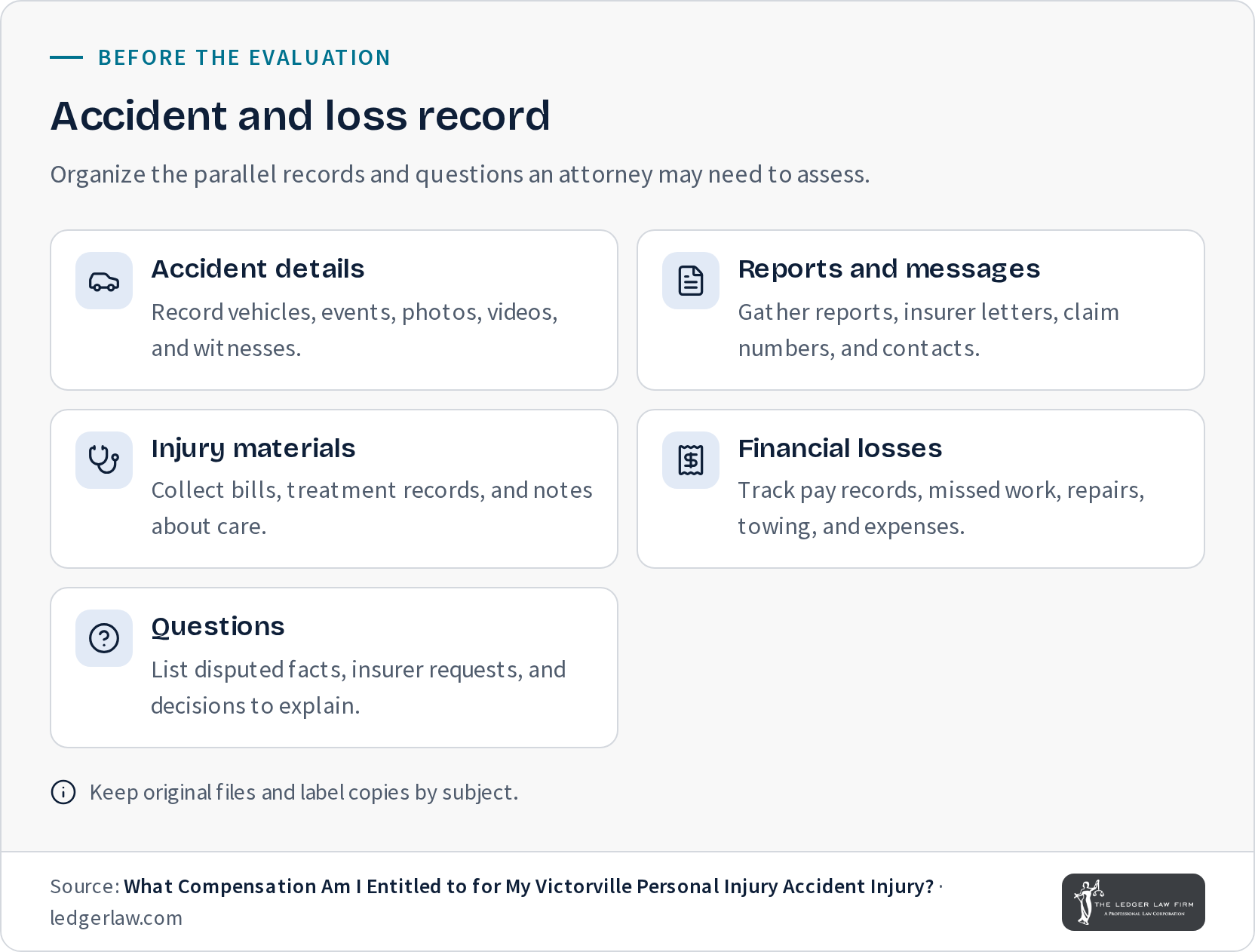
Your accident and loss record gives the attorney something specific to assess. Gather the materials you already have before requesting an evaluation, but do not delay urgent care or wait to create a perfect file.
- Accident details: date, location, vehicles involved, sequence of events, photographs, videos, and witness names or contact information.
- Reports and communications: accident reports, insurer letters, claim numbers, adjuster contact details, and messages about responsibility or payment.
- Injury materials: medical bills, hospital bills, examination costs, treatment records, and notes showing the care you received.
- Financial losses: pay records, time missed from work, vehicle-damage estimates, repair invoices, towing records, and other out-of-pocket expenses.
- Questions: disputed facts, unanswered insurer requests, and the decisions you need the attorney to explain.
Keep the original files and a simple list of dates together. Label documents by subject so you can find them during the conversation. Do not alter photographs, messages, or other original records while organizing copies for review.
Economic damages have a quantifiable value, including medical bills, lost wages, and vehicle damage. Economic damages also include out-of-pocket expenses such as hospital bills, examination costs, repairs to personal property, and lost wages resulting from the accident. Those categories help you organize the record; they do not determine the amount or outcome of a claim.
Tell the firm what you have already requested and what may still exist. Keep a short inventory of missing reports, unavailable video, or unidentified witnesses with the other questions for the evaluation.
Separate confirmed amounts from estimates and unpaid bills from amounts already paid. Note the date and purpose of each expense, and keep a running list of questions about items you cannot yet document. This makes the evaluation easier to follow without suggesting that any particular loss will be accepted or recovered.
Use the evaluation to test the firm’s answers
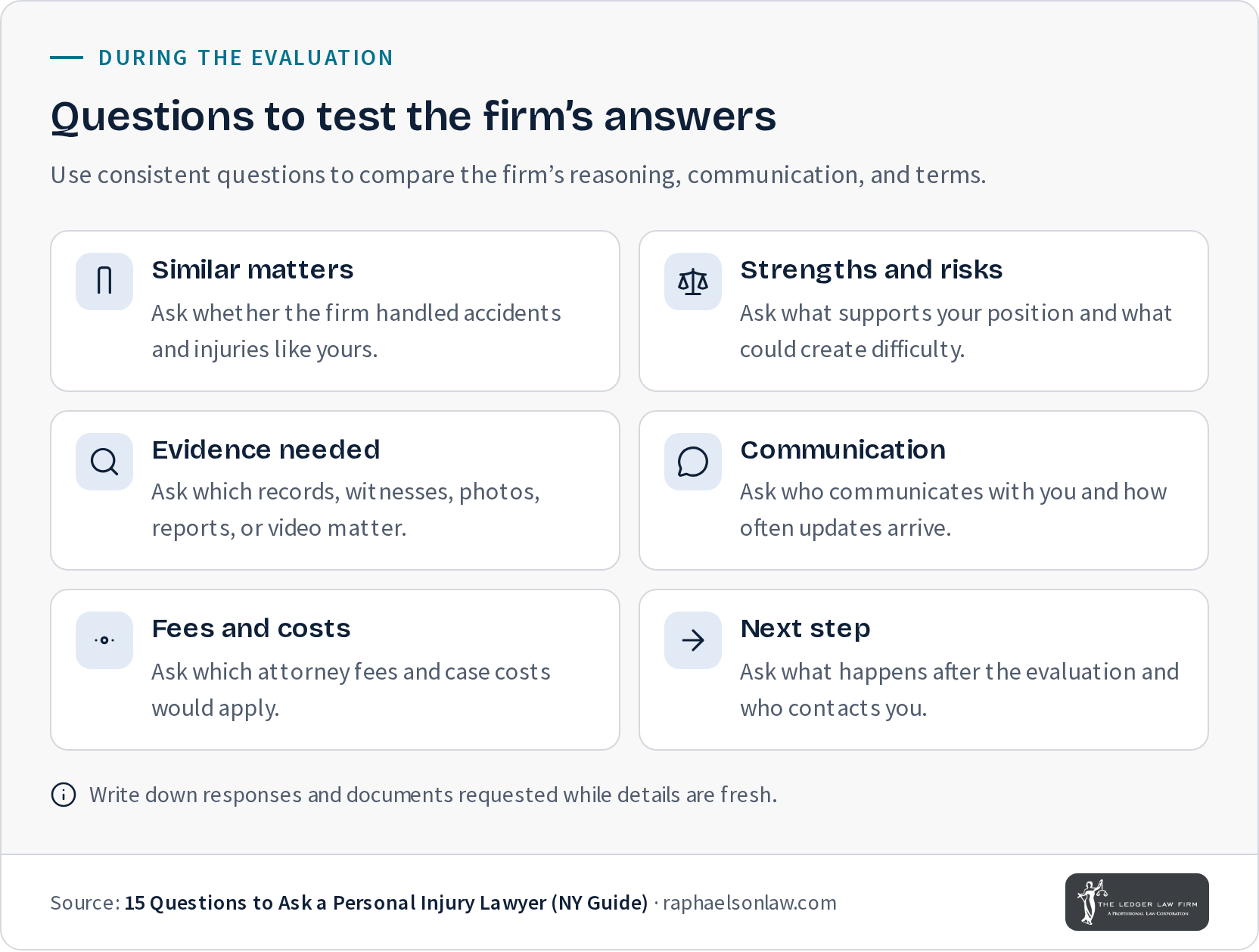
Your initial evaluation should test the firm’s answers against your accident record. Ask questions that reveal how the attorney thinks about the matter rather than questions designed to produce reassurance.
- Have you handled accidents and injuries like mine?
- What facts support my position, and what facts could create difficulty?
- What records, witnesses, photographs, reports, or video would you want to investigate?
- How would you approach the insurance dispute or negotiation?
- Who would communicate with me, and how often should I expect updates?
- What timing factors should I understand without treating them as a promise?
- What attorney fees and case costs would apply?
- What decisions would require my approval?
The answers should identify open questions. A lawyer who acknowledges uncertainty can still explain what information would help resolve it. Write down the response to each question while the details are fresh, including any documents the firm asks you to provide.
Communication is part of the fit decision, not an afterthought. We keep clients informed throughout the process and consult them along the way regarding their personal-injury lawsuit. Ask how updates are delivered, who answers routine questions, and when the firm will contact you about a material development.
Ask the attorney to explain the case’s strengths and weaknesses in ordinary language. Ask what the firm still needs from you and what you should expect after the evaluation. Then compare the explanation with your own notes. A clear conversation should leave you with defined questions, known documents to provide, and a better understanding of the decisions that remain open.
Before you finish, summarize your understanding of the next step and ask whether that summary is accurate. Ask who will contact you, what information is needed, and what the fee agreement says about moving forward. You should leave knowing what has been decided and what has not.
Understand fees, costs, and the written agreement
Contingency fees commonly mean you do not owe attorney fees unless there is a recovery, but you may still owe case costs. A legal guide said most car accident lawyers use contingency fees, while Florida Bar guidance explains that a contingency agreement may waive attorney fees unless you win while still charging costs such as court filing fees or witness expenses.
The contract and applicable state rules determine which costs you may owe if the case is unsuccessful. Ask the attorney to separate attorney fees from case costs and to explain what happens if there is no recovery. Do not treat the phrase contingency fee as a complete description of your financial responsibility.
Ask specifically about filing fees, records, expert or witness expenses, investigation expenses, and other costs identified in the agreement. The categories that apply, who advances them, and who ultimately pays them depend on the contract and applicable rules.
A legal fee guide reported that contingency fees for car accident lawyers often ranged from 33% to 40% of the recovery, with some lawyers charging more depending on the case or how far it proceeded. The 33% to 40% range measures the attorney-fee percentage applied to a recovery, not the amount of money you would take home.
A fee table dated February 8, 2026, listed a standard contingency fee of 33.3% before litigation and 40% after filing a lawsuit. The 33.3% and 40% figures measure the attorney-fee percentage at the respective stage in that table, not a universal rate or the actual terms for your matter. Ask which percentage applies, when it changes, and what amount the percentage is calculated against.
Case costs need their own questions. Florida Bar guidance says costs may be deducted from your share of a recovery and that you may owe them even if you lose unless the contract specifically says otherwise. That statement is Florida-specific, so ask how the law and contract apply where your matter is handled.
A fee guide dated February 8, 2026, listed typical case costs deducted from a settlement as $3,000 to $15,000 and attributed the estimate to the American Bar Association. The $3,000 to $15,000 range measures typical case costs in that report, not a forecast for your case. Ask for a written cost estimate, whether you pay costs directly or reimburse the firm, and whether you can approve costs over a specified amount in advance.
In California, State Bar guidance says a fee agreement must be in writing when expected fees and costs total $1,000 or more. The $1,000 figure measures the expected combined fees and costs that trigger the writing requirement described in that California guidance. Ask for the complete written agreement and read the provisions covering fees, expenses, payment if the matter is unsuccessful, and changes if litigation begins.
Recognize when prompt qualified review matters
Immediate medical or safety needs come first. After those needs are addressed, prompt qualified legal review matters when the accident involves serious injuries, questions about the legal process, disputed blame, or significant damage to a vehicle. We recommend considering an auto accident lawyer if you have been seriously injured or have questions or concerns about the legal process.
We also recommend considering an auto accident lawyer when an insurance company is not offering a fair settlement. We recommend contacting a car accident lawyer if you are being blamed after a crash, if there are injuries, or if your car is expensive and damaged. These signals are reasons to seek qualified review, not conclusions about eligibility or compensation.
Speaking with a car accident attorney can help you protect your legal rights after a car accident. We advise clients on navigating the legal process, investigate accidents, and gather evidence. Contact a qualified attorney or responsible authority promptly when you are unsure what a document, insurer request, or decision means.
Keep your questions and records together for that conversation. Avoid treating an insurer’s position or a search result as the final answer about your claim.
Do not make a binding decision simply because you feel pressured to respond quickly. Ask what a document means, what deadline it presents, and what consequences may follow before you sign or give a statement you do not understand.
Build a comparison sheet for the case evaluation
Turn the record you have assembled into a comparison sheet for the evaluation. For each firm, note its service area, answers about accident-specific experience, investigation, communication, and fees, the accident, injury, insurance, or financial information that bears on each unresolved crash question, and any follow-up needed from qualified review. Bring your central questions, identify the disputed facts, and organize the documents that show the accident, injuries, insurance position, and financial losses.
We offer individuals a free consultation with an auto-accident lawyer. Ask about the rules that apply to your matter before making a binding decision, then submit the information and questions needed for an informed initial review.
Questions to ask before requesting a car accident case evaluation
How long does a car accident injury claim usually take after an initial evaluation?
The timeline can vary by case. The duration can depend on injury severity, medical treatment, disputed responsibility, negotiations, litigation, the jurisdiction, and the available evidence. Ask the attorney which factors could affect your matter and what decision points to expect, rather than treating an estimate as a promise.
Can I request a case evaluation if I do not have every accident record yet?
Yes. You do not need a perfect file before requesting an evaluation. Bring the records you have, identify missing reports, photographs, witness information, medical documents, or insurer communications, and explain what remains uncertain. A firm can then tell you what additional information may be important to investigate.
What should I ask about case costs before signing a contingency-fee agreement?
Ask the firm to distinguish attorney fees from case costs and explain who advances expenses such as filing, records, investigation, expert, or witness costs. Request a written cost estimate, ask whether you can approve costs above a specified amount, and find out what you may owe if there is no recovery. The contract and applicable state rules control those responsibilities.
What should I do if the insurance company or another driver blames me for the crash?
Record the specific allegation, preserve related messages and documents, and ask a qualified attorney to review the disputed facts promptly. Explain what you personally observed, what other evidence may exist, and which parts of the account are uncertain. Avoid signing or giving a statement you do not understand, and do not treat a blame determination or insurer position as the final answer about your claim.

Emery Brett Ledger brings 28+ years of experience to personal injury law. He founded & led The Ledger Law Firm in securing over $100 million in compensation for clients with life-altering injuries & complex claims. Prior results do not guarantee a similar outcome. Licensed in California, Texas, & Washington, Emery earned his law degree from Pepperdine University School of Law. His practice areas include car & truck accidents, wrongful death, catastrophic injuries, maritime claims, & mass tort litigation. He has been recognized by The National Trial Lawyers’ Top 100, Mass Tort Trial Lawyers Top 25, and America’s Top 100 Personal Injury Attorneys. Emery also received the 2025 Elite Lawyer Award & holds a perfect 10.0 Avvo rating with Platinum Client Champion status. His legal work has been featured on CNN, Forbes, NBC, & ABC.
Free Case Evaluation
Recent Posts
- How to Choose a Car Accident Attorney Firm Near You and Prepare for a Case Evaluation
- 7 steps to take after a dog bite in California
- 6 mistakes that can hurt a California dog bite claim
- 7 things families should do after a wrongful death in California
- How to Choose an Attorney at Law Near You After a Slip and Fall
Emery Brett Ledger brings 28+ years of experience to personal injury law. He founded & led The Ledger Law Firm in securing over $100 million in compensation for clients with life-altering injuries & complex claims. Prior results do not guarantee a similar outcome. Licensed in California, Texas, & Washington, Emery earned his law degree from Pepperdine University School of Law. His practice areas include car & truck accidents, wrongful death, catastrophic injuries, maritime claims, & mass tort litigation. He has been recognized by The National Trial Lawyers’ Top 100, Mass Tort Trial Lawyers Top 25, and America’s Top 100 Personal Injury Attorneys. Emery also received the 2025 Elite Lawyer Award & holds a perfect 10.0 Avvo rating with Platinum Client Champion status. His legal work has been featured on CNN, Forbes, NBC, & ABC.