7 steps to take after a dog bite in California

The first steps to take after a dog bite in California are to get somewhere safe, obtain medical care, report the bite, and preserve evidence. This 2026 guide explains seven practical steps for injured people and parents, including what to document before discussing an insurance settlement.
- The steps to take after a dog bite in California begin with safety and prompt medical care.
- Report the bite and preserve the dog owner’s details, photographs, witness contacts, and medical records.
- California Civil Code section 3342 can impose owner liability without proof of a previous bite, subject to exceptions.
- The Ledger Law Firm represents injured individuals; a case evaluation can address evidence, insurance, and filing deadlines.
Why this matters
A dog bite creates two immediate problems: an injury that needs attention and evidence that can disappear. You do not need to resolve legal responsibility before getting treatment. You do need an accurate record of what happened.
The Ledger Law Firm represents individuals with personal injury claims in California. For a California dog bite in 2026, the practical priority is to protect your health while keeping the information needed to evaluate an injury claim.
If someone else can photograph the scene or obtain contact details while you receive care, ask for help. Do not delay treatment to complete a checklist.
What matters most after a California dog bite
Use these priorities to decide what needs attention first:
- Safety: Separate yourself from the dog without trying to capture it.
- Medical care: Let a clinician assess the wound, infection risk, and necessary preventive treatment.
- Identification: Record who owns or controls the dog and where the bite happened.
- Evidence: Preserve original photographs, messages, reports, and witness details.
- Claim protection: Understand the injury and applicable deadlines before signing a release.
The seven steps at a glance
These steps are an order of priorities, not a reason to postpone emergency care. A family member can handle reporting and documentation while you receive treatment.
| Step | Action | Best for | Main benefit | Limitation |
|---|---|---|---|---|
| 1 | Get to safety | An ongoing threat | Prevents further exposure to the dog | Does not replace medical assessment |
| 2 | Obtain medical care | Any bite that breaks skin or causes injury | Addresses the wound and treatment needs | Medical records alone do not establish responsibility |
| 3 | Identify the dog and owner | An unidentified animal or handler | Supports public health follow-up and investigation | A handler is not necessarily the owner |
| 4 | Report the bite | Creating an official incident record | Gives authorities information to investigate | Reporting does not itself open an insurance claim |
| 5 | Preserve evidence | Disputed facts or changing injuries | Keeps records available for later review | Photographs cannot establish every medical effect |
| 6 | Track losses and communications | Ongoing treatment or missed work | Documents how the injury affects you | Receipts alone do not prove legal entitlement |
| 7 | Evaluate the injury claim | Questions about liability or settlement | Clarifies deadlines and next decisions | An evaluation cannot guarantee recovery |
1. Get away from the dog and assess immediate danger
Move to a secure location away from the animal. Do not chase the dog, corner it, or put yourself at risk to obtain a photograph. Keep children and other people away from the immediate danger.
Call 911 if someone has a life-threatening injury or there is an immediate threat to public safety. Severe bleeding, difficulty breathing, or loss of consciousness requires emergency attention.
If you are helping an injured child, arrange care before questioning witnesses. Another adult can collect details. Your child's safety comes first.
Priority: Get safe before trying to collect evidence.
2. Obtain medical care and describe the bite accurately
Wash the wound gently with soap and running water when you can do so safely. Apply clean pressure to bleeding and seek prompt medical advice. A small puncture can conceal a deeper injury, so do not judge the bite only by its appearance.
Tell the clinician when the bite occurred, which body parts were affected, and whether you know the animal's vaccination history. Ask about infection, tetanus, rabies assessment, and follow-up care. The treatment decision belongs to the medical professional, not the dog owner or an insurance representative.
Keep discharge instructions and attend recommended follow-up appointments. If redness, swelling, pain, drainage, fever, numbness, or movement problems develop or worsen, contact a medical professional promptly.
California's rabies-control rules provide for a 10-day observation period for a biting dog under local health authority direction, subject to the applicable rules and circumstances. California Code of Regulations, title 17, section 2606 governs this process; it is not permission to postpone your own care.
Priority: Follow medical advice without waiting for an insurance decision or observation period to end.
3. Identify the dog, its owner, and the person handling it
Ask for the owner's name and contact information. If someone else was walking or supervising the dog, record that person's details separately. Do not assume the handler owns the animal.
Collect what you can without confrontation:
- The dog's description and where it can be located.
- The owner's and handler's names and contact details.
- Available vaccination information and the veterinarian's details.
- The address where the bite occurred.
- Names and contact information for witnesses.
If the owner refuses to cooperate, record what you observed and give it to the investigating authority. Do not enter private property or follow someone into an unsafe situation.
The distinction between an owner, handler, and property owner matters. Different legal rules can apply to each. A rental address alone does not establish that a landlord is responsible for the bite.
Priority: Record identities accurately rather than deciding responsibility at the scene.
4. Report the bite to the appropriate local authority
Contact local animal control or the local public health department and ask how to report the bite. Procedures depend on where the incident happened. Give the location, time, dog description, owner information, and a factual account.
Ask for the report or incident number and the investigating office's contact details. Save any instructions about identifying the animal or providing additional information. Medical providers also have reporting obligations, but confirm how your incident is being handled rather than assuming someone else completed every step.
A report helps document the incident and supports public health follow-up. It does not automatically establish civil liability, guarantee payment, or notify an insurer on your behalf.
If an officer's account contains a factual error, ask how to submit a correction or supplemental statement. Keep your own dated account as well.
Priority: Report the facts and preserve the report number.
5. Preserve evidence before the scene and injuries change
Take photographs as soon as you can safely do so, then continue documenting visible changes during recovery. Keep original files, not just edited screenshots. Photograph the wound from different distances without interfering with treatment.
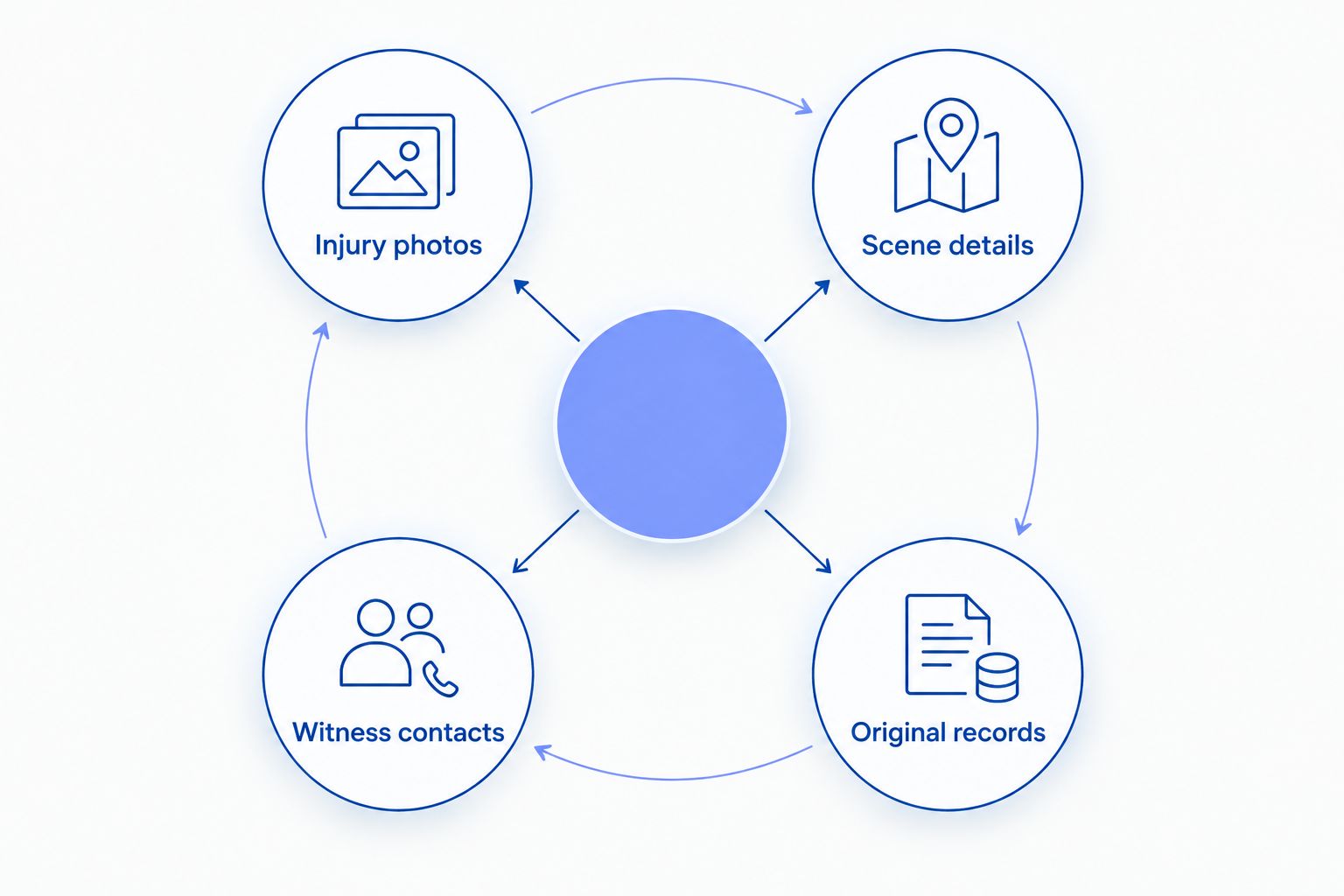
Build an evidence folder around four categories:
- Injury photos: Images of wounds, bruising, swelling, and later scarring.
- Scene details: The location, entrances, fences, gates, and relevant warning signs.
- Witness contacts: Names, contact details, and what each person observed.
- Original records: Messages, reports, treatment documents, and damaged clothing.
Nearby cameras can matter, especially when the owner disputes how the encounter began. Identify possible cameras and promptly ask that relevant footage be preserved. Do not assume a business or neighbor will retain recordings indefinitely.
Write down the sequence while your memory is fresh. Describe what you saw and heard, including where you were and what happened immediately before the bite. Separate direct observations from information someone told you later.
Priority: Preserve the original evidence, even when you are unsure whether it helps your claim.
6. Track treatment, expenses, missed work, and insurance contact
Keep medical bills, prescription records, travel receipts, and documentation of missed work together. Note practical effects such as difficulty sleeping, dressing, driving, or performing your job. Describe specific limitations rather than using broad statements about suffering.
Follow your clinician's wound-care instructions. Keep receipts for first aid and wound care supplies with your other treatment expenses, and distinguish what you purchased from what a clinician recommended. An item's eligibility for a tax-advantaged account does not establish whether a liability insurer must reimburse it.
Ask the dog owner to identify potentially relevant liability insurance. Homeowners or renters coverage can be relevant, but policy terms, exclusions, and the facts determine whether coverage applies. Do not assume a policy pays simply because the bite occurred at a home.
For insurance communications:
- Save the adjuster's name, claim number, and correspondence.
- Give accurate information without guessing about your prognosis.
- Understand the scope of any medical authorization before signing it.
- Ask what a proposed release would settle and which claims it would end.
Do not post speculation about the incident or your recovery online. Preserve existing relevant posts and messages rather than deleting potential evidence.
Priority: Document actual losses and understand documents before signing them.
7. Evaluate liability and deadlines before accepting a settlement
California Civil Code section 3342 is the starting point for many dog-bite claims in 2026. It generally makes a dog owner liable for bite injuries suffered in a public place or while the injured person was lawfully on private property, regardless of the dog's previous viciousness or the owner's knowledge of it. Exceptions and defenses still require individual review.
That rule does not automatically answer every question. The analysis changes when ownership is disputed, lawful presence is contested, someone other than the owner is involved, or a dog causes injury without biting. Describe the full encounter, including facts that seem unfavorable.
California Code of Civil Procedure section 335.1 generally gives an adult 2 years from the injury to file a personal injury lawsuit. Exceptions can change the calculation; claims involving children or public entities need separate deadline review. Opening an insurance claim does not itself stop a filing deadline.
For a 2026 case evaluation, bring your treatment records, photographs, incident information, insurance correspondence, and work-loss documents. The Ledger Law Firm represents injured individuals in California; a consultation can address how those records relate to liability, coverage, and your next decision.
Before hiring counsel, ask how attorney fees and case expenses are handled. A contingency fee concerns attorney compensation; it does not automatically mean every case expense disappears if there is no recovery. Get the agreement in writing and ask what deductions would apply.
You can contact the firm to discuss an injury claim without deciding on a settlement first.
Priority: Understand your injury, deadlines, and release terms before closing the claim.
How these steps are ordered
These seven steps put safety and treatment ahead of claim preparation. Identification, reporting, and evidence preservation come next because the animal, witnesses, and recordings can become harder to locate. Settlement decisions come after you understand the injury and relevant legal questions.
The California legal references in this 2026 guide address owner liability, the general personal injury filing period, and rabies-control procedures. They do not determine the result of an individual case.
FAQ
What’s the first thing I should do after a dog bite in California?
Get away from the dog and obtain appropriate medical care. Call 911 for a life-threatening injury or immediate safety threat, and do not delay treatment to gather evidence.
Can I bring a California dog-bite claim if the dog never bit anyone before?
A previous bite is not generally required under California Civil Code section 3342. The statute addresses owner liability for qualifying bites in public places or while the injured person was lawfully on private property, subject to exceptions and defenses.
Should I report a dog bite if the owner says the dog is vaccinated?
Report the bite to the appropriate local authority even if the owner says the dog is vaccinated. Give vaccination information to your clinician and the investigating authority rather than treating the owner’s statement as a substitute for assessment.
How long do I have to file a California dog-bite lawsuit in 2026?
An adult personal injury claim generally has a 2-year filing period under California Code of Civil Procedure section 335.1. Exceptions can change the deadline, and cases involving children or public entities require separate review.
What should I save if my child was bitten by a dog?
Save treatment records, photographs, witness details, incident reports, and communications with the owner or insurer. Document changes in your child’s daily activities and ask about the separate rules governing a minor’s claim.
Should I accept the dog owner’s insurance settlement?
Do not accept a settlement until you understand what claims the release ends and what is known about your injury. Review ongoing treatment, documented losses, coverage questions, and the applicable deadline before deciding.
Does a contingency fee mean I will never owe case expenses?
A contingency fee does not automatically eliminate responsibility for case expenses. Ask how expenses are advanced, deducted, and handled if there is no recovery, and read the written agreement.
One last thing
Keep a record of improvement as well as setbacks. An accurate recovery timeline is more useful than a file containing only the worst moments. Include follow-up visits, returning activities, persistent limitations, and questions for your clinician.
For anyone dealing with a California dog bite in 2026, the next move is practical: obtain needed care, keep the records, and resolve deadline questions before negotiating a final release. The Ledger Law Firm can discuss the injury claim without promising a particular outcome.
Related guides
- What parents should save after a child is bitten in California
- When a California landlord can be liable for a tenant's dog bite
- What a California family should bring to a wrongful death lawyer

Emery Brett Ledger brings 28+ years of experience to personal injury law. He founded & led The Ledger Law Firm in securing over $100 million in compensation for clients with life-altering injuries & complex claims. Prior results do not guarantee a similar outcome. Licensed in California, Texas, & Washington, Emery earned his law degree from Pepperdine University School of Law. His practice areas include car & truck accidents, wrongful death, catastrophic injuries, maritime claims, & mass tort litigation. He has been recognized by The National Trial Lawyers’ Top 100, Mass Tort Trial Lawyers Top 25, and America’s Top 100 Personal Injury Attorneys. Emery also received the 2025 Elite Lawyer Award & holds a perfect 10.0 Avvo rating with Platinum Client Champion status. His legal work has been featured on CNN, Forbes, NBC, & ABC.
Free Case Evaluation
Emery Brett Ledger brings 28+ years of experience to personal injury law. He founded & led The Ledger Law Firm in securing over $100 million in compensation for clients with life-altering injuries & complex claims. Prior results do not guarantee a similar outcome. Licensed in California, Texas, & Washington, Emery earned his law degree from Pepperdine University School of Law. His practice areas include car & truck accidents, wrongful death, catastrophic injuries, maritime claims, & mass tort litigation. He has been recognized by The National Trial Lawyers’ Top 100, Mass Tort Trial Lawyers Top 25, and America’s Top 100 Personal Injury Attorneys. Emery also received the 2025 Elite Lawyer Award & holds a perfect 10.0 Avvo rating with Platinum Client Champion status. His legal work has been featured on CNN, Forbes, NBC, & ABC.