Injury Attorney in LA: How to Decide Whether to Seek a Case Evaluation After a Crash

Start with the decision your crash record can support
Your decision about legal help should begin with the condition of your crash record and the practical demands of the claim, not with a promise about what your claim might be worth. Serious injuries, significant losses, disputed responsibility, or a need to have compensation decided in court are reasons to consider contacting an auto accident lawyer. You may also need a closer review when the crash involved a commercial truck, delivery vehicle, or rideshare vehicle and the available facts do not clearly identify who was responsible.
A useful first screen is:
- Injury: Are you dealing with more than a short-lived ache, or has a medical provider identified an injury that affects your daily life?
- Loss: Do you have medical bills, hospital or examination costs, vehicle or personal-property repair expenses, or lost wages? Economic damages can include each of those categories.
- Responsibility: Does the other driver, an insurer, a trucking company, or another party dispute what happened?
- Practical burden: Can you preserve records, communicate with insurers, track your losses, and make decisions while you are recovering?
- Court concern: Do you need to understand what could happen if negotiation does not resolve the dispute?
You do not need a finished legal theory before asking for an evaluation. You do need enough information to explain what happened, what changed afterward, and what remains uncertain.
For this decision, consider an attorney evaluation when injuries are serious, losses are significant, responsibility is disputed, or compensation may need to be decided in court. That can include people after commercial-truck, delivery-vehicle, rideshare, or other vehicle crashes when the available facts do not clearly identify responsibility.
If your injuries are serious, your losses are significant, or responsibility is difficult to sort out, an evaluation can help you understand which questions deserve attention. You can then decide whether to handle the claim yourself, seek limited help, or pursue representation.
Take the immediate steps that protect the basic record
Your first response after a crash should protect your physical safety and preserve basic information. Stop immediately and move only if it is safe to do so. Call 911 if anyone is injured, and call the police after the accident.
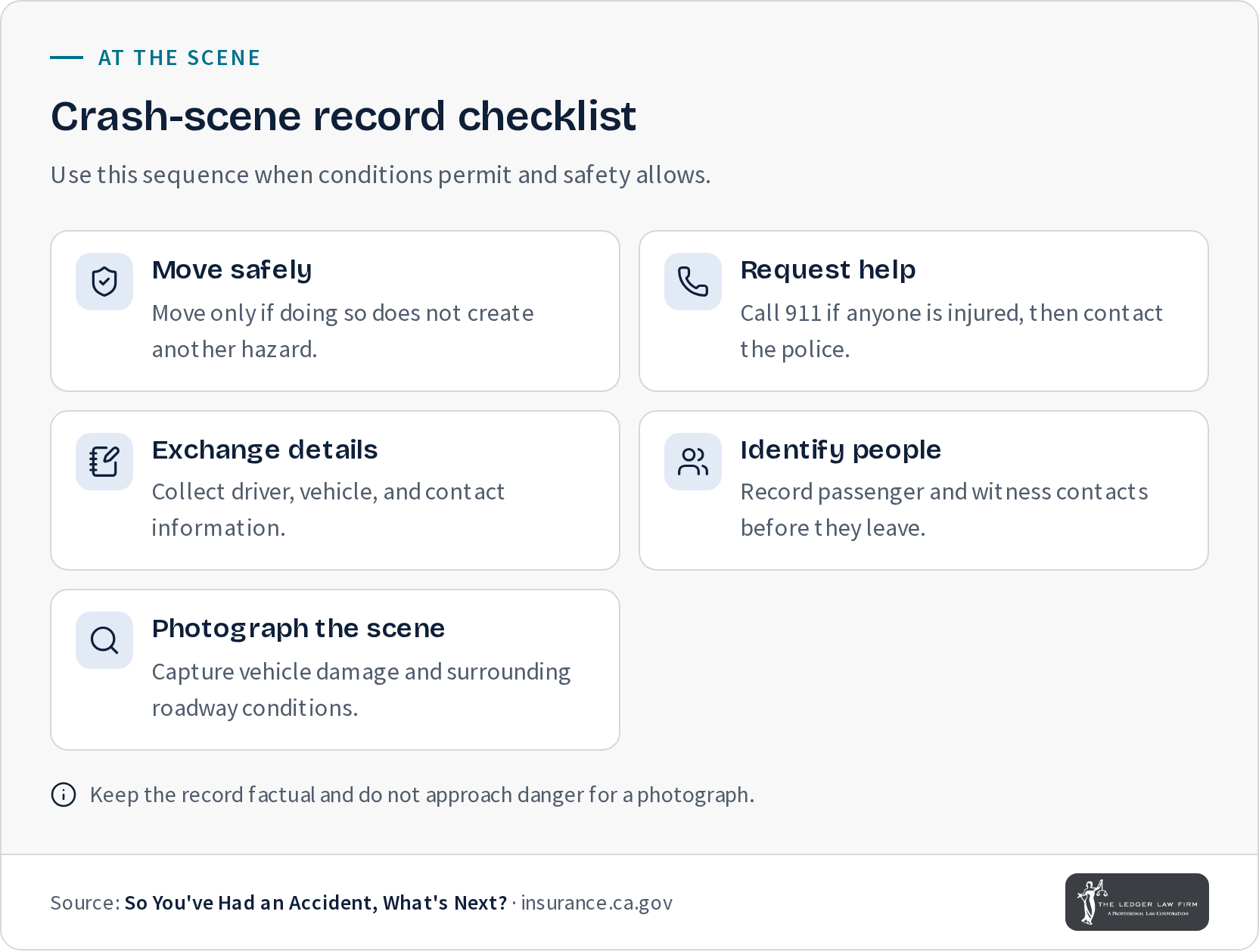
Use this sequence when conditions permit:
- Move only for safety. Do not create another hazard while trying to position a vehicle or reach a safer place.
- Request emergency help. Call 911 if anyone is injured, then contact the police after the collision.
- Exchange driver information. Collect each driver’s name, address, telephone number, driver’s license number, license plate, and vehicle identification number.
- Identify witnesses and passengers. Collect contact information for passengers and witnesses before people leave, when it is safe and practical.
- Photograph the scene. If you have a cellphone or camera, photograph vehicle damage and the accident scene, including details that may help show the roadway or surrounding conditions.
Your health comes first. If your condition prevents you from gathering information, ask someone you trust to preserve what can be collected without disturbing the scene.
Your photographs and contact list should remain a factual record rather than an argument about fault. Save the original images, note when and where you took them, and write down what you remember while the sequence is still clear. Keep the police report, tow information, vehicle-storage details, and any messages connected with the collision in one place.
Do not put yourself in danger to obtain a photograph or approach a vehicle. Do not guess about a driver’s identity, a vehicle’s ownership, or the cause of the crash when you are speaking with others at the scene. Record what you know and label what you only suspect. That distinction will help you explain the situation accurately during an evaluation.
Complete the California reporting and insurance tasks
California insurance and reporting duties can affect what you do after a collision. California insurance laws require vehicle owners and operators to be financially able to provide monetary protection for people injured or property damaged in vehicle accidents, regardless of fault.
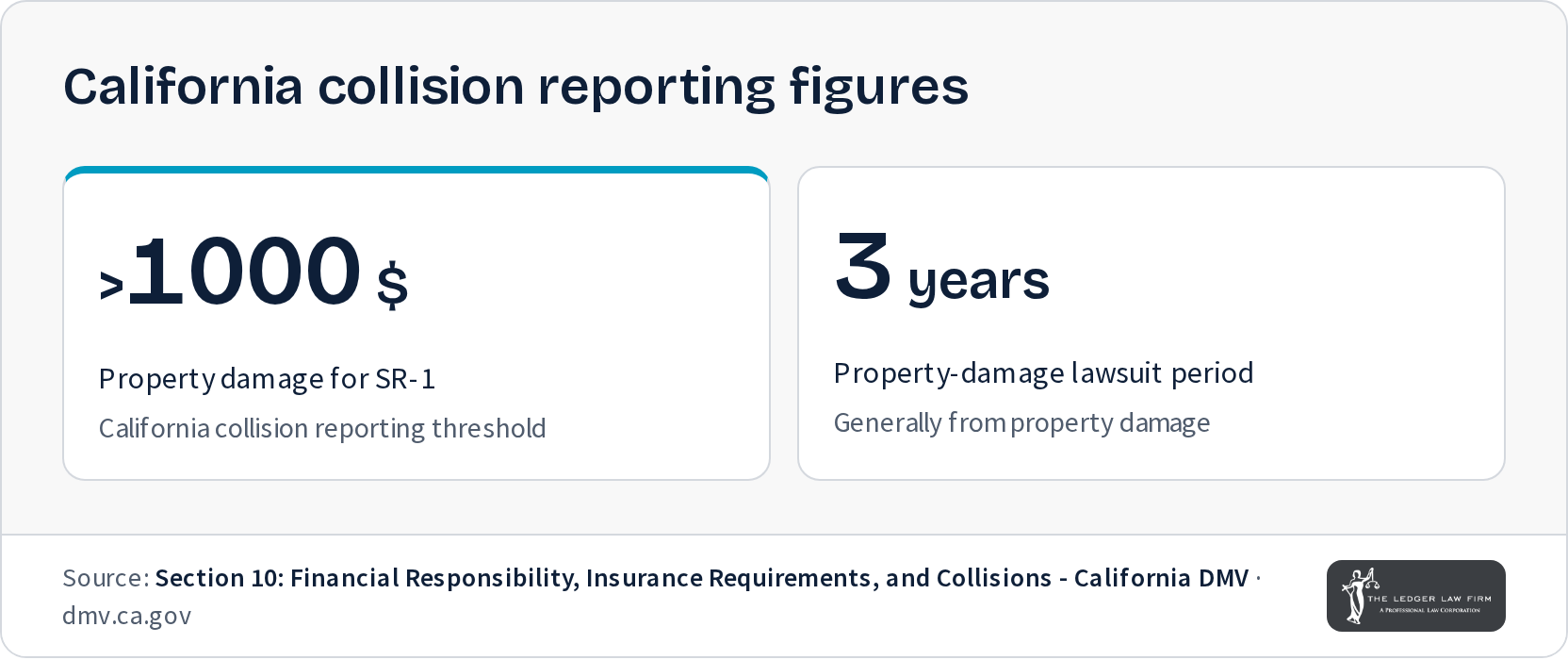
In California, an SR-1 is required when a collision causes more than $1,000 in property damage or when anyone is injured or killed, even if the injuries are minor. Each California driver must file an SR-1 whether or not that driver caused the collision, and the requirement applies even when the collision occurred on private property.
Treat the SR-1 as a separate reporting task, not as a substitute for a police report, an insurance notice, or legal advice about your particular facts. Record the date of the collision, the vehicles and drivers involved, the injuries you know about, and the property damage before completing required forms. If you are unsure how a reporting rule applies to your circumstances, ask a qualified professional or the responsible authority promptly.
Your insurance communications should stay accurate and focused on facts you can support. Keep copies of claim numbers, adjuster messages, repair estimates, medical records, bills, and requests for statements. Do not discard photographs, damaged items, receipts, or messages simply because an insurer has opened a claim.
California generally allows 3 years from the date property was damaged to sue over property damage, including damage from crashing a vehicle. A different deadline applies to injury claims, so do not assume that the property-damage period controls every part of your situation. Put all known dates on a calendar and raise timing questions promptly rather than waiting for negotiations to finish.
Build an evaluation packet from losses and available proof
Your evaluation packet should show the crash, the injury, the financial effect, and the proof you already have. You do not need a perfect file. A clear, labeled collection of ordinary records is more useful than a large folder that no one can follow.
Gather these items when they are available:
- Crash details: date, time, location, direction of travel, weather or roadway observations, a short description of the impact, and the responding agency or report number.
- People and vehicles: driver information, license plates, vehicle identification numbers, passenger contacts, witness contacts, and any business or employer information shown on a commercial vehicle.
- Injury records: emergency-care information, medical-provider names, appointment dates, diagnoses or restrictions you were given, prescriptions, treatment records, and a dated symptom log.
- Loss records: medical bills, hospital bills, examination costs, repair estimates, invoices, receipts, and wage information. Economic damages can include medical bills, hospital bills, examination costs, personal-property repair expenses, and lost wages resulting from an accident.
- Available proof: photographs, video, dashcam files, messages, police materials, insurance correspondence, tow records, and notes about what each witness observed.
Name files by date and subject. Keep originals unchanged and make working copies when you need to add notes.
Your packet should answer practical questions rather than announce a conclusion. Start with a one-page timeline: what happened, when symptoms appeared, what treatment followed, what work or activities you missed, and what communications came from insurers or other parties. Add a loss list that separates amounts already paid, amounts billed, estimates, and losses you are still documenting.
Mark missing items plainly. For example, write “witness contact not available” or “repair estimate requested” rather than filling the gap with an assumption. A lawyer can then tell you which missing records matter and which questions can wait. Bring the packet to an evaluation in the form you can manage, including paper records if electronic files are difficult to organize.
Ask what responsibility the crash record leaves unresolved
Your responsibility question may extend beyond the driver when a commercial truck is involved. Commercial-truck crash liability may involve the trucking company, cargo loaders, maintenance contractors, or manufacturers as well as the driver. Causation in personal injury cases can sometimes involve multiple defendants sharing liability.
Commercial-truck cases can involve federal regulations, multiple potential defendants, larger insurance policies, black box data, and driver logs. Those categories do not establish fault by themselves. They identify subjects that may need to be examined before you decide whether a simple insurance discussion is enough.
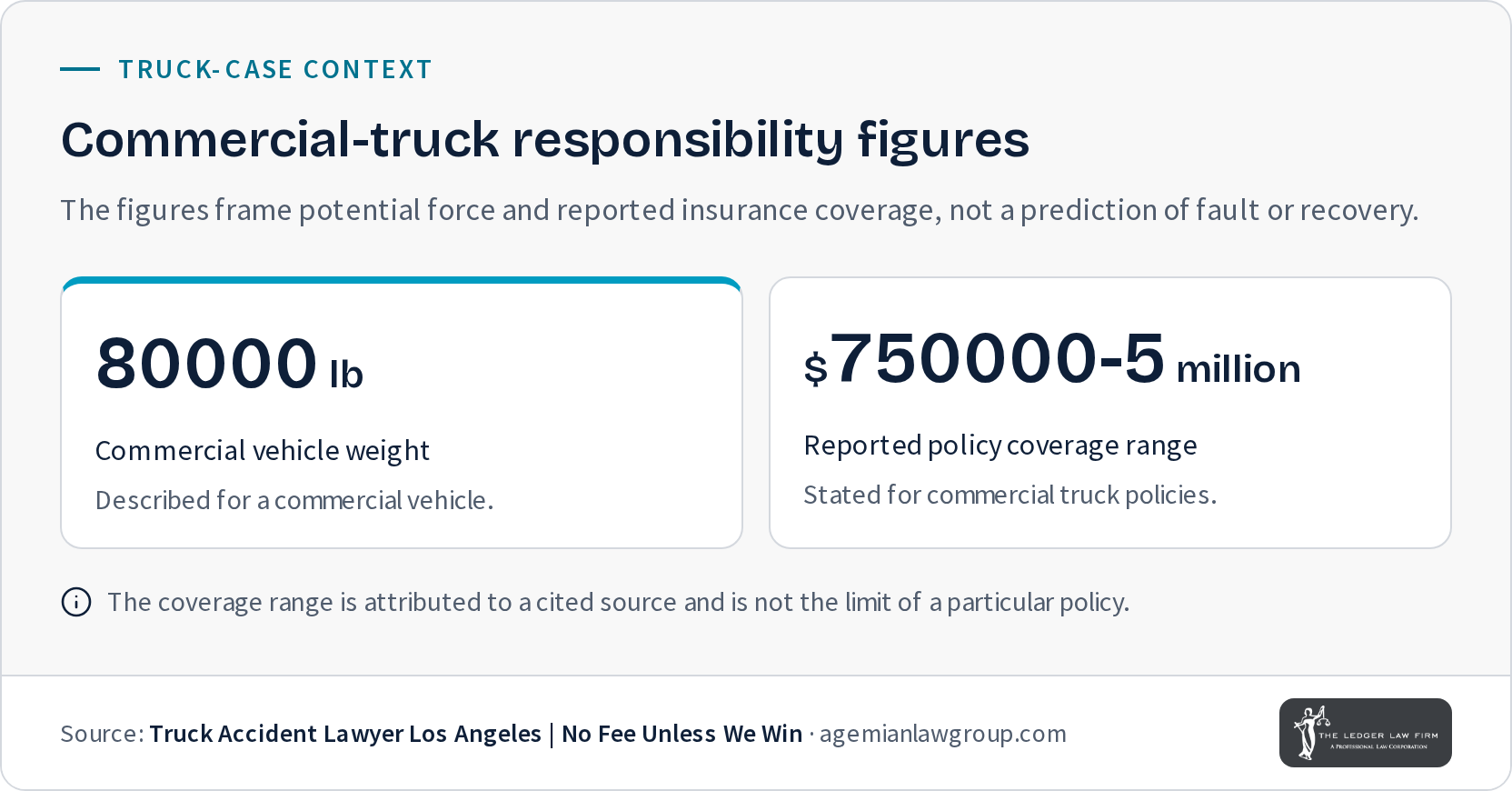
The size of the vehicle can also change the practical stakes. An 80,000-pound commercial vehicle can cause catastrophic damage when it collides with a passenger car. That statement describes the potential force of the collision, not the severity of your injuries or the result of your claim.
Your evaluation should test what the current record can and cannot answer. Ask questions such as:
- Which people or companies may have information about the vehicle, driver, cargo, maintenance, or dispatch?
- What records could clarify the driver’s conduct, the vehicle’s condition, or the cargo’s loading?
- Has any vehicle, device, cargo, or document been moved, repaired, overwritten, or discarded?
- Which facts support your account, and which facts remain disputed?
- Does the insurance coverage available to the commercial vehicle need to be identified before you assess the practical options?
A reference on commercial-truck insurance reports that commercial truck policies carry minimum coverage from $750,000 to $5 million. That is a figure stated by that source about commercial truck policies, not a determination that a policy in your crash has a particular limit. Ask for the actual coverage information rather than using a general figure to predict recovery.
Match the evidence request to the suspected truck issue
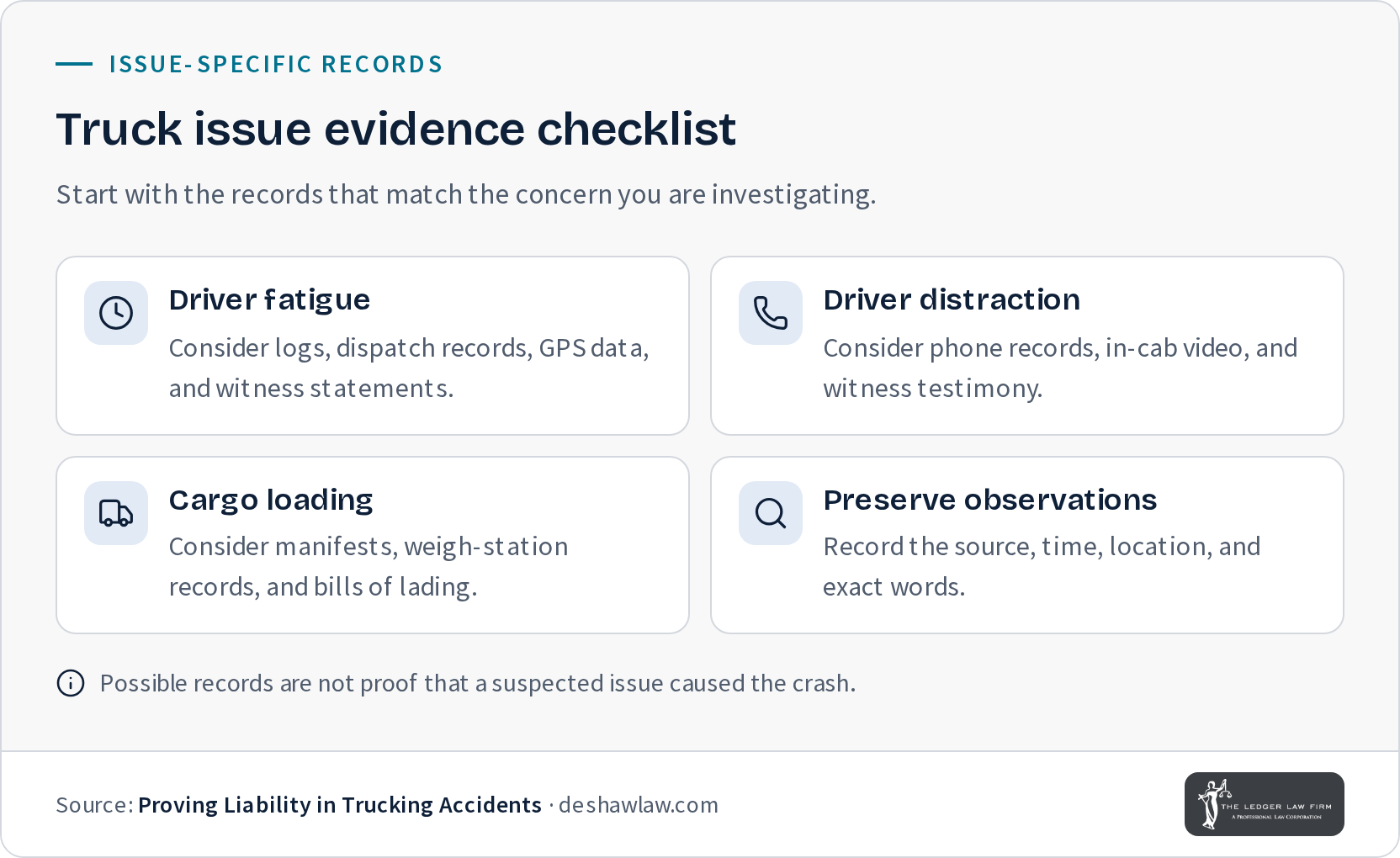
Your suspected truck issue should determine which records you ask about first. If driver fatigue is suspected, possible evidence may include electronic logging device data, driver logbooks, dispatch records, fuel and toll receipts, GPS records, witness statements, dashcam footage, and relevant medical records.
That list describes possible records, not proof that fatigue caused the crash. Write down the observations that led to the concern: an unusually long delay, repeated lane movement, a statement from a witness, a schedule detail, or something visible in a recording. Preserve the original source of each observation and identify who provided it.
Ask an attorney what can be requested, from whom, and in what form. Do not try to obtain private records by misrepresentation or alter a recording to make a point. Give the information you have and let the appropriate process determine what can be pursued.
Your distraction question may require a different group of records. When distracted driving is suspected, possible evidence may include cell phone records, in-cab video, telematics data, dashcam or surveillance footage, police reports, and witness testimony.
Separate what you saw from what you infer. “The driver was looking down” is an observation; “the driver was texting” is a conclusion unless a record supports it. Keep the time, location, witness, video source, and exact words associated with each observation. Ask whether nearby businesses, residences, transit vehicles, or other drivers may have recorded the scene, and pass that lead to an attorney without contacting a potential witness aggressively.
Your cargo concern should focus on loading and weight records. Possible overloaded-cargo evidence includes bills of lading, weigh-station records, cargo manifests, photographs, and cargo-expert analysis. Evidence of cargo shifting, spilled freight, or a higher-than-allowed gross vehicle weight can show that improper loading contributed to instability, mechanical failure, or the crash.
Photograph spilled material, damaged restraints, open or damaged doors, and vehicle damage if you can do so safely and without moving anything. Note who controlled the cargo, what you observed about its condition, and whether the truck or trailer was later repaired or unloaded. Do not state that improper loading caused the crash merely because cargo was present or damage was severe. Ask for an evaluation of the specific connection between the loading condition and the collision.
Compare handling the claim with obtaining legal help
Your practical alternatives are different paths, not different labels for the same process. Most personal injury cases start as insurance claims rather than lawsuits, and many personal injury accident cases are settled through negotiations before a lawsuit is prepared. A claim can therefore begin without filing in court, but the decision to handle it alone becomes harder when the injury, losses, responsibility, or records are complicated.
| Path | What you would handle | When it may fit | Direct action or boundary |
|---|---|---|---|
| Self-directed insurance claim | Notices, records, estimates, negotiations, and follow-up | Your injuries and losses are limited, responsibility is clear, and you can manage the communications | Keep a complete file and do not treat an insurer’s position as a legal determination |
| Negotiation without a lawsuit | A direct settlement discussion with the insurer or opposing side | The dispute may be resolved through an insurance claim and you understand what is being offered | Compare the proposed terms with your documented losses before accepting anything |
| Focused legal consultation | Specific questions about responsibility, records, timing, or an agreement | You need help with a narrow issue but are not ready to choose full representation | Bring the question and the relevant records; ask what remains your responsibility |
| Ongoing representation | Investigation, communications, negotiation, and decisions about possible court action | Serious injury, significant losses, disputed responsibility, or a record that requires broader investigation | Ask what work the attorney will perform and how decisions and costs will be handled |
The table is a decision aid, not a prediction about which path applies to your facts.
Your choice should account for what happens if negotiation fails. Out-of-court settlements are typically desired because they are faster and cost less money than full personal injury trials. That does not mean every dispute should be settled quickly or that every case will follow the same path.
Ask during an evaluation how often the attorney handles cases that go to court. Many car accident claims settle out of court, but trial preparation can still be useful. Use the answer to understand the work the attorney is prepared to discuss, not to rank attorneys by an unsupported label.
If you are considering filing without counsel, make sure you understand rules about when, where, and how much you can sue for. Filing in the wrong court can waste time and energy or cause you to miss the chance to sue. The direct boundary is simple: do not file a lawsuit until you understand the court, timing, claims, and records required for your situation.
Calculate the real cost before signing
Your cost comparison should include the fee, the expenses, the calculation method, and the work covered. Even with a contingency fee, you may have to pay some or all court costs and other expenses, which can be high.
A Los Angeles County legal-fee discussion states that contingency fees typically range from 33.33% to 40% of the settlement amount. The stated range measures the lawyer’s percentage of a settlement in that source’s Los Angeles County discussion; it does not set the percentage for your agreement.
Before signing, ask:
- Is the percentage calculated before or after other costs are deducted?
- Which costs are you responsible for if the case settles, goes to court, or ends without recovery?
- Do you pay those costs directly, or reimburse the lawyer for costs paid on your behalf?
- Which services are included, and which services could create a separate charge?
- When will you receive an accounting of fees and expenses?
Obtain a full and complete explanation of the written agreement before you sign it.
Your payment structure may be different if the work is billed hourly or by a flat fee. A flat fee is a fixed amount agreed upon upfront for specific legal services.
The same Los Angeles County source states that case complexity can add an extra $5,000 to $10,000 in legal fees. The stated dollar amount describes an added-cost estimate in that source’s discussion of complexity, not a forecast for your case. It also states that failing to discuss the potential total hours needed for a case can result in a 30% increase in final costs; the 30% figure measures that source’s stated possible increase in final costs, not a guaranteed result.
Use those figures as questions, not as a budget. Ask for the expected work, the assumptions behind any estimate, and the events that could change the amount. If the agreement is unclear, stop before signing and request an explanation in plain language.
Use the evaluation to test practical fit
Your evaluation should produce understandable answers to the questions that matter in your crash. Ask about the attorney’s experience with auto accident cases. For a commercial-truck collision, add questions about driver and company records, cargo or maintenance issues, preservation of available information, and the difference between investigating a possible issue and proving it.
Bring a short list so the conversation stays concrete:
- Which facts make this crash different from a straightforward vehicle claim?
- What records should be preserved first, and who may control them?
- What responsibility questions remain open after reviewing the information I have?
- What work would you perform before recommending negotiation, litigation, or another path?
- How often do you handle cases that go to court?
- Who will communicate with me, how will major decisions be made, and what updates should I expect?
- What does the fee agreement cover, and which costs remain my responsibility?
The goal is not to obtain a prediction. The goal is to learn whether the attorney can explain the next questions, the work involved, and the limits of what can be known from your present record.
Your communication expectations belong in the decision. We keep clients informed during the entire process and consult them along the way regarding their personal injury lawsuit. If you are considering us, ask how that commitment would apply to the work you are discussing and who would contact you about meaningful developments.
Your written agreement deserves the same attention as the conversation. Contingency agreements are written in different ways, so obtain a full and complete explanation before signing one. Ask the attorney to identify the percentage, cost treatment, payment timing, scope of work, and circumstances that could change the arrangement. If an answer is difficult to understand, ask for it to be restated before you decide.
Set expectations for the claim’s changing path
Your claim’s duration will depend on the injury, the facts, and the path you choose. Most California personal injury cases are described as resolving within a few months to two years, with the pace driven mostly by medical recovery, the clarity of fault, and how the insurer behaves. Straightforward cases with clear fault may move faster, while serious injuries or a filed lawsuit may take longer.
A relatively straightforward personal injury case involving mild to moderate injuries and clear liability may take around six months on average to settle, but it may take less or more time. The six-month figure applies only to the described limited case; it does not establish a deadline or forecast for a serious injury or commercial-truck claim.
Most personal injury cases start as insurance claims rather than lawsuits. Keep working on the record while the claim develops. Medical treatment, wage information, repair documentation, insurer communications, and newly identified witnesses can change the questions that need to be answered.
Your timing question includes a legal deadline that should not be confused with an estimated settlement timeline. Under California Code of Civil Procedure section 335.1, most personal injury claimants have two years from the date of injury to file a lawsuit.
The two-year period is a general rule for most personal injury claimants, not a personalized deadline for every possible defendant, claim, or fact pattern. Government-related claims and other circumstances can involve different requirements. Write down the injury date and seek a prompt evaluation when timing, responsibility, or the identity of a responsible party is uncertain. Do not allow ongoing negotiations or treatment to become a reason to ignore a filing deadline.
Recognize when prompt qualified evaluation matters most
Your need for prompt legal review increases when the practical questions are larger than the record you can manage alone. Consider requesting an evaluation promptly if:
- you have serious injuries or symptoms that continue to affect work, movement, sleep, or ordinary activities;
- your medical bills, repair costs, examination costs, or lost wages are significant or still accumulating;
- the other side disputes responsibility or several people or companies may share responsibility;
- the collision involved a commercial truck and possible driver, cargo, maintenance, or company records may matter;
- an insurer is asking for a statement, proposing a settlement, or taking a position you do not understand; or
- you may need compensation decided in court.
Serious injuries, significant damages, or the need for compensation to be decided in court are reasons to contact a lawyer. An experienced personal injury accident attorney can provide an assessment of the compensation you may be entitled to for your injuries, but an evaluation is not a promise of eligibility, value, or outcome.
Your next action should match the most time-sensitive problem. Preserve the records you already have, write down the injury date, and do not discard original photographs, messages, vehicle information, or bills. If a commercial-truck issue may involve records held by a driver, carrier, loader, maintenance provider, or manufacturer, identify that concern during the evaluation rather than waiting until every detail is known.
If you are unsure whether a deadline, insurance request, or reporting obligation applies, ask for help promptly. Most California personal injury claimants have two years from the injury date to file a lawsuit under the general rule described above, but your particular circumstances may require a different analysis.
Submit the evaluation request with the record you have
Your next step is to turn the information you already have into a clear account of the crash. Include the date and location, vehicles and drivers, injuries and treatment, medical or repair expenses, lost wages, insurance communications, witnesses, photographs, and any concern about a commercial vehicle’s driver, cargo, maintenance, or company records. You can add missing items later; do not delay simply because the packet is not perfect.
A case evaluation can help you identify which questions deserve legal attention and whether handling the claim alone, seeking focused help, or pursuing representation fits your circumstances. Serious injuries, significant losses, disputed responsibility, and possible court involvement are reasons to request that review.
This article provides general information, not individualized legal advice. A qualified attorney familiar with your facts must decide what rules, deadlines, options, and legal strategy apply to you. Submit the information you can document and describe the uncertainties plainly.
What California crash records, reporting rules, and truck evidence should I know?
What information should I record at a California crash scene?
At the scene, collect each driver’s name, address, telephone number, driver’s license number, license plate, and vehicle identification number. Collect passengers’ and witnesses’ contact information, and photograph the damage and accident scene if a camera or cellphone is available.
When is a California SR-1 required after a crash?
In California, an SR-1 is required when a collision causes more than $1,000 in property damage or when anyone is injured or killed, even if the injuries are minor. Each California driver must file an SR-1 whether or not they caused the collision, including when it occurred on private property.
What deadlines should I track after a California crash?
Under California Code of Civil Procedure section 335.1, most personal injury claimants have two years from the date of injury to file a lawsuit. Property-damage claims generally have three years from the date the property was damaged. A claim involving a California government agency may have a shorter deadline.
What records may matter when a commercial-truck crash raises possible fatigue, distraction, or cargo issues?
Evidence in a possible truck-driver-fatigue case may include ELD data, driver logbooks, dispatch records, fuel and toll receipts, GPS records, witness statements, dashcam footage, and relevant medical records. When distracted driving is suspected, evidence may include cell phone records, in-cab video, telematics data, dashcam or surveillance footage, police reports, and witness testimony. Possible overloaded-cargo evidence includes bills of lading, weigh-station records, cargo manifests, photographs, and cargo-expert analysis. Evidence of cargo shifting, spilled freight, or a higher-than-allowed gross vehicle weight can show that improper loading contributed to instability, mechanical failure, or the crash.

Emery Brett Ledger brings 28+ years of experience to personal injury law. He founded & led The Ledger Law Firm in securing over $100 million in compensation for clients with life-altering injuries & complex claims. Prior results do not guarantee a similar outcome. Licensed in California, Texas, & Washington, Emery earned his law degree from Pepperdine University School of Law. His practice areas include car & truck accidents, wrongful death, catastrophic injuries, maritime claims, & mass tort litigation. He has been recognized by The National Trial Lawyers’ Top 100, Mass Tort Trial Lawyers Top 25, and America’s Top 100 Personal Injury Attorneys. Emery also received the 2025 Elite Lawyer Award & holds a perfect 10.0 Avvo rating with Platinum Client Champion status. His legal work has been featured on CNN, Forbes, NBC, & ABC.
Free Case Evaluation
Recent Posts
- Injury Attorney in LA: How to Decide Whether to Seek a Case Evaluation After a Crash
- Best Morgan & Morgan alternatives for California car accident claims
- 8 mistakes that can hurt a California car accident claim
- 6 steps families should take after a wrongful death in Texas
- How to Choose a Car Accident Attorney Firm Near You and Prepare for a Case Evaluation
Emery Brett Ledger brings 28+ years of experience to personal injury law. He founded & led The Ledger Law Firm in securing over $100 million in compensation for clients with life-altering injuries & complex claims. Prior results do not guarantee a similar outcome. Licensed in California, Texas, & Washington, Emery earned his law degree from Pepperdine University School of Law. His practice areas include car & truck accidents, wrongful death, catastrophic injuries, maritime claims, & mass tort litigation. He has been recognized by The National Trial Lawyers’ Top 100, Mass Tort Trial Lawyers Top 25, and America’s Top 100 Personal Injury Attorneys. Emery also received the 2025 Elite Lawyer Award & holds a perfect 10.0 Avvo rating with Platinum Client Champion status. His legal work has been featured on CNN, Forbes, NBC, & ABC.