Lawyers for Wrongful Death: How to Choose One and Prepare for a Case Evaluation

Turn the first contact into a decision about fit and next steps
This guide focuses on the work a wrongful-death lawyer may take on, the records to gather, and how to prepare for an initial evaluation. You do not need to arrive with a finished case file. You need a clear handoff: what happened, what records exist, what may be disappearing, and what you need the lawyer to assess.
The lawyer also investigates what caused the death and what happened leading up to and around it. Those tasks give you a practical way to judge the first conversation: does the lawyer identify the facts that must be established, explain what can be investigated, and separate known information from open questions?
Use the evaluation to leave with three things:
- A plain-language description of the issues the lawyer believes require review.
- A list of records, people, communications, or other material that may need preservation or follow-up.
- A clear explanation of the proposed next step, including what the lawyer would handle and what decisions would remain yours.
A confident promise of a result is not a substitute for that plan. A useful first contact makes the next questions easier to ask.
Understand the work a wrongful-death lawyer may take on
A wrongful-death lawyer may begin by reconstructing the events that led to the death, studying available records, and identifying people or organizations whose conduct may require examination. That assessment is not based on the fact of death alone; it depends on responsibility, proof, and the rules governing the matter.
A wrongful-death claim may help surviving family members address lost income, future support, medical bills, and funeral costs. A lawyer may therefore ask for records that connect the death to both the conduct being examined and the financial consequences that followed.
Insurance communication can become part of the legal work. A lawyer can handle communication with insurance adjusters, review settlement offers, and determine whether an offer is fair given the losses your family has suffered. You can ask who will communicate with each insurer, what information will be requested, and how you will be involved before any settlement decision is made.
The person authorized to bring an action can depend on state law. In New York, the legal representative of the estate has the right to bring a wrongful-death action under EPTL Section 5-4.1. That state-specific example shows why an evaluation should identify the governing jurisdiction and the role each person may have before you assume that any family member can file.
Use the governing law and facts to frame the unanswered questions
A wrongful-death claim may allow legally eligible people to seek remedies after a death caused by another party’s legally actionable conduct. An unexpected death alone does not establish a wrongful-death claim; applicable state law and available evidence matter. Use the first evaluation to ask what legal questions must be answered rather than treating the consultation as confirmation that a claim exists.
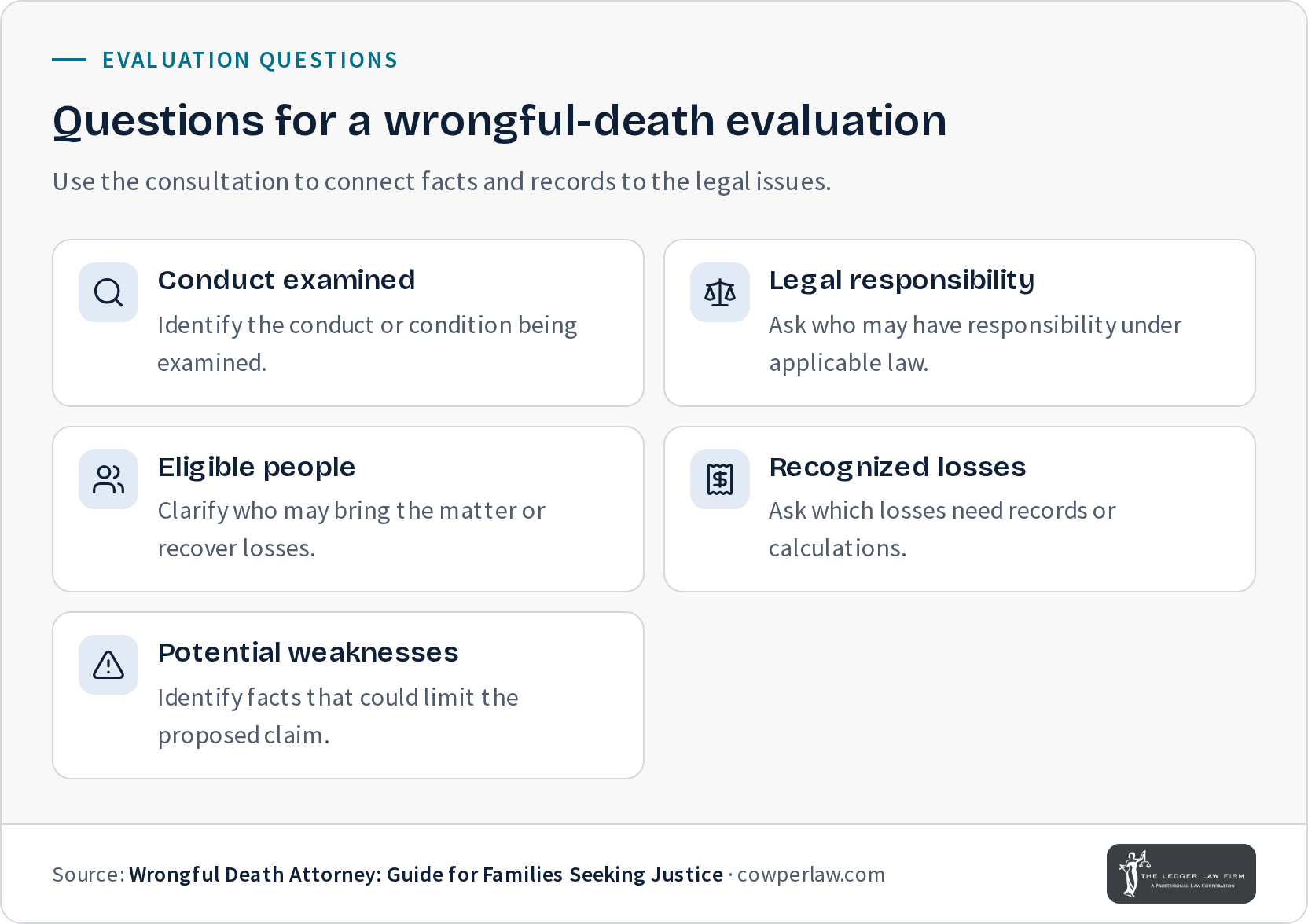
Wrongful-death rules vary by jurisdiction, including rules concerning responsibility, eligible claimants, and recognized losses. Evidence in a wrongful-death claim must address both liability and damages, including who caused the death and the consequences for the family. Ask the lawyer to explain which facts relate to each issue:
- What conduct or condition is being examined?
- Who may have legal responsibility under the applicable law?
- Who may be eligible to bring the matter or recover recognized losses?
- Which losses require records, calculations, or other proof?
- What facts could weaken, change, or limit the proposed claim?
A lawyer who can connect each requested record to one of those questions gives you a more useful evaluation than a broad statement that the matter looks strong. Ask for the reasoning in ordinary language. You should be able to distinguish a fact already supported by a record from an issue that still needs investigation.
Protect the record before it becomes harder to reconstruct
Preserving the available record should come before trying to organize it perfectly. Keep key records and save communications to help document losses and preserve the ability to seek accountability. Social-media posts, text messages, cloud backups, and vehicle EDR data can be overwritten or deleted within days, so save what you already have in its original form when you can.
Take these practical steps before the evaluation:
- Keep original emails, texts, photographs, videos, bills, and letters rather than relying only on screenshots or summaries.
- Write down names and contact information for people who may have witnessed events or communicated with your loved one.
- Record when an insurer, business, government office, or other organization contacts you, and preserve the message or letter.
- Avoid deleting, editing, or resetting devices that may contain relevant information.
- Tell the lawyer promptly if you learn that surveillance footage, digital material, vehicle data, or other records may be overwritten.
An insurer may ask for information or present settlement documents before you understand the legal position. Understand your rights before providing unnecessary statements or signing settlement documents after an insurer contacts you. You can tell the lawyer exactly what was requested, what you provided, and what you were asked to sign.
Time can also affect the quality of the record. Evidence may be collected selectively, including police reports, medical records, surveillance footage, and employment records; the defense may secure what helps it while evidence that helps your family slips away. Witnesses may scatter, and by the time they are found, their memories may have faded and details may have changed. In Texas, Texas Civil Practice & Remedies Code Section 16.003 imposes a two-year deadline from the date of death, with limited exceptions. Comparative fault is a standard defense in Texas wrongful-death cases, and a defendant may argue that the deceased was 51% or more at fault to eliminate or reduce recovery.
Build a usable evaluation file from what is already available
A usable evaluation file does not need to be complete. Begin collecting available evidence and documentation without treating missing material as a reason to postpone contact.
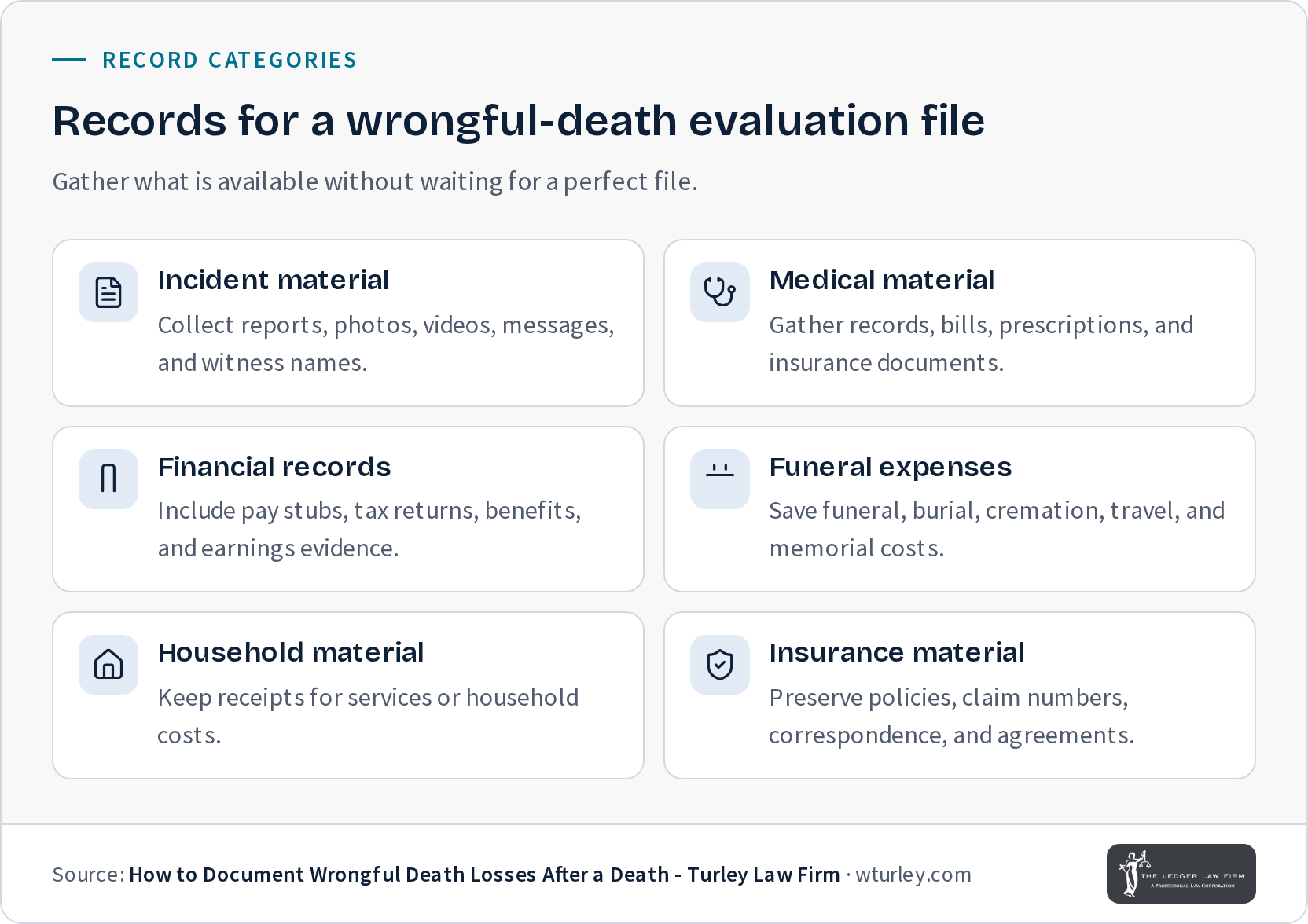
Useful records may include:
- Incident material: police or incident reports, photographs, videos, messages, emails, and names of witnesses.
- Medical material: medical records, hospital bills, ambulance bills, prescriptions, and insurance explanations of benefits.
- Financial and employment material: pay stubs, tax returns, employment benefits, business records, and evidence of expected earnings.
- Funeral and memorial material: funeral, burial, cremation, travel, obituary, and memorial expenses.
- Household material: receipts for services or household costs previously handled by the deceased.
- Insurance material: policy information, claim numbers, adjuster correspondence, requests for statements, and proposed agreements.
Organize the file by date and category if doing so is manageable, but do not delay because the folders are imperfect. Add a short timeline describing what happened, when you learned key facts, which organizations contacted you, and where the original records are stored. Mark questions rather than guessing at answers. The purpose is to help the lawyer see which records may address liability and which may document the consequences for your family. An evaluation-file index can make the handoff clearer without requiring a complete file. Create one line for each item with the record category, date, source, and a short description of what the item may show. Mark each item as available, requested, missing, or disputed instead of filling gaps with assumptions. A record index can help the lawyer distinguish documented facts from issues that still need investigation. Keep the index separate from original records so original emails, messages, photographs, videos, bills, and letters remain unchanged. A short list of unanswered questions can sit beside the index, including who has a missing record, when an insurer requested information, and which event needs a date confirmed. This format gives the lawyer both the available evidence and a practical investigation list. The absence of an indexed record does not prevent an initial evaluation.
Bring the available material even if an important report, bill, or employment record is missing. Tell the lawyer what you requested, who has it, and whether access has been denied or delayed. That information can become part of the investigation plan, while a missing document should not stop you from explaining what happened and asking what to do next.
Ask how the lawyer will investigate and communicate
When comparing lawyers, consider wrongful-death experience, trial background, investigation and documentation practices, communication, services covered, and case-expense policies—not percentages alone. A lawyer can be excellent at personal injury work and still be the wrong fit for a wrongful-death case because wrongful-death claims are distinct. Ask for examples of the work the lawyer would expect to perform, not only the practice areas listed on a website.
Experience should be discussed in relation to the work your situation may require. A lawyer may have broad personal-injury experience, but wrongful-death matters can involve a death investigation, questions about who may bring the matter, documentation of family losses, insurer communications, and state-specific rules. Ask what part of that work the lawyer would perform personally and what would be handled by other team members. You can also ask how the firm will keep the available records organized and how it will tell you when an important fact remains uncertain.
Communication questions are practical, not merely matters of preference. Clarify whether updates will cover new records, requests from insurers, changes in the proposed approach, and decisions that require your approval. Ask how quickly urgent notices or settlement requests should be sent to the firm. The answers help you compare the proposed service scope with the questions you need resolved, while leaving the legal assessment to a qualified review of your facts and applicable law. Ask whether the proposed scope includes the initial investigation, insurer communications, loss documentation, negotiation, and litigation if appropriate, or whether any of those tasks would require a later agreement. A written scope can reduce misunderstandings about what the lawyer will handle. Ask how the firm will identify conflicts before accepting the matter and what happens if a conflict limits the proposed representation. The answers give you concrete terms to compare across evaluations without treating a broad practice label as proof that the fit is right.
Use questions that test the proposed working relationship:
- How much of the practice involves wrongful-death matters?
- Who will investigate responsibility and document losses?
- What trial experience is relevant to the type of dispute you may face?
- Who will be your day-to-day contact, and how should you send new information?
- How often will you receive updates, and what events will prompt a call?
- Which services are included in the proposed representation?
- Are there conflicts or limits that could affect the lawyer’s ability to handle the matter?
- What decisions will require your approval?
Clients generally remain involved in major decisions while the lawyer handles day-to-day legal work and provides updates at each stage. Treat that division as a topic to clarify, not an assumption. Ask how you will approve settlement decisions, receive copies of important filings or correspondence, and learn about changes in strategy.
A useful comparison sheet can place each lawyer’s answer beside the same criteria: experience, investigation plan, communication, service scope, conflicts, and expenses. You are not trying to reduce a serious matter to a score. You are making it easier to notice whether each proposed plan addresses the unanswered questions in your record.
Read the fee agreement as a plan for the case’s economics
Many wrongful-death firms use contingency arrangements, with no upfront fees and payment only if they recover compensation; the consultation may also be free. The written fee agreement controls when the percentage changes, how expenses are handled, and whether you may owe costs if there is no recovery. Those terms deserve the same attention as the lawyer’s experience.
Ask the lawyer to explain the agreement before you sign it:
- Does the percentage apply before or after case expenses are deducted?
- Can the percentage change if the matter becomes more complex or goes to trial?
- Which expenses may be advanced, and which could become your responsibility?
- Are expert fees, court costs, records, investigation, or other charges treated differently?
- Could you owe costs if there is no recovery?
- When will you receive an accounting of deductions and the amount distributed?
A contingency-fee percentage can change depending on case complexity, whether the case goes to trial, and what extra costs are involved. A fee percentage alone does not show the total cost; case expenses, expert fees, court costs, and deduction methods can affect the final amount your family receives. Compare the full economic structure rather than choosing a lawyer based on a single percentage.
A Florida Bar consumer resource says lawyer overhead normally is 35 percent to 50 percent of the legal fees charged. That figure describes a lawyer’s business overhead in the Florida resource; it is not a fee percentage for your matter and does not predict what you will pay. Ask for the actual agreement that would govern your case and have each deduction explained in plain language.
Before deciding, write down the answers that affect your own exposure: the fee base, possible changes, expenses, responsibility for costs without a recovery, and the timing of payment. If an answer is unclear, ask for the relevant agreement language to be explained before you accept representation.
Check for timing and insurance issues that need early attention
Insurance requirements can create an early task separate from the general question of whether to pursue a claim. Many insurance policies impose strict notice deadlines, and failing to comply can jeopardize coverage. Have a qualified lawyer assess which notice is required under the policies and applicable law.
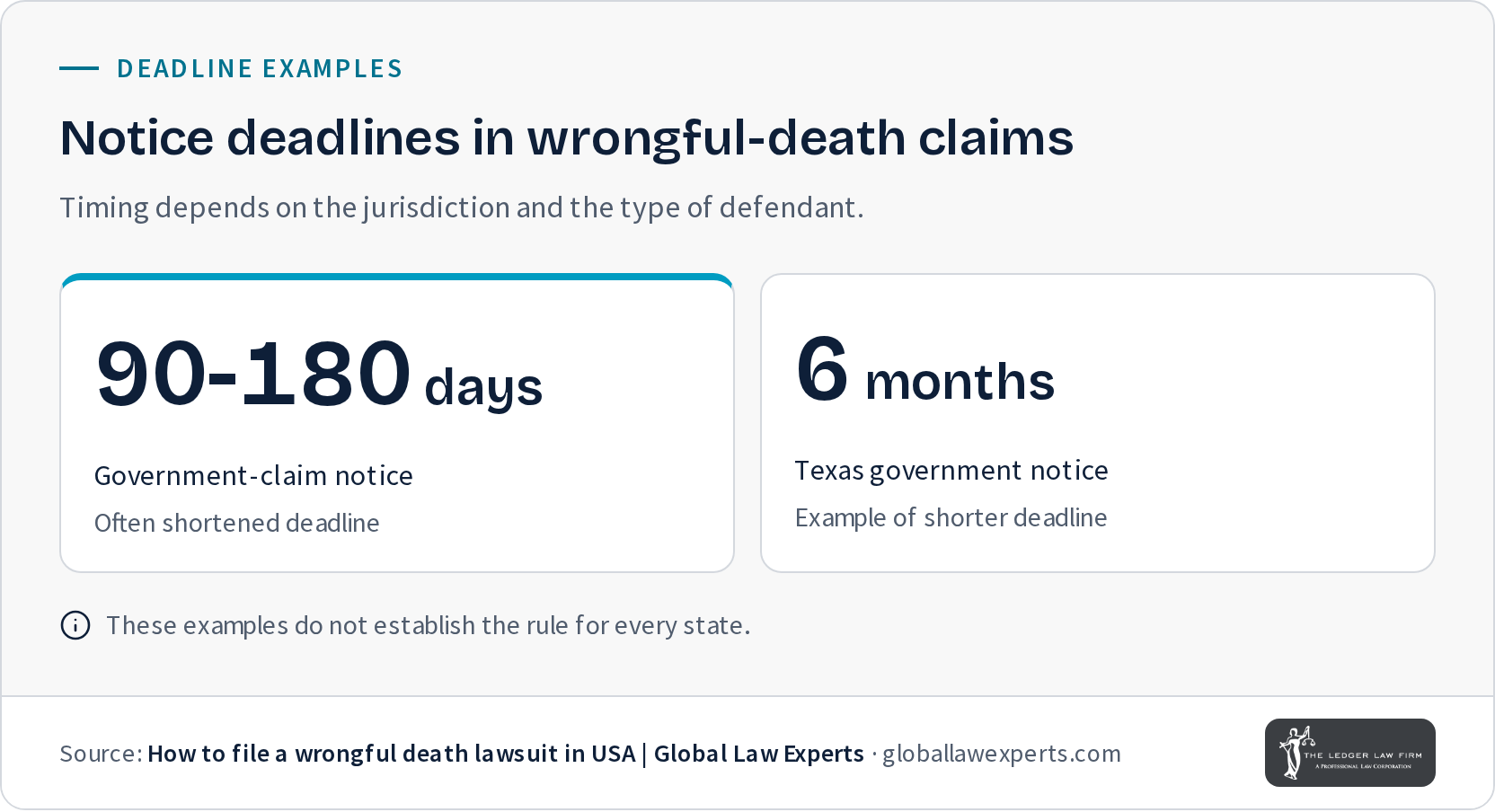
A government defendant can create a separate notice problem. In most jurisdictions, a government-entity claim may require formal tort-claim notice within a shortened deadline, often as short as 90 to 180 days, and missing a government notice deadline can bar the claim entirely regardless of the underlying statute of limitations. Ask during the evaluation whether a city, county, state, federal agency, public facility, or other government entity may be involved.
Texas illustrates why you should not apply a deadline from one state to another. In the Texas example, the statute of limitations is described as a two-year deadline from the date of death, with limited exceptions, while government claims may have shorter notice deadlines as short as 6 months. In Texas, the statute of limitations continues to run during negotiations with an insurance carrier. Those Texas details do not establish the rule for another state; they show why the jurisdiction, date of death, defendant, and type of claim must be identified promptly. They also give you concrete questions for the evaluation: Is a government entity involved? Has an insurer or public body requested notice? Which date controls the applicable period? What documents show when the death, contact, or notice-related event occurred? A lawyer can separate these timing questions from the broader assessment of responsibility, eligible claimants, recognized losses, and available proof. If the applicable timing is uncertain, contact a qualified professional or the responsible authority promptly rather than relying on a deadline from this example.
Bring these timing details to the evaluation:
- The date and location of the death.
- The names of possible responsible parties and whether any is a government entity.
- Every insurer or adjuster that has contacted you.
- The date of each letter, call, request, offer, or proposed release.
- Any known notice, filing, preservation, or response deadline.
- Whether negotiations or other discussions are already underway.
Ask what must happen first and by when.
Seek qualified evaluation when the record or clock is moving
Prompt qualified legal help may be appropriate when an insurer has contacted you, important digital or physical evidence may disappear, witnesses may be difficult to locate, or a government entity may be involved. The same is true when you are unsure which state’s law applies, who may bring the matter, or whether a deadline is approaching. These conditions call for an early review of the facts and available record.
Start with what you can preserve today: save communications, keep original records, write down the basic timeline, and gather the documents already within your control. Then tell the lawyer what is missing and what is urgent. You do not need to solve responsibility, losses, eligibility, or timing before asking for help; you need to identify those questions clearly enough for the evaluation to address them.
A case evaluation is a place to discuss the specific facts, jurisdiction, records, timing, and legal questions in a potential wrongful-death matter. Use the conversation to discuss the proposed investigation and consider whether the working relationship and next step fit your circumstances.
Submit the evaluation request with the record you have
The first contact can be more useful when you treat it as a structured handoff rather than a test of whether you already know the law. Provide the available timeline and records, identify insurer or government contacts, preserve communications, and list the questions you need answered about responsibility, losses, timing, fees, and communication. Missing information can be identified during the evaluation instead of becoming a reason to wait.
A qualified professional should decide individual suitability after reviewing the specific facts and applicable law. Before you provide unnecessary statements or sign settlement documents, obtain qualified advice about the request, agreement, or offer in front of you. When you are ready to discuss the matter, use the record you have and describe what happened as plainly and completely as you can.
Questions to resolve before requesting a wrongful-death lawyer evaluation
How much does it cost to hire a wrongful-death lawyer?
Many lawyers handle these matters on a contingency basis, so there may be no upfront hourly fee and payment may depend on recovering compensation. The written agreement controls the percentage, whether it changes if the matter goes to trial, which expenses are deducted, and whether you could owe costs if there is no recovery. Ask whether the percentage applies before or after expenses and request an explanation of every deduction.
What should I do if an insurance company contacts me after a wrongful death?
Preserve every letter, email, message, offer, and request for a recorded statement. Before providing unnecessary statements or signing a release or settlement agreement, obtain qualified advice about your rights and the document. Tell the lawyer when the insurer contacted you, what it requested, and what you have already provided.
Can I speak with a wrongful-death lawyer if I do not have all the records?
Yes. Bring the records you can obtain, such as incident materials, medical and funeral bills, employment and financial documents, insurance communications, and relevant messages or photographs. Explain what is missing, who may have it, and whether access has been delayed. Missing information does not prevent an initial evaluation; it can become part of the investigation plan.
Why should I seek legal help promptly in a wrongful-death matter?
Evidence and deadlines may become harder to address with time. Digital records can be overwritten or deleted, witnesses’ memories may change, insurance policies may impose notice requirements, and government-related claims may involve shortened notice periods. The applicable rules depend on the jurisdiction and facts, so promptly provide the date and location of death, possible responsible parties, insurer contacts, and any stated deadline for qualified review.

Emery Brett Ledger brings 28+ years of experience to personal injury law. He founded & led The Ledger Law Firm in securing over $100 million in compensation for clients with life-altering injuries & complex claims. Prior results do not guarantee a similar outcome. Licensed in California, Texas, & Washington, Emery earned his law degree from Pepperdine University School of Law. His practice areas include car & truck accidents, wrongful death, catastrophic injuries, maritime claims, & mass tort litigation. He has been recognized by The National Trial Lawyers’ Top 100, Mass Tort Trial Lawyers Top 25, and America’s Top 100 Personal Injury Attorneys. Emery also received the 2025 Elite Lawyer Award & holds a perfect 10.0 Avvo rating with Platinum Client Champion status. His legal work has been featured on CNN, Forbes, NBC, & ABC.
Free Case Evaluation
Recent Posts
- Lawyers for Wrongful Death: How to Choose One and Prepare for a Case Evaluation
- Best Morgan & Morgan alternatives for Texas truck accident claims
- Best Morris Bart alternatives for Texas truck accident claims
- Best Shouse Law Group alternatives for California injury claims
- Injury Attorney in LA: How to Decide Whether to Seek a Case Evaluation After a Crash
Emery Brett Ledger brings 28+ years of experience to personal injury law. He founded & led The Ledger Law Firm in securing over $100 million in compensation for clients with life-altering injuries & complex claims. Prior results do not guarantee a similar outcome. Licensed in California, Texas, & Washington, Emery earned his law degree from Pepperdine University School of Law. His practice areas include car & truck accidents, wrongful death, catastrophic injuries, maritime claims, & mass tort litigation. He has been recognized by The National Trial Lawyers’ Top 100, Mass Tort Trial Lawyers Top 25, and America’s Top 100 Personal Injury Attorneys. Emery also received the 2025 Elite Lawyer Award & holds a perfect 10.0 Avvo rating with Platinum Client Champion status. His legal work has been featured on CNN, Forbes, NBC, & ABC.