

Who Pays Medical Bills in A Car Accident in California? An In-Depth Discussion

- Personal Injury: You generally have two years from the accident date to file a lawsuit.
- Property Damage: The statute of limitations is typically three years from the date of damage.
- Government Claims: Strict deadlines of six months for personal injury and one year for property damage.
- Discovery Rule: The two-year personal injury deadline may be extended if the injury wasn’t immediately apparent.
- Tolling: Deadlines can be paused for minors or due to mental incapacity.
- Consequences of Missing: Failing to meet a deadline can result in the dismissal of your claim.
- Legal Counsel: An attorney is essential for navigating these complexities and ensuring deadlines are met.
Car accidents bring traumatic experiences along with unexpected injuries. It requires medical visits, a doctor’s checkup, and medication to recover from the accident injuries. So, who pays medical bills in a car accident in California?
Since California is an at-fault state, the at-fault driver’s insurance company pays for the medical bills of the injured party. You can claim through the Uninsured/Underinsured Motorist Coverage (UM/UIM) policy if the at-fault driver has no or insufficient insurance coverage.
Alternatively, medical liens, pay through out-of-pocket, and government assistance could be used to pay the medical bills. You can reach a mutual settlement or file a lawsuit to claim compensation for the car accident, including medical bills.
Who Pays Medical Bills in A Car Accident in California?

In California, the law is straightforward for car accident medical bills:
“The at-fault driver is responsible for the damages, including the medical bills of the injured person. Also, with its pure comparative negligence policy, there could be shared compensation. It depends on the percentage of the fault.”
However, the insurance company won’t pay your bills upfront. The process is often a waiting game, coming through long negotiations. The payment typically comes after you reach a mutual settlement or a court issues the verdict. In the meantime, you must find a way to cover medical expenses. This is where various options come into play, including your insurance company, medical liens, and other relevant parties.
Let’s illustrate this with an example:
Imagine Sarah is driving her car in Los Angeles when a distracted driver, Mark, runs a red light and T-bones her vehicle. Sarah suffered a broken arm and a concussion. She rushes to the hospital in an ambulance and receives emergency medical care. Her initial bills for the ambulance and ER visit amount to $15,000. Sarah’s health insurance will likely pay for the initial bills, but they will later seek reimbursement from Mark’s auto insurance company. Meanwhile, Sarah’s auto insurance company may also get involved, depending on her coverage. The ultimate responsibility for these bills lies with Mark’s insurance. However, the payout requires a claim and often settlement negotiation. It shows the distinction between the liable person and the actual person initially paying them.
General Overview of Medical Bills After a Car Accident
Car accidents cause minor to major injuries that immediately require medical attention. So, the financial fallout after car accidents can be just as severe as the physical injuries. So, people ask who pays for medical bills after a car accident. Before answering it, you must know the sectors of medical bills.
Also, you can contact (949) 377-1111 for details about the medical bills of a car accident.

Medical expenses can include the following services and products:
- Hospital and emergency room bills: The immediate costs for stabilization and treatment.
- Ambulance and transport fees: These fees cover the ambulance charges for transporting individuals from the accident scene to a medical facility.
- Doctor’s visits and specialist consultations: Fees for follow-up appointments and expert evaluations.
- Prescriptions and medications: The cost of drugs required for pain management and recovery.
- Physical therapy and rehabilitation: Ongoing treatment to regain mobility and function.
- Diagnostic tests: X-rays, CT scans, and other tests to assess injuries.
- Surgeries and medical procedures: The cost of operations and related hospital stays.
For many victims, these expenses are a significant financial burden. The burden becomes severe if they are unable to work. At such a moment, you must find the primary source of payment for the medical bills. Also, report to the Accident Management Center (AMC) for faster settlement.
Primary Sources of Payment
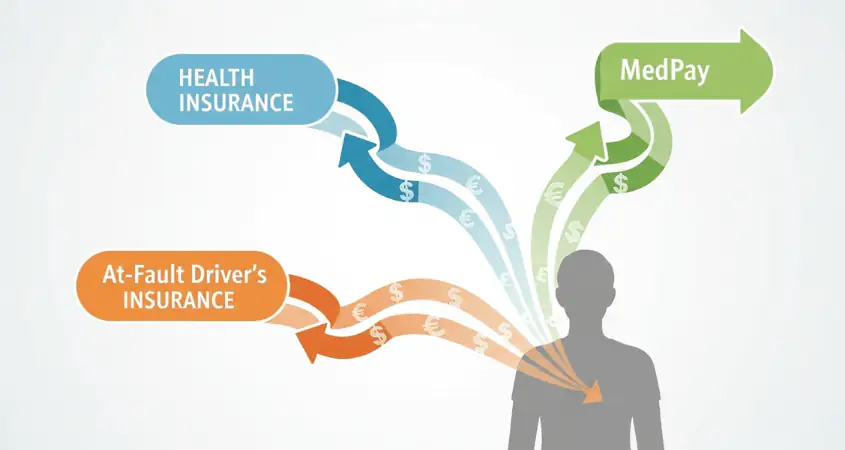
In California, the primary source of medical payments is the insurance company of the at-fault driver, as well as your insurance coverage, such as health insurance and MedPay.
The At-Fault Driver’s Insurance
California is a tort-based or “at-fault” state. So, the responsible driver for the accident is also responsible for paying the other party’s damages. The at-fault driver’s liability insurance is the primary source of compensation for medical bills.
However, this is not an immediate solution. The at-fault driver’s insurance company will not pay your bills as they come in. Instead, they try to lowball your settlement. Also, the settlement takes time, often longer than it takes to pay your medical bills.
Your Insurance Coverage
As you wait for the settlement payout, you can’t just stay with your recovery. So, alternatively, you have to pay the medical bills through health insurance and MedPay. Also, for drivers with no to little insurance coverage, UM or UIM is recommended.
Health Insurance:
Your health insurance is often the first line of defense for covering medical bills after a car accident in California. It could be through your employer or a private plan.
The insurance provider will pay for the medical treatment as it would for any other illness or injury. Once you settle, you can reimburse the payout. However, there could be:
- Deductibles
- Co-Pays
- Out-of-Pocket Maximums
Plus, your health insurance company may have a right to “subrogation.” It means they can seek reimbursement from the at-fault driver’s insurance once a settlement is paid.
Medical Payments Coverage (MedPay):
MedPay is an optional and recommended add-on to your car insurance policy. It is a “no-fault” coverage. That’s why MedPay pays for your medical bills regardless of who caused the accident. You can get the medical bills up to the policy limit. It is a lifesaver for covering initial costs, such as deductibles and co-pays.
Uninsured/Underinsured Motorist Coverage (UM/UIM):
California had almost 15.4% of uninsured vehicles in 2023. Also, it stands among the top 10 states with the largest number of uninsured vehicles. That’s why Uninsured/Underinsured Motorist Coverage (UM/UIM) is crucial coverage in California.
It protects you if the at-fault driver has no insurance (uninsured) or not enough insurance to cover your full damages (underinsured). UM/UIM covers your medical bills, lost wages, and pain and suffering up to your policy limits.
| Payment Source | How It Works | Pros | Cons |
| At-Fault Driver’s Insurance | Pays as little as possible after a settlement or verdict. | The ultimate source of compensation for damages. | Payment can be significantly delayed, sometimes for months or years. |
| Your Health Insurance | Pays for medical treatment as with any other illness. | Covers initial costs and often has pre-negotiated rates. | It includes deductibles and co-pays; it has the right to subrogation. |
| Medical Payments (MedPay) | Optional auto insurance coverage pays regardless of fault. | Covers initial medical bills quickly, including co-pays and deductibles. | Has a policy limit, and it’s an optional add-on. |
| Uninsured/Underinsured Motorist (UM/UIM) | Pays when the at-fault driver has no or insufficient insurance. | Protects you from a common problem in California. | You must purchase it as an add-on and have policy limits. |
Alternative Payment Methods
Besides the primary source of car accident payments, there are a few alternatives. So, how do insurance companies pay accident medical bills? They will assess your medical bills and the severity of the accident, and then disburse the payout.
It can often be a long process. So, you can choose alternative payment methods.
“In California, the at-fault driver's insurance pays for medical bills after a car accident; Ledger Law Firm helps you navigate the claims process to ensure you receive full compensation.
Emery Brett LedgerInsight From The Ledger Law Firm
”
Paying Through Out-of-Pocket Payments
Sometimes, accident victims could pay their medical expenses out of their pocket. It happens when they have a high-deductible health insurance plan or no health insurance at all. You must keep records of all costs, including receipts and bills. The bill’s records will be included in your personal injury claim. Once you settle, you will have to reimburse the bills.
Medical Liens
A medical lien is a legal claim placed on your personal injury settlement. The healthcare provider will claim the settlement. Sometimes, you might not have health insurance or MedPay. So, a doctor or hospital may agree to treat you on a lien basis.
It means they will defer payment until the personal injury case is resolved. They will be paid directly out of the settlement proceeds. This is a common practice for people with little to no insurance coverage. Also, it helps injured individuals receive necessary medical care without upfront costs.
Government Assistance Programs
Government programs like Medi-Cal or Medicare may cover your medical expenses. You must enroll in this program to get government assistance. However, like private health insurance, they have a right of subrogation. Plus, they will seek reimbursement from your settlement.
Situations When Insurance May Not Be Enough

Sometimes, the at-fault driver’s insurance may not be enough to cover the medical expenses. It is a serious problem in California because of its low minimum liability limits ($30,000 per person and $60,000 for more than one person).
You have to cover the difference once your medical bills for a serious injury exceed these limits. In such a situation, you have a few critical options. You can file a claim with your underinsured motorist (UIM) coverage. You may also explore the possibility of a personal injury lawsuit against the at-fault driver.
What if the Insurance Settlement Is Not Enough to Cover My Medical Bills?
This is a very real possibility for severe injuries and high medical costs. In most cases, drivers in California are required to have a minimum coverage of $30,000 per person for car accidents. So, when your medical bills are $50,000, you are left with a significant gap.
In these situations, you may need to pursue a personal injury lawsuit against the at-fault driver. With the lawsuit, you recover the remaining amount through the court’s verdict. In case the insurance settlement is insufficient, call (949) 377-1111 for your next steps.
Dealing with Uninsured or Underinsured Drivers
If the at-fault driver has no insurance, your Uninsured Motorist (UM) coverage will pay for the personal and property damages. It will be up to your policy limit. Underinsured Motorist (UIM) coverage will kick in when there is insufficient coverage. It will cover the difference between their policy limit and your total damages, up to your UIM policy limit.
Contact us online for a legal consultation to discuss your Newport Beach accident today.
Legal Options for Covering Medical Bills
There are multiple legal options to cover the medical bills for car accidents. From personal injury lawsuits to filing a first-party claim, you can choose different options.
Personal Injury Lawsuits
You can file a personal injury lawsuit if the insurance company refuses to settle. In California, you have two years from the date of the accident to file a lawsuit (Code of Civil Procedure §335.1). A lawsuit lets you seek compensation for all damages, including past and future medical expenses, lost wages, and pain and suffering.
An experienced car accident attorney can be invaluable in this process. They can:
- Negotiate with insurance companies
- Help you find the right treatment through medical liens
- Negotiate down the amount of medical liens and subrogation claims
- File a lawsuit and represent yourself in court
Filing a First-Party Claim
A first-party claim will be against your insurance company. It could be against MedPay or UM/UIM coverage. The first-party claim is a straightforward and faster process because your insurer has a contractual obligation to you.
| Legal Option | Description | When to Use It | Key Consideration |
| Medical Liens | A healthcare provider agrees to defer payment until a settlement is reached. | Lack of health insurance or MedPay. | The provider has a legal claim on your settlement, which must be paid first. |
| Personal Injury Lawsuit | Filing a formal lawsuit against the at-fault party. | Unable to reach a fair settlement with the insurance company. | The process can be lengthy and requires strong legal representation. |
| Negotiating Liens | Your attorney negotiates with medical providers to reduce the bills. | After a settlement or verdict is reached. | It significantly increases the settlement amount. |
| Subrogation | An insurer seeks reimbursement for what they paid. | After the settlement, the third-party insurer pays. | A routine part of the claims process, a lawyer will manage it. |
Special Considerations for Paying Medical Bills After Car Accidents:
When paying your medical bills, insurance companies consider pre-existing injuries. Also, they have subrogation rights, which play a vital role in paying the medical bills for the car accident.
Pre-Existing Injuries
Insurance companies will often try to lowball your settlement claim. They will argue that your injuries are a result of a pre-existing condition, not the accident. An experienced car accident lawyer can effectively demonstrate that the accident aggravated or worsened your condition. It’s critical for medical bills when you have pre-existing injuries.
Subrogation
Subrogation is the right of an insurer to claim payment from the at-fault party. For example, your health insurance pays for the medical bills. Later, when you receive a settlement, your insurer must be reimbursed for the money they spent. It is a common and legally supported practice. (See O’Connell v. City of Stockton, 41 Cal. App. 4th 234 (1995).
How Medical Bills Affect Your Settlement?
Medical bills directly affect your personal injury settlement. Insurance companies often multiply medical expenses by a factor of 1.5 to 5. With this calculation, they see the final settlement outcome. The factor depends on the severity of your injuries. The higher your medical bills, the greater the potential for a higher settlement.
Thus, you can use a car accident settlement calculator in California to find out your possible settlement payout.
Average Cost of Medical Bills After a Car Accident
Medical costs for car accidents are around $10,000 to $30,000 for visible injuries. For deaths in a car accident, the cost could be as high as 1M to 2M. However, the average cost of medical bills in California after a car accident could be:
| Service/Procedure | Average Cost (without insurance) |
| Ambulance Ride | $1,500 – $3,500 |
| Emergency Room Visit | $1,000 – $5,000+ |
| X-Ray | $100 – $500 per scan |
| CT Scan | $300 – $5,000 per scan |
| MRI | $400 – $12,000 per scan |
| Doctor’s Office Visit | $150 – $300 |
| Physical Therapy | $75 – $350 per session |
| Surgery | $10,000 – $200,000+ |
You can call (949) 377-1111 to know about further details about the car accident medical bills.
How to Collect Medical Records and Bills
You must keep records of medical records, bills, receipts, and correspondence. The right documentation is essential for a personal injury claim. Once you submit the medical records and assess future costs, the lawyer will negotiate with the insurance adjusters for the medical bills.
Time Limits for Submitting Medical Bills
In California, the statute of limitations for personal injury is two years. It starts from the date of the accident. However, it’s best to submit medical as soon as you receive the bills. It ensures a fast recovery of the medical bills.
Check Our Review To Know About Our Ability
Frequently Asked Questions – FAQ
1. Who pays medical bills in a car accident in CA?
The at-fault driver pays the medical bills. However, initially, your health insurance or MedPay coverage will typically pay. The at-fault driver’s insurance will then pay after a settlement or verdict.
2. Does health insurance cover car accidents in California?
Yes, your health insurance must cover medical bills. The payment system is subject to your policy terms. However, they will likely seek reimbursement through subrogation.
3. What happens if I don’t have insurance after a car accident?
If you don’t have health insurance, you can still seek medical treatment. You may be treated on a medical lien. Without car insurance, your ability to recover non-economic damages could be limited under California’s “Proposition 213” law.
4. What if the insurance settlement is not enough to cover my medical bills?
If the at-fault driver’s policy limits are too low, you may have to rely on Uninsured/Underinsured Motorist (UM/UIM) coverage. Alternatively, you can pursue a personal injury lawsuit against the at-fault driver to recover the remaining amount.
5. How do medical liens work?
A medical lien is a legal agreement between you and a healthcare provider. The provider treats you without upfront payment. Once you receive the settlement payout, you pay the lien directly to the healthcare provider.
Consult Us for Quick Medical Bills Payout
The medical bills after a car accident in California are higher than you think. Also, you won’t initially receive the claim payout from the at-fault driver. That’s where the need for an expert car accident lawyer is inevitable.
Contact Ledger Law Firm fast so we can assess your medical bills quickly and file the claim. Our negotiation process and lawsuit steps ensure you get the maximum payout at the shortest possible time. Our free consultation will help you find ways to adjust the initial cost.

Emery Brett Ledger brings 28+ years of experience to personal injury law. He founded & led The Ledger Law Firm in securing over $100 million in compensation for clients with life-altering injuries & complex claims. Prior results do not guarantee a similar outcome. Licensed in California, Texas, & Washington, Emery earned his law degree from Pepperdine University School of Law. His practice areas include car & truck accidents, wrongful death, catastrophic injuries, maritime claims, & mass tort litigation. He has been recognized by The National Trial Lawyers’ Top 100, Mass Tort Trial Lawyers Top 25, and America’s Top 100 Personal Injury Attorneys. Emery also received the 2025 Elite Lawyer Award & holds a perfect 10.0 Avvo rating with Platinum Client Champion status. His legal work has been featured on CNN, Forbes, NBC, & ABC.
Free Case Evaluation
Recent Posts
- Punitive Damages in a Car Accident: When Can You Recover Them?
- Tailgating Injury: What Causes Tailgating, Road Rage & How to Stay Safe
- Waiting to Call a Lawyer Can Hurt Your Case: Evidence, Deadlines & Legal Risks
- What Is Property Damage in a Car Accident? Claims, Costs & Who Pays
- Bodily Injury & Property Damage: Coverage, Claims, Liability & Compensation
Emery Brett Ledger brings 28+ years of experience to personal injury law. He founded & led The Ledger Law Firm in securing over $100 million in compensation for clients with life-altering injuries & complex claims. Prior results do not guarantee a similar outcome. Licensed in California, Texas, & Washington, Emery earned his law degree from Pepperdine University School of Law. His practice areas include car & truck accidents, wrongful death, catastrophic injuries, maritime claims, & mass tort litigation. He has been recognized by The National Trial Lawyers’ Top 100, Mass Tort Trial Lawyers Top 25, and America’s Top 100 Personal Injury Attorneys. Emery also received the 2025 Elite Lawyer Award & holds a perfect 10.0 Avvo rating with Platinum Client Champion status. His legal work has been featured on CNN, Forbes, NBC, & ABC.