7 things families should do after a wrongful death in California

Start by preserving evidence, checking California deadlines, and identifying who can bring the claim. These seven things to do after a wrongful death in California give your family a practical 2026 checklist; The Ledger Law Firm represents families seeking personal injury and wrongful death representation.
- The things to do after a wrongful death in California start with evidence preservation and a deadline review.
- California generally allows two years to file a wrongful death lawsuit; exceptions and government claims require separate review.
- The Ledger Law Firm represents families seeking California wrongful death representation.
- Gather family records, insurance correspondence, and financial documents before signing a settlement release.
Why this matters
You do not need to solve every legal issue while arranging a funeral and supporting your family. You do need to protect records and avoid decisions that close off a claim before you understand it.
An insurance conversation is not a substitute for checking your filing deadlines. A criminal investigation, an insurance claim, and a civil wrongful death case serve different purposes. Do not assume progress in one protects your rights in another.
This guide concerns California wrongful death claims, including losses arising from crashes in Newport Beach and elsewhere in the state. Washington and Texas have different rules. Do not apply this checklist's California deadlines to a Seattle or Dallas case.
What makes the best next step for your family?
Use these criteria to prioritize your 2026 checklist:
- Evidence protection: Does the action preserve something that can disappear?
- Deadline protection: Does it identify a filing requirement before time runs out?
- Family clarity: Does it establish who belongs in the claim and who handles estate matters?
- Decision protection: Does it help you understand a document before signing?
- Manageable effort: Can a trusted person help without adding to your burden?
The order below reflects urgency and practical usefulness, not a requirement to finish one task before starting another. Evidence preservation and legal review often need to happen together.
Seven actions at a glance
| Priority | Action | Best for | Main benefit | Limitation |
|---|---|---|---|---|
| 1 | Preserve evidence | Records at risk of disappearing | Protects original information | Some records require formal legal requests |
| 2 | Check deadlines | Every family considering a claim | Identifies urgent filing requirements | The general deadline does not cover every case |
| 3 | Identify eligible claimants | Families with several relatives or dependents | Clarifies who belongs in the case | Relationship alone does not answer every eligibility question |
| 4 | Organize loss records | Families gathering financial and personal evidence | Documents the effects of the death | Documents do not guarantee recovery |
| 5 | Manage insurance contact | Families receiving calls or paperwork | Creates a clear communication record | Notice and cooperation duties still need attention |
| 6 | Separate claim types | Families handling both estate and family losses | Prevents confusion about legal roles | Separate claims need coordinated review |
| 7 | Prepare a case evaluation | Families deciding whether to hire counsel | Turns scattered questions into next steps | An evaluation cannot promise an outcome |
1. Preserve evidence: best for protecting records that can disappear
Save what your family already has before trying to obtain everything else. Keep original photographs, videos, messages, witness details, police report information, and correspondence about the incident. Preserve files in their original format rather than relying only on screenshots.
For a fatal vehicle crash, record where the vehicles are located and who controls them. Ask counsel promptly whether inspection or preservation requests are needed before repairs, disposal, or other changes occur. Do not retrieve belongings or inspect a scene if doing so is unsafe.
Advantages:
- Original files retain context that copied images can lose.
- Witness contact information gives an investigator a starting point.
- Early preservation requests identify records that need protection.
Limits: You cannot assume a business will retain camera footage because an investigation exists. Some evidence requires a subpoena or another formal process.
Best for: Families facing missing footage, damaged vehicles, or scattered digital records.
Verdict: Preserve what you control and flag everything else promptly.
2. Check deadlines: best for protecting the right to file
For a California claim being evaluated in 2026, the general wrongful death lawsuit deadline is 2 years from the date of death under California Code of Civil Procedure section 335.1. Exceptions and special rules require individual review. Do not calculate the last filing day from an online article alone.
Government involvement changes the analysis. California Government Code section 911.2 generally requires presentation of a claim relating to death to the public entity within 6 months after accrual. Claim presentation and filing a lawsuit are different steps, with different requirements.
Tell counsel immediately if the incident involved a public bus, public roadway condition, government vehicle, or public employee. Also disclose medical treatment issues, uncertainty about when the cause became known, and any connection to another state.
Advantages:
- A deadline review identifies urgent action before document gathering is complete.
- A written calendar helps relatives coordinate responsibilities.
- Early review separates insurance activity from court requirements.
Limits: The general two-year rule is not a safe assumption for every death. Government claim rules also involve requirements beyond the initial presentation deadline.
Best for: Every family considering a California wrongful death claim.
Verdict: Get the deadline reviewed before waiting for an insurer's answer.
3. Identify eligible claimants: best for avoiding family confusion
California Code of Civil Procedure section 377.60 identifies who can bring a wrongful death action. The statute includes a surviving spouse, domestic partner, and children, along with other categories that depend on the family circumstances. Not every grieving relative automatically qualifies.
Prepare a family list showing relationships to the person who died. Include children, a spouse or domestic partner, and anyone whose dependency or inheritance relationship needs legal review. Tell counsel about deceased children, grandchildren, separation, adoption, or disputed relationships rather than deciding eligibility yourself.
Keep this conversation factual. Being named executor, paying funeral expenses, or acting as the family's main contact does not by itself resolve who can bring the wrongful death claim.
Advantages:
- A family list helps counsel identify people whose rights need attention.
- Early disclosure reduces confusion about who is speaking for whom.
- Relationship documents give the legal review a clearer foundation.
Limits: Family agreement does not replace statutory eligibility. Eligibility can require more than a birth certificate or marriage record.
Best for: Blended families, dependent relatives, and families with several potential claimants.
Verdict: Share the full family picture before anyone signs claim documents.
4. Organize loss records: best for documenting the family's harm
Create 1 shared folder with separate sections for incident records, family records, financial documents, and correspondence. Give access only to trusted people who need it. Keep originals secure and use copies for routine sharing.
Gather funeral and burial invoices, available income records, benefits information, and documents showing financial support. Also write down the household work, caregiving, guidance, and companionship your loved one provided. Use specific examples rather than trying to assign a settlement value.
A short factual note about daily responsibilities can help explain a loss that tax records do not capture. Keep private reflections separate from a document-sharing system, and ask counsel what should be collected and how it should be handled.
Advantages:
- Organized records reduce repeated requests to grieving relatives.
- Financial documents show support beyond a single paycheck.
- Concrete examples explain the person's role in family life.
Limits: A receipt does not establish that a particular claimant can recover that expense. The recoverable losses depend on the claim and applicable law.
Best for: Families gathering information without knowing what a lawyer will need.
Verdict: Document the loss without guessing what the case is worth.
5. Manage insurance contact: best for protecting informed decisions
Keep a communication log with the insurer's name, representative, claim number, and each request. Ask for important requests and proposed agreements in writing. Save envelopes, emails, attachments, and copies of anything already submitted.
Do not guess about speed, fault, medical events, or family finances. If you do not know an answer, say so. Before giving a recorded statement, signing a broad records authorization, or accepting a release, ask counsel what the request covers and what obligations apply.
Do not ignore your own insurer's notice or cooperation requirements. Instead, get advice about responding accurately while protecting your family's interests.
Advantages:
- A written log makes conversations easier to track.
- Reviewing documents helps identify what rights a release addresses.
- Accurate answers avoid turning assumptions into recorded statements.
Limits: Declining every contact without advice can create problems. Different policies and requests require different responses.
Best for: Families receiving early settlement paperwork or repeated insurance calls.
Verdict: Respond deliberately; do not sign simply to stop the calls.
6. Separate claim types: best for distinguishing family and estate losses
A California wrongful death action concerns qualifying survivors' losses caused by the death. A survival action continues a claim the deceased person could have brought, through the legally authorized representative or successor in interest. California Code of Civil Procedure sections 377.60 and 377.30 address these distinct legal routes.
The distinction matters when identifying who acts, which records belong to which claim, and how the case should be organized. An estate document does not automatically answer every wrongful death eligibility question.
Advantages:
- Separating the claims clarifies the different legal roles.
- Coordinated review helps organize records and potential damages.
- Identifying estate issues early gives counsel time to address authority.
Limits: The same event can involve overlapping facts and separate procedural requirements. Do not assume every loss belongs in both claims.
Best for: Families handling probate questions alongside a wrongful death case.
Verdict: Ask counsel to explain each claim and who has authority to act.
7. Prepare a case evaluation: best for choosing your next move
Bring what you have; do not postpone a conversation because a report or death certificate is still pending. Start with the incident date, death date, location, known parties, insurance letters, family relationships, and questions about urgent evidence.
The Ledger Law Firm is an option for families seeking California wrongful death representation. A case evaluation should help you understand the issues requiring investigation, the records to preserve, and the next decisions—not produce a promised recovery.
Ask who will handle communications, what representation covers, and how attorney fees and case expenses work. If a contingency arrangement is proposed, ask separately about costs and responsibility for them if there is no recovery. Read the written agreement before deciding.
Advantages:
- A prepared question list keeps the conversation focused.
- Sharing difficult facts early supports a realistic review.
- A written agreement clarifies the proposed working relationship.
Limits: An initial conversation cannot establish every disputed fact or guarantee an outcome.
Best for: Families ready to understand whether legal representation fits their situation.
Verdict: Seek clarity, not a settlement prediction.
Discuss your family’s next steps
Ask about evidence, California deadlines, and representation for a wrongful death claim.
How these actions are prioritized
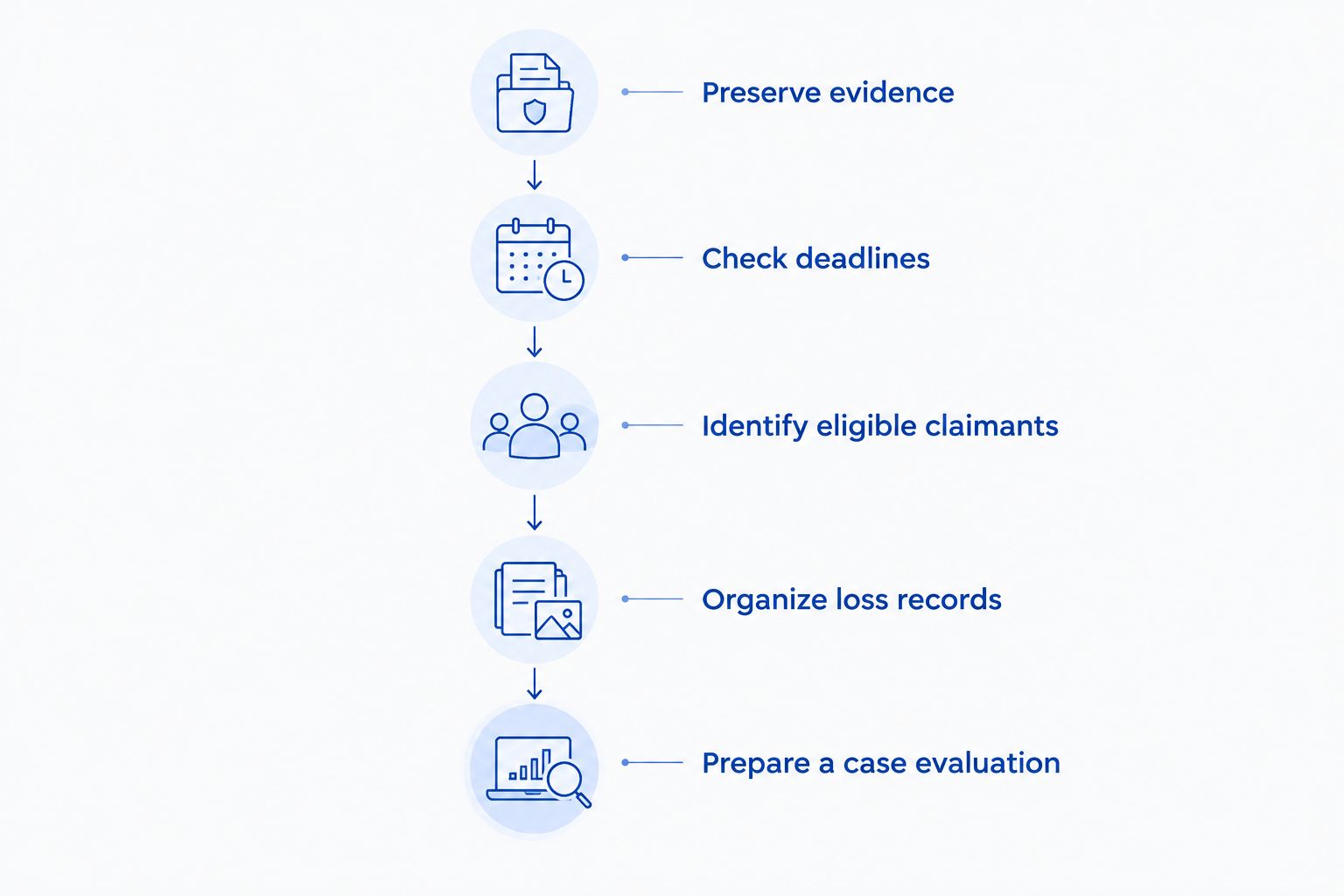
This 2026 checklist puts disappearing evidence and filing requirements first, then addresses family eligibility, documentation, communications, and representation. These are practical priorities, not findings about fault in your case.
You can divide the work without dividing responsibility for legal decisions. For example, one trusted relative can organize records while another maintains the contact log. Share important correspondence with counsel rather than assuming another family member has handled it.
Which action should your family take first?
Start with evidence preservation and a California deadline review together. If you have already received a release or suspect government involvement, put that information at the front of the conversation.
You do not have to complete all seven steps before asking for help. The point is to protect your ability to make informed decisions while giving your family room to grieve.
FAQ
What’s the first thing to do after a wrongful death in California?
Preserve available evidence and arrange a review of the California filing deadlines. Save original files and correspondence, and tell counsel immediately about government involvement or settlement paperwork.
How long do we have to file a California wrongful death lawsuit in 2026?
California generally allows two years from the date of death under Code of Civil Procedure section 335.1. Exceptions and special rules apply, and government claims can require a much earlier claim-presentation step.
Can anyone in the family bring a wrongful death claim?
No; California Code of Civil Procedure section 377.60 defines eligible claimants. A lawyer needs the family relationships and relevant dependency information to assess who qualifies.
Should we wait for the criminal investigation to finish?
Do not wait for a criminal investigation before checking civil deadlines. Criminal proceedings and a family’s civil claim serve different purposes, and waiting does not automatically protect the civil claim.
Do we need every document before speaking with a lawyer?
No; you can seek a case evaluation with the information already available. Bring key dates, known parties, insurance correspondence, and a list of records still missing.
Is a wrongful death claim the same as a survival action?
No; a wrongful death claim addresses qualifying survivors’ losses, while a survival action continues the deceased person’s claim through an authorized person. The claims require separate analysis even when they arise from the same event.
Does no recovery always mean we owe no case expenses?
No; responsibility for case expenses depends on the representation agreement and applicable rules. Ask separately about attorney fees, advanced expenses, and costs if the case does not produce a recovery.
One last thing
A useful record is not always an official record. A calendar showing school pickups, caregiving, or regular family responsibilities can help you explain what your loved one contributed. Preserve existing records honestly; do not recreate events as though the notes were made at the time.
For a loss being evaluated in 2026, ask The Ledger Law Firm which records need immediate attention. Your family can take the next step without having every answer today.
Related guides
- What a California family should bring to a wrongful death lawyer
- How California wrongful death and survival actions differ
- Steps to take after a truck accident in California

Emery Brett Ledger brings 28+ years of experience to personal injury law. He founded & led The Ledger Law Firm in securing over $100 million in compensation for clients with life-altering injuries & complex claims. Prior results do not guarantee a similar outcome. Licensed in California, Texas, & Washington, Emery earned his law degree from Pepperdine University School of Law. His practice areas include car & truck accidents, wrongful death, catastrophic injuries, maritime claims, & mass tort litigation. He has been recognized by The National Trial Lawyers’ Top 100, Mass Tort Trial Lawyers Top 25, and America’s Top 100 Personal Injury Attorneys. Emery also received the 2025 Elite Lawyer Award & holds a perfect 10.0 Avvo rating with Platinum Client Champion status. His legal work has been featured on CNN, Forbes, NBC, & ABC.
Free Case Evaluation
Recent Posts
Emery Brett Ledger brings 28+ years of experience to personal injury law. He founded & led The Ledger Law Firm in securing over $100 million in compensation for clients with life-altering injuries & complex claims. Prior results do not guarantee a similar outcome. Licensed in California, Texas, & Washington, Emery earned his law degree from Pepperdine University School of Law. His practice areas include car & truck accidents, wrongful death, catastrophic injuries, maritime claims, & mass tort litigation. He has been recognized by The National Trial Lawyers’ Top 100, Mass Tort Trial Lawyers Top 25, and America’s Top 100 Personal Injury Attorneys. Emery also received the 2025 Elite Lawyer Award & holds a perfect 10.0 Avvo rating with Platinum Client Champion status. His legal work has been featured on CNN, Forbes, NBC, & ABC.