What should a California family bring to a wrongful death lawyer?

Bring the records you already have: the death certificate, incident details, medical records, insurance correspondence, financial records, and documents showing your relationship to the person who died. For a California wrongful death consultation in 2026, an incomplete folder is enough to start a conversation—do not delay getting advice while waiting for every document, and ask the lawyer to review deadlines and explain attorney fees separately from case expenses.
- California wrongful death lawyer family checklist: bring existing records, relationship documents, correspondence, and questions.
- Do not wait for a death certificate or complete medical file before requesting a case evaluation.
- Preserve original messages, photographs, and recordings; keep a separate copy for your consultation.
- Ledger Law provides personal injury representation in California; ask about the circumstances of your family’s loss.
What should a California family bring to a wrongful death lawyer?
Bring information that helps the lawyer understand what happened, who your family lost, and how the loss affects you. You do not need to organize the case yourself or decide which documents prove legal responsibility.
Use this checklist to prepare. If something is missing, write down who might have it rather than postponing the appointment.
| What to bring | What it helps the lawyer review | What to do if it is missing |
|---|---|---|
| Death certificate, if available | Identity, date of death, and recorded information | Explain whether you have requested it |
| Police or incident report | Reported circumstances and investigating agency | Bring the report number or agency name |
| Medical and hospital records | Treatment connected to the incident | List the providers and treatment locations |
| Photographs, video, and messages | Available evidence about the incident | Identify the person or business holding it |
| Insurance letters and claim numbers | Insurers involved and communications received | Bring the correspondence you can access |
| Relationship and estate documents | Family relationships and any estate appointment | Explain your relationship and any uncertainty |
| Income, support, and expense records | Financial effects of the death | List the records and who maintains them |
| A short timeline and questions | Events, concerns, and immediate decisions | Prepare a rough outline from memory |
Why this matters
A useful consultation starts with the facts you know, not a perfect evidence packet. Your lawyer needs to distinguish confirmed information from unanswered questions and identify records that require further investigation.
Ledger Law provides personal injury representation in California. Ledger Law is a fit for injured people and families seeking personal injury representation, rather than help limited to vehicle damage.
This guide concerns preparing for a California consultation in 2026. Do not assume advice about a Washington or Texas claim applies to your family's situation, even when the incident sounds similar.
Bring the incident records without trying to investigate everything
Start with the incident date, location, and a brief description of what you understand happened. Include the names of involved drivers, businesses, property owners, employers, or other people if you know them.
Keep firsthand knowledge separate from information someone else supplied. Writing that a witness told you something is more useful than presenting that account as something you personally observed.
Useful materials include:
- Police, collision, workplace, or property incident reports you already possess.
- Report numbers and the investigating agency's contact information.
- Photographs and recordings in their original form.
- Witness names and contact information.
- Messages discussing the incident or its aftermath.
- Vehicle, location, or business details relevant to what happened.
Do not put yourself at risk to collect evidence. Tell the lawyer about potential surveillance footage, vehicle data, or business records instead of entering private property or attempting to access someone else's account.
If you have already spoken with an investigator or insurance representative, bring your notes about that conversation. Include any written statement, recording, or document you received.
Bring death and medical records you can lawfully access
Bring the death certificate if you have it. Also include hospital paperwork, discharge documents, ambulance information, and medical correspondence connected to the incident.
You do not need to interpret a medical chart. A provider list can still help when the complete records are unavailable: identify the hospital, treating facilities, and approximate treatment dates as accurately as you can.
Tell the lawyer whether a coroner or medical examiner was involved and whether you received any related documents. Do not guess about the medical cause of death or whether treatment changed the outcome. Those questions require evidence and appropriate review.
Access to another person's medical records involves privacy and authorization requirements. Ask the lawyer what authorization or documentation is needed rather than assuming a family relationship gives unrestricted access.
Bring documents showing family relationships and estate roles
Identify the surviving family members and explain each person's relationship to the person who died. Bring relevant marriage, birth, adoption, or other relationship documents already in your possession.
If an estate proceeding exists, include court papers identifying any appointed representative. Bring relevant estate documents you already have, but do not assume that being named in a will answers every question about a wrongful death claim.
Explain sensitive circumstances plainly. A separation, disputed relationship, minor child, or disagreement between relatives is information the lawyer needs to assess—not something you must resolve before asking for help.
Ask who has the right to bring a claim and who the lawyer would represent. Do not assume every relative has the same legal role, or that the person arranging the consultation automatically speaks for everyone.
Bring financial records and describe support beyond income
Collect existing records showing earnings, financial contributions, and incident-related expenses. Relevant materials can include pay statements, tax documents, employment information, funeral invoices, medical bills, and receipts.
Do not create a settlement estimate from those records. Their purpose is to help the lawyer understand the loss and identify what needs documentation.
Describe household contributions too. Childcare, transportation, caregiving, home maintenance, and other regular responsibilities help explain how the household functioned before the death.
Write down who received that support and how routines have changed. Use concrete examples rather than assigning a dollar amount yourself.
You can also bring a brief personal account of your relationship with the person who died. You do not have to reduce your grief to a spreadsheet or prepare a polished statement.
Bring every insurer letter and proposed agreement
Include insurance claim numbers, adjuster contact details, coverage letters, payment notices, and any proposed release. Keep the full document, including attachments, rather than bringing only the signature page.
Tell the lawyer about any offer, payment, recorded statement, or document you have already signed. That information belongs in the consultation even if you are worried you made a mistake.
If someone has given you a response date, flag it when scheduling. A date in an insurer's letter and a legal filing deadline are different questions; ask the lawyer to review both.
Before signing an unfamiliar release, get an explanation of what it covers. Do not assume a document concerns only a particular bill or payment because that is how a conversation described it.
How should you organize your 2026 consultation folder?
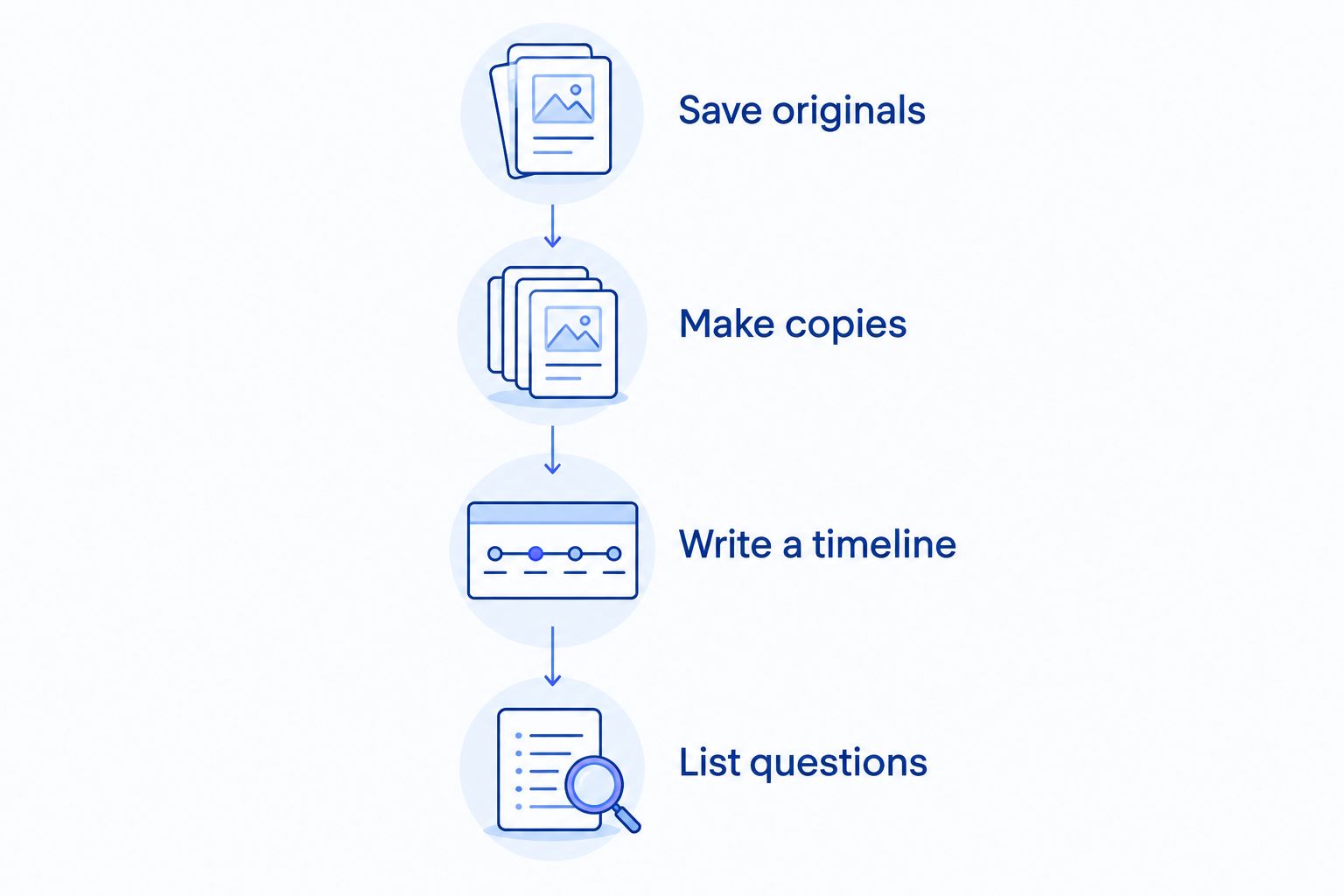
Keep the preparation manageable. Use 2 folders—one for originals and one for copies—and prepare a 1-page timeline if that helps you explain the sequence.
- Save originals. Preserve original files and paper documents without adding notes directly to them.
- Make copies. Put consultation copies together and retain your originals unless you agree on another arrangement.
- Write a timeline. List the incident, treatment, death, and significant communications in date order.
- List questions. Put urgent decisions and unfamiliar documents at the top.
For electronic materials, retain the original file where possible rather than relying only on a screenshot. Avoid cropping, editing, or deleting material because it seems unhelpful; let the lawyer assess its relevance.
Ask the office how to send sensitive records securely. Do not send passwords, unrestricted account access, or original documents without discussing what is needed and how they will be handled.
Why the documents your family needs vary
The useful starting packet depends on the circumstances, not a universal paperwork requirement. Explain these factors so the lawyer can identify the next records to seek:
- The incident involved. A vehicle collision, property incident, or other event produces different records.
- The treatment history. Treatment before death affects which providers and records need review.
- The family relationships. Relationship questions determine what supporting documents need examination.
- Any estate proceeding. Existing appointments and court papers help clarify roles.
- Existing communications. Insurer requests, signed documents, and pending decisions need individual attention.
A checklist organizes the first meeting. It does not establish fault, eligibility, or the value of a claim.
What if your family has almost no documents?
You can request a consultation with the person's name, the incident date and location, your relationship, and a description of what happened. Explain which records you lack and whether anyone has contacted you about an investigation or claim.
Missing paperwork is a question for the consultation, not a reason to put it off. A lawyer can discuss what records matter and what steps are appropriate to obtain them.
What should your family ask about attorney fees and expenses?
Ask how attorney fees are calculated, what case expenses involve, and when either becomes payable. Attorney fees and case expenses are separate subjects; do not assume that no recovery necessarily means no costs.
Before signing, ask for a plain-language explanation of the written agreement. Cover 3 questions: how fees are calculated, how expenses affect any recovery, and what you could owe if the case ends without a recovery.
When should your family request a case evaluation?
Request an evaluation when you need advice about a death connected to an accident or another person's conduct. Do not wait for a complete report or assume a claim has the same deadline as another family's case.
For a California matter in 2026, ask the lawyer to assess the applicable deadlines using the actual facts. Bring any notices or documents carrying dates that require a response.
You can contact the firm to ask about a case evaluation. Explain the location, incident date, and your relationship so the conversation starts with the right information.
FAQ
What should I bring to a California wrongful death consultation in 2026?
Bring the records you already have, including incident information, a death certificate if available, medical documents, insurance correspondence, relationship records, and financial information. Add a short timeline and your most urgent questions.
Can I talk to a lawyer before receiving the death certificate?
Yes, you can request a consultation before receiving the death certificate. Explain what happened and which records are still pending rather than delaying the conversation.
Should every family member attend the first meeting?
Ask the office who should attend the first meeting. Identify the surviving relatives and any estate representative so the lawyer can discuss participation and representation.
Should I bring something an insurance company asked me to sign?
Yes, bring the entire document and any related correspondence. Ask what it covers and explain whether you have already signed it or received a payment.
Do I need to estimate what the wrongful death claim is worth?
No, you do not need to estimate a claim’s value before the consultation. Bring supporting records and describe the financial, household, and personal effects of the loss without inventing a settlement figure.
Does a contingency fee mean my family cannot owe expenses?
No, a contingency fee does not by itself answer whether your family could owe case expenses. Ask the lawyer to explain the written agreement, including expenses if there is no recovery.
Can Ledger Law discuss a California accident involving a death?
Ledger Law provides personal injury representation in California. Contact the firm to describe the accident and ask about an evaluation of your family’s circumstances.
One last thing
Bring the document you least understand. A confusing release, unexpected bill, or letter from an unfamiliar insurer belongs in the consultation folder, not a separate pile for later.
For your family's 2026 consultation, preparation should make the conversation easier—not become another burden. Start with what you have and identify what you need help understanding.
Related guides
- Preserving evidence after a California lane-splitting crash
- Medical records for a Newport Beach car accident claim
- Reviewing an early Newport Beach crash settlement offer

Emery Brett Ledger brings 28+ years of experience to personal injury law. He founded & led The Ledger Law Firm in securing over $100 million in compensation for clients with life-altering injuries & complex claims. Prior results do not guarantee a similar outcome. Licensed in California, Texas, & Washington, Emery earned his law degree from Pepperdine University School of Law. His practice areas include car & truck accidents, wrongful death, catastrophic injuries, maritime claims, & mass tort litigation. He has been recognized by The National Trial Lawyers’ Top 100, Mass Tort Trial Lawyers Top 25, and America’s Top 100 Personal Injury Attorneys. Emery also received the 2025 Elite Lawyer Award & holds a perfect 10.0 Avvo rating with Platinum Client Champion status. His legal work has been featured on CNN, Forbes, NBC, & ABC.
Free Case Evaluation
Recent Posts
- What Is a Legal Tort After a Car Accident? Understanding Claims, Negligence, and Next Steps
- Tort Law and Slip-and-Fall Injuries: How to Decide Whether to Seek a Case Evaluation
- Tort Lawyer for a Slip and Fall: How to Decide Whether to Seek Help and Prepare for a Case Evaluation
- Suing After a Car Accident: How to Compare Your Options, Evidence, Timing, and Costs
- How to Settle a Car Accident Claim Without a Lawyer
Emery Brett Ledger brings 28+ years of experience to personal injury law. He founded & led The Ledger Law Firm in securing over $100 million in compensation for clients with life-altering injuries & complex claims. Prior results do not guarantee a similar outcome. Licensed in California, Texas, & Washington, Emery earned his law degree from Pepperdine University School of Law. His practice areas include car & truck accidents, wrongful death, catastrophic injuries, maritime claims, & mass tort litigation. He has been recognized by The National Trial Lawyers’ Top 100, Mass Tort Trial Lawyers Top 25, and America’s Top 100 Personal Injury Attorneys. Emery also received the 2025 Elite Lawyer Award & holds a perfect 10.0 Avvo rating with Platinum Client Champion status. His legal work has been featured on CNN, Forbes, NBC, & ABC.