Accident Lawyers Near Me: How to Choose Help and Prepare for a Case Evaluation

Choose legal review for the problem that remains unresolved
The unresolved problem after an accident should guide your search for legal help, not distance alone. You may be trying to understand what happened, organize injuries and treatment, respond to an insurer, or account for medical bills, lost wages, and property expenses. Those questions give you a practical reason to seek an initial case evaluation without assuming that you already know who was legally responsible or what you may recover.
A nearby office can make contact convenient, but convenience does not answer the questions that affect your situation. The useful question is whether the lawyer can examine the kind of accident, records, insurance issue, and local court or jurisdiction that matter to you. The answer may also depend on what remains uncertain: the accident account, the extent of the injury, the financial effect, or the next communication you need to send.
Use four questions to decide what you need from an initial conversation:
- What happened? Write a short account of the accident, including where it occurred, what you remember, and who may have seen it.
- What followed? List injuries, treatment, changes to work or daily activities, vehicle or property damage, and expenses.
- What remains unresolved? Identify disputed facts, missing records, an insurer’s request, or uncertainty about the next response.
- What do you want the conversation to clarify? Ask for a review of the records and issues you can describe rather than a prediction of an outcome.
This approach turns a broad search into a defined decision. If your main concern is an insurance communication, prepare that communication first. If your concern is the effect of the accident on your health and finances, organize those records before you compare firms.
Start with the unresolved accident question, not the nearest listing
Searching for an accident lawyer nearby can be useful when an insurance communication or another accident-related issue needs focused review. Location alone does not show whether a lawyer fits your matter. Before choosing whom to contact, identify one question that is holding you up—for example, whether to speak with an insurer or how to respond to a first settlement offer. That question can set the scope of the first conversation.
Bring the accident account, available witness information, treatment records, losses, and insurance communications that relate to the question. A direct consultation can help you decide what to do next; general website information is not a substitute for advice about your particular matter.
Use the following filters when you review a nearby lawyer’s website or prepare questions:
- Case similarity: Ask how the lawyer handles accidents like yours. A car accident, bicycle crash, and slip-and-fall can produce different records and questions, so ask for experience that matches your facts rather than a broad practice label.
- Practice focus: Ask whether the lawyer focuses on personal-injury law and whether that focus matches your problem. A general practice description does not tell you how much of the work concerns accident cases.
- Local legal setting: Ask whether the lawyer has handled cases in the courts relevant to your matter and understands their procedures. Do not treat a nearby address as proof of local court experience.
- Review scope: Ask what the first conversation will examine: the accident account, witness information, treatment records, losses, insurance communications, or another defined issue.
- Communication: Ask how you will receive updates and who will explain the next step. A clear answer helps you decide whether the working relationship fits your needs.
- Agreement terms: Ask when the relationship would begin, what the agreement covers, and how fees and costs would be explained.
These filters are not a score that predicts a result. They are a short set of questions for deciding whether a direct conversation is worth arranging.
A short list is usually more useful than a long list of names. Put each possible lawyer beside the unresolved issue you want reviewed, then remove any option that cannot clearly address the accident type, jurisdiction, or conversation you need. Keep the remaining questions identical for each contact so that you compare answers rather than impressions.
A lawyer who is farther away may fit your matter better than a lawyer down the street, while a nearby lawyer may still be a sensible option if the practice, local setting, and review scope match your needs. The decision should rest on the work your accident may require and the information you can bring to the conversation.
Match the lawyer to the kind of accident and legal problem
The accident type should shape the questions you ask a prospective lawyer. A lawyer who regularly discusses car accidents may not approach a bicycle crash or slip-and-fall in the same way, because the useful records, witnesses, insurance communications, and local procedures may differ. Ask about cases similar to yours instead of relying on a general promise to handle personal-injury matters.
The legal problem also matters. You may need help organizing disputed facts, understanding an insurer’s position, separating personal losses from property damage, or identifying which records deserve attention first. A focused conversation starts with that problem and then connects it to the evidence you have. It does not require you to label the legal claim before you speak with a lawyer.
Ask questions that connect your accident pattern to the lawyer’s work:
- For a car accident: Ask how the lawyer reviews the collision account, witness information, vehicle damage, treatment records, and insurer communications.
- For a bicycle crash: Ask what experience the lawyer has with bicycle-crash cases and what information would help explain the event and its effects.
- For a slip-and-fall: Ask whether the lawyer handles slip-and-fall matters and what facts or records would be examined about the location and the accident.
- For an insurance dispute: Ask whether the lawyer has experience with the type of insurance claim involved and what communication should be reviewed first.
- For a mixed problem: Explain which question is causing the most uncertainty, such as the accident account, injury records, financial impact, or an insurer’s request.
The consultation source specifically recommends asking about similar cases, personal-injury focus, and relevant local courts. The Ledger Law Firm also says it has experience handling both first-party and third-party claims in auto-accident cases. That firm-specific information applies to our auto-accident work; it does not establish a conclusion about your claim.
A matching practice should be able to describe the first review in concrete terms. Listen for an explanation of what information the lawyer needs, which questions remain open, and what the next decision would be after the records are examined. Be cautious about treating a broad list of accident types as an answer to your specific problem.
Your goal is not to find a label that sounds familiar. Your goal is to find a conversation that can address the accident and unresolved question you can describe today.
Ask what the lawyer would examine before discussing outcomes
The first legal conversation should identify what needs examination before anyone discusses possible outcomes. Ask how the lawyer would work through the accident account, the available records, the injury and loss information, and the insurance position. A useful answer should connect the proposed review to your facts rather than skip directly to a prediction.
Those questions help you understand the lawyer’s frame of reference. They do not require you to accept an assessment before the underlying information has been reviewed.
For an auto-accident matter, ask whether the review would include:
- Your written account of the collision and any changes or additions you have made.
- The names and contact information of witnesses, along with any statements or messages they provided.
- The accident report or other official records you have obtained.
- Vehicle photographs, repair information, and property-damage records.
- Treatment information, bills, wage records, and other documents showing the effects you describe.
- Insurance policies, claim correspondence, requests for statements, offers, or other communications.
The Ledger Law Firm says that, for auto-accident cases, we interview witnesses and obtain their official statements. That is a description of our process for those cases, not a promise that any particular witness or record will exist in your matter.
A focused question list can keep the conversation from becoming vague. Ask, “What would you need to see before you could explain the questions that remain?” Ask, “Which record should I locate first?” Ask, “What part of my account needs clarification?” Then write down the answer in plain language.
An evaluation can help organize the issues and identify a next step, but the usefulness of that step depends on the facts and records connected to your accident.
Frame the insurance question that remains unresolved
When the unresolved problem is an insurer’s request, offer, or dispute, organize the record around that problem. Bring together the accident account, injury and treatment information, loss documents, and insurance communications that bear on the question you want clarified. This keeps the conversation focused without asking you to decide liability or what the claim is worth.
Start with the question rather than a conclusion. Note what the insurer requested, offered, or disputed, what response is being sought, and which part of the record needs explanation. Keep gaps visible so a lawyer can see what remains unknown during an initial case evaluation.
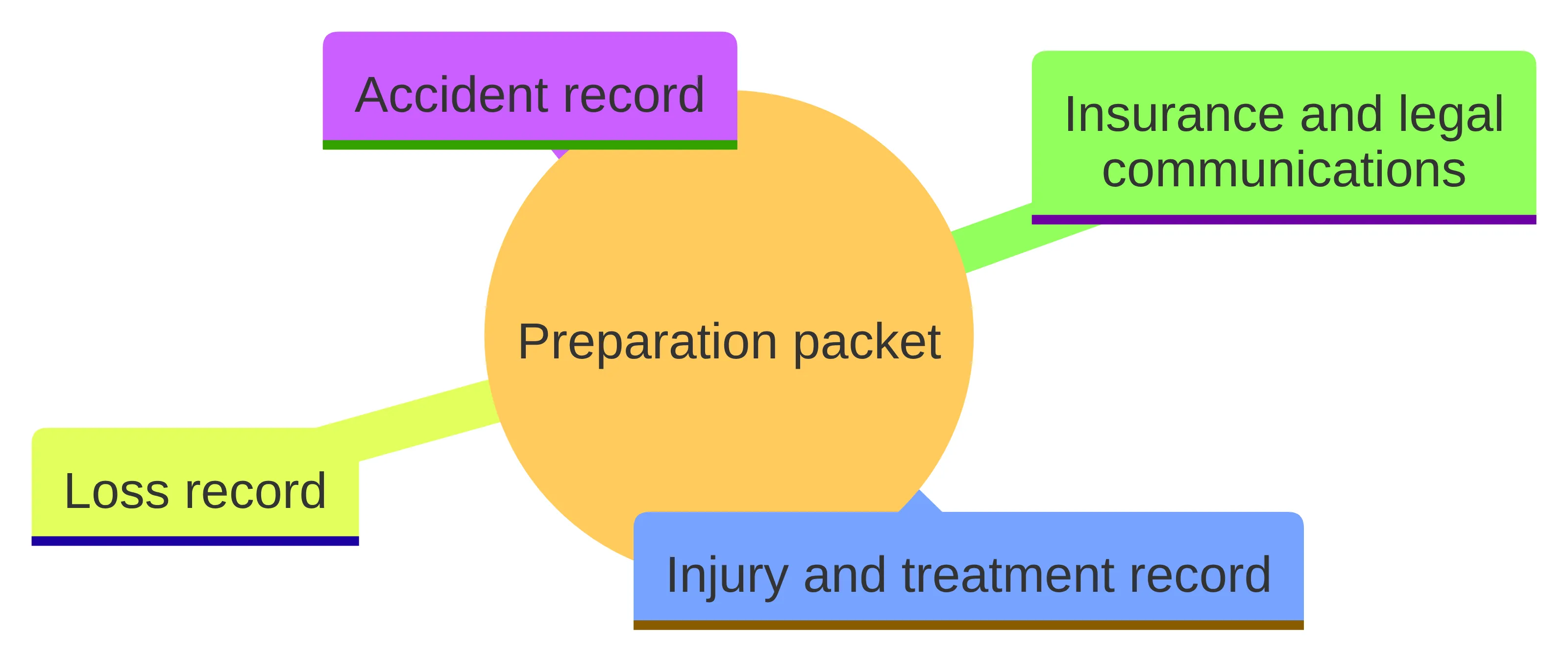
Build the packet in four sections:
- Accident record: Write the date and location, your sequence of events, the people or vehicles involved, witness details, photographs, reports, and any messages about what occurred. Separate what you directly remember from what someone else told you.
- Injury and treatment record: List symptoms or injuries you have reported, appointments, providers, examinations, hospital or medical bills, prescriptions or treatment instructions, and changes to ordinary activities. Keep copies of records and bills in date order.
- Loss record: List missed work, wage information, vehicle or personal-property repair expenses, medical bills, hospital bills, examination costs, and other out-of-pocket expenses connected to the accident. Keep the amount and document together.
- Insurance and legal communications: Save policy information, claim numbers, adjuster messages, letters, requests for statements, settlement offers, releases, and notices with dates. Record what response is requested and by when.
The Ledger Law Firm describes economic damages as potentially including medical, hospital, and examination bills, personal-property repair expenses, and accident-related lost wages. Those are categories to organize, not a decision that any particular item is recoverable.
Use a simple index at the front of the packet. Write the document name, date, category, and one sentence explaining why it may matter. Flag gaps such as a missing report, an unpaid bill, an unknown witness, or an insurer communication you do not understand.
The index lets you tell a lawyer what you have and what you still need. It also prevents one dramatic document from replacing the larger record. Keep the original files, save copies, and bring the questions created by the gaps.
Record losses without deciding what is recoverable
Loss records should describe what the accident cost you without deciding the legal answer in advance. Medical bills, hospital bills, examination costs, personal-property repair expenses, and accident-related lost wages are examples of economic losses. Medical bills and lost wages are also examples of economic damages in the cited accident guidance, while pain and suffering is described as an example of a non-economic damage.
Those categories do not establish that a particular expense can be recovered in your situation. Record the item, date, amount, source, and connection you believe it has to the accident, then let a direct legal review address the applicable questions.
Use separate lists for different kinds of impact:
- Treatment expenses: Keep bills, statements, examination costs, hospital charges, and other payment records together. Note whether an amount is paid, outstanding, disputed, or covered by another source.
- Work and income: Record dates missed, the work effect you experienced, wage information, and any employer correspondence you have. Do not estimate a final loss when you can preserve the underlying document instead.
- Property: Keep photographs, repair estimates, invoices, receipts, and information about damaged personal property. Identify which item each document concerns.
- Daily effects: Write dated notes about changes to ordinary activities, appointments, or responsibilities. Treat these notes as your account of what happened, not as a legal conclusion.
- Non-economic effects: Record the pain, distress, or disruption you want to discuss, using your own words and dates. A description is not a determination of value.
A dated list helps connect the accident to the consequence you are describing. It also gives the lawyer a way to ask focused follow-up questions.
Do not discard small expenses because they seem less significant than a hospital bill. Keep the receipt, note why the expense arose, and place it in the correct category. At the same time, do not add an expense merely because it might sound relevant; preserve what you can identify and explain.
A clean loss record gives you a factual starting point. It does not promise compensation, set a settlement value, or replace a case-specific assessment.
Preserve insurer communications and ask about the next response
Insurance communications can create a separate unresolved problem after an accident. Save every letter, email, text message, claim notice, request for a recorded statement, release, and settlement offer with the date received. Write down the sender, the response requested, and the date mentioned in the communication.
The cited Tarrant County guidance advises considering a consultation with a lawyer who handles car-accident cases in your jurisdiction before speaking with an insurer or accepting a first settlement offer. That recommendation is not a direction to ignore a communication. It is a reason to preserve the communication and ask what it requires before you respond.
Use a communication log with five columns:
- Date received: Record when the message reached you.
- Sender: Identify the insurer, adjuster, opposing party, representative, or other sender.
- Request: Describe what the sender wants, such as documents, a statement, a signature, or a response.
- Your record: Link the message to the saved file or photograph.
- Question: Write what you do not understand or what you want a lawyer to review.
Do not summarize away the original language. A short paraphrase can hide a condition, a requested release, or a deadline. Keep the original and place your notes beside it.
Ask a prospective lawyer how the insurance issue would fit into the review. The Ledger Law Firm says we have experience handling both first-party and third-party claims in auto-accident cases, and we can help address insurance difficulties when pursuing compensation to which you may be legally entitled. Those statements describe our auto-accident experience and the type of issue we address; they do not determine what coverage, responsibility, or compensation applies to your case.
Bring the full communication trail to the conversation. A single offer or request may make more sense when read with the earlier claim notice, policy information, accident account, and records of loss.
Use the first conversation to test communication and scope
The first conversation is an opportunity to clarify the review’s scope, any information still needed, and the next decision. Use the same questions with each prospective lawyer so that you compare the substance of the answers rather than the warmth of an introduction or the appearance of an office.
Then connect those questions to your own problem: the accident record, injury and treatment information, financial effects, property damage, or insurance communication.
Use this conversation checklist:
- What part of my account needs clarification?
- Which records would you examine first?
- What facts would affect the next step?
- What information should I preserve or obtain?
- What question can this initial review answer, and what question would remain open?
- Who would explain the next step to me?
- How would updates be handled during the process?
- What agreement would define the relationship if we continue?
The questions are designed to expose scope. A response that identifies the records and decision points gives you something concrete to consider. A response that moves directly to an outcome without discussing the underlying information leaves the central problem unresolved.
Communication should remain understandable after the first call. That is our description of client communication, not a promise about the result of a case.
Before you choose representation, write down what you understood about the proposed review, the next decision, the records still needed, and the person who will communicate with you. If those points are unclear, ask the lawyer to explain them in plain language.
Clarify fees and consultation terms before choosing representation
Fee questions belong in the first conversation because different lawyers and referral services can use different arrangements. Ask whether the initial conversation has a charge, when a fee agreement would begin, what the agreement covers, which costs may arise, and when payment would be expected. Ask for an explanation you can understand before deciding whether to continue.
The cited Texas State Bar referral service says its referred lawyer provides up to a 30-minute consultation for no more than $20, and it says that later fees are determined by an agreement between the client and lawyer. Those terms belong to that referral service and should not be applied to another lawyer or firm. The same service says its participating attorneys do not offer free or reduced-fee legal assistance through that service.
Put fee questions beside the service questions in your notes:
- Is the initial consultation free or charged?
- If there is a charge, what time or service does it cover?
- When would a written fee agreement be provided?
- What work would the agreement include?
- Which case costs are separate from legal fees?
- When would you receive an explanation of those costs?
- What happens if you decide not to continue after the initial conversation?
Do not compare a free or low-cost consultation with a fee agreement as though they were the same service. A consultation may be a limited conversation, while representation involves terms that should be explained in a written agreement.
A clear fee discussion gives you a decision point before you provide more information or sign an agreement. Keep your questions factual and ask the lawyer to identify any term you do not understand. Record the answer next to the name of the lawyer and the date of the conversation so that you can compare the arrangements accurately.
The purpose of this step is clarity, not a ranking of fee structures. Choose only after you understand the proposed scope and the terms that would govern the relationship.
Keep deadlines and local rules open for direct verification
Filing deadlines and local rules depend on the jurisdiction and circumstances, so do not carry a time limit from one location into another. Record where the accident occurred, when it happened, and which parties or insurers are involved. Take those details to a lawyer who can address the law that applies to your matter.
For Tarrant County, Texas, the cited source says you typically have two years from a car accident to file a claim or lawsuit. The same claim is date-sensitive and should be confirmed with a qualified attorney before you rely on it. That Tarrant County statement is not a nationwide deadline and does not determine your filing period.
Use a jurisdiction checklist before contacting a lawyer:
- Record the location of the accident as precisely as you can.
- Record the accident date and preserve documents that show when events occurred.
- Identify the people, businesses, insurers, or other parties connected to the matter.
- Mark every deadline or response date appearing in a communication.
- Ask which local rule or deadline should be addressed first.
- Write down what the lawyer says still needs direct review.
This checklist helps you raise timing questions without guessing at the answer. A date in an insurer’s letter, for example, may concern a response to that communication rather than the legal deadline for a claim. Preserve the letter and ask what each date means.
Do not postpone a legal conversation merely because your packet is incomplete. Send or bring the information you have, identify the missing items, and explain the dates that concern you. A lawyer can tell you what needs attention first after reviewing the relevant facts and jurisdiction.
Your task at this stage is to preserve timing information and ask a focused question. It is not to select a legal deadline from a general article.
Separate Ledger Law’s stated service information from general guidance
The Ledger Law Firm offers free evaluations of potential Fresno personal-injury accident cases, and we offer evaluations of California personal-injury accident cases at no cost. Those are our firm-specific service terms for the California contexts described above. They do not establish that every accident case qualifies, that every location has the same process, or that an evaluation predicts an outcome.
If your matter is in California, use the accident account, injury and loss records, and insurance communications you organized to explain what you want reviewed. If your matter is elsewhere in the United States, identify the location and ask what service information applies to that matter rather than assuming that the California description answers it.
Our auto-accident work includes interviewing witnesses and obtaining their official statements. We also have experience handling both first-party and third-party claims in auto-accident cases. If insurance is giving you a hard time, we can help address the issues involved in pursuing compensation to which you may be legally entitled.
Those points describe the areas we identify for auto-accident matters. They do not decide responsibility, establish coverage, or promise that a particular record, witness, or recovery will exist. Bring the specific problem you want reviewed so the conversation can stay tied to your accident.
Ask who would explain decisions about your matter and what information you should keep available.
The purpose of separating firm information from general guidance is practical. General checklists help you prepare; firm-specific information tells you which topics to raise with us. Neither replaces a direct review of your facts.
Use the information you organized to request an initial evaluation
Your organized information can now support a focused decision about whether to contact a lawyer. Bring the accident account, treatment and injury records, loss list, and insurance log, then identify the one unresolved question you want addressed first. Ask about similar case experience, personal-injury focus, relevant local courts, review scope, communication, and fee terms before deciding how to proceed.
General website information is not a substitute for advice from a qualified attorney and does not, by itself, create an attorney-client relationship. A qualified attorney must assess the facts, applicable law, and individual suitability for your matter. Use the conversation to understand what remains open and what direct legal work would address it; do not treat general information as an individualized claim assessment.
A practical next-step test is simple:
- If an insurer’s request, a disputed account, an injury record, a financial loss, or a local deadline remains unclear, put that issue at the top of your notes.
- If your information is incomplete, label the gaps instead of filling them with guesses.
- If a lawyer’s answers connect your accident, records, jurisdiction, and next decision, write down the proposed scope and terms.
- If the conversation does not address the problem you brought, continue asking focused questions before choosing representation.
Your decision should come from the unresolved issue and the information available to examine, not from proximity alone. Keep the packet, communication log, and question list together for the next conversation.
A direct case evaluation can give you a place to discuss the accident, injuries, losses, insurance communications, and timing questions in the same conversation. Prepare what you know, identify what you do not know, and let the resulting discussion determine which question needs attention next.
What should you confirm before relying on a nearby accident lawyer?
What should I prepare before contacting an accident lawyer?
Gather information in four categories: the accident details, your injury and treatment records, financial losses, and any insurance or legal communications. This preparation will help you provide a clear account of your situation.
How can I evaluate nearby accident lawyers beyond their location?
Consider asking about their experience with cases similar to yours, whether they focus on personal injury law, and if they have handled cases in the relevant local courts. This will help you assess their fit for your specific legal needs.
What types of damages can I claim after an accident?
You may be entitled to economic damages such as medical bills and lost wages, as well as non-economic damages like pain and suffering. However, the specifics depend on your situation and should be discussed with a lawyer.
What questions should I ask during my initial consultation with a lawyer?
Inquire about their experience with similar cases, the scope of the review they would conduct, how they communicate updates, and the terms of their fee agreement. This will help you understand their approach and whether it aligns with your needs.
What should I do if I receive a settlement offer from an insurance company?
Before accepting any settlement offer, consider consulting with a lawyer who handles accident cases.

Emery Brett Ledger brings 28+ years of experience to personal injury law. He founded & led The Ledger Law Firm in securing over $100 million in compensation for clients with life-altering injuries & complex claims. Prior results do not guarantee a similar outcome. Licensed in California, Texas, & Washington, Emery earned his law degree from Pepperdine University School of Law. His practice areas include car & truck accidents, wrongful death, catastrophic injuries, maritime claims, & mass tort litigation. He has been recognized by The National Trial Lawyers’ Top 100, Mass Tort Trial Lawyers Top 25, and America’s Top 100 Personal Injury Attorneys. Emery also received the 2025 Elite Lawyer Award & holds a perfect 10.0 Avvo rating with Platinum Client Champion status. His legal work has been featured on CNN, Forbes, NBC, & ABC.
Free Case Evaluation
Recent Posts
- What Is a Legal Tort After a Car Accident? Understanding Claims, Negligence, and Next Steps
- Tort Law and Slip-and-Fall Injuries: How to Decide Whether to Seek a Case Evaluation
- Tort Lawyer for a Slip and Fall: How to Decide Whether to Seek Help and Prepare for a Case Evaluation
- Suing After a Car Accident: How to Compare Your Options, Evidence, Timing, and Costs
- How to Settle a Car Accident Claim Without a Lawyer
Emery Brett Ledger brings 28+ years of experience to personal injury law. He founded & led The Ledger Law Firm in securing over $100 million in compensation for clients with life-altering injuries & complex claims. Prior results do not guarantee a similar outcome. Licensed in California, Texas, & Washington, Emery earned his law degree from Pepperdine University School of Law. His practice areas include car & truck accidents, wrongful death, catastrophic injuries, maritime claims, & mass tort litigation. He has been recognized by The National Trial Lawyers’ Top 100, Mass Tort Trial Lawyers Top 25, and America’s Top 100 Personal Injury Attorneys. Emery also received the 2025 Elite Lawyer Award & holds a perfect 10.0 Avvo rating with Platinum Client Champion status. His legal work has been featured on CNN, Forbes, NBC, & ABC.