How can a Dallas lawyer investigate a hit-and-run injury?

A Dallas lawyer can investigate a hit-and-run injury in 2026 by tracing witnesses and video, examining crash evidence, and checking insurance coverage when the driver remains unidentified. The investigation must connect the collision to your injuries; identifying a vehicle alone does not establish who drove it, who caused the crash, or which insurance applies.
- Dallas car accident lawyer hit and run investigations connect crash evidence, driver identification, injury records, and insurance coverage.
- Preserve original video, witness details, photographs, and medical records before evidence becomes harder to obtain.
- An unidentified driver does not automatically eliminate an injury claim; Texas uninsured motorist coverage requires policy-specific review.
- The Ledger Law Firm represents injured people; a case evaluation can address evidence gaps and possible insurance claims.
Why this matters
After a hit-and-run, you face separate problems: getting treatment, establishing what happened, and finding a potential source of compensation. A police report helps document the incident, but it does not replace medical evidence or an insurance investigation.
The most useful investigation pursues evidence and coverage together. Waiting to identify the driver before examining your own policy leaves an important question unanswered. Before a case evaluation, organize the documents listed in this Dallas car accident lawyer consultation guide.
This article addresses injury claims in Dallas, Texas. California and Washington have different rules; advice for Newport Beach or Seattle should not be treated as Texas legal guidance.
How can a Dallas lawyer investigate a hit-and-run injury?
A Dallas lawyer builds the investigation around evidence that answers specific questions: what happened, who was involved, what injuries resulted, and what coverage applies. Each lead needs corroboration rather than an assumption that a partial plate or vehicle description identifies the responsible driver.
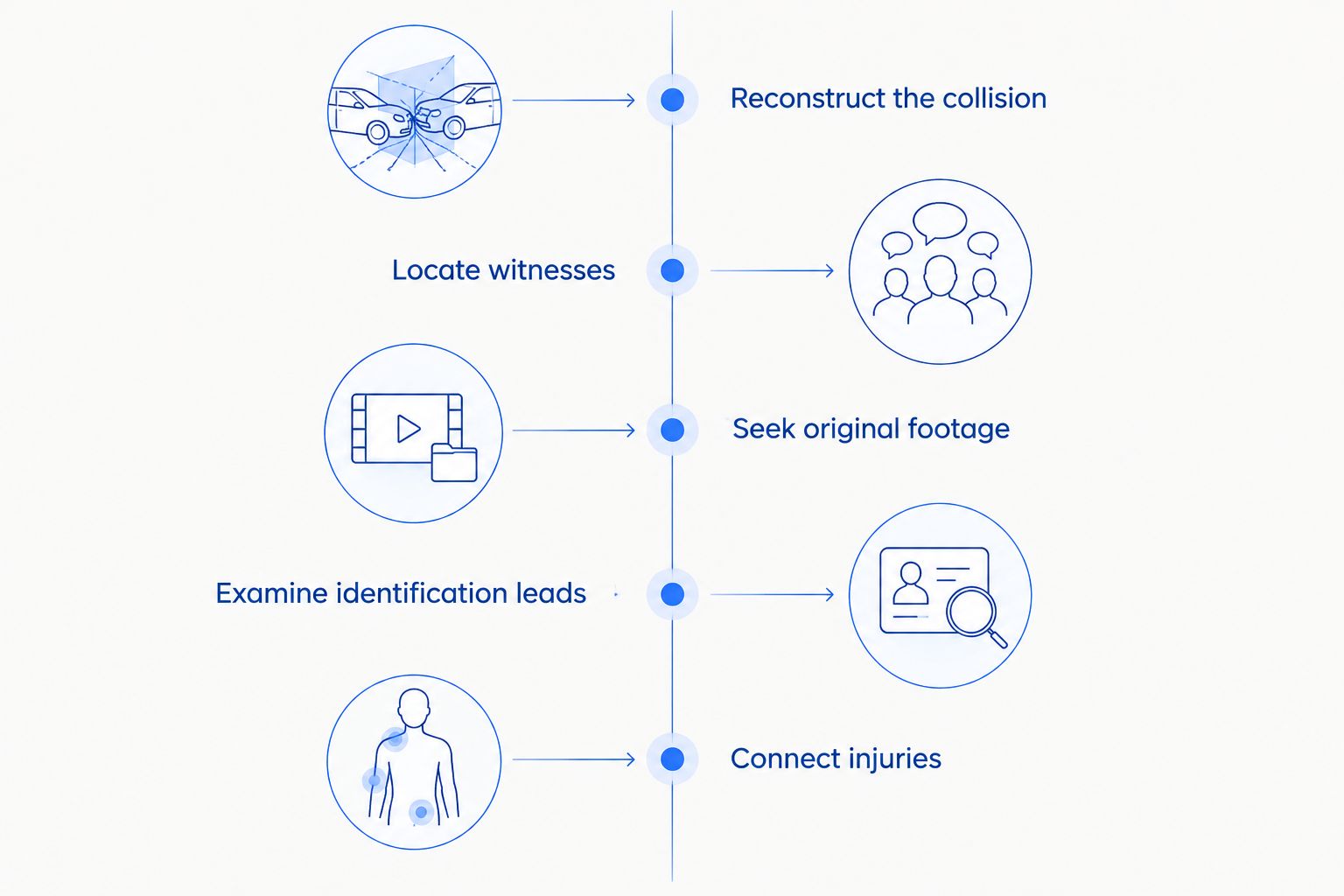
1. Reconstruct the collision
Your lawyer reviews the location, direction of travel, impact points, photographs, and your account of the collision. Vehicle damage and debris can help test whether the physical evidence matches the reported sequence.
Describe what you actually observed. Keep a clear distinction between seeing a driver leave and later learning that a nearby vehicle matched a description.
2. Locate witnesses
Witnesses can provide information about the vehicle, the driver's actions, and the direction of departure. A passenger, pedestrian, nearby worker, or another motorist might have observed a different part of the event.
Your lawyer can compare those accounts and seek contact details for follow-up. An uncertain recollection should stay uncertain; turning a guess into a definite statement damages the investigation.
3. Seek original footage
Nearby businesses, homes, parking facilities, and passing vehicles are potential sources of footage. Your lawyer can identify likely camera locations and request preservation of relevant recordings.
A preservation request is not a guarantee that footage exists or will be released. Access can require permission or legal process, and a camera aimed at the road does not establish that it recorded the collision.
4. Examine identification leads
A partial license plate, distinctive damage, vehicle markings, or a witness description can narrow an inquiry. Your lawyer can organize those details and provide relevant information to the investigating agency.
A vehicle owner is not automatically the driver. Establishing the connection between a vehicle, its operator, and the collision remains a separate task.
5. Connect injuries and coverage
Medical records, treatment recommendations, work restrictions, and wage documentation help establish the injury claim. Insurance review proceeds alongside that work, including an examination of uninsured motorist provisions when relevant.
The Ledger Law Firm represents people injured in car accidents, including people seeking help after a hit-and-run. A case evaluation can identify which evidence and coverage questions need attention first.
What evidence should you preserve after a Dallas hit-and-run?
Preserve original material rather than relying only on summaries. A photograph of a screen or a cropped clip can leave out context that the underlying file contains.
Keep these materials together for your 2026 case evaluation:
- Crash details: Date, time, location, direction of travel, and your account of what happened.
- Photographs and recordings: Original files showing damage, debris, road conditions, and relevant surroundings.
- Witness information: Names, contact details, and the observations each person shared.
- Police information: Report or incident number, agency name, and investigator contact information you received.
- Medical documentation: Visit summaries, treatment instructions, prescriptions, and follow-up recommendations.
- Financial records: Injury-related bills, receipts, missed-work records, and employer documentation.
Do not enter private property, confront a suspected driver, or put yourself in traffic to collect evidence. Tell your lawyer where a lead came from and preserve any messages associated with it.
If pain, dizziness, or other symptoms develop after the collision, seek medical attention and explain when the symptoms began. Accurate treatment histories matter more than trying to make every symptom fit a single narrative.
What happens if the driver is identified or remains unknown?
The investigation changes depending on what the evidence establishes. Identifying the driver opens questions about liability and that driver's insurance; an unresolved identity places greater emphasis on other potentially applicable coverage.
For a Dallas injury claim in 2026, these are different investigative paths—not promises of payment.
| Investigative path | Best for answering | Main advantage | Main limitation |
|---|---|---|---|
| Identified-driver investigation | Who drove and what coverage applies? | Allows direct examination of the driver's responsibility and insurance | Identification does not prove fault or establish available coverage |
| Unidentified-driver coverage review | Does your own policy address this collision? | Examines a possible claim without first identifying the driver | Policy terms, exclusions, and Texas requirements still apply |
| Injury documentation | What harm did the collision cause? | Connects treatment, work disruption, and other losses to the claim | Medical records do not independently identify the driver or prove fault |
If the driver is identified
Your lawyer can examine the driver's account, available insurance information, and evidence of responsibility. Depending on the facts, the investigation can also examine whether the driver was working at the time.
Employment alone does not establish an employer's liability. That question requires evidence about the relationship and the circumstances of the trip.
If the driver remains unidentified
Your lawyer should review the actual policy rather than assume that a hit-and-run is covered. Declarations, endorsements, exclusions, and reporting provisions all matter.
Texas law addresses actual physical contact in uninsured motorist claims when the owner or operator is unknown. A collision involving an unidentified vehicle and a no-contact evasive maneuver require different analysis; describe exactly what made contact with what.
The Dallas uninsured-crash guide explains the related coverage questions to raise during a case evaluation.
Why a hit-and-run investigation varies
The strength of an investigation depends on the evidence available and the questions that evidence answers. A large collection of photographs does not replace a missing link between the collision and the alleged driver.
- Witness observations: A witness who saw the impact answers different questions from someone who saw only the departure.
- Camera coverage: Camera position, image quality, and the existence of a recording determine its usefulness.
- Identification detail: A full plate and clear vehicle description provide different leads from a color alone.
- Physical contact: Contact evidence matters when evaluating an unidentified-vehicle uninsured motorist claim under Texas law.
- Medical history: Treatment records must distinguish collision-related injuries from other conditions without concealing either.
- Policy language: Applicable coverage depends on the contract and governing law, not simply the label “hit-and-run.”
Ask what each piece of evidence proves—and what it does not. This keeps the investigation focused on the disputed issues rather than the volume of paperwork.
What Texas deadlines and fault rules matter in 2026?
Texas law generally provides a 2-year limitations period for personal injury lawsuits. Exceptions and different requirements can affect a particular claim, so do not use that general rule as your personal filing deadline.
An insurance notice requirement is also different from a lawsuit deadline. Have a lawyer review both promptly; time spent searching for a driver should not be treated as an automatic extension.
Texas law bars recovery under its proportionate-responsibility rule when a claimant's responsibility is greater than 50%. Under that rule, 51% responsibility crosses the recovery bar; responsibility at or below the threshold can still affect damages under Texas law.
A fleeing driver does not automatically resolve the fault question. Preserve evidence of the collision itself, including lane positions, traffic controls, and witness observations, rather than relying only on the driver's departure.
These statutory references explain the general Texas framework for a 2026 injury claim. A lawyer must assess the applicable provisions, exceptions, policy terms, and facts before advising you about your case.
Can a lawyer obtain nearby surveillance footage?
A lawyer can request that a camera owner preserve and provide relevant footage, then evaluate whether legal process is appropriate. The request should identify the location and time window clearly enough for the owner to locate the recording.
Give your lawyer the business name or location even if staff initially decline to help. Do not assume a refusal means the recording has been deleted.
Does the police investigation replace your injury claim?
No. Police investigate the incident for law-enforcement purposes, while an injury claim addresses responsibility, injuries, losses, and applicable insurance.
Give your lawyer the report information and any investigator updates. Correct factual errors through the appropriate process rather than editing a report yourself or asking witnesses to change their accounts.
What should you ask during a case evaluation?
Ask which leads need immediate attention, which policies need review, and what documents would help establish your injuries. Bring the insurance policy if you have it, not just an insurance card.
This guide is for injured people considering personal injury representation, not property-damage-only guidance. An investigation can clarify a claim, but no lawyer can guarantee identification of the driver or a recovery.
Prepare for a Dallas case evaluation
Organize your crash records, medical documents, and insurance information before discussing your injury claim.
FAQ
Can a Dallas car accident lawyer help if I only remember part of the license plate?
Yes. A partial plate can support an investigation when combined with vehicle details, witness accounts, or footage, but it does not establish the driver’s identity by itself.
Can I pursue an injury claim if the hit-and-run driver is never found?
An injury claim can remain possible through applicable coverage even if the driver is never found. A lawyer must review your policy, the collision facts, and Texas requirements before determining whether coverage applies.
Does Texas require physical contact for an unknown-driver uninsured motorist claim?
Texas law addresses an actual-physical-contact requirement when the owner or operator is unknown. Tell your lawyer precisely which vehicles or objects made contact so the facts can be evaluated.
How long do I have to file a Texas hit-and-run injury lawsuit?
Texas generally applies a 2-year limitations period to personal injury lawsuits under Texas law. Exceptions, different requirements, and separate insurance notice provisions require case-specific review.
Should I wait for the police to identify the driver before calling a lawyer?
No. Evidence preservation, injury documentation, and insurance review can begin while the police investigation continues. Waiting does not automatically extend a legal deadline.
Does leaving the scene prove the other driver caused the crash?
No. Leaving the scene does not independently establish who caused the collision. Photographs, recordings, witness accounts, and other evidence still matter to the fault analysis.
One last thing
The recording that shows the departure might not show the impact. Tell your lawyer about cameras along the driver's departure route as well as those facing the crash location, and explain which direction the vehicle traveled.
For a 2026 case evaluation with The Ledger Law Firm, bring an honest list of what you know, what you suspect, and what you still need answered. That distinction gives the investigation a useful starting point without turning uncertainty into a claim of fact.
For the firm’s Dallas office address and its attorneys licensed in Texas, see the Dallas personal injury attorney page.
Related guides
- What an injured passenger can claim after a Seattle crash — Washington
- Medical records for a Newport Beach car accident claim — California

Emery Brett Ledger brings 28+ years of experience to personal injury law. Licensed in California, Texas, & Washington, Emery earned his law degree from Pepperdine University School of Law. His practice areas include car & truck accidents, wrongful death, catastrophic injuries, maritime claims, & mass tort litigation. He has been recognized by The National Trial Lawyers’ Top 100, Mass Tort Trial Lawyers Top 25, and America’s Top 100 Personal Injury Attorneys. Emery also received the 2025 Elite Lawyer Award & holds a perfect 10.0 Avvo rating with Platinum Client Champion status. His legal work has been featured on CNN, Forbes, NBC, & ABC.
Free Case Evaluation
Recent Posts
- What Is a Legal Tort After a Car Accident? Understanding Claims, Negligence, and Next Steps
- Tort Law and Slip-and-Fall Injuries: How to Decide Whether to Seek a Case Evaluation
- Tort Lawyer for a Slip and Fall: How to Decide Whether to Seek Help and Prepare for a Case Evaluation
- Suing After a Car Accident: How to Compare Your Options, Evidence, Timing, and Costs
- How to Settle a Car Accident Claim Without a Lawyer
Emery Brett Ledger brings 28+ years of experience to personal injury law. Licensed in California, Texas, & Washington, Emery earned his law degree from Pepperdine University School of Law. His practice areas include car & truck accidents, wrongful death, catastrophic injuries, maritime claims, & mass tort litigation. He has been recognized by The National Trial Lawyers’ Top 100, Mass Tort Trial Lawyers Top 25, and America’s Top 100 Personal Injury Attorneys. Emery also received the 2025 Elite Lawyer Award & holds a perfect 10.0 Avvo rating with Platinum Client Champion status. His legal work has been featured on CNN, Forbes, NBC, & ABC.