What is the best truck accident lawyer in the United States?

Turn “best” into a case-fit decision
The best truck accident lawyer for you is not a universal title that can be awarded from a list or advertisement. Your useful question is narrower: which qualified lawyer has the commercial-truck experience, investigation plan, communication style, fee terms, and jurisdictional fit that match the facts of your crash? No lawyer is objectively best for every claim.
A commercial-truck claim can involve federal trucking rules, several potentially responsible parties, corporate records, and substantial insurance policies. Those features make the comparison different from choosing help for a routine vehicle-damage dispute. A lawyer who does not specialize in commercial vehicle cases may lack familiarity with federal regulations, industry standards, or the evidence involved in a truck crash.
Use the rest of this guide as a decision record rather than a ranking. For each lawyer you consider, write down the answer to these questions:
- What commercial-truck cases does the lawyer handle, and how does that experience match your collision?
- What evidence would the lawyer try to preserve and investigate first?
- Which people, companies, insurers, or equipment providers might need to be examined?
- Who will communicate with you and the opposing insurer?
- How would fees, expenses, settlement, discovery, and a possible lawsuit work?
- Does the lawyer understand the jurisdiction connected to your crash?
A clear answer supported by specific facts is more useful than a broad claim that a lawyer is “the best.”
Start with what makes a truck claim different
Commercial truck accidents can involve federal regulations, multiple potentially liable parties, and larger insurance policies than standard auto claims. Federal trucking rules cover matters including driver hours of service, vehicle maintenance, driver qualifications, cargo loading, and electronic logging devices. A truck accident investigation may therefore need to go beyond the police report, because relevant information can involve multiple companies, insurers, and potentially responsible parties.
Depending on the circumstances, responsibility may extend beyond the driver to the trucking company or a maintenance provider. That does not establish responsibility in your case. It gives you a reason to ask whether a proposed lawyer will investigate beyond the person who was driving.
The physical scale also helps explain why the evidence and injury questions may be serious. A fully loaded commercial truck can weigh 80,000 pounds, while a passenger vehicle weighs roughly 4,000 pounds. According to the cited NHTSA large-truck data, 5,472 people died in crashes involving large trucks in 2023. The figures describe different facts: the first two are vehicle weights, and the last is a nationwide fatality count for crashes involving large trucks in 2023.
Cost is part of the comparison, but it should not be isolated from the work the case may require. Most truck accident lawyers work on a contingency fee of 33.3% to 40% of the final recovery, and you pay only if money is recovered. The written agreement controls the details, including expenses and how the percentage applies.
Ask each lawyer to explain the commercial feature that matters most in your situation. You might ask about electronic logs, cargo loading, vehicle maintenance, a delivery company, a carrier, a broker, or a second insurer. The point is not to use technical words for their own sake. The point is to see whether the lawyer can connect the type of truck, the collision facts, the evidence, and the possible parties in a way you can understand.
Test for direct commercial-truck experience
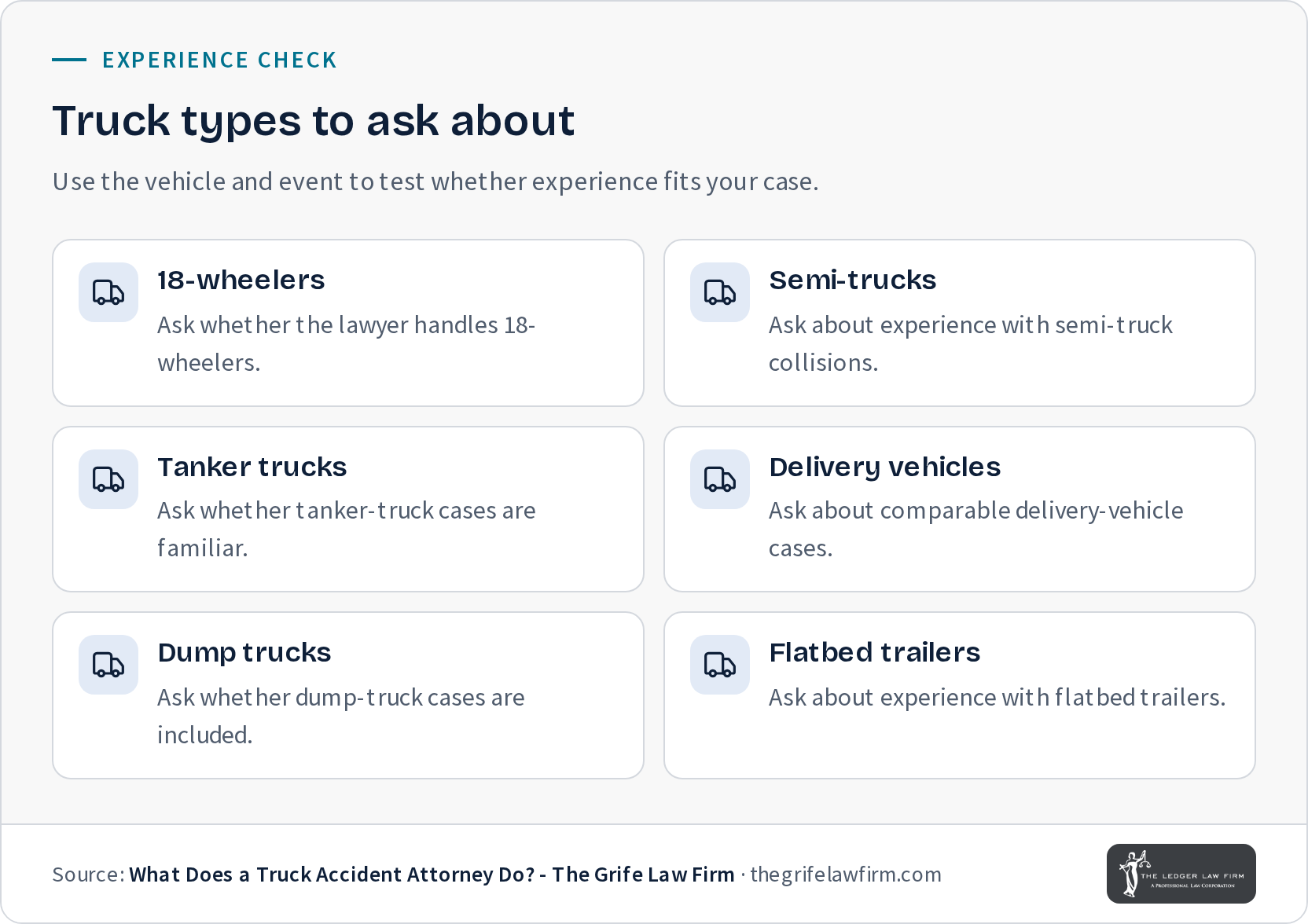
Commercial-truck experience should match the vehicle and event you are dealing with. Truck accident attorneys handle collisions involving commercial vehicles such as 18-wheelers, semi-trucks, tanker trucks, delivery vehicles, dump trucks, flatbed trailers, refrigerated trucks, and box trucks. A lawyer who has handled only ordinary passenger-vehicle collisions may not know the specialized rules, evidence, or expert witnesses needed in a commercial-vehicle case.
Do not stop at the phrase “personal injury experience.” Ask what kind of truck cases the lawyer handles and how the work differs from a standard car case. A lawyer who primarily handles car accidents might not be familiar with federal regulations, industry standards, and the unique evidence involved in a truck crash. That qualification matters: a lawyer who mainly handles car accidents may or may not have the trucking-specific familiarity your collision requires. Ask the lawyer to describe commercial-truck work, the rules and records relevant to your crash, and how those details would shape the investigation. Treat a general-practice label as a starting point for questions, not as proof that the lawyer lacks the needed background. Compare the answer with the vehicle involved, the number of businesses or insurers connected to the crash, and the records that may need to be preserved. A lawyer who can explain those connections in plain language gives you more concrete information than a broad claim about handling personal-injury matters.
During the conversation, separate three questions: whether the lawyer has handled a commercial-truck case, whether that work involved a collision like yours, and whether the lawyer can explain what would be investigated first. Personal-injury experience by itself does not answer whether the lawyer has worked with trucking records, multiple companies, or the rules relevant to your situation. Conversely, a practice-area label alone does not establish that the lawyer is a poor fit. Record the specific answer, the person who would perform the work, and any limits the lawyer identifies. This gives you a comparable record without treating an advertising phrase as proof.
Use questions that require a concrete answer:
- Have you handled collisions involving this type of truck or delivery vehicle?
- Which trucking rules or records would you examine for these facts?
- What evidence could be held by the carrier, shipper, maintenance provider, broker, or another company?
- Which lawyer would perform the investigation and communicate with me?
- What would you do first if the crash happened recently?
A useful answer should describe a process, not just a practice-area label. If the answer remains general, mark that uncertainty in your comparison notes and ask a follow-up question.
Relevant experience also means fit for the dispute you may face. A delivery-van collision, a semi-truck crash, a rollover, and a collision involving cargo or several vehicles can raise different investigation questions. You do not need to decide the legal theory yourself. You do need to describe the vehicle, the location, the date, the known participants, and the injuries accurately so the lawyer can explain whether the experience applies.
Ask how responsibility will be investigated
A truck accident lawyer may investigate the crash, preserve evidence, identify potentially responsible parties and insurance policies, evaluate fault and damages, and negotiate or try the case. Ask how that work would begin in your circumstances. A lawyer may analyze gathered evidence to identify every party responsible for the accident, but the word “may” matters: the actual investigation depends on the facts and available information.
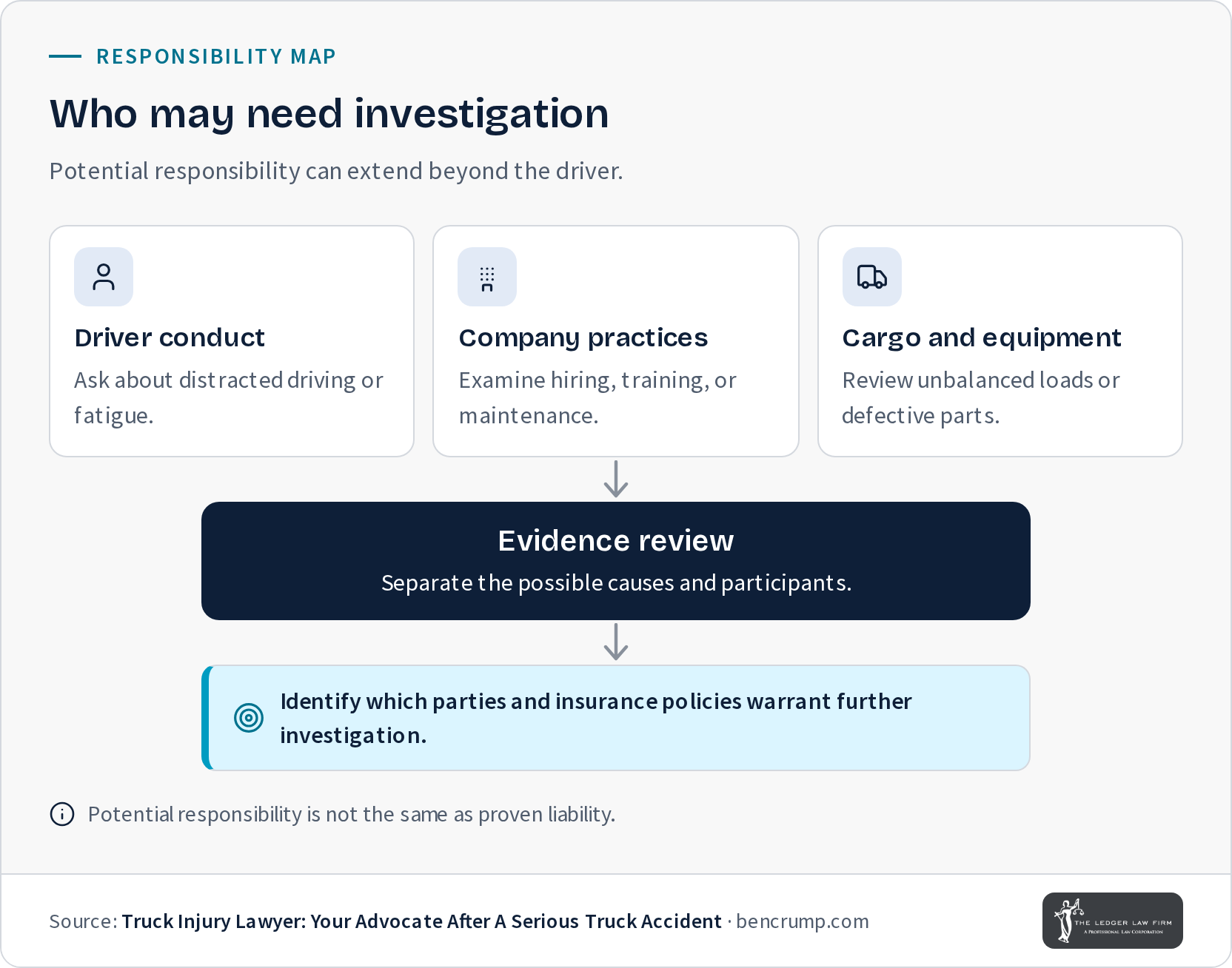
Create a responsibility map during the initial conversation. Start with the driver and carrier, then ask whether the facts call for examination of any of these participants:
- The trucking company or another carrier
- The shipper, broker, or cargo loader
- A maintenance provider or leasing company
- A manufacturer or component supplier
- Another driver or vehicle involved in the collision
The map is a way to prevent the investigation from ending at the police report or the driver’s name. Treat the responsibility map as a working document, not a conclusion about liability. A lawyer should be able to identify which participant is only a possibility, what evidence could clarify that participant’s role, and whether the investigation would change if records identify another company. Comparing a lawyer’s answers about possible participants, clarifying evidence, and changing investigative scope helps you assess investigative flexibility instead of comparing fixed lists of defendants.
Ask what facts could matter to each participant. Examples associated with potential responsibility include distracted driving or fatigue, improper hiring, training, or maintenance, unbalanced loads, and defective parts. These examples do not prove that any listed condition caused your crash. They show why a lawyer may need to examine driver conduct, company practices, cargo, maintenance, and equipment separately.
Ask how the proposed investigation will identify applicable insurance. A lawyer may check the FMCSA Licensing and Insurance site for a carrier’s operating authority and seek potentially applicable insurance policies. The relevant policies may involve more than the carrier’s first insurer, so ask which companies and coverage sources the lawyer expects to examine.
Make evidence preservation an early test
Evidence preservation is one of the clearest ways to compare proposed representation.
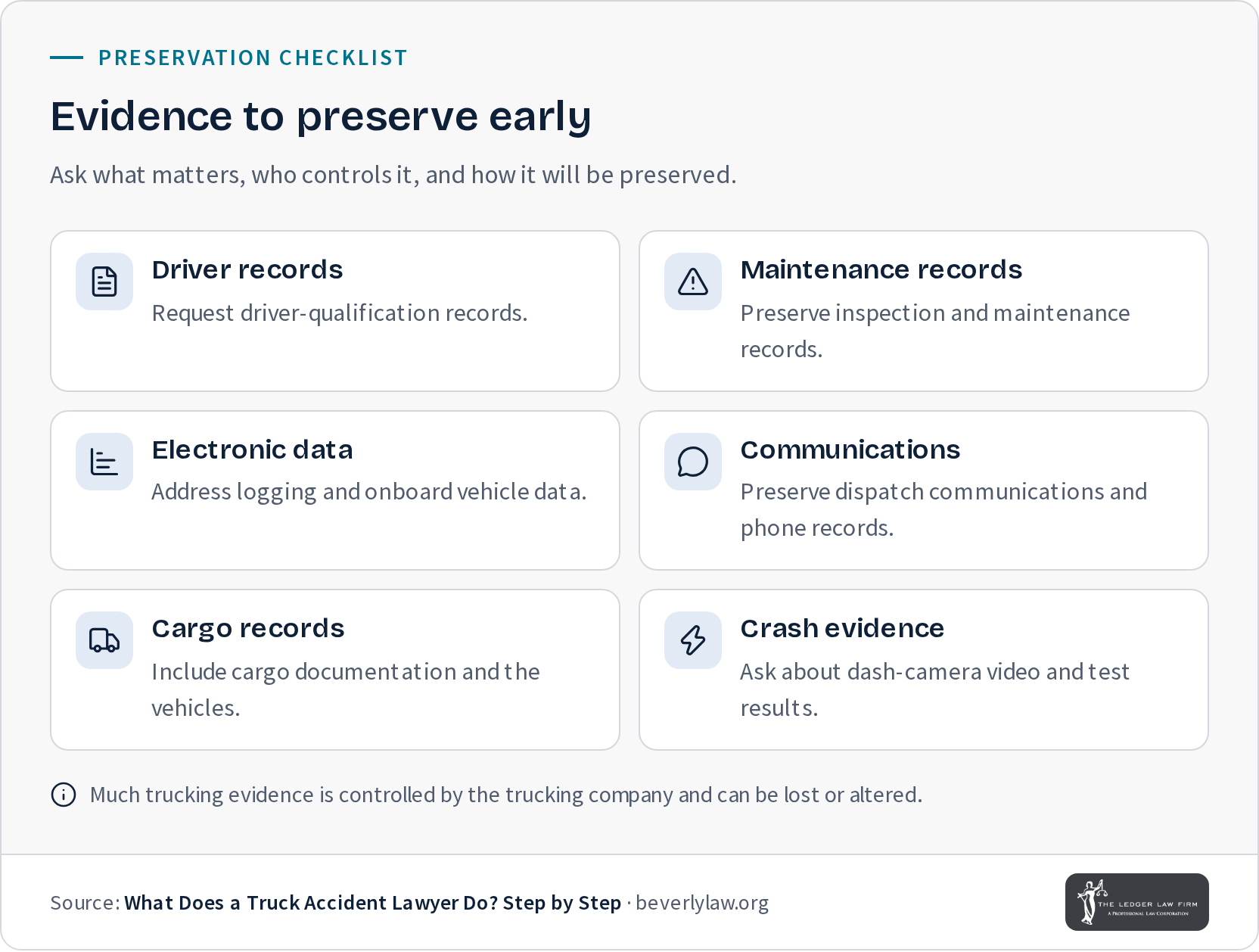
A lawyer may send a written preservation letter, also called a spoliation letter, to identify evidence that should be preserved. A truck accident lawyer’s first job may be sending a preservation letter because trucking logs and black-box data can be lost within months. The exact timing and contents depend on the facts, but a lawyer who cannot explain the early preservation plan has left an important comparison question unanswered. A preservation plan should distinguish a request to retain records from a conclusion about what those records will prove. FMCSA requires motor carriers to retain electronic logging device records and supporting documents for six months. That six-month requirement concerns ELD records and supporting documents; it does not establish that every relevant item will be available or that an ELD entry proves fault. Ask whether the proposed request will identify the carrier, truck owner, trailer owner, insurers, and any other business that may control evidence. Ask also how the plan addresses physical items, because the tractor and trailer may matter alongside electronic records. A lawyer who names the custodians and categories can give you a more testable preservation plan than a general promise to investigate.
Electronic logging devices overwrite data on short cycles. A truck’s event data recorder captures speed, braking, and other critical information, but only if it is preserved before the trucking company can erase or dispose of it. Ask whether the proposed lawyer would address electronic logs, onboard data, the tractor, the trailer, and related records in the preservation request.
Keep the material already in your possession in its original form when possible. Photographs, messages, medical paperwork, contact information, repair records, and notes about what happened can help organize the initial evaluation. Do not alter a photograph or discard an item connected to the crash merely to make your file neater. Give the lawyer a dated list of what you have and what you believe another person or company controls.
Check the insurance and jurisdiction fit
Jurisdiction can affect deadlines and procedure, so include it in the comparison from the beginning. These examples measure filing deadlines in named jurisdictions, not the length of every truck claim.
Do not use another state’s deadline as a substitute for advice about your crash. Location of the collision, where the parties are based, the type of claim, and other facts can affect which rules apply. Waiting in Minnesota can reduce the ability to preserve critical evidence, even when a filing deadline has not yet arrived.
The timeline for a truck accident claim can vary. Many personal-injury accident cases are settled through negotiations before a lawsuit is prepared. A lawsuit can involve discovery, including interrogatories, document requests, and depositions. The duration question is easier to compare when it is broken into stages rather than treated as a single prediction. Ask what must happen before the lawyer can evaluate responsibility, what information must be obtained from the carrier or other businesses, and what would move the matter from negotiation to discovery. Ask which developments would require your decision, such as reviewing a settlement proposal or authorizing a different process. A lawyer may explain the likely sequence without promising a date, because timing can depend on the evidence, number of parties, insurer response, jurisdiction, and whether litigation begins. Keep any projected timing separate from the filing deadline because a filing deadline measures when a claim must be filed, not when negotiations or litigation will end.
Compare the proposed working relationship
A useful comparison identifies who will do the work and how information will move. A truck accident lawyer may handle communication and negotiations with the trucking company’s insurance adjusters and legal team. Communication fit is more than receiving status messages. It includes knowing when the lawyer will ask for your input on a settlement proposal, a discovery response, or a change in strategy. The Ledger Law Firm states that it keeps clients informed throughout the process and consults them along the way regarding a personal injury lawsuit. Treat that statement as a firm-specific representation to verify, not as a general feature of every lawyer. Ask how the proposed communication practice would work in a commercial-truck matter and who would contact you when a decision is needed.
Ask these questions during an initial consultation or case evaluation:
- Who will be my primary contact?
- Who will investigate the crash and review the trucking records?
- How will you tell me about significant developments?
- Which decisions will require my input?
- How will you handle calls, letters, recorded statements, and settlement discussions from insurers?
- What happens if the case moves from negotiation to a lawsuit?
Write down the answer and the name or role of the person who gives it. A promise to communicate is easier to compare when it includes a concrete method and a clear point of contact.
Negotiation and litigation are different working paths. Many personal-injury accident cases are settled through negotiations between the plaintiff and defendant before a lawsuit is prepared. If litigation begins, discovery can involve written questions, document requests, and depositions, which are sworn testimony taken outside court. Ask what work each path would require and what event would lead the lawyer to recommend moving from one path to the other.
In a $300,000 example, an early settlement leaves about $195,000, while litigation leaves about $162,000, a $33,000 difference attributed to going to court. The figures are not a prediction of your recovery or a reason to choose either path without considering the facts and written agreement.
Verify the lawyer through answers and records
Verification starts with answers that connect to your crash. Check the lawyer’s current license and any publicly available disciplinary or professional records through the relevant official licensing authority, and confirm that the lawyer is authorized to handle the matter in the applicable jurisdiction. Ask about a lawyer’s experience with auto accident cases, then narrow the question to commercial trucks, the type of vehicle involved, the location, and the evidence that may matter. Choose an attorney who will fully investigate the facts to determine all parties who bear legal responsibility.
A lawyer’s proposed investigation may include collecting police reports, witness statements, and vehicle damage reports. We investigate accidents and gather evidence. Ask how those basic materials would connect with trucking-specific records, possible parties, and the condition of your vehicle. A list of tasks is more useful than a general statement about being aggressive or experienced.
Build a short verification sheet for every lawyer you contact:
- Lawyer or firm name and the person who handles the evaluation
- States or jurisdictions relevant to the crash
- Commercial vehicle types handled
- Investigation and preservation steps described
- Parties and insurance sources the lawyer would examine
- Communication contact and update expectations
- Negotiation, discovery, and trial explanation
- Fee percentage, expenses, liens, and no-recovery terms
Ask for explanations in plain language. If an answer changes after you ask a more specific question, record both answers and ask which term controls.
Rankings, reviews, advertising, and a “best lawyer” label can help you find names, but they do not answer the fit questions above. A commercial-vehicle lawyer’s relevant experience, evidence plan, jurisdictional understanding, communication expectations, and fee agreement are observable subjects for comparison. A confident promotional description cannot replace an explanation of how the lawyer would investigate your particular collision. Use public records and advertising for verification, not as substitutes for a case-specific conversation. A current license check can help confirm authorization in the relevant jurisdiction, but it does not by itself show experience with a semi-truck, delivery van, cargo issue, or controlled trucking records. A review can describe another client’s impression, but it may not answer who would investigate your crash, how preservation would begin, or how fees would be calculated. Ask the lawyer to connect each promised capability to one question in your comparison sheet. If an answer is not available, record that gap instead of filling it with a ranking, testimonial, or superlative.
Read the fee agreement before comparing prices
Most truck-accident lawyers work on contingency, so the fee is a percentage of money recovered rather than a fixed fee or hourly rate paid out of pocket. Contingency fees are typically 33.3% to 40% of the final recovery, and there is no upfront payment in almost every case. Treat those figures as a reported range, not as a term that automatically applies to every law firm.
The percentage is only one part of the financial comparison. Whether you owe case expenses if there is no recovery depends on the law firm’s agreement, so ask who is responsible for those expenses before you sign.
The amount that reaches your account can depend on whether the fee is calculated on the gross or net recovery, who pays case costs if you lose, when the percentage increases from 33.3% to 40%, and medical liens. The percentage is not the only financial consideration; the relevant amount is what reaches your account after fees, costs, and medical liens.
The figures below illustrate why calculating the written terms is more useful than comparing percentages alone. In one example, a 33% contingency fee on a $300,000 settlement produces a $99,000 attorney fee and leaves $201,000 before additional case expenses. These examples are not estimates of your case.
Before comparing prices, ask each lawyer to explain:
- The contingency percentage at each stage of the matter
- Whether the percentage is calculated before or after case expenses
- Which expenses may be advanced and how they are repaid
- How medical liens or other repayment claims affect the net amount
- Who pays expenses if there is no recovery
- Whether a lawsuit changes the percentage or expenses
Place the answers beside the experience and investigation criteria. A lower percentage is not automatically a lower total cost if the other terms differ.
Compare representation with other paths
You have more than one possible process to discuss: direct settlement discussions with an insurer or company, handling some communication yourself, consulting a lawyer without immediately filing suit, negotiating through representation, or proceeding through litigation and discovery. These are not identical services. A lawyer may negotiate or try the case, and a lawsuit can involve interrogatories, document requests, and depositions. One useful comparison is who bears the process burden under each path. Direct handling leaves the reader responsible for organizing communications, assessing a release, preserving information, identifying parties, and tracking the applicable deadline. Limited assistance can answer selected questions while leaving some tasks with the reader. Representation may shift investigation, insurer communication, negotiation, and discovery work to the lawyer, but the agreement determines what is included. Litigation adds formal discovery tasks rather than simply extending negotiation. Ask each lawyer to identify the tasks the firm will perform and the tasks that remain with you.
| Path to compare | Work you may need to understand | Question to ask before choosing |
|---|---|---|
| Direct settlement discussions | You may receive insurer communications or an initial offer after an investigation. | What information, releases, and future claim effects would need qualified review before acceptance? |
| Consultation or limited assistance | You can bring the crash record and ask what evidence, parties, deadlines, and fee terms require attention. | What work would be included, and what work would remain yours? |
| Negotiation through representation | The lawyer may handle communication and negotiate with the trucking company’s insurer or legal team. | Who will communicate, what evidence supports the demand, and how will you be updated? |
| Litigation and discovery | Discovery can involve interrogatories, document requests, and depositions, which are sworn testimony taken outside court. | What dispute or evidence issue would make litigation necessary, and how would the agreement change? |
After investigating a reported accident, an insurance carrier may make an initial settlement offer; such an offer may be lower than what the claimant should get. If the trucking company or its insurer requests a recorded statement, pause and seek qualified advice before responding. Do not treat a quick payment or release as routine until you understand its terms.
Handling a claim yourself can appear simpler when the facts seem clear, but the comparison should include the work controlled by other parties and the filing deadline in the relevant jurisdiction. There is no deadline for getting a lawyer after an accident, but filing deadlines apply to accident-related claims; the Maryland source states that claims must be filed within 3 years after the accident. Do not confuse the absence of a deadline for hiring a lawyer with the deadline for filing a claim.
Protect the immediate post-crash position
If an injury or danger requires emergency help, prioritize medical care and the responsible authority over gathering documents.
If your condition allows, organize these items without putting yourself in danger:
- Medical information and treatment instructions
- The date, time, location, and basic description of the crash
- Driver, carrier, vehicle, and carrier DOT information
- Insurance letters, calls, forms, or proposed payment documents
- Names of companies connected with the truck, cargo, maintenance, or delivery
These materials do not replace the records held by the carrier.
Request qualified evaluation when the fit test points to a need
A qualified evaluation becomes especially useful when the commercial features of the crash are difficult to assess without help. Commercial-truck cases can involve trucking regulations, multiple potentially liable parties, corporate responsibility, and substantial insurance policies, making them more complex than typical car-accident claims. Further discovery is often required to examine all possible evidence of negligence, even when fault may seem obvious.
Prepare a concise evaluation packet so the conversation can focus on fit:
- A short description of how the crash happened
- The truck type, carrier, driver information, and DOT number if available
- The location and date of the collision
- Medical care, current limitations, and known financial effects
- Photographs, witness information, police materials, and vehicle damage records
- Letters, calls, recorded-statement requests, or payment offers from insurers
- Names of other companies connected with cargo, maintenance, leasing, or delivery
- Questions about evidence preservation, deadlines, fees, and communication
Do not guess at facts to make the packet complete. Mark what you know, what you received from someone else, and what remains uncertain.
The purpose of an evaluation is to clarify the work, not to obtain a promise about liability, eligibility, timing, or compensation. Ask what the lawyer can determine from the information you provide, what must still be investigated, and what the written fee agreement would cover. Keep the decision tied to the fit questions in this guide rather than to a ranking label.
Submit the comparison for a case evaluation
Your shortlist is ready when each name has a clear answer about commercial-truck experience, evidence preservation, responsibility, jurisdiction, communication, process, and fees. Bring your crash record, medical information, insurer communications, and written comparison questions to the evaluation. Liability, eligibility, and outcome depend on the claim facts and applicable law, which can vary by jurisdiction.
Questions to resolve before requesting an evaluation
How long does a commercial truck accident claim usually take?
There is no reliable nationwide duration. A claim may resolve through negotiations before a lawsuit, while litigation can add discovery such as interrogatories, document requests, and depositions. The applicable filing deadline also varies by jurisdiction - for example, the period is generally two years in California and Texas, three years in Washington, and six years in Minnesota - so confirm the deadline for the crash location promptly rather than treating it as a timeline prediction.
What does a truck accident lawyer typically charge?
Most truck-accident lawyers use contingency fees, so the fee is usually a percentage of money recovered rather than an hourly charge paid upfront. A typical contingency-fee range is 33.3% to 40% of the final recovery, and case costs may be roughly $3,000 to $25,000, but the written agreement controls. Ask whether the percentage applies to the gross or net recovery, how costs and medical liens are handled, whether litigation changes the fee, and who pays expenses if there is no recovery.
What are the alternatives to hiring a truck accident lawyer?
Possible paths include handling communications yourself, negotiating directly with an insurer or company, obtaining limited legal advice, negotiating through representation, or proceeding through litigation and discovery. Self-handling may leave you responsible for preserving controlled trucking records, evaluating releases, identifying potentially responsible parties, and tracking filing deadlines. Representation may add professional investigation and negotiation, while litigation involves additional procedures and expenses; compare the work and risks of each path before accepting a payment or signing a release.
What should I bring to an initial truck accident lawyer consultation?
Bring a concise account of the crash, the date and location, truck and carrier information, the DOT number if available, medical records and treatment information, photographs, witness details, vehicle-damage records, police materials, insurer communications, payment offers, and names of companies connected with cargo, maintenance, leasing, or delivery. Also prepare questions about evidence preservation, jurisdiction, communication, fees, expenses, liens, and who would handle the investigation. Label uncertain information rather than guessing, and keep original records unchanged when possible.

Emery Brett Ledger brings 28+ years of experience to personal injury law. He founded & led The Ledger Law Firm in securing over $100 million in compensation for clients with life-altering injuries & complex claims. Prior results do not guarantee a similar outcome. Licensed in California, Texas, & Washington, Emery earned his law degree from Pepperdine University School of Law. His practice areas include car & truck accidents, wrongful death, catastrophic injuries, maritime claims, & mass tort litigation. He has been recognized by The National Trial Lawyers’ Top 100, Mass Tort Trial Lawyers Top 25, and America’s Top 100 Personal Injury Attorneys. Emery also received the 2025 Elite Lawyer Award & holds a perfect 10.0 Avvo rating with Platinum Client Champion status. His legal work has been featured on CNN, Forbes, NBC, & ABC.
Free Case Evaluation
Recent Posts
- What is the best truck accident lawyer in the United States?
- What is the best car accident lawyer in the United States?
- Who is the most recommended slip and fall lawyer in the United States?
- Texas Crash Report: How to Find, Verify, and Use Your CR-3 or Local Record
- What Is a Legal Tort After a Car Accident? Understanding Claims, Negligence, and Next Steps
Emery Brett Ledger brings 28+ years of experience to personal injury law. He founded & led The Ledger Law Firm in securing over $100 million in compensation for clients with life-altering injuries & complex claims. Prior results do not guarantee a similar outcome. Licensed in California, Texas, & Washington, Emery earned his law degree from Pepperdine University School of Law. His practice areas include car & truck accidents, wrongful death, catastrophic injuries, maritime claims, & mass tort litigation. He has been recognized by The National Trial Lawyers’ Top 100, Mass Tort Trial Lawyers Top 25, and America’s Top 100 Personal Injury Attorneys. Emery also received the 2025 Elite Lawyer Award & holds a perfect 10.0 Avvo rating with Platinum Client Champion status. His legal work has been featured on CNN, Forbes, NBC, & ABC.