The Ledger Law Firm for a Truck Accident: Deciding Whether to Request an Evaluation
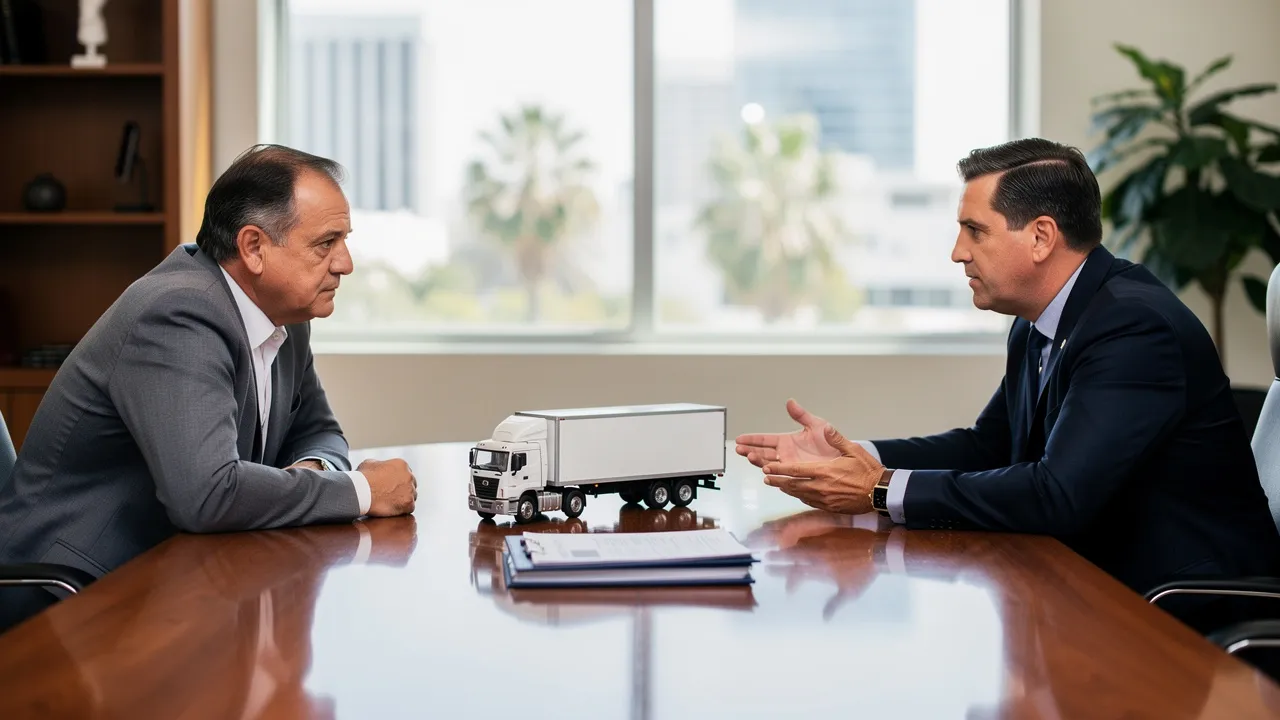
The firm states it handles truck-accident claims in California
We offer truck accident legal services in California. That gives you a concrete starting point if your crash involved a truck and the matter is connected to California.
A service description is not a decision about your particular claim. It does not establish that we can take every matter, determine what happened in your crash, or promise a result. Your next decision is whether the stated location and type of service seem relevant, then what you need to clarify before deciding whether to contact us.
Keep those questions separate. The first is about scope: does your matter involve a truck, and is California relevant to it? The second is about fit: can the firm consider your particular circumstances? The third is about working together: what would be examined, how communication would work, and what the written agreement would cover? An evaluation may be a way to raise those questions; it is not a guarantee of a particular answer.
If your situation does not clearly match the stated location or truck-accident scope, treat that as a question to ask rather than assuming the service applies. If it does appear relevant, the sections below can help you identify the practical points you may want addressed.
Which injury matters are listed, and what truck coverage is confirmed?
For a truck-accident matter in California, our stated service is truck accident legal services. That is the specific scope you can use as your starting point.
The listed matters use several different kinds of labels. Car, truck and 18-wheeler, and motorcycle accidents name vehicles; pedestrian and rideshare crashes point to other crash circumstances; slip-and-fall cases and dog bites name incident types; wrongful death and mass tort claims are also included. These entries are not accompanied by definitions or criteria for deciding how an individual incident should be categorized. They are not described as mutually exclusive, and the list does not explain how to classify a situation involving more than one vehicle or circumstance. The broader list does not specify the locations where those other services are available.. If no phrase matches neatly, a plain description of what happened is still clearer than forcing it into a label.
The vehicle descriptions are separately named: truck and 18-wheeler appear alongside cars and motorcycles. The list does not define the boundaries between those terms, so an unfamiliar vehicle does not have to be assigned a label before asking whether it fits the firm’s work. Similarly, pedestrian and rideshare appear as listed crash types, without an explanation of how they might overlap with vehicle descriptions. When several phrases seem relevant, the list provides no rule for choosing among them. Treat the terms as a broad overview of the kinds of matters named, not as a classification system for individual incidents.
You can make the question concrete without trying to decide the legal issues yourself. Describe the kind of vehicle involved and where the crash occurred, then ask whether those facts fit the firm’s truck-accident work. If the location or vehicle category is not straightforward, say so plainly. You do not need to force an uncertain situation into a category before asking.
To compare the listed matters with your situation, keep three details distinct: what happened, what vehicle or circumstances were involved, and where the matter is connected. These are plain-language descriptions, not a legal classification exercise; the firm’s list gives no definitions or test for an individual incident. Separating them can show which part of the comparison is clear and which remains a question. For example, an event may involve a truck while the location falls outside California, or it may resemble a listed rideshare crash while the particular vehicle category remains uncertain. Those examples do not establish how the firm would treat the matter. If your account appears to overlap categories, describe both aspects rather than choosing one on the firm’s behalf. If none fits, that alone does not show whether the firm handles or excludes it. The list is a broad starting point, not a resolution of individual fit. Naming the incident, vehicle or circumstances, and location separately can help frame a focused question about how your facts relate to the firm’s work. The supplied business profile also lists car accidents, truck and 18-wheeler accidents, motorcycle accidents, pedestrian and rideshare crashes, slip-and-fall cases, dog bites, wrongful death, and mass tort claims. This broader list identifies other matters associated with the firm; it does not expand the specifically confirmed California truck-service statement or establish coverage for every location or claim. If your incident falls outside the truck example, ask whether the firm handles that particular matter.
Check how the lawyer would approach the facts of your crash
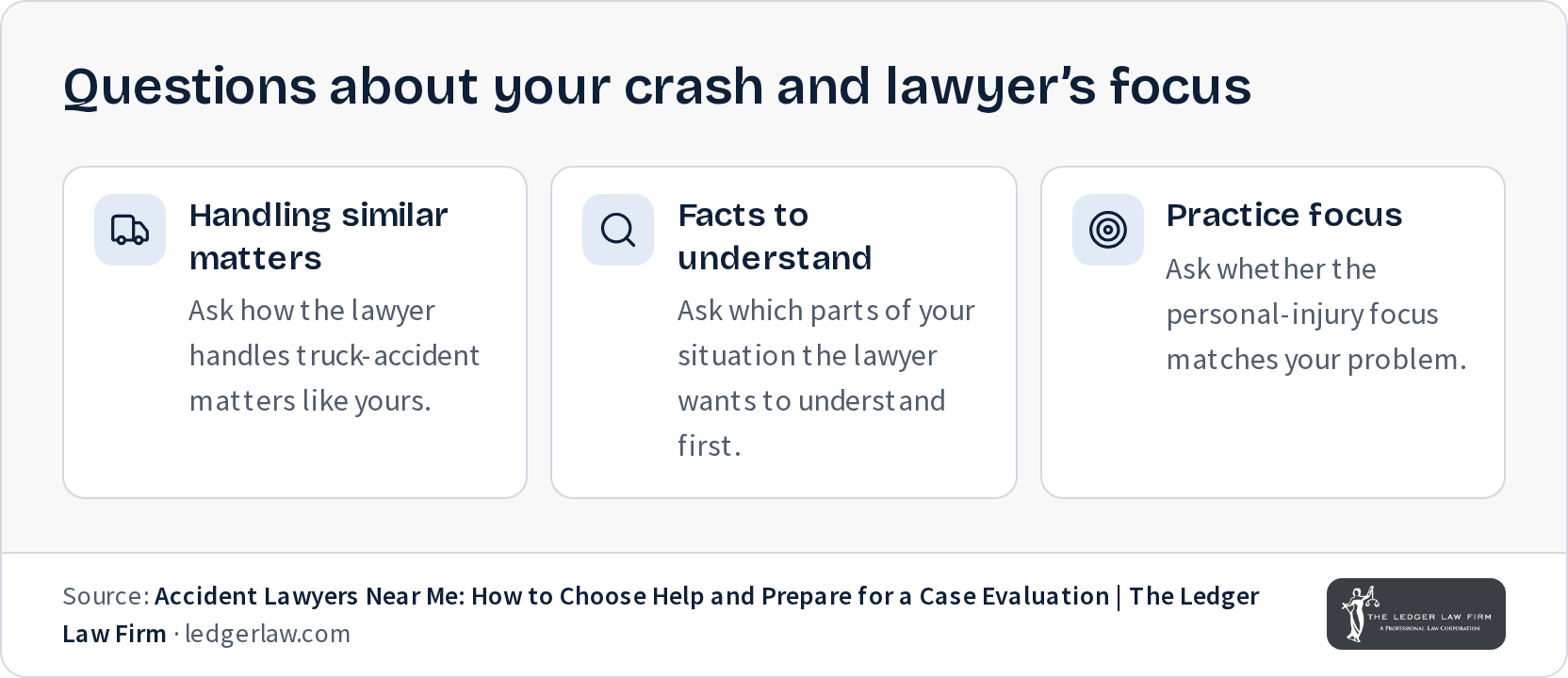
Your crash facts are a more useful starting point than a broad practice label. Different kinds of accidents can produce different records and questions; car accidents, bicycle crashes, and slip-and-fall incidents, for example, may not raise the same issues. Ask how the lawyer handles accidents like yours and whether their experience matches the facts you can describe.
You can keep the conversation focused with a few direct questions:
- “How do you handle truck-accident matters like mine?”
- “Which parts of my situation would you want to understand first?”
- “Does your personal-injury practice focus match the problem I am bringing to you?”
Listen for whether the response addresses your actual situation rather than relying only on a general description of practice areas. A broad label does not show how much of a lawyer’s work concerns accident cases. You can ask what the lawyer’s focus means for the kind of problem you have, then consider whether the answer is specific enough to help you decide what to do next.
You do not need to assess the lawyer’s entire practice from one conversation. The practical goal is narrower: learn whether the lawyer can explain how your kind of crash relates to the work they do. If the answer stays general, ask one follow-up about your facts. If you still cannot tell whether the practice focus fits, treat that as an unresolved point rather than assuming a match.
This is a way to compare relevance, not to predict a result. A useful answer can help you understand what the lawyer would want to discuss; it cannot, on its own, determine whether your claim will be accepted or what it may be worth. Location can be a separate fit question from the type of crash. Ask whether the lawyer has handled cases in courts relevant to your matter and understands their procedures; a nearby office address alone does not establish that experience. This can clarify what the lawyer’s location does—and does not—tell you about the relevant court setting.
Ask what the first conversation would examine
The first conversation can be easier to assess when you know what it is meant to cover. Ask whether it will examine your account of the accident, witness information, treatment records, losses, insurance communications, or another defined issue.
You can start with a simple question: “What would you want to understand about my crash during the first conversation?” Then listen for the topics named and whether they connect to the reason you are seeking help. If your main concern is an insurance dispute, for example, ask whether that communication will be part of the discussion. If you have questions about treatment records or losses, ask whether those topics will be covered too.
You are not expected to arrive with a complete case theory. The point of asking about the conversation’s scope is to understand what you can raise and what the discussion is intended to examine. You can note the subjects you want to ask about before speaking so that you do not have to remember every concern at once.
A clear scope also helps you distinguish an initial discussion from a final decision about your matter. If a topic you consider important is not included, ask whether it can be addressed and what the next step would be. If the conversation is limited to particular questions, keep that boundary in mind when deciding what you still need to learn.
Use the answer to judge whether the planned discussion addresses your immediate questions. Do not assume that a subject will be investigated or resolved simply because it is relevant to you; ask whether it will be examined.
Clarify the contingency-fee statement and written agreement
We work on a contingency-fee basis for truck-accident cases. The specific terms of any written agreement are a separate question, so ask what the agreement would cover before deciding whether to enter into a lawyer-client relationship.
Two questions give you a practical place to begin:
- “When would the lawyer-client relationship begin?”
- “What does the written agreement cover?”
Keep the general fee description distinct from the terms that would apply to your matter. The statement that we work on a contingency-fee basis does not spell out an individual agreement. Do not assume details that have not been explained to you. Ask for the agreement’s scope and make sure you understand what it says before you decide whether to proceed.
You can also ask who will explain the terms if a clause is unclear. The purpose is not to negotiate from a guess or to infer costs from the phrase “contingency fee”; it is to understand the document you are being asked to consider. If you need time to read it, ask when a decision is expected and what happens next. Those questions help you separate the firm’s general fee arrangement from the written terms in front of you.
The agreement and the timing of the relationship matter to your decision, so seek direct answers about both. If you cannot explain to yourself what the agreement covers, pause before treating the general description as a substitute for its specific terms.
Find out how communication and next steps would work
Communication is another part of deciding whether the working relationship would suit you. Ask how you would receive updates and who would explain the next step.
You might ask:
- “How will I receive updates?”
- “Who will explain what happens next?”
- “If I have a question after our conversation, whom should I contact?”
The first two questions help you understand the basic communication plan. The third can clarify where to direct a question, if that point is not already clear. Consider whether the answers are specific enough for you to know what to expect from the working relationship. A vague answer is a reason to ask for clarification, not a reason to guess how communication will work.
Your own needs can guide what you ask. If you prefer a particular way of receiving updates, raise that preference and ask whether it can be accommodated. If you want to know who will explain decisions or next steps, ask directly. You are trying to understand the communication arrangement, not to infer it from a general promise to keep you informed.
Write down any answer you want to compare with the agreement or revisit later. If you still do not know who will communicate with you or how you will learn about the next step, leave that as an open question before deciding whether the relationship fits.
The evaluation form is identified, but its access instructions are not
The case-evaluation form asks for your name, phone, email, and a description. Those fields let you identify yourself and put your concern into your own words; they do not themselves establish that a claim will be accepted or that a particular result is available.
Before you fill in the description, you can make a short note of the points you want to raise: that the matter involves a truck crash, the location, and the question you most want answered. Keep the account accurate and focused on what you want to discuss. You do not need to use legal terminology or reach a conclusion about responsibility in order to describe your concern.
The form’s URL and submission instructions are not provided. Keep those questions for the discussion itself. If you are not ready to submit, you can use the list in this guide to decide what you still want clarified before taking that step.
Decide whether the stated scope and open questions justify an evaluation
Your decision can turn on a few concrete points: whether your matter appears connected to our California truck-accident service, whether the first conversation would address the questions you have, and whether the proposed communication and written terms are clear enough for you to consider. We work on a contingency-fee basis for truck-accident cases, but you still need to understand the agreement that would apply to your matter.
If the location or type of crash is uncertain, ask whether it fits the firm’s scope. If you do not know what the first conversation would cover, ask about its focus. If the fee terms or communication plan remain unclear, ask for an explanation before deciding about a lawyer-client relationship. These are practical questions you can raise without assuming that your claim will be accepted or predicting an outcome.
A qualified lawyer can assess whether your individual matter is suitable; this guide cannot decide that for you. The useful next step is to make your decision from the specific scope and answers you receive, rather than treating a general service description as a promise.
Questions to clarify before contacting the firm
What truck-accident services does The Ledger Law Firm offer in California?
The firm states that it offers truck-accident legal services in California. That does not confirm whether a particular crash or vehicle type falls within its work, so describe the vehicle and crash location when asking about fit.
Does the stated truck-accident service confirm coverage for delivery-van or rideshare crashes?
No. The available service description confirms truck-accident work in California but does not specify delivery vans or rideshare crashes. Ask about the vehicle involved rather than assuming those matters are included.
Does the firm’s truck-accident service description establish that it handles other injury claims?
No. The confirmed description is limited to truck-accident legal services in California; it does not establish which other injury matters the firm handles. If your claim involves a different kind of incident, ask whether that specific matter is within scope.

Emery Brett Ledger brings 28+ years of experience to personal injury law. He founded & led The Ledger Law Firm in securing over $100 million in compensation for clients with life-altering injuries & complex claims. Prior results do not guarantee a similar outcome. Licensed in California, Texas, & Washington, Emery earned his law degree from Pepperdine University School of Law. His practice areas include car & truck accidents, wrongful death, catastrophic injuries, maritime claims, & mass tort litigation. He has been recognized by The National Trial Lawyers’ Top 100, Mass Tort Trial Lawyers Top 25, and America’s Top 100 Personal Injury Attorneys. Emery also received the 2025 Elite Lawyer Award & holds a perfect 10.0 Avvo rating with Platinum Client Champion status. His legal work has been featured on CNN, Forbes, NBC, & ABC.
Free Case Evaluation
Recent Posts
- Attorneys for Work Injuries: How to Decide Whether to Contact One and Prepare for an Evaluation
- Injury Attorneys Dallas: How to Decide Whether to Contact a Car Accident Lawyer
- Personal Injury Lawyer Greenville South Carolina: How to Decide Whether to Seek Help After a Slip and Fall
- Lawyers for Wrongful Death: How to Choose One and Prepare for a Case Evaluation
- Injury Attorney in LA: How to Decide Whether to Seek a Case Evaluation After a Crash
Emery Brett Ledger brings 28+ years of experience to personal injury law. He founded & led The Ledger Law Firm in securing over $100 million in compensation for clients with life-altering injuries & complex claims. Prior results do not guarantee a similar outcome. Licensed in California, Texas, & Washington, Emery earned his law degree from Pepperdine University School of Law. His practice areas include car & truck accidents, wrongful death, catastrophic injuries, maritime claims, & mass tort litigation. He has been recognized by The National Trial Lawyers’ Top 100, Mass Tort Trial Lawyers Top 25, and America’s Top 100 Personal Injury Attorneys. Emery also received the 2025 Elite Lawyer Award & holds a perfect 10.0 Avvo rating with Platinum Client Champion status. His legal work has been featured on CNN, Forbes, NBC, & ABC.