

Does Johnson And Johnson Baby Powder Cause Cancer ? Legal Help And Settlements
Key Takeaways:
Key takeaways from Johnson & Johnson’s baby powder and cancer connection:
- Johnson & Johnson sold baby powder made from asbestos-contaminated talcum powder
- The company was aware of asbestos contaminated talc, but they never disclose it publicly or make people aware of it.
- Thousands of people developed asbestos-related cancers through the use of J&J’s baby powder
- Mesothelioma, lung cancer, ovarian, and cervical cancer are all related to Johnson & Johnson’s baby powder
- Users developed cancer even though they were never exposed to asbestos
- A $966 million talc cancer settlement and $700m lawsuit settlement were made in the US while a 1.3B lawsuit has begun in the UK in October, 2025.
For decades, Johnson & Johnson (J&J) sold baby powder to millions of customers and claimed their product was safe. The truth is, their baby powder was never safe because of its source material. Talcum is found in deposits that contain asbestos, a cancer-causing material. Johnson & Johnson has consistently denied their product contained asbestos, but users who never went near asbestos still developed mesothelioma and other cancers. In the case of mesothelioma, it’s a cancer that’s only caused by inhaling asbestos.
Does Johnson and Johnson baby powder cause cancer?
The short answer to the question of “does Johnson and Johnson cause cancer with its talcum powder products?” is yes. The American Cancer Society states that “Talc that has asbestos is generally accepted as being able to cause cancer if it is inhaled.” Talcum powder comes in two forms: with asbestos, and asbestos-free. Indiscriminate mining practices meant that both types of talc made it into baby powder products.
Asbestos is a fibrous and friable material, which means it easily becomes airborne. The dusty nature of asbestos-contaminated talcum powder means that the risk of inhaling asbestos is high, and can lead to mesothelioma and other cancers. It’s one of the major cancer causing agents in Johnson and Johnson product lineup.
What Types of Cancer are Associated With Johnson & Johnson’s Baby Powder?
J&J’s baby powder product is associated with three distinct types of cancers. They include the following types.
Mesothelioma and Johnson & Johnson Baby Powder:
Mesothelioma is a type of cancer that affects the mesothelial layers in the body. These protective barriers surround different organs in the body and protect them. Asbestos fibers lodge themselves into the mesothelioma and start an inflammation cycle that degrades over time.
Lung Cancer and Johnson & Johnson Baby Powder:
Asbestos is inhaled into the lungs and embeds itself into the lung tissue. The asbestos fiber then causes the body to react through inflammation. This type of cancer is also known as asbestosis.
Ovarian Cancer and Johnson Baby Powder:
Women who used baby powder around their genital area were more likely to develop ovarian cancer. It’s worth noting that the correlation has not been fully proven, but there is evidence that the risk of ovarian cancer increased with long-term use of talcum powder.
Why Johnson & Johnson Baby Powder Became a Cancer Risk for Women?
Baby powder is used to wick sweat and water away from the skin, and commonly used after showers. It was also used on sanitary napkins. Women who used baby powder on their genitalia unknowingly introduced asbestos into their reproductive organs. Studies found that women who used talcum powder on their genitalia had talcum powder particles in their fallopian tubes. This led to an estimated increase in risk of 20 to 30% for the development of ovarian cancer.
Besides the women at risk, Johnson & Johnson baby powder also has other complications:
- Ovarian Cancer: Presence of asbestos in J&J powder could iIncrease risk up to 20-30% with long-term genital use.
- Mesothelioma: Inhaling asbestos might cause cancer. It has been alleged to contaminate the talc which J&J were aware of but didn’t warn the users.
- Lung Cancer: Increased risk of lung cancer in talc miners/millers. The incident becomes complicated by potential asbestos and other exposures.
- Respiratory Problems (especially in infants): Infants might suffer from serious respiratory problems from inhalation of talcum powder dust. At worse, it could lead to a respiratory disorder called Talcosis.
- Skin Irritations: Possible for individuals with sensitive skin or existing conditions like eczema.
3 Johnson and Johnson Baby Powder Settlements:
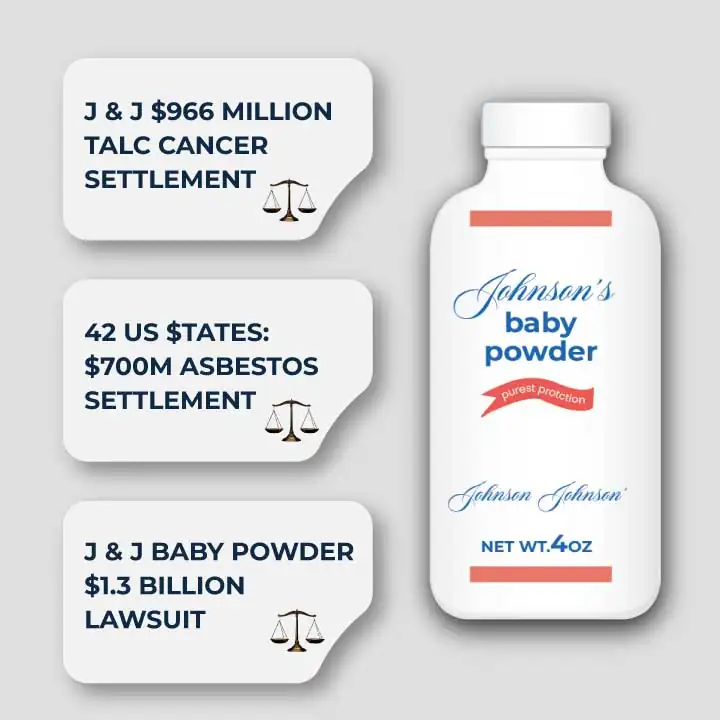
To date, there have been three major settlements related to J&J’s baby powder and cancer. Class action lawsuits and individual personal injury lawsuits are still ongoing, and the most recent settlements have been in the millions of dollars.
1. Johnson & Johnson $966 million talc cancer settlement:
On October 7, 2025, a jury found that Johnson & Johnson was aware of the asbestos presence in its talc powder. Although their researchers found asbestos-contaminated talc, the company never warned the user about it. So, the court found that J&J had failed to maintain its duty of care towards its consumers.
So, they had to pay $966 million to the surviving family of Mae Moore, an 88-year-old woman who died from mesothelioma. She had no other exposure to asbestos outside of her use of J&J’s baby powder.
2. $700m lawsuit settlement to 42 US states for baby powder asbestos:
The District of Columbia and 42 U.S. states settled a lawsuit against Johnson and Johnson for the inclusion of asbestos in its baby powder. The lawsuit alleged that J&J was fully aware of the fact that asbestos was in its product even though the company continues to deny this allegation.
The claimants argued that J&J knew about the asbestos in their baby powder since the 1960s. They even tried to find alternatives to its talc-component but never disclosed the matter publicly to maintain their monopoly in the market.
Their negligence and failure to maintain duty of care, caused thousands of users cancer and other side-effects. Although J&J denied the allegation, claimants submitted credible proofs against them.
3. Johnson and Johnson Baby Powder $1.3B Lawsuit:
In October 2025, a group claim, or a class-action lawsuit, was filed in the U.K. court system totaling over $1.3 billion. The lawsuit has been brought on behalf of 3,000 people, mostly women, who were harmed by J&J’s baby powder. The suit alleges that Johnson & Johnson knew their product contained asbestos and caused ovarian cancer after use.
This lawsuit was largely inspired by the two previous lawsuits in the US against Johnson & Johnson. The company tactfully tried to limit their damage by transferring the ownership to Kenvue, as a separate entity. But, claimants and their attorneys argued that it was an act of misguiding the court.
Legal Help And Attorney for People Exposed to Johnson & Johnson Powder:
Individuals who have suffered from asbestos-related cancers and have used Johnson & Johnson talcum powder can seek compensation for their injuries. Surviving family members can also file a lawsuit against J&J for the loss of their loved one. People used baby powder with the sense they could trust the manufacturer to sell them a safe product. However, Johnson & Johnson failed to do right by their customers and sold a defective, cancer-causing product for decades.
At The Ledger Law firm, we recognize that you have rights that were violated by J&J’s sale of defective products. If you or a loved one has had asbestos-related cancer, contact us today to schedule a consultation with one of our J&J lawyers. We’ll help you learn more about your rights and options for suing for damages.
Conclusion:
Johnson & Johnson sold a defective product that millions thought was safe. Talcum-based baby powder was marketed for safe use on people of all ages, especially babies. However, J&J used asbestos-contaminated talc because of poor internal decision-making. The link between asbestos and cancer has been known for 100 years, yet it seems the research was ignored by J&J. Now victims of asbestos-tainted baby powder are suing for damages and winning.
1. Does Johnson and Johnson still use talcum powder?
No, Johnson and Johnson ceased using talcum powder in their baby powder. Global use of talc in their baby powder products ended in 2023. It has transitioned to an all cornstarch-based baby powder portfolio globally. The move began earlier in the U.S. and Canada in 2020 but was globally adapted in 2023, only.
2. Does baby powder cause cancer in females?
There currently is no direct link between ovarian cancer and the use of baby powder. However, there is an increased risk of developing ovarian cancer among women who used the product on their genitalia.
3. Is Johnson baby powder safe for adults?
It depends on when you bought your bottle of baby powder. Johnson and Johnson cancer causing products have been pulled from the shelves for years. However, if you have an old bottle of baby powder that contains talc, it’s not safe for adults or babies.
There currently is no direct link between ovarian cancer and the use of baby powder. However, there is an increased risk of developing ovarian cancer among women who used the product on their genitalia.
4. How does talcum powder cause cervical cancer?
Talcum powder is a fine powder that is easily transferable in the air and in fluids. When talcum powder contains asbestos and is used on women’s genitalia, it gets transferred into the reproductive system. The asbestos particles can lodge themselves into the cervix and cause cervical cancer.
It depends on when you bought your bottle of baby powder. Johnson and Johnson cancer causing products have been pulled from the shelves for years. However, if you have an old bottle of baby powder that contains talc, it’s not safe for adults or babies.
There currently is no direct link between ovarian cancer and the use of baby powder. However, there is an increased risk of developing ovarian cancer among women who used the product on their genitalia.

Emery Brett Ledger brings 28+ years of experience to personal injury law. He founded & led The Ledger Law Firm in securing over $100 million in compensation for clients with life-altering injuries & complex claims. Prior results do not guarantee a similar outcome. Licensed in California, Texas, & Washington, Emery earned his law degree from Pepperdine University School of Law. His practice areas include car & truck accidents, wrongful death, catastrophic injuries, maritime claims, & mass tort litigation. He has been recognized by The National Trial Lawyers’ Top 100, Mass Tort Trial Lawyers Top 25, and America’s Top 100 Personal Injury Attorneys. Emery also received the 2025 Elite Lawyer Award & holds a perfect 10.0 Avvo rating with Platinum Client Champion status. His legal work has been featured on CNN, Forbes, NBC, & ABC.
Free Case Evaluation
Recent Posts
- Punitive Damages in a Car Accident: When Can You Recover Them?
- Tailgating Injury: What Causes Tailgating, Road Rage & How to Stay Safe
- Waiting to Call a Lawyer Can Hurt Your Case: Evidence, Deadlines & Legal Risks
- What Is Property Damage in a Car Accident? Claims, Costs & Who Pays
- Bodily Injury & Property Damage: Coverage, Claims, Liability & Compensation
Emery Brett Ledger brings 28+ years of experience to personal injury law. He founded & led The Ledger Law Firm in securing over $100 million in compensation for clients with life-altering injuries & complex claims. Prior results do not guarantee a similar outcome. Licensed in California, Texas, & Washington, Emery earned his law degree from Pepperdine University School of Law. His practice areas include car & truck accidents, wrongful death, catastrophic injuries, maritime claims, & mass tort litigation. He has been recognized by The National Trial Lawyers’ Top 100, Mass Tort Trial Lawyers Top 25, and America’s Top 100 Personal Injury Attorneys. Emery also received the 2025 Elite Lawyer Award & holds a perfect 10.0 Avvo rating with Platinum Client Champion status. His legal work has been featured on CNN, Forbes, NBC, & ABC.