

No Chase Law in California – A Detailed Overview | Vehicle Pursuits Rule in California | What You Need to Know | Why Police Departments Implement This
- The no chase laws in California aim to protect innocent people from high risk. It limits when police should pursue a party.
- Police must have training and understand the circumstances of every situation. These rules protect everyone on the road.
- Justifying a pursuit isn’t always easy. But police have extensive training to know when and how to do so safely.
- There are some exceptions to these rules. Every member of the community should understand what these are.
- There’s no single law that governs this. But there are guidelines that aim to provide clarity.
A high-speed pursuit puts lives on the line. No one wants that. California’s no chase law aims to minimize those risks. These guidelines help to balance your safety with the needs of law enforcement.
There isn’t a specific no chase law in California. Instead, the state has several guidelines that provide specific structure for making decisions. The bottom line is clear. Police shouldn’t pursue lower-level crimes. They should instead put public safety first. It’s your right to understand what that means.
What Is a No Chase Law California and Vehicle Pursuits in California?
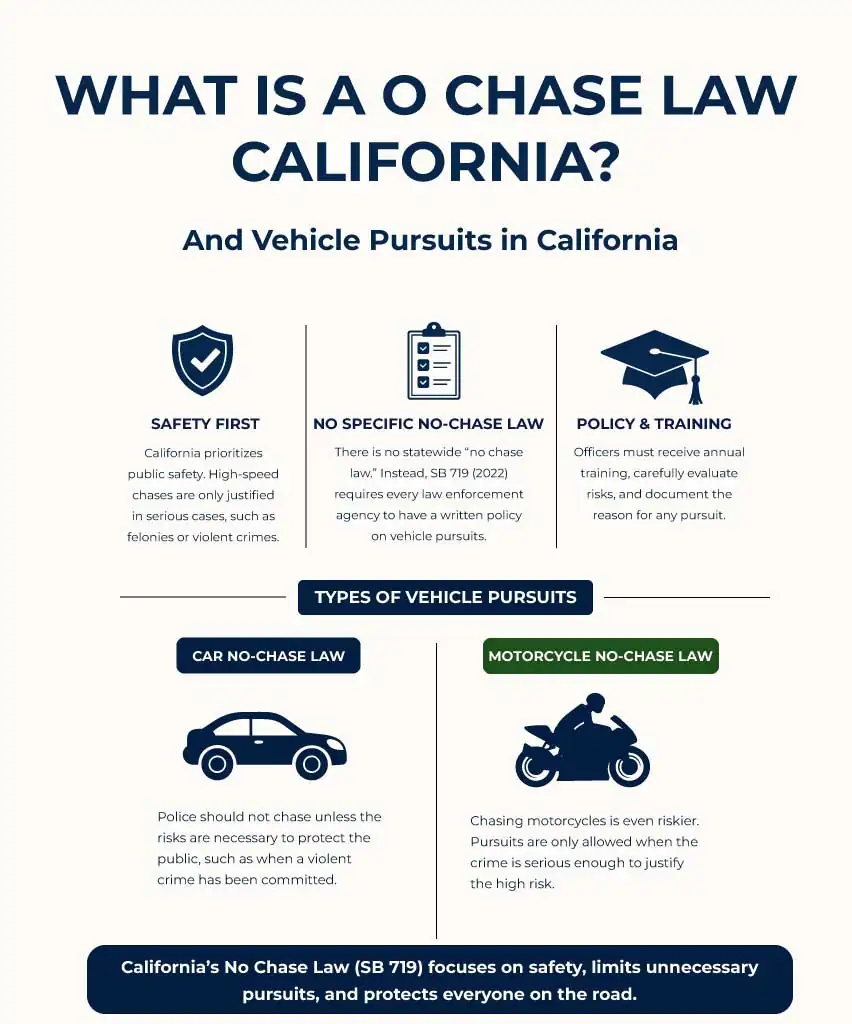
SB 719 put in place specific guidelines for people and agencies to follow. This rule puts safety first. Each jurisdiction needs to make its own decisions about when it should pursue. Most of the time, they shouldn’t.
High-speed chases are risky. They put everyone involved at risk. That includes the police officer. The law requires that careful consideration be made to determine when pursuing is actually beneficial. One example may be a felony or some type of violent crime.
These guidelines encourage departments to define what risk is acceptable. Every high-speed chase comes with risks of severe injuries to bystanders.
California No Chase Law:
There’s no specific no chase law in California. Each agency must create policies for governing the need to pursue others. That falls under SB 719. It was put in place in 2022. Under California Vehicle Code §17004.7, all agencies must adopt a very specific written policy for handling these situations.
Keep in mind that some jurisdictions can set up rules. Training and education on limitations is encouraged. Every law enforcement agency can develop its own rules for these tasks. Those rules also come with stipulations. For example, all police officers need annual training about these decisions. If a pursuit happens, there needs to be clear documentation of what occurred and why.
Different Vehicle Pursuits in California:
There are no outright laws related to pursuits. However, there are some specific considerations applicable. In every situation, police must consider what risks exist.
Any case needs careful consideration. Police shouldn’t pursue at all costs. They need to consider a risk-conscious approach. That means making a strategic decision to chase or not to do so. Officers must consider the entire situation before making that decision.
Car No-Chase Laws:
The no chase laws prohibit police officers from taking aggressive action. The law requires that the officer take the public’s safety into consideration before pursuing. These rules help protect officers, suspects, and the public. High-speed chases are often too dangerous. There’s little potential benefit to using them.
Police must decide that the risks of pursuing a car are necessary. That may be applicable in cases where the person fleeing has committed a violent crime.
Motorcycle No-Chase Laws:
It is even less common for police to make a case for chasing a motorcycle. The risk of the rider suffering a serious or fatal accident is very high. California law enforcement will seek the rider if the officer makes the decision that it is necessary to do so. The crime must warrant the actions. That’s a huge obstacle to overcome.
What You Need to Know About No Chase Policies in California:
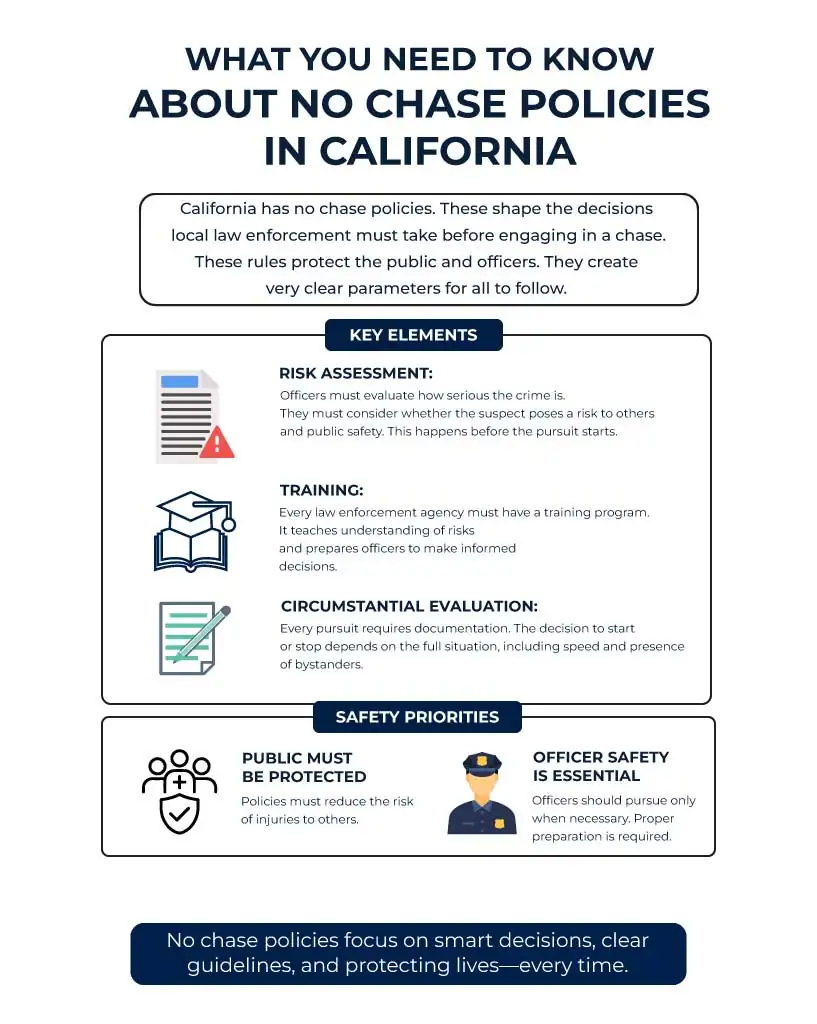
California has no chase policies. These shape the decisions local law enforcement must take before engaging in a chase. These rules protect the public and officers. They create very clear parameters for all to follow.
Key elements:
- Risk assessment: Officers must evaluate how serious the crime itself is. They must consider whether the suspect poses a risk to others. They also have to think about the risk to public safety. That happens before the pursuit starts.
- Training: Every law enforcement agency must have a training program in place. It must teach an understanding of these risks. It also needs to prepare the police to make an informed decision.
- Circumstantial evaluation: Every time a pursuit occurs, documentation is necessary. The decision to initiate or terminate must happen. That decision has to come from the totality of the situation. That includes speeds and the presence of bystanders.
Safety priorities:
- The public must be protected. This must reduce the risk of injuries to others.
- Officer safety is essential. Officers should pursue only when necessary. Proper preparation is necessary.
An Overview on No Chase Policy:
California requires law enforcement agencies to create a policy about pursuits at high speeds. Police should not chase unless there is a risk to the public of not doing so. Police must make informed, careful decisions about when to do so.
Officers must make a risk-based decision. If they pursue, they must stop if risks change. Protection of bystanders and officers is paramount.
How Do No Chase Policies Work in California?
These rules change the way police officers approach pursuits. It also changes how and when they apprehend people. They require a careful evaluation of every situation. A decision-making process must happen that puts the public’s safety as the top priority. Police must maintain law enforcement effectiveness.
That often means using other methods to seek the party. That may include using technology or surveillance.
Violent or high-risk offenders can be sought at high speed. If there is a risk to the public in not chasing, the police can do so. The objective of all of these rules is the same. Don’t chase unless it’s really necessary to do so.
How No Chase Policies Affect Police Procedures:
These rules change in every situation. In every single case, officers must work through a decision-making process. They have to consider the risk of chasing or not doing so. Police must consider numerous factors before they start a chase. They also have to consider changing circumstances during that chase. That means police have a lot of factors to think about. That includes how fast the vehicles are traveling. It means considering the types of vehicles. They have to consider how likely a successful apprehension is. They also have to consider bystanders in the way.
In addition to this, officers also have to think about other options. Alternative methods of apprehending the suspect are preferred if there’s no risk to the public. That means changing the way they think. It means changing their instincts.
Training programs teach these types of changes. Police need to have instructions on how to make risk assessments effective. They have to learn decision-making rules. And they have to adopt alternative methods.
Procedure impact includes changes to the way the units communicate. It also means more reliance on technology. It’s always important for policy to use radios to coordinate and aerial support to minimize the need for a chase.
Why Do Police Departments Implement No-Chase Policies?
There are plenty of reasons not to chase. It’s not safe for anyone involved. There’s no real benefit of chasing a no-risk violator, especially when there’s other technology that can be used to support the apprehension.
High rates of speed make it challenging for drivers to control vehicles. They could lose control. That may lead to the person being chased being hurt. It could also lead to the officer suffering injuries or to innocent bystanders being hurt.
With modern technology available in numerous forms, it’s also not often necessary. There are other tools available to help with surveillance and arrests.
Who Is Liable for Injuries Caused by Police Pursuits?
When something goes wrong, it’s critical to consider fault. All factors must be considered to determine who is at fault.
Determine Liability Police Pursuit Accidents for Multiple Parties:
In every situation, a careful evaluation of what occurred is necessary. A police officer could be responsible if they cannot justify their actions of pursuing someone in a high-speed chase.
For example, if you are standing on the side of the road during a chase and suffer an injury, all factors related to that situation must be considered. The decision about whether the police should chase is always based on the information the officer has at that moment. Officers who believe the person is a high risk to the public may be warranted in chasing. Officers who engage in a high-speed incident without such proof may be at fault. It’s necessary to base these decisions on facts. The police officer may not know that the person behind the wheel is not a violent threat. If they believe that to be the case, they have the right to pursue.
However, most police pursuits shouldn’t happen. That makes the burden of proving that the action is justified harder to do. It is still critically necessary for each party involved to clarify these details. Showing there was no risk or that the officer made the wrong decision isn’t easy to do.
Your attorney in these cases will help you determine what evidence is available. Remember that officers must consider the totality of the entire situation when making decisions.
What to Do If You’re Injured in a Police Pursuit?
If you’re hurt, hire an attorney to help you. No matter the role you play an attorney will guide you in gathering evidence to prove what your rights are. Taking these steps is the best way to protect yourself.
Always seek legal guidance. Your attorney will explore all steps possible. They will advise you on the actions you should take. You should also notify your insurance provider about what occurred. Document the injuries you have as well as any other losses.
Discuss Your Police Pursuit Accident Injury with Ledger Law Attorney:

You’re hurt. You believe a police officer didn’t need to engage in a high-speed pursuit. What do you do? Call Ledger Law. Let our car accident attorney help you determine who is really at fault. Request a free consultation with our team now. Let us determine what your rights are moving forward. Our experience can help you to get the best possible outcome.
Conclusion:
High-speed pursuits are very dangerous. The police know that. They also know they should not engage in them if there’s a risk of hurting someone else. If you are hurt in such an accident, speak to a car accident lawyer about your rights.
Victims of high-speed accidents involving the police benefit from legal guidance. Our legal team can offer guidance to you throughout this situation.
1. Is there a no chase law in California?
There is not. There are guidelines that require each law enforcement department to create its own policy surrounding high-speed chases. This is not a statewide law.
2. Does California have a no chase law for motorcycles?
No. The state’s police officers can chase motorcyclists in rare cases when there’s a risk to the public for not doing so.
3. How do police officers decide whether to initiate a pursuit in California?
They must determine if the person is a risk to others. A person believed to have committed violent actions or other serious crimes may be pursued.
4. Are there any exceptions to no-chase policies?
There are exceptions to not chasing. A person who is likely to be violent can be chased. If there’s a danger to the public, they can seek legal action.
5. Can no-pursuit policies limit liability under Monell claim?
Under this rule, the municipality is only liable if it is their policy or their custom to engage in these actions.
6. How are the public protected by car or motorcycle no-chase laws?
Bystanders are the primary focus. The public shouldn’t be at risk when it comes to chasing others.
7. Which states have a no-chase law?
Some states have laws. This includes Washington and New Mexico. Other states have restrictions.
8. Do all states have no-chase laws?
No, many states do not have these laws.
9. What are the safety implications of police no-pursuit policies?
There are always risks. If the police do not chase and the person gets away, and causes harm to others, that is an important consideration.
10. Are police allowed to hit motorcycles in high-speed chases?
Police are generally banned from striking a motorcycle with a police car. That is because the risk of serious injury is very high.
11. Do motorcycle no-chase policies reduce accident rates?
They are not meant to reduce accident rates. They are in place to reduce the risks to the public.

Emery Brett Ledger brings 28+ years of experience to personal injury law. He founded & led The Ledger Law Firm in securing over $100 million in compensation for clients with life-altering injuries & complex claims. Prior results do not guarantee a similar outcome. Licensed in California, Texas, & Washington, Emery earned his law degree from Pepperdine University School of Law. His practice areas include car & truck accidents, wrongful death, catastrophic injuries, maritime claims, & mass tort litigation. He has been recognized by The National Trial Lawyers’ Top 100, Mass Tort Trial Lawyers Top 25, and America’s Top 100 Personal Injury Attorneys. Emery also received the 2025 Elite Lawyer Award & holds a perfect 10.0 Avvo rating with Platinum Client Champion status. His legal work has been featured on CNN, Forbes, NBC, & ABC.
Free Case Evaluation
Recent Posts
- Punitive Damages in a Car Accident: When Can You Recover Them?
- Tailgating Injury: What Causes Tailgating, Road Rage & How to Stay Safe
- Waiting to Call a Lawyer Can Hurt Your Case: Evidence, Deadlines & Legal Risks
- What Is Property Damage in a Car Accident? Claims, Costs & Who Pays
- Bodily Injury & Property Damage: Coverage, Claims, Liability & Compensation
Emery Brett Ledger brings 28+ years of experience to personal injury law. He founded & led The Ledger Law Firm in securing over $100 million in compensation for clients with life-altering injuries & complex claims. Prior results do not guarantee a similar outcome. Licensed in California, Texas, & Washington, Emery earned his law degree from Pepperdine University School of Law. His practice areas include car & truck accidents, wrongful death, catastrophic injuries, maritime claims, & mass tort litigation. He has been recognized by The National Trial Lawyers’ Top 100, Mass Tort Trial Lawyers Top 25, and America’s Top 100 Personal Injury Attorneys. Emery also received the 2025 Elite Lawyer Award & holds a perfect 10.0 Avvo rating with Platinum Client Champion status. His legal work has been featured on CNN, Forbes, NBC, & ABC.