

How to Choose a Personal Injury Lawyer?: A Definitive Guide for You

When you suffer from an accident, wrongful death of loved ones, or injury due to negligence, the aftermath becomes overwhelming. Besides the physical, mental, and financial burdens, the legal process becomes crucial. But how to choose a personal injury lawyer that fits your needs? How do you know if the personal injury attorney is right for you or not?
Well, first check the expertise, compensation recovered, communication and negotiation skills, etc. Also, look for their peer reviews, recommendations, and fee structure. You can ask them various questions to clear your doubts.
How to Choose a Personal Injury Lawyer?
Choosing a reputable counsel for your personal injury claims is not so easy. It’s a critical decision that will directly affect your case outcome and settlement payout. So, you must treat the initial process of choosing the best personal injury lawyer with the seriousness it deserves.
Importance of Specialization (Generalists vs. Specialists)
In law, as in medicine, specialization is key. It’s crucial since personal injury law is a vast subject, covering simple rear-end accidents to wrongful death claims. So, who is a personal injury lawyer, in the first place?
Personal Injury (PI) law involves civil lawsuits. The lawyer seeks damages for injuries due to the negligence or wrongdoing of the at-fault party. It is distinct from Family Law and Criminal Law. So, look for a personal injury lawyer, not an expert in family or criminal law.
Identify Niche Expertise:
Simply finding a personal injury lawyer isn’t enough. You must find a lawyer whose expertise aligns with your specific incident. Check the types of cases the lawyers handle, including trucking accidents, medical malpractice, construction site injuries, and product liability. It’s crucial since the laws, regulations, and investigations for a medical malpractice case are different from a regular drunk and drive case.
| Personal Injury Practice Area | Key Expertise & Case Focus |
| Car Accident Claims |
|
| Trucking Accidents |
|
| Medical Malpractice |
|
| Product Liability |
|
| Premises Liability |
|
| Construction Site Injuries |
|
| Catastrophic Injury |
|
| Wrongful Death |
|
Start with Referrals from Lawyers, Friends, and Local Bar Associations
Referrals from non-PI attorneys are the gold standard. You can check referrals from lawyers in another area, such as a corporate or real estate lawyer. They know the legal community, the reputation of the personal injury lawyers, their skills, etc. Also, they have no financial incentive to recommend a mediocre lawyer.
Also, consider referrals from friends, family, and past clients. They can provide the most detailed information about the lawyer’s capacity, their fees, etc. They will give insight into how the personal injury attorney handled their case.
Utilize guidebooks of bar associations. Local Bar Associations are a reliable way to find certified local resources. They often categorize lawyers by their specialization and rating.
Also, you can search on law directory websites like Lawyers.co to find the most prominent and sought-after personal injury lawyers. You can research using their name, specialization, location, etc.
Evaluate the Attorney’s Web Presence and Reviews
You must also evaluate the online presence of the attorney. You should check his website content, client testimonials, recovered compensation, etc.
-
- Scrutinize Website Content: Look for case results, academic publications, and specific attorney bios. Do they have any case studies or just big, fatty settlement numbers? Do they post regular content about personal injury laws in your state? Chem these.
- Analyze Client Testimonials: Look for genuine, detailed reviews instead of generic, five-star feedback. The review should be detailed about the case study, how the lawyer communicated, negotiated, and updated the client about the case.
- Check Disciplinary Records: Visit your state bar association website to look for any formal complaints, sanctions, or disciplinary actions against the attorney.
- Check for Public Media Commentary or Legal Analysis: An expert personal injury attorney will have media commentary or legal analysis. So, check if they have any media or podcast presence.
Compensation Recovered and Experience:
Always check the experience level of the personal injury lawyer. A personal injury law firm with years of experience will be more familiar with the local details. They have a better understanding of the local community, law enforcement authorities, and experts. Additionally, their reputation enables them to negotiate more favorable terms with insurance companies.
Plus, check the compensation they have recovered. It shows their expertise and how they dealt with the insurers.
Initial Free Consultation
One of the best ways to know how to pick a personal injury lawyer is to pay attention to their free case evaluation process. It will help you know they communicate, analyze your case, and prepare for it.
- Prepare Essential Documents: Bring medical records, the police report, insurance correspondence, photos, and any communication you’ve had. So, the lawyer can assess them, not just a guess.
- What to Bring: Bring a detailed timeline and a written list of questions. It shows your seriousness and allows you to cover all your concerns.
Find the Right Lawyer Today.
Evaluate the Consultation:
Is the lawyer listening to your full story? Do they interrupt and focus on what they want? Do they go through the paper? Are they asking tough questions about the weaknesses in your case?
Also, how is their communication? What did they tell you about the case? Do they provide real insight or show impossible outcomes?
Assess Communication Style and Empathy:
When you hire a personal injury lawyer, remember one thing. You are about to enter a stressful, years-long journey. The compensation may take years, and you must be well-connected with the lawyer during this time. So, it’s imperative that your lawyer is empathic and communicates well.
Your lawyer should professionally direct you about the legal realities. They must give you a clear preliminary (non-binding) range of potential recovery. Ensure you get an honest assessment of the challenges for your claim. A good lawyer will discuss both the best- and worst-case scenarios. Lastly, they must provide a detailed timeline and costing range for the case. It will help you prepare both financially and mentally for the case.
Location, Jurisdiction, and Local Court Experience
It’s always better to choose a state-specific personal injury attorney instead of a national law firm. They know the local scenarios and state-specific laws better.
- Local Presence: Your lawyer should be familiar with local judges, opposing counsel, and local court procedures. A lawyer can prepare better when he knows the judge’s tendencies, the court’s rules, and the track record of the defense firm.
- Venue Selection: Expert local attorneys know where your case may be filed. Different counties or districts may have different jury pools. It will impact potential outcomes.
- Assess Resources: The firm must have adequate infrastructure to handle your specific claim size. So, choose a firm who have already handled multi-million dollar cases. They have an appropriate support structure and expertise for complex cases.
- The Firm’s Staff-to-Attorney Ratio and Caseload Capacity: Ask about the lawyer’s current caseload capacity. What is the ratio of paralegals and support staff to attorneys? If the lawyer has a low number of support staff, they may be overburdened with too many cases. It will potentially hurt your outcome.
Understand the Legal and Financial Partnership
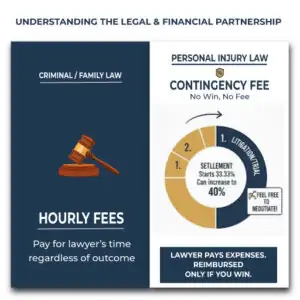
Appropriate communication, expertise, and skills of a lawyer aren’t enough; their expenses must meet your budget, too. So, you must understand the attorney fee structures. Although there are many fee structures for lawyers, personal injury attorneys work with a contingency fee. Criminal and family attorneys work on an hourly basis. But, personal injury attorneys agree on a specific percentage of your compensation outcome.
- Contingency Fee: The attorney’s fee depends on the actual outcome of your case.
- Tiered Fees: Discuss common variations and the fee increment as the case progresses. If the claim is settled outside the court, you can ask for a discount on the contingency fee.
Also, find a way to lower or legally cap your fees. Some states or specific types of cases, such as medical malpractice, have statutory caps on attorney fees.
The Crucial Difference: Attorney Fees vs. Case Expenses
Get one point clear: attorney fees are different from case expenses. So, you must ask your personal injury lawyer about the case expenses.
| Financial Term | Definition | Typical Payment Source | Risk to Client if Case is Lost |
| Attorney Fees | It’s the amount you pay for the lawyer’s time and legal expertise. | A percentage of your claim outcome. | None (If handled via standard contingency). |
| Case Expenses | Out-of-pocket costs paid to third parties, including experts, court fees, etc. | The firm bears it, then is reimbursed from the final recovery. | Depends on the fee agreement. |
| Advanced Expenses | A firm pays upfront to keep a case moving. | Reimbursed from the client’s share of the settlement or verdict. | The client must pay back |
Case Expenses (Costs):
These are reimbursable out-of-pocket costs paid to third parties. It includes:
- Court filing fees
- Expert witness retention fees
- Deposition transcripts
- Medical record acquisition costs
- Private investigators
Injury Attorney Recommendation: Professional Indicators of Elite Counsel
The right injury attorney recommendation is crucial for your case outcome. So, what are the indicators to choose an appropriate counsel? How to hire a personal injury lawyer? What should you consider for hiring a personal injury attorney?
Peer-Review Ratings and Endorsements
Peer-review ratings from reputable organizations are crucial. They speak about the true reputation and specialization of the lawyers.
- Martindale-Hubbell (AV Preeminent): The highest rating is the. It is awarded to only a small percentage of attorneys. The Martindale-Hubbell AV Preeminent signifies the highest level of professional excellence and ethical standards. The rating is made through the confidential opinions of other lawyers and judges.
- Best Lawyers in America: The selection depends on exhaustive peer-review surveys. The rating comes from the top lawyers in America in the same field. So, the inclusion in this list means the lawyer has a wider reputation.
- Super Lawyers: It mainly explains the patented selection process. The selection process includes peer nominations, independent research, and a selection committee review. Only 5% of attorneys in a state are selected to the main list.
High Percentage of Lawyer-to-Lawyer Referrals
The best thing is to find a referral from another lawyer. It’s the best metric of all since a lawyer won’t easily recommend another lawyer. Other attorneys only refer out cases when they trust the receiving attorney’s skill, ethics, and specialization. So, you can trust their ability to maximize the settlement.
Lawyers with national recognition often receive referrals from other states for major cases. It shows how other lawyers respect and trust them.
Proven Trial Experience: Settlers vs. Trial Lawyers
Insurance companies are not charities; they respond to risk. Most insurance companies are afraid of a skilled trial lawyer. In fact, a reputable personal injury trial lawyer will negotiate your settlements out of court. So, it will be swift and hassle-free, mostly.
You must understand that not all personal injury lawyers go to court. Most PI cases settle out of court. However, it only happens when the defense knows that the lawyer is trial-ready for the litigation. Most insurers avoid going to court and so settle peacefully. You can take advantage of it with an expert trial lawyer.
- The Insurance Company Calculation: Insurers offer more money to lawyers with a proven record of taking cases to a jury and winning. Also, the insurance companies offer lower payments to lawyers who rarely or never try a case.
- Questions to Ask: How many jury trials have you completed in the last five years? What were the outcomes?
Board Certification: The National Board of Trial Advocacy (NBTA)
Board certification measures trial competency of the personal injury lawyers. It is similar to the medical profession’s standard for specialization. However, the board certification is a voluntary program. It helps you recognize attorneys with appropriate skill and expertise.
- The NBTA Standard: The certification requirements are rigorous. It includes extensive courtroom experience, peer review from judges, and opposing counsel. Also, the lawyers must pass a written exam.
- Why it Matters: NBTA certification is a measurable standard for lawyers. It proves their competence in trial settings.
Academic Contribution and Professional Leadership
The best personal injury advocates are those who have better peer review, empathy, and professional leadership.
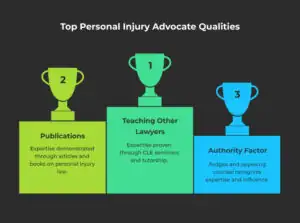
- Teaching Other Lawyers: Many lawyers lecture at Continuing Legal Education (CLE) seminars. It proves their expertise. Only the best attorneys with the authority in their field can enter the tutorship profession. So, you can trust them.
- Publications: Check for the publications of the attorneys. Do they write articles or books on specific areas of personal injury law? It shows their expertise, skill, and deep understanding of the personal injury laws.
- The Authority Factor: Judges and opposing counsel consider lawyers who teach or write the law as authorities. It can subtly influence your case outcome.
Involvement in Professional Organizations
Check whether the lawyer is involved with any professional organization or not. Such involvement means they are connected with others in the field. It can be decisive in many personal injury cases.
- American Association for Justice (AAJ): The national organization dedicated to protecting the rights of the injured. It is a vital network for information and co-counsel.
- State Trial Lawyers Associations (e.g., CA-TLA, NY-TLA): Local advocacy and education groups.
When lawyers are connected with professional organizations, they have better access to specialized resources. Also, they can share knowledge and co-counsel through these networks. So, your personal injury lawyer is never fighting alone.
Measuring Success: Verdicts, Settlements, and Case Results
Don’t just look for their overall settlement output. Remember that every personal injury case is different. So, look for results in cases that match your specific injury and accident type. A lawyer who has won a TBI case is better for your TBI case than a general auto accident lawyer.
Also, check how the clients reacted to their outcome. Sometimes a smaller, quicker settlement is the best outcome for the client’s peace of mind.
Questions to Ask a Personal Injury Lawyer
When you have shortlisted your personal injury lawyers, it’s time to assess them. And the best way to evaluate them is to prepare a questionnaire and ask them these questions. Their answer and the way they communicate with you will clarify your doubts about whom to select.
| Question to Ask the Attorney | Rationale for the Question | Preferred Answer/Action |
| How many jury trials have you completed in the last five years? What is your success rate? | You can assess their willingness and ability to go to court. It also reveals their reputation as a trial-ready firm. | A demonstrable number, such as 50, 100, instead of 5 or 10. Also, a clear, honest success rate, preferably over 90%. |
| What is your firm’s contingency fee percentage? Also, do I have to pay the litigation expenses if we lose the case? | It confirms the financial terms and your financial risk. | A clear percentage, and a plain answer on who pays the litigation expenses if the case is lost. |
| What percentage of your new cases are referred to you by other lawyers? | You can recognize their professional reputation, skills, competence, and ethical practice. | A high percentage, 30% or more. |
| Who will be my primary contact? What communication standards do you follow for updates and response times? | It sets clear expectations for the client relationship. Also, you will know how the lawyer will deal with your case and keep you updated. | They must commit to a specific communication method and timeline. Also, should assign one of their professionals for you. |
| What percentage of your practice focuses exclusively on personal injury? How many active cases do you currently manage? | It’s crucial to check their specialization and capacity to handle your file thoroughly. | 100% or very close to it. Also, the caseload should be reasonable, allowing detailed attention. |
| Does your firm have the financial resources to fund all major litigation expenses, including top-tier experts, in my case? | It helps in determining the firm’s ability to fund major case expenses. | Yes, with an emphasis on retaining the highest level of experts. |
| Are you board-certified, and what peer-review ratings (e.g., AV Preeminent) have you received? | You can check their formal accolades, including the NBTA certification or Martindale-Hubbell’s AV Preeminent rating. | Yes, with high ratings in AV, Super Lawyer, Best Lawyers, NBTA, etc. |
| Based on my facts, what is the realistic preliminary valuation and estimated timeline for my case? | You will get a clear idea of the personal injury claim output. | They must give you a clear idea about the payout and the negotiation timeline. |
The Exit Strategy: What Happens if You Need to Change Lawyers?
Sometimes, even the best personal injury lawyer won’t work for you. Thus, you might change the lawyer. So, how to pick a personal injury lawyer when you change one? In such a case, remember the following suggestions:
- Right to Fire: You can discharge your attorney at any time, for any reason.
- Attorney’s Lien: The previous lawyer may place a lien on your case for the value of their work done. You can settle it with a peaceful discussion.
- Quantum Meruit: The lien depends on Quantum Meruit, the reasonable value of services provided.
- New Counsel Pays: You can give the right to the new lawyer to negotiate with the former lawyer’s lien from the final settlement.
- Seamless Transfer: Your new and old counsel must cooperate for a smooth case transfer of all files.
- Dispute Resolution: For disputable lien fees, the court can decide on it.
- Shared Fee: Ask how the fee is shared: when two firms work on a case, the fee agreement should say how one fee is divided between them. It will depend on the time and work they have invested in your case.
FAQs About How to Choose a Personal Injury Lawyer?
How much does a personal injury lawyer cost?
Most personal injury lawyers operate on a contingency fee basis. They take a percentage of the final payout.
Is a high settlement amount on their website applicable to my case?
No, past results for personal injury cases are not guarantees. Consider the results in similar cases to yours. It will give you a better comparison and outlook.
What should I bring to my initial free consultation?
Bring all related documents, including accident reports, insurance cards, medical bills, photos of the scene and injuries, and a written timeline of events.
Should I hire a lawyer who is not located in my state?
Although there are no strict restrictions, it’s best to hire a lawyer in your state. For instance, a California personal injury lawyer will understand the California laws better than a lawyer from Colombia. So, the Californian lawyer can help you better with car accidents in Newport Beach.
What is the most important factor in choosing an attorney?
The most important factors in choosing the right personal injury attorney is their expertise, settlement output, their willingness to take your case, and how they communicate.
What is the difference between attorney fees and case expenses?
Attorney fees are the payments for the lawyer’s work. But the case expenses are external costs. It includes court fees and expert witness fees. In personal injury claims, attorneys work on a contingency fee. Who pays these costs, and when, is set out in the fee agreement.
How do I know if an attorney is specialized or just a generalist?
Ask what percentage of their total case volume covers personal injury law. True specialists will have a case volume close to 100%.
What if I need to fire my current personal injury lawyer?
You have the right to discharge your attorney at any time. The previous lawyer will usually place a lien on your case. Your new attorney can settle the lien.
Conclusion
Now you should know all the necessary things about how to choose a personal injury lawyer. The injury attorney recommendations include their specialization, expertise, experience, fee structure, and communication method.
You should shortlist two to three personal injury attorneys through their peer review, referrals, immediate response, and settlement output. Then, ask them the questions we prepared to finalize your personal injury lawyer selection.

Emery Brett Ledger brings 28+ years of experience to personal injury law. He founded & led The Ledger Law Firm in securing over $100 million in compensation for clients with life-altering injuries & complex claims. Prior results do not guarantee a similar outcome. Licensed in California, Texas, & Washington, Emery earned his law degree from Pepperdine University School of Law. His practice areas include car & truck accidents, wrongful death, catastrophic injuries, maritime claims, & mass tort litigation. He has been recognized by The National Trial Lawyers’ Top 100, Mass Tort Trial Lawyers Top 25, and America’s Top 100 Personal Injury Attorneys. Emery also received the 2025 Elite Lawyer Award & holds a perfect 10.0 Avvo rating with Platinum Client Champion status. His legal work has been featured on CNN, Forbes, NBC, & ABC.
Free Case Evaluation
Recent Posts
- Punitive Damages in a Car Accident: When Can You Recover Them?
- Tailgating Injury: What Causes Tailgating, Road Rage & How to Stay Safe
- Waiting to Call a Lawyer Can Hurt Your Case: Evidence, Deadlines & Legal Risks
- What Is Property Damage in a Car Accident? Claims, Costs & Who Pays
- Bodily Injury & Property Damage: Coverage, Claims, Liability & Compensation
Emery Brett Ledger brings 28+ years of experience to personal injury law. He founded & led The Ledger Law Firm in securing over $100 million in compensation for clients with life-altering injuries & complex claims. Prior results do not guarantee a similar outcome. Licensed in California, Texas, & Washington, Emery earned his law degree from Pepperdine University School of Law. His practice areas include car & truck accidents, wrongful death, catastrophic injuries, maritime claims, & mass tort litigation. He has been recognized by The National Trial Lawyers’ Top 100, Mass Tort Trial Lawyers Top 25, and America’s Top 100 Personal Injury Attorneys. Emery also received the 2025 Elite Lawyer Award & holds a perfect 10.0 Avvo rating with Platinum Client Champion status. His legal work has been featured on CNN, Forbes, NBC, & ABC.