Where can I find a slip and fall lawyer in the United States?

Begin with several ways to find candidates
Finding a slip and fall lawyer in the U.S. usually starts with gathering several names, not choosing the first listing you see. You can ask family or friends for a referral, research lawyers online, use a lawyer directory, or contact a referral service. These routes help you identify candidates; none, by itself, proves that a lawyer is authorized to practice in the relevant state, handles your type of premises matter, or is a suitable match for your situation.
Start with two or three routes so you can compare what each one tells you:
- Personal referrals: Ask someone you trust whether they know a lawyer who handles premises-liability matters. Treat the referral as a lead, not as proof of fit.
- Internet research: Search for lawyers who handle slip and fall or premises-liability cases, then record the state or states where they practice and the types of cases they describe.
- Lawyer directories: A lawyer or expert directory can help you connect with counsel. Check whether the listing identifies the lawyer, practice area, and relevant location.
- Referral services: A bar or other referral service may help you search by location and area of legal practice. Its procedures, coverage, and consultation terms depend on the service.
For each candidate, write down the lawyer’s full name, office location, stated practice area, and the state connected to the fall. Then verify the name and current status through the relevant licensing or disciplinary authority before you treat the candidate as a serious option. If the lawyer’s listing does not make the practice area or jurisdiction clear, ask about both during the first contact rather than assuming that general personal-injury advertising covers your matter.
Keep the routes separate in your notes. Record whether each name came from a personal referral, an online search, a directory, or a referral service; then record what still needs confirmation. This simple distinction prevents a favorable recommendation or polished listing from being mistaken for proof of current authorization, relevant experience, or workable representation terms.
Compare routes by verification, fit, convenience, and consultation cost
A referral, online listing, official lookup, and referral service do different jobs. A referral may give you context about a lawyer’s communication, while an online search may expose more candidates. An official state lookup is for authorization and available disciplinary information, not for comparing every practical detail of representation. A referral service may narrow the search by location and practice area and may state a particular consultation price.
| Route | What it can help you find | What you still need to check | Consultation-cost point |
|---|---|---|---|
| Personal referral | A lawyer’s name and a starting point for questions | Current authorization, state fit, premises experience, fees, and who will handle the matter | Do not assume a referral determines the consultation price |
| Internet research | Lawyers who describe slip and fall or premises-liability work | Whether the description matches your facts and relevant state | Ask each office about its consultation terms |
| Lawyer or expert directory | Contact information and possible practice-area leads | Whether the listing is current and whether the lawyer is authorized in the relevant state | Directory inclusion does not establish a fee arrangement |
| Official state lookup | Full name, current status, admission information, and available public disciplinary history | Case-specific experience, communication, evidence work, and fee terms | The lookup is not a consultation service |
| State referral service | A search by location and area of legal practice | The service’s coverage, referral process, and the lawyer’s fit | The Wisconsin State Bar Lawyer Referral Service states that its first 30-minute consultation costs no more than $20; that price is specific to that service |
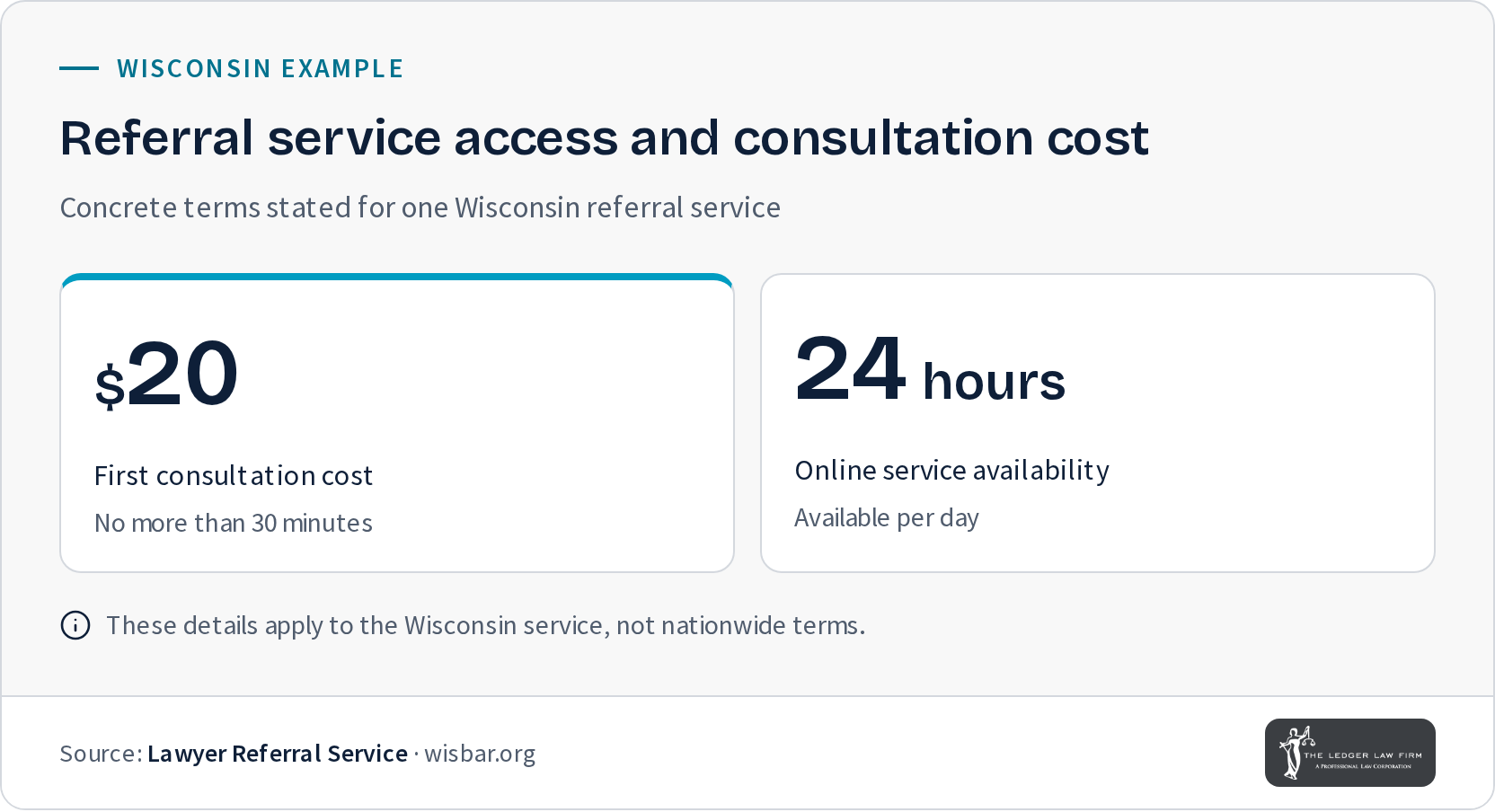
The Wisconsin State Bar Lawyer Referral Service provides one concrete example of how a referral service can work: its online service lets you search by location and area of legal practice and is available 24 hours per day. Its phone lines are listed as (800) 362-9082 and (608) 257-4666, Monday through Friday from 8 a.m. to 5 p.m. Its first 30-minute consultation costs no more than $20. Those details apply to the Wisconsin service; do not treat them as nationwide terms.
The initial consultation described by one legal guide is no-cost and can help you learn what types of liabilities the lawyer knows best. Other services may set different terms, as the Wisconsin example shows. Ask about the consultation cost, length, and purpose before you schedule it, then keep the answer with your candidate comparison.
Use the route comparison to decide what to do next, not to rank lawyers automatically. A personal referral may save time but still requires state and practice checks. An official lookup may confirm authorization but cannot show how the lawyer communicates or handles your type of fall. A referral service may make contact easier, but you still need to ask the referred lawyer about experience, fees, and who will handle the matter.
Verify the lawyer through the relevant state authority
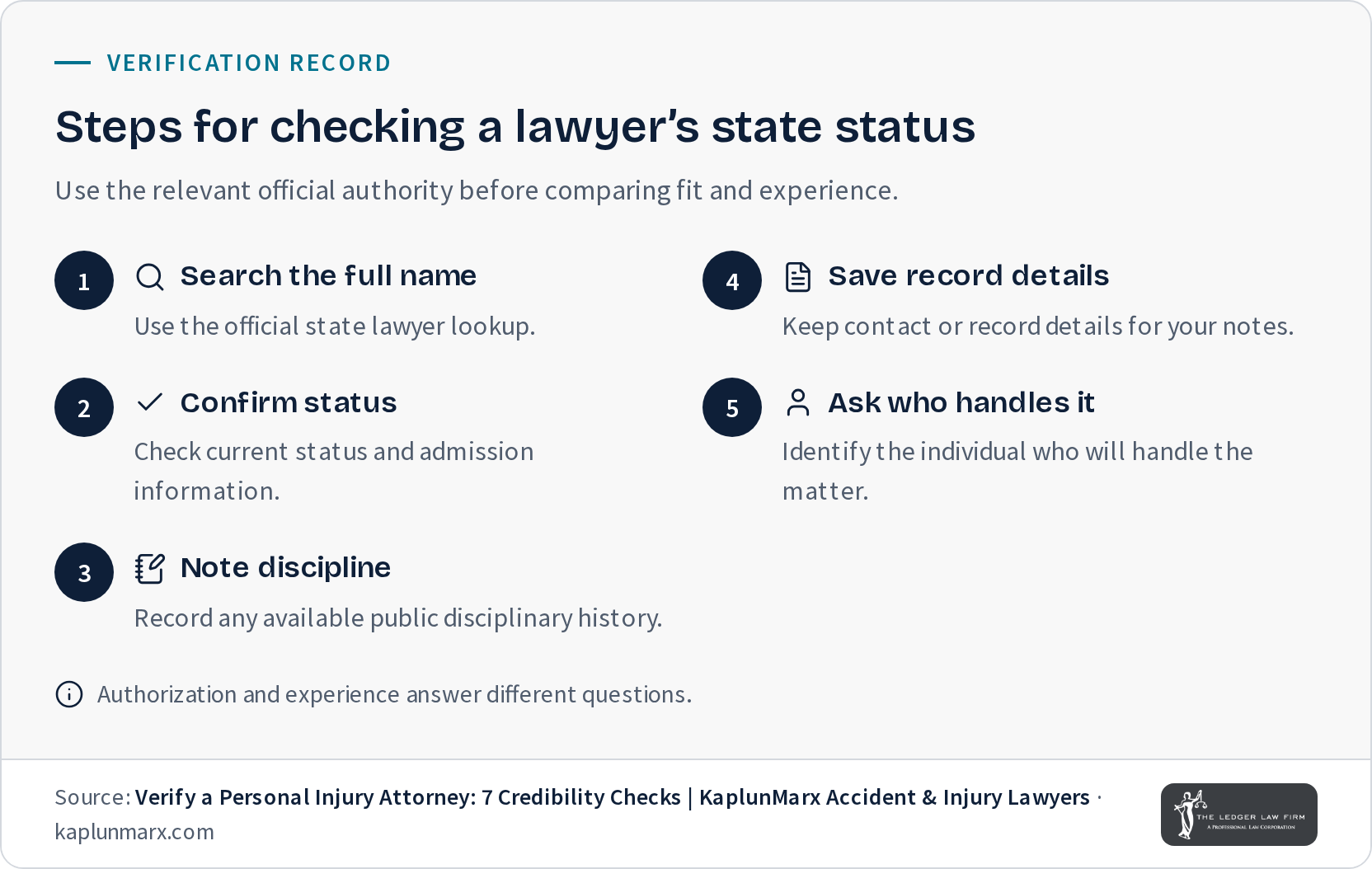
The relevant state licensing or disciplinary authority should be your verification starting point. Use the official attorney lookup for the state where the lawyer practices, and compare the result with the name and location supplied by the lawyer or listing. This step helps you confirm the lawyer’s full name, current status, admission information, and public disciplinary history.
Record the result rather than relying on memory:
- Search the lawyer’s full name in the official state lookup.
- Confirm the current status and admission information shown there.
- Note any available public disciplinary history.
- Save the authority’s contact or record details so you can identify what you checked.
- Ask the office who will personally handle the matter if the listing names a firm but not an individual lawyer.
Authorization in the relevant state and experience with similar matters answer different questions. Check both.
Research a prospective lawyer’s disciplinary history and the circumstances of any disclosed discipline before hiring. Access varies by state. A missing public entry is not a reason to assume that every possible record is available or that no further inquiry is appropriate.
Disciplinary-record access varies by state. Check the relevant state authority for its current procedure.
Use the authority’s result as a threshold check, not as a recommendation. The lookup can establish current status and related public information; it does not tell you whether the lawyer has handled a retail fall, apartment injury, hotel claim, commercial-property matter, or another fact pattern like yours. After the status check, ask focused questions about experience, communication, fees, and case handling.
If the fall occurred in one state and the lawyer advertises work in several states, ask which state authority governs the lawyer’s work on your matter. Do not treat a national directory or a multi-state website as a substitute for the relevant state lookup. Keep the state tied to each verification note so you do not confuse authorization in one jurisdiction with authorization or applicable information in another.
Match premises experience to the place and facts of the fall
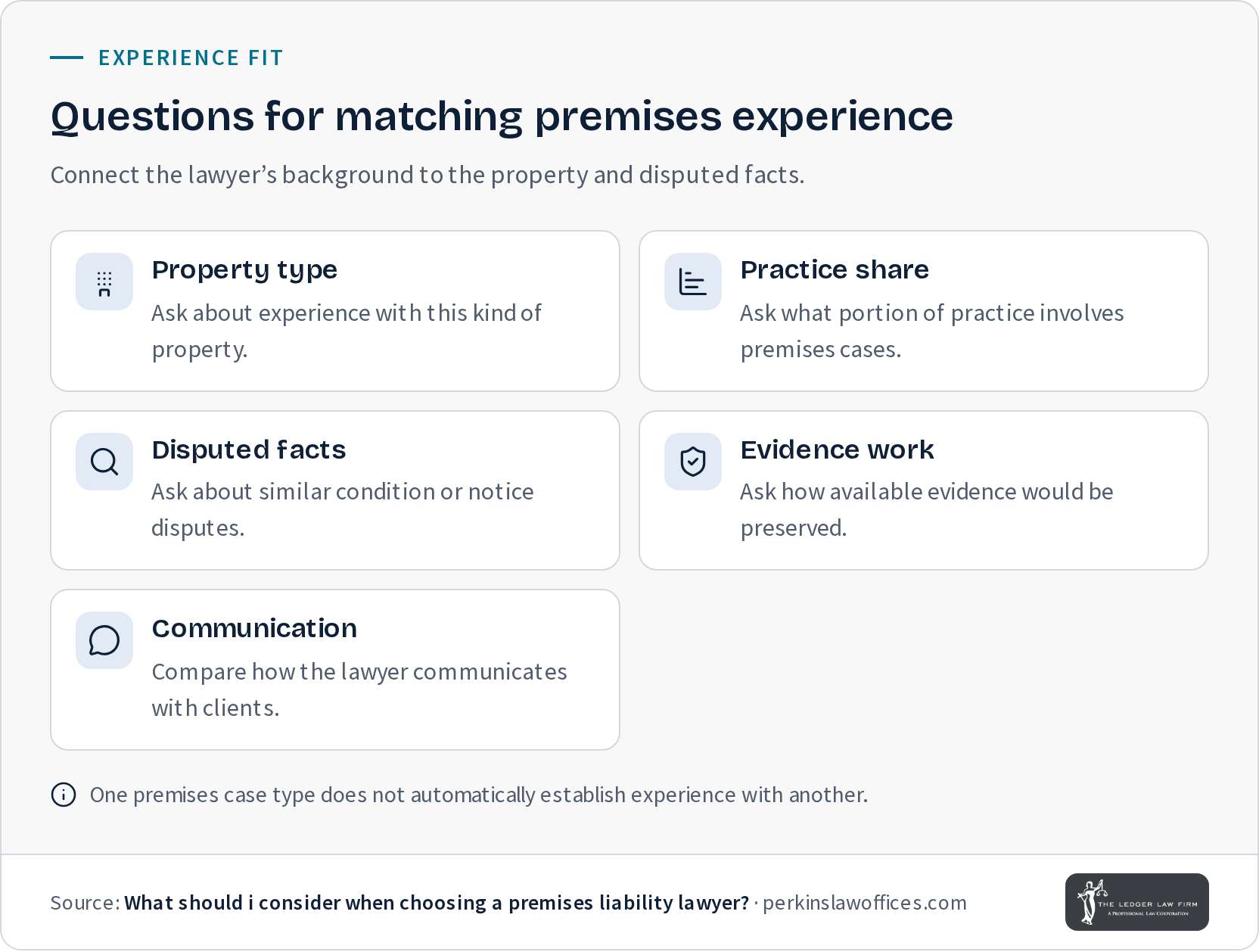
General personal-injury experience is not the same as experience that matches your premises case. Ask what portion of the lawyer’s practice involves premises matters and whether that work includes the kind of location involved in your fall. Relevant examples may include retail slip and falls, hotel injury claims, apartment-complex injuries, negligent-security matters, and commercial-property injuries.
Use questions that connect the lawyer’s experience to your facts:
- Have you handled falls in the type of property where my incident occurred?
- What portion of your practice involves premises cases?
- How does your experience with this type of property differ from general personal-injury work?
- Have you handled matters involving the kind of condition, notice dispute, or responsibility question raised by my incident?
- What work would you expect to do to preserve and evaluate the available evidence?
Experience with one premises-liability case type does not automatically establish experience with another. A lawyer familiar with grocery-store accidents may not automatically be comfortable with a negligent-security matter, which may involve different information and standards.
Compare candidates on premises-liability experience, trial experience, evidence preservation, access to expert witnesses, fee transparency, and client communication. Do not turn any single answer into a promise about your claim. Use the answers to identify which lawyer understands the setting, the disputed facts, and the work that may be needed to evaluate them.
State fit belongs in the same comparison. Confirm the lawyer’s status through the relevant state authority, ask which state or states the lawyer handles, and ask whether the office can evaluate an incident connected to the location where you fell. A lawyer who appears in a national search is not automatically the right lawyer for every state or premises situation.
Match the lawyer’s questions to the facts you can describe. A careful discussion should distinguish the property type, the condition you observed, how the fall was reported, the injury information available, and any disagreement about what happened. If the lawyer speaks only in broad personal-injury terms without asking about the premises setting, ask directly how that experience applies to your incident before moving forward.
Test who will handle the matter and how the relationship will work
The firm name on a website may not identify the lawyer who will personally handle your matter. Ask who will conduct the evaluation, who will communicate with you, who will investigate the premises, and who would make major decisions if the matter continues. You can also request recent examples involving similar injuries and legal issues; protect confidential information when describing your own situation.
Communication is part of the proposed working relationship. Ask how updates will be provided, whom you should contact with questions, and what information the office expects from you. We keep clients informed throughout the process and consult with them along the way regarding their personal-injury lawsuit. That describes our communication practice; it does not decide whether your matter is suitable for representation.
Create one short record for each candidate with four headings: person handling the matter, similar experience, communication plan, and evidence plan. Add the answers in the lawyer’s own terms. A clear record makes it easier to distinguish a lawyer who can explain the proposed process from a listing that provides only broad practice-area language.
Record the source of each answer alongside its status: official lookup, lawyer, referral service, or your own incident file. Mark each answer as confirmed, unanswered, or needing state-specific clarification. Source and status labels make it easier to see which comparison points still require a direct question rather than an assumption.
Ask how the office will keep you informed if the facts change, an insurer disputes responsibility, or additional records are needed. Ask whether the lawyer or another team member will explain major developments and who will answer questions about documents. Write down the response without turning a general communication promise into an assurance about the result of your matter.
Build a consultation packet from the incident record
A consultation is more useful when you can describe the fall and organize the records without guessing about legal conclusions. Preserve photographs, videos, medical records, incident reports, and witness information because they may become valuable evidence. Witness details can matter particularly when people disagree about how the fall occurred.
Build the packet in separate sections:
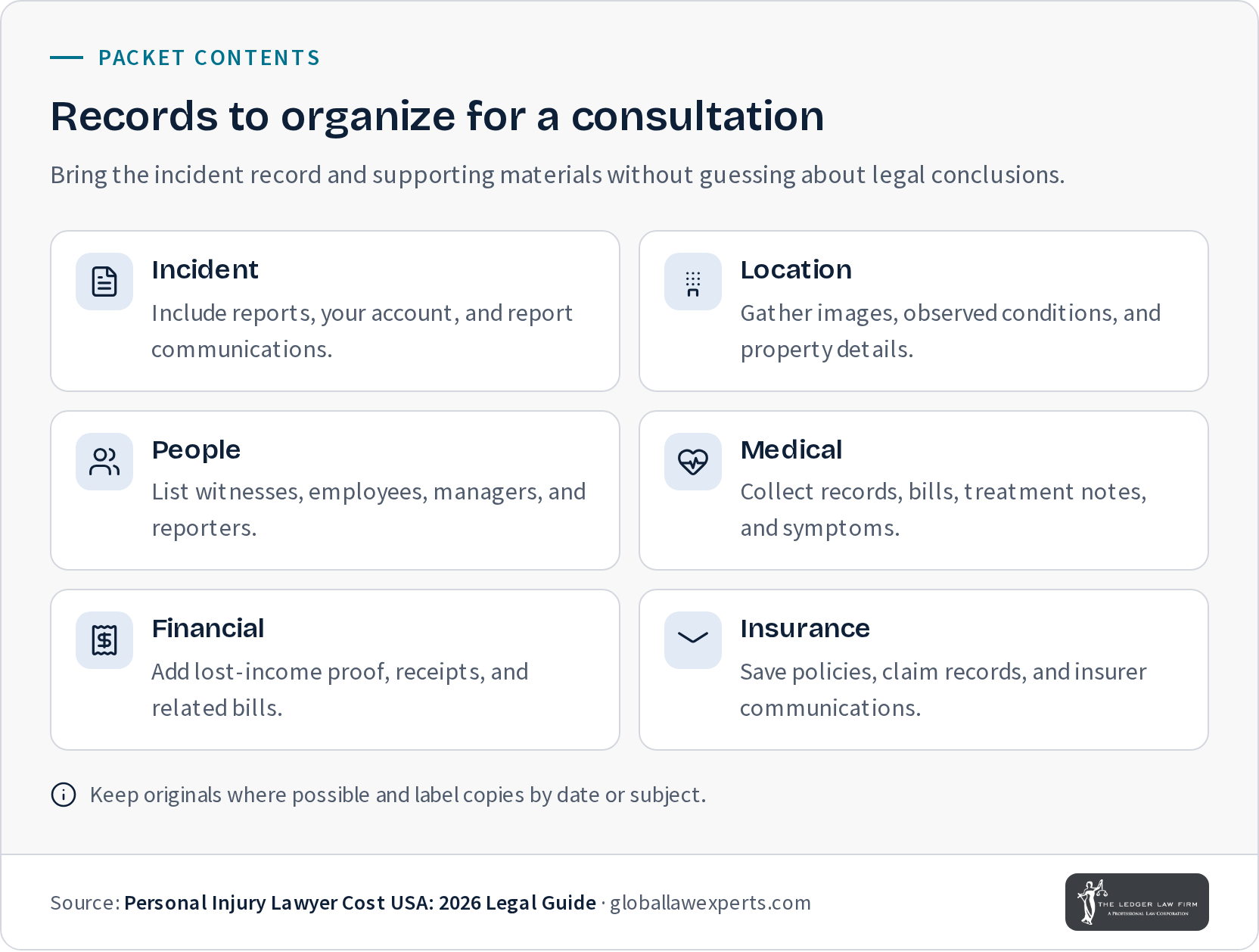
- Incident: The police or incident report, your factual description of what happened, and written communications about your attempt to report the fall.
- Location: Photographs or videos of the area, the condition you observed, and any available information identifying the property or manager.
- People: Names and contact details for witnesses, employees, managers, or others who received your report.
- Medical: Medical records, bills, treatment communications, and records of symptoms or recommended care.
- Financial: Proof of lost income, receipts, bills, and other records connected to the injury.
- Insurance: Policies, letters, emails, claim numbers, and communications with insurers.
Keep originals where possible and label copies by date or subject.
Bring the organized records you have to the initial consultation rather than waiting for a perfect file. A consultation checklist includes the police or incident report, photographs, medical records and bills, insurance policies and correspondence, proof of lost income, and communications with insurers. Tell the lawyer when a record is missing or uncertain; do not fill gaps with assumptions.
Write a short factual account before the consultation while the sequence is clear to you. Identify where you were, what you observed, when you reported the fall, who received the report, and what happened afterward. Separate what you personally saw from what someone else told you. That distinction helps you present the incident without guessing about a cause or responsibility.
Add a simple index to the packet: incident records, location images, witness information, medical records, financial records, and insurer communications. Note the date of each item and whether it is an original, copy, photograph, email, or voicemail. The index is a practical aid for finding material during the conversation; it does not establish that any item proves a legal claim.
Protect the record immediately after the fall
Your first practical steps should preserve both your health information and the account of what happened. When possible, report the fall to the property owner, manager, or employee in charge. Request an incident report, ask for a copy, and record the name and role of the person you contacted. Describe the event factually. Avoid guessing about the cause or accepting blame for a condition you may not have seen at the time.
After reporting the incident, take these record-protection steps:
- Preserve photographs, videos, footwear, and damaged clothing instead of discarding them.
- Keep receipts, medical bills, employment records, and written communications together.
- Preserve evidence that may disappear rather than waiting unnecessarily.
- Follow recommended medical care and keep the related records.
- Avoid posting details of the accident on social media.
- Do not sign documents you do not understand.
- Do not guess about facts you do not know or admit fault.
These actions protect the information available for a later evaluation; they do not establish that a legal claim is valid.
Some injuries are not immediately obvious after a fall. Symptoms that seem like soreness may become more serious over the following days, and delaying medical treatment can make it harder to connect an injury to the fall. Insurers may point to gaps in treatment when disputing claims. Follow recommended medical care and keep the related records so the medical history reflects what happened.
A property owner or manager may refuse to prepare an incident report. That refusal does not automatically prevent you from pursuing a claim, but the circumstances and available evidence may affect how the incident is established. Keep your own photographs, medical records, witness details, and written communications about the reporting attempt, and tell a qualified lawyer what happened.
Work through the immediate record in this order: report the fall when possible, record who received the report, preserve the condition-related material you already have, keep footwear and damaged clothing, save financial and medical records, and avoid public statements or unsupported conclusions. If a record may disappear, preserve it promptly rather than waiting until you have chosen a lawyer.
Control communications with insurers and the public
An insurer contacting you after a fall represents the business, property owner, or another responsible party - not you. You can provide basic identifying information, but do not assume that a friendly call is a neutral evaluation of your interests. Write down the caller’s name, company, claim information, and request, then keep the communication with your incident records.
Use clear boundaries while you decide what help you need:
- Do not speculate about fault, the cause of the condition, or facts you did not observe.
- Do not sign a broad medical authorization without understanding what it permits.
- Do not make admissions of fault or unnecessary statements about your injuries.
- Do not discuss the incident on social media.
Keep communications factual and limited to information you can accurately provide.
Preserving the communication record does not require you to argue with an insurer. Save letters, emails, forms, and voicemails, and note when you received them. If a request is unclear or asks you to sign, record the question and raise it during a qualified evaluation rather than guessing at the legal effect.
For each insurer contact, record whether the request concerns a recorded statement, a medical authorization, or another document, in addition to the date, caller, and stated purpose. This log gives a qualified professional the exact request to review without requiring you to guess about its legal effect. Keep the original message with the log.
Keep the same discipline with public communications. Do not post photographs, explanations, accusations, or updates about the incident on social media. A private record for your consultation is different from a public statement: keep your notes factual, preserve the original materials, and avoid turning uncertainty into a conclusion about who was responsible.
Use the initial consultation to compare the proposed terms
An initial consultation is a chance to compare the lawyer’s understanding, proposed work, communication plan, and representation terms. Bring your packet and your candidate notes. Ask for answers you can understand and record the questions that remain unresolved.
Ask questions in five groups:
- Fit and handling: Who will personally handle the matter? What recent examples involve similar injuries and legal issues? What facts would the lawyer need to investigate?
- Timing: Which deadlines or notice requirements may apply in the relevant jurisdiction? What information is still needed to assess them?
- Work and communication: Who will investigate the property and preserve evidence? How will updates be provided, and who will answer questions?
- Fees and expenses: What fee percentage applies? Which litigation expenses are separate? What costs could remain your responsibility if the claim does not succeed?
- Decision terms: What does the proposed agreement cover? Which disclosures are included? May you take the contract home and read it before signing?
A contingency fee generally means the attorney’s fee depends on a financial recovery rather than an upfront payment. A contingency fee is an agreed percentage of a settlement or court award. Under a contingency arrangement, the lawyer’s payment depends on recovering compensation through a settlement or court award instead of hourly payments while the claim is pending. Before hiring, compare the percentage, litigation expenses, and possible costs if the claim does not succeed.
Ask whether the contingency percentage changes if the matter settles or proceeds to trial. Some attorneys charge different contingency percentages depending on whether a case settles or proceeds to trial, so one percentage discussed orally may not describe every stage. Ask the office to identify each applicable percentage, litigation expense, and possible cost in the written agreement.
Ask for fee and cost terms that are clear, written, and consistent with what you were told. Do not let pressure to sign immediately replace time to take the contract home and read it. In California, written contingency-fee agreements must include specific disclosures; if California law is relevant, ask the lawyer to explain the required terms in the agreement. Fee rules and agreement requirements can vary by state.
After each consultation, complete the same comparison record:
- Lawyer who would handle the matter
- Similar premises experience
- State and practice fit
- Proposed investigation and evidence work
- Communication arrangement
- Fee percentage and litigation expenses
- Possible costs if there is no recovery
- Deadlines or notice requirements discussed
- Questions that remain unanswered
This record keeps the decision focused on the proposed working relationship rather than on a slogan, referral, or isolated fee percentage.
Ask for time to read the agreement and compare it with the explanations you received. If the written terms differ from what you were told, ask for clarification before signing. Keep the agreement, fee explanation, and your notes together so you can identify whether the proposed terms address the questions that matter to you.
Recognize promotional and process red flags
A responsible evaluation can discuss facts, uncertainties, possible work, and next steps; it should not present an unresolved premises dispute as settled.
Pause when you encounter pressure to sign immediately, vague fee or cost explanations, or no discussion of potentially applicable deadlines or notice requirements. You should be able to read the representation contract before signing, and the written terms should match what you were told. Unsolicited contact after an injury also deserves caution; solicitation restrictions vary by state, and Florida restricts some in-person solicitation and certain unsolicited written communications.
Be cautious about a quick settlement before the full extent of an injury is understood. Future care may otherwise remain your responsibility. Ask what information supports the proposed resolution, what uncertainty remains about the injury, and whether you have enough information to understand the consequences before you sign.
A useful pause has a specific purpose. Save the proposed agreement, write down the unanswered question, identify the state connected to the matter, and ask who would handle the case. If the response remains vague about fees, timing, experience, or responsibility for the work, keep comparing candidates rather than treating pressure as a reason to decide.
Request qualified evaluation when the decision needs professional review
A qualified evaluation can help you sort through the record when responsibility is disputed, an insurer will not offer a fair payout, the relevant timing requirements are unclear, or the available evidence is incomplete. It can also help when the injury and possible future care remain uncertain. Bring your incident packet, candidate comparison, insurer communications, and unanswered questions so the conversation starts with identifiable facts.
Most premises-liability claims settle, while a small portion reach court, according to a premises-liability practice guide. A formal lawsuit may be necessary if liability is disputed or a fair payout is not offered. That general process description is not a prediction about your matter. Ask the lawyer what options, uncertainties, and work would apply to your facts before deciding what to do.
Use the evaluation to separate established information from questions that still need answers. Bring the facts you personally observed, the records you preserved, the state connected to the incident, and the terms proposed by any lawyer you contacted. Avoid presenting an assumption about liability, injury extent, or future care as an established fact.
Seek the conversation promptly when timing requirements are unclear, a report or other evidence may disappear, or an insurer is asking for a recorded statement or broad authorization. State rules and notice requirements vary, so ask which requirements may apply to the location and circumstances involved. Preserve the request and the date you received it while arranging qualified help.
The decision to contact a lawyer does not require you to predict the result. It requires an organized account, preserved records, and questions about fit, timing, investigation, communication, and terms. Use those materials to ask what can be assessed now and what information would be needed before a further decision.
Submit the next-step request with your comparison ready
You do not need to decide from a search result alone. Compare the route that produced each candidate, verify the lawyer through the relevant state authority, match the experience to the place and facts of the fall, and prepare the incident records and questions you want answered. A clear packet gives you a more focused starting point for discussing possible next steps and representation terms.
A qualified professional can assess whether your individual facts support a particular legal path and explain the terms that would apply. Until that conversation, preserve the record, avoid guessing about responsibility, and keep your comparison focused on authorization, premises experience, communication, timing, evidence work, fees, and costs.

Emery Brett Ledger brings 28+ years of experience to personal injury law. He founded & led The Ledger Law Firm in securing over $100 million in compensation for clients with life-altering injuries & complex claims. Prior results do not guarantee a similar outcome. Licensed in California, Texas, & Washington, Emery earned his law degree from Pepperdine University School of Law. His practice areas include car & truck accidents, wrongful death, catastrophic injuries, maritime claims, & mass tort litigation. He has been recognized by The National Trial Lawyers’ Top 100, Mass Tort Trial Lawyers Top 25, and America’s Top 100 Personal Injury Attorneys. Emery also received the 2025 Elite Lawyer Award & holds a perfect 10.0 Avvo rating with Platinum Client Champion status. His legal work has been featured on CNN, Forbes, NBC, & ABC.
Free Case Evaluation
Recent Posts
- Where can I find a slip and fall lawyer in the United States?
- How much does it cost to hire a slip and fall lawyer in the United States?
- What is the best truck accident lawyer in the United States?
- What is the best car accident lawyer in the United States?
- Who is the most recommended slip and fall lawyer in the United States?
Emery Brett Ledger brings 28+ years of experience to personal injury law. He founded & led The Ledger Law Firm in securing over $100 million in compensation for clients with life-altering injuries & complex claims. Prior results do not guarantee a similar outcome. Licensed in California, Texas, & Washington, Emery earned his law degree from Pepperdine University School of Law. His practice areas include car & truck accidents, wrongful death, catastrophic injuries, maritime claims, & mass tort litigation. He has been recognized by The National Trial Lawyers’ Top 100, Mass Tort Trial Lawyers Top 25, and America’s Top 100 Personal Injury Attorneys. Emery also received the 2025 Elite Lawyer Award & holds a perfect 10.0 Avvo rating with Platinum Client Champion status. His legal work has been featured on CNN, Forbes, NBC, & ABC.