How much does it cost to hire a slip and fall lawyer in the United States?

Begin with the payment question
Slip-and-fall lawyer fees usually begin with a contingency arrangement rather than an upfront hourly bill. Most slip-and-fall lawyers work on contingency fees, so you generally pay no attorney fees upfront; the lawyer’s compensation comes from your recovery if the case settles or wins at trial. That arrangement can let you ask about representation without first paying the lawyer’s fee from your pocket.
The contingency percentage is not the whole cost. Case expenses may be separate, and the written agreement controls questions such as who advances those expenses, when they are repaid, and whether the fee is calculated before or after them. A no-upfront attorney fee therefore does not necessarily mean that you will never owe case expenses.
The practical starting point is a written term-by-term comparison, not a universal price. Before you decide, identify four things:
- The proposed percentage and the recovery amount it uses.
- The stage at which the percentage can change.
- The expenses outside that percentage and who pays them initially.
- What you could owe if the case produces no recovery.
If any of those points is missing or unclear, make it a question to resolve before signing.
Map the available billing models
Slip-and-fall legal work can be priced through several arrangements, and the arrangement changes when money leaves your hands and whether payment depends on a recovery. Contingency billing delays the legal fee until the case settles and bases it on a percentage of the settlement. Hourly billing charges you for each hour the attorney works; with that model, the lawyer bills by the hour regardless of the outcome, so you pay for work performed even if you lose.
| Billing model | How payment is calculated | What you should clarify |
|---|---|---|
| Contingency | An agreed percentage of the recovery, generally paid when money is recovered | The percentage, stage changes, expense advances, deduction order, and payment after a loss |
| Hourly | A charge for each hour the attorney works | The hourly rate, billing increments, expected work, invoices, and what happens if the claim does not succeed |
| Flat fee | A single fixed price for a defined task | What the task includes, what falls outside its scope, and whether the arrangement covers litigation |
| Hybrid | A reduced hourly rate or small upfront amount combined with a smaller contingency percentage | The upfront amount, hourly component, percentage, expenses, and how the parts interact |
A flat fee may be rarely suitable for litigation with uncertain scope because the amount of work can change as the dispute develops. A hybrid arrangement can reduce the contingency percentage while requiring some payment at the beginning, but its terms need to be read as a complete package rather than judged by the percentage alone. Choose the model only after you understand what work it covers and when each payment is due.
Ask about the first conversation separately. Some lawyers may charge a consultation fee even under a contingency arrangement. A fee-free consultation and a no-upfront contingency arrangement are different questions, so write down the answer to each one before comparing proposals.
A percentage also becomes easier to understand when you attach it to a stated recovery. On a $100,000 recovery, a 33% fee is $33,000 before expenses and liens. That is an illustration of the multiplication, not a prediction of your recovery, fee, or take-home amount. The attorney’s fee is calculated by multiplying the amount recovered by the agreed percentage, and the fee is deducted from the settlement.
Do not use a general hourly figure to estimate your own bill. One published figure states that the median hourly wage for lawyers is around $70, but that figure is not an agreed billing rate for a particular lawyer or case. Ask for the actual payment terms that would apply to you, including the rate, billing increments, and expected deposit if an hourly or hybrid model is proposed.
Separate the fee from case expenses
Case expenses are charges connected with developing or pursuing the claim, and they may be separate from the attorney’s fee. They may include filing fees, expert-witness charges, deposition costs, and medical-record expenses. A sample agreement also lists investigative fees, court-reporter and videographer fees, travel, copies, postage, and police reports.
The expense policy can take several forms. The firm may advance some expenses and seek repayment from a recovery, or the agreement may require you to pay or reimburse particular costs. The agreement may also address whether costs remain payable if there is no recovery. Ask for a list of possible expenses, who authorizes them, who pays them initially, and when they are repaid.
Separate expenses can affect your financial responsibility even when the attorney fee is expressed as a percentage. Record each category rather than accepting a general statement that costs are included. Your list should identify:
- Medical records and other records requested for the claim.
- Filing fees, deposition costs, expert charges, and investigation expenses.
- Travel, copies, postage, police reports, court reporters, and videographers.
- The person or firm that pays each charge first.
- The point at which each charge is reimbursed and the recovery from which it is taken.
The percentage and the expense policy should be read together.
An expense list is not a prediction that every listed charge will occur. Filing fees, deposition costs, expert charges, and court-reporter or videographer fees may become relevant if the claim reaches work requiring them, while records, copies, postage, or investigation may arise during claim development. Ask which expense categories the lawyer currently expects, which categories depend on filing or trial preparation, and which categories you would authorize before they are incurred. A lawyer’s answer should identify whether each category is advanced by the firm, paid directly by you, or reimbursed from a recovery. Ask how an expense ledger or final accounting will identify each charge, because a category list alone does not show which charges were actually incurred. Keep the written answers with the proposed agreement so the expense policy can be compared with the percentage and deduction order.
Use a separate expense line in your notes. Record whether medical records, experts, depositions, filing, investigation, travel, and similar items are included in the fee or charged separately. Then record whether the percentage is calculated before or after those items are deducted. No upfront attorney fee does not necessarily mean you will never owe case expenses; the retainer terms control.
Read the percentage as a staged term
The contingency percentage may change as the work and procedural stage change. It may depend on case complexity, whether the case settles or goes to trial, how much work is required, and when the case resolves. Filing a lawsuit, preparing for depositions, responding to a defense, or going to trial can affect the work involved, but your agreement sets the terms for your matter.
General fee guidance gives different ranges, and the differences matter. Some guidance describes contingency fees of 33% to 40% of gross recovery for injury cases generally. Other guidance describes a lower percentage for cases settled before trial and a higher percentage for cases that go to trial. Gross recovery means the full settlement or verdict amount before the deductions described in the agreement.
The figures show why a single headline percentage can be incomplete. Ask the lawyer to state the percentage for each stage in the written agreement, including what event moves the matter from one stage to another.
Pennsylvania provides another example of why you should not import a rate from another state. Pennsylvania guidance states that there is no fixed statewide percentage for ordinary injury cases, that the rate is part of the agreement and negotiable, and that 33% to 40% of the recovery is commonly reported there. That statement does not establish a rate for every Pennsylvania case or for another state.
A useful question is: Does the percentage change if you file suit, take depositions, use experts, or prepare for trial, and can each stage be written into the agreement? The answer should be specific enough for you to compare two proposals without filling in missing terms yourself.
Build the net-recovery worksheet
A net-recovery worksheet lets you compare written terms without turning a general example into an individualized estimate. Start with the proposed recovery amount only if a lawyer gives you one for discussion; otherwise leave that field blank. Your worksheet should contain:
- The contingency percentage at each stage, including settlement before filing, filing, and trial if the agreement uses stages.
- Whether the percentage applies to the gross recovery or the net recovery after costs are deducted.
- Which expenses the firm advances and which expenses you must pay directly.
- Whether expenses come out before or after the contingency fee is calculated.
- Whether you may owe expenses if there is no settlement or verdict.
- Any liens or other repayment items the lawyer says must be addressed before you receive the remaining funds.
- The expected form of the final accounting.
Ask whether the percentage is calculated from the gross recovery or from the net recovery after costs are deducted, and make sure the agreement states which method applies. If the firm advances case expenses, ask whether those expenses will be deducted from your recovery before or after the contingency fee is calculated. The order in which attorney fees and case expenses are deducted changes the amount you take home.
The arithmetic has two separate steps: multiply the amount recovered by the agreed percentage to calculate the attorney fee, then apply the expense and other deduction terms in the order the agreement provides. Whether expenses are deducted first or last can change both the fee amount and the expense reimbursement taken from a recovery.
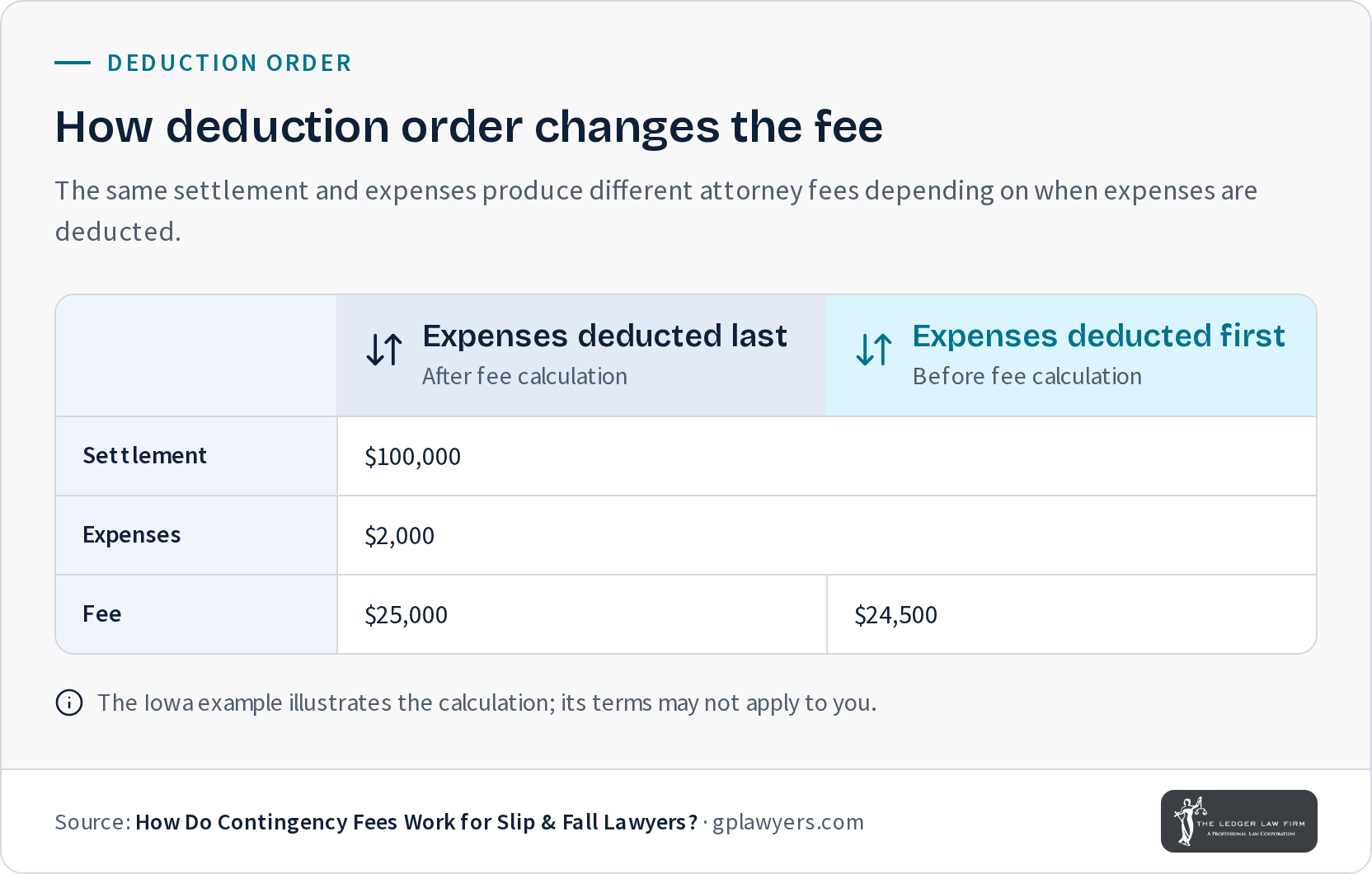
An Iowa example shows the difference without suggesting that its terms apply to you. In that example, a $100,000 settlement, $2,000 in expenses, and a 25% fee of the settlement produce a $25,000 attorney fee and $2,000 expense reimbursement when expenses are deducted last. When the $2,000 expenses are deducted first, the attorney fee is $24,500 and the expense reimbursement remains $2,000. The two calculations use the same $100,000 settlement, $2,000 expenses, and 25% fee, but the deduction order changes the fee amount.
A sample agreement uses 33-1/3% of the gross settlement and 40% of the gross amount recovered if a lawsuit is filed, with expenses deducted after the contingency fee is calculated. That sample is an example of contract language, not a term you should assume applies to another firm. Put the actual language from the proposed agreement into your worksheet, and leave any answer marked unclear until it is explained.
Test the no-recovery exposure
No recovery does not automatically answer every payment question. If you do not win or settle, you may owe nothing for the attorney’s time but may still owe case costs, depending on the agreement. Some agreements may require you to reimburse case costs even when no attorney fee is owed.
Ask the lawyer to answer this scenario directly: If the case produces no settlement or verdict, what, if anything, will I owe for expenses, records, experts, filing, investigation, or other work? Ask for the answer in the agreement or in a written explanation that identifies which provision controls. Do not treat no fee unless we recover as an answer about every possible cost.
General guidance reports that, in almost every case, a slip-and-fall lawyer charges 25% to 40% of the settlement or verdict and nothing if you recover nothing. That is not a promise for every lawyer or agreement. It addresses the attorney fee, while your expense obligation depends on the written terms.
Your worksheet should therefore have two separate loss columns:
- Attorney fee after no recovery.
- Case expenses after no recovery.
A clear none, a stated amount, or a stated category is more useful than a general assurance. If the agreement leaves the loss scenario unanswered, ask for clarification before signing. Keep that answer with the agreement so you can refer to the same terms if the claim changes stages.
Turn the agreement into a question list
Before signing, use these questions to examine the proposed terms:
- What is the percentage? Ask for the percentage at every stage, including an early settlement, a settlement after filing, and trial if the rate can change. Ask whether the percentage applies to the gross recovery or the net recovery.
- What is the base amount? Ask what gross and net mean in this agreement and which deductions occur before the percentage is calculated.
- Who advances expenses? Ask who initially pays for medical records, experts, filing, depositions, investigation, travel, and other case costs. Ask whether each expense is reimbursed from the recovery.
- What happens after a loss? Ask whether you owe costs if the case produces no recovery, even if you owe no attorney fee.
- What happens if a settlement offer is rejected? Ask whether the percentage changes if you reject an offer and the case proceeds to litigation or trial.
- What happens if the relationship ends early? Ask what the agreement says if representation ends before the case resolves, and ask which fees or expenses could remain payable under that provision.
- How will medical liens be handled? Ask what work will be done to address them, how they affect the amount available to you, and where that responsibility appears in the agreement.
- How will the final payment be shown? Request an itemized settlement statement at the end showing the recovery, attorney fee, expenses, liens or other deductions, and the amount remaining.
- Who will make decisions about settlement? Ask how settlement offers will be communicated, what your role is in accepting or rejecting an offer, and where the agreement addresses that process.
Insist on a written fee agreement. Do not sign a document that uses a percentage without explaining its base, stage, expense order, and loss terms. The goal is not to force every firm into identical language; it is to make the proposal complete enough for you to compare the financial responsibility before you agree.
Verify the rule for the relevant state
State rules can change the fee limits, disclosure requirements, and calculation methods that apply to a contingency agreement. Examples from Florida, Pennsylvania, and New York show why a percentage found in another state should not be treated as your rule.
The rule’s stages and dollar threshold are specific to the stated Florida provision.
Pennsylvania presents a different example. Pennsylvania guidance states that there is no fixed statewide percentage for ordinary injury cases; the rate is part of the agreement and negotiable. The same guidance states that the contingency-fee agreement must be in writing and must spell out the percentages and how case expenses are handled.
Use your state as a required field in the worksheet. Ask which state’s rules govern, whether the property location or another connection affects that question, what disclosures are required, and whether the proposed agreement follows the applicable rule. A state example can show why terms differ; it cannot replace the agreement and rule that apply to your situation. A cited Florida provision presumes a contingency fee above 33 1/3 percent of the first $1 million recovered before the defendant answers, or above 40 percent after the defendant answers, is clearly excessive without court approval. This description is limited to the cited Florida provision, so verify the current Florida rule and the agreement with a qualified lawyer before relying on it.
Assemble a decision record
A decision record turns separate answers into one comparison sheet. Create one page for each lawyer or firm you are considering, then place the same fields in the same order:
- State and governing terms: Record the state connected with the agreement and any state-specific disclosure or signature requirements explained to you.
- Fee basis: Record the percentage, whether it applies to gross or net recovery, and the meaning of each term in the agreement.
- Stage changes: Record the percentage before filing, after filing, and at trial if the agreement uses different stages. Note what event triggers each change.
- Expense policy: List the costs that may arise, who advances them, whether you reimburse them, and whether they are deducted before or after the attorney fee.
- No-recovery terms: Record whether you owe attorney fees, case expenses, or another amount if there is no settlement or verdict.
- Resolution terms: Record what happens if you reject an offer, the case proceeds, representation ends, or a settlement is reached.
- Liens and accounting: Record the questions about medical liens and the form of the itemized settlement statement.
- Unanswered points: Mark every term that still needs a direct explanation instead of filling it in with an assumption.
This record is a comparison tool, not a fee estimate or a prediction of what your case will recover. Its immediate use is simple: compare complete written terms, identify the financial questions that remain, and avoid choosing based only on the first percentage you hear.
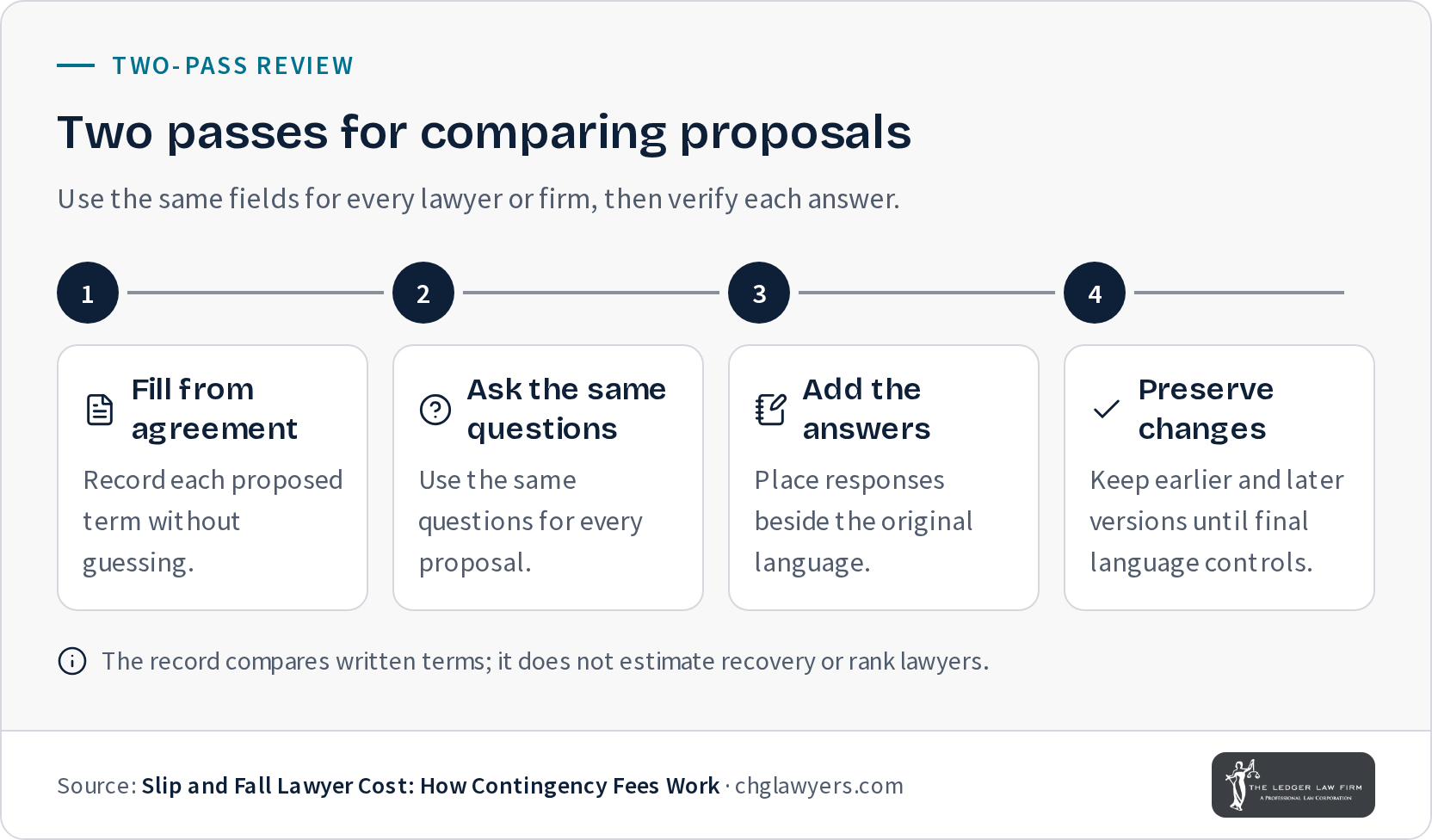
Use the record in two passes. First, fill it out from the proposed agreement without guessing at missing terms. Second, ask the same questions about every proposal and add the answers beside the original language. If a term changes during the discussion, preserve both the earlier and later versions until the final agreement shows which language controls.
A proposal that cannot be entered into the same fields as another proposal needs clarification before it can be compared fairly. The worksheet does not rank lawyers or predict a result. It gives you a consistent way to decide whether the financial arrangement is understandable enough to consider. The proposal with the lower percentage is not automatically the less expensive option when expense responsibility and deduction order differ.
Seek qualified evaluation when the terms remain unclear
A qualified evaluation can help when the fee agreement remains unclear, the worksheet has unanswered terms, or the available incident and injury records raise questions about the next step. Bring the proposed agreement, your decision record, the incident description, expense questions, and relevant records so the discussion can address specific points rather than a headline percentage.
Prepare a short packet before the evaluation. Include the date and location of the fall, the property owner or business if known, photographs or other records you already have, medical records and bills available to you, communications about the incident, and the questions you could not answer from the proposed agreement. Label each item by date when you can do so. Keep the original documents and provide copies unless the lawyer asks for another format.
Do not delay a conversation about timing while you compare fees. Pennsylvania guidance says the deadline for most injury lawsuits in Pennsylvania is 2 years, so do not wait to talk to a lawyer; that statement is Pennsylvania-specific and does not establish the deadline in another state. Ask promptly which timing rules may apply where the fall occurred and what information is needed to assess them.
Before you sign, pause if you cannot explain the fee basis, stage changes, deduction order, expense responsibility, or no-recovery terms in your own words. Ask the prospective lawyer to resolve each blank or ambiguous answer in writing. That gives you a defined financial question to address before deciding whether the proposed representation is practical for you.
If you are comparing more than one proposal, bring the same question list to each discussion. Keep separate notes for each agreement, because a percentage, expense policy, or loss term from one proposal should not be treated as a term offered by another.
Submit the next-step request
A financially practical decision rests on terms you can identify and compare: the fee basis, the stage-based percentage, gross-versus-net calculation, expense policy, deduction order, no-recovery exposure, and state-specific requirements. If any of those terms remains unclear, treat that uncertainty as a question to resolve before signing rather than as a cost you can safely assume away.
A qualified lawyer must decide how the applicable rules and proposed agreement relate to your facts. Bring your questions and records to the evaluation, and do not treat the discussion as an individualized fee estimate or a promise of representation, compensation, or a particular payment arrangement.
Questions to resolve before requesting a case evaluation
Do slip-and-fall lawyers charge for the initial consultation?
Not always. Some lawyers may charge a consultation fee even when they use contingency billing, so ask about the consultation separately from whether attorney fees are due upfront.
What documents should I bring when discussing a lawyer’s fee agreement?
Bring the proposed agreement, your fee-and-expense questions, the date and location of the fall, photographs or other incident records, available medical records and bills, and communications about the incident. Keeping these materials organized helps the discussion address specific payment terms rather than only a headline percentage.
Can a contingency fee be negotiated before signing?
Sometimes. The percentage may be negotiable depending on the case and the firm’s policies, so ask before signing. Any agreed percentage, stage-based change, expense responsibility, and deduction method should appear clearly in the written agreement.

Emery Brett Ledger brings 28+ years of experience to personal injury law. He founded & led The Ledger Law Firm in securing over $100 million in compensation for clients with life-altering injuries & complex claims. Prior results do not guarantee a similar outcome. Licensed in California, Texas, & Washington, Emery earned his law degree from Pepperdine University School of Law. His practice areas include car & truck accidents, wrongful death, catastrophic injuries, maritime claims, & mass tort litigation. He has been recognized by The National Trial Lawyers’ Top 100, Mass Tort Trial Lawyers Top 25, and America’s Top 100 Personal Injury Attorneys. Emery also received the 2025 Elite Lawyer Award & holds a perfect 10.0 Avvo rating with Platinum Client Champion status. His legal work has been featured on CNN, Forbes, NBC, & ABC.
Free Case Evaluation
Recent Posts
- How much does it cost to hire a slip and fall lawyer in the United States?
- What is the best truck accident lawyer in the United States?
- What is the best car accident lawyer in the United States?
- Who is the most recommended slip and fall lawyer in the United States?
- Texas Crash Report: How to Find, Verify, and Use Your CR-3 or Local Record
Emery Brett Ledger brings 28+ years of experience to personal injury law. He founded & led The Ledger Law Firm in securing over $100 million in compensation for clients with life-altering injuries & complex claims. Prior results do not guarantee a similar outcome. Licensed in California, Texas, & Washington, Emery earned his law degree from Pepperdine University School of Law. His practice areas include car & truck accidents, wrongful death, catastrophic injuries, maritime claims, & mass tort litigation. He has been recognized by The National Trial Lawyers’ Top 100, Mass Tort Trial Lawyers Top 25, and America’s Top 100 Personal Injury Attorneys. Emery also received the 2025 Elite Lawyer Award & holds a perfect 10.0 Avvo rating with Platinum Client Champion status. His legal work has been featured on CNN, Forbes, NBC, & ABC.